The Chemistry Behind Honey That Never Expires
In 2015, archaeologists excavating a 3,000-year-old Egyptian tomb discovered sealed ceramic pots containing honey with its chemical composition fully preserved — not petrified, not fermented, not decomposed, with characteristic sugar composition and antimicrobial activity intact. Food scientists are not surprised. Honey's legendary shelf life is not a mystery: it is the predictable result of three simultaneous chemical realities. Honey contains roughly 80% sugars with almost no free water (water activity Aw ≈ 0.5–0.6, far below the ≥0.85 Aw that most bacteria need to reproduce). It contains hydrogen peroxide released slowly by the enzyme glucose oxidase. And it is meaningfully acidic — with a pH between 3.2 and 4.5 depending on floral source, making it more acidic than black coffee (pH ~5) and approaching the range of vinegar (pH ~2.5–3.5). The combination of all three factors is what makes honey genuinely hostile to microbial life.
Of these three factors, acidity is the least understood by honey consumers — and the most informative for evaluating quality, flavor, and therapeutic value. This guide presents a floral-source pH survey and a free acidity data comparison across 12 major honey types, explains the biochemical origin of honey's organic acids, and shows what the numbers mean in practice.
How Honey Becomes Acidic: The Glucose Oxidase Mechanism
Raw honey's acidity is not inherited from flower nectar — nectar is nearly neutral, with a pH typically between 5.0 and 7.5 depending on species. The acidity is created by the bees themselves during honey production. Worker bees carry nectar in their honey stomach, where it mixes with secretions from the hypopharyngeal gland. This gland produces glucose oxidase, an enzyme that catalyzes a specific reaction: it cleaves glucose into gluconolactone, which spontaneously hydrolyzes to gluconic acid, releasing hydrogen peroxide as a byproduct.
Gluconic acid accounts for approximately 70–80% of the organic acid fraction in most honeys. The remaining 20–30% comprises citric acid (~5%), malic acid (~5%), formic acid (~3%), acetic acid (~2%), pyroglutamic acid (~2%), and trace amounts of lactic, oxalic, tartaric, pyruvic, and succinic acids. The exact proportions depend on the nectar source, the bees' physiology, and the enzymatic activity during honey ripening. This multi-acid profile is why honey's tartness is different from lemon juice (mostly citric acid) or vinegar (mostly acetic acid) — it is a softer, more layered sourness that most tasters perceive as "brightness" rather than sharpness.
Glucose oxidase activity is highest in raw, unprocessed honey. Heating honey above approximately 40°C begins to denature the enzyme. This is one of several reasons why raw honey has different chemistry from pasteurized honey: pasteurized honey typically shows lower residual glucose oxidase activity, altered organic acid ratios, and a measurably different pH profile. It also explains why HMF (hydroxymethylfurfural) content — a Maillard reaction byproduct formed when fructose is heated in acidic conditions — is used as a pasteurization and freshness indicator. Fresh raw honey has HMF below 10 mg/kg; the EU maximum is 40 mg/kg (80 mg/kg for honey from high-temperature climates).
Get the Honey Buyer's Cheat Sheet (free PDF)
16 varieties on one page — color, flavor, best use and what a fair price looks like — from the 304 honeys we track.
pH Survey: 12 Floral Sources Ranked
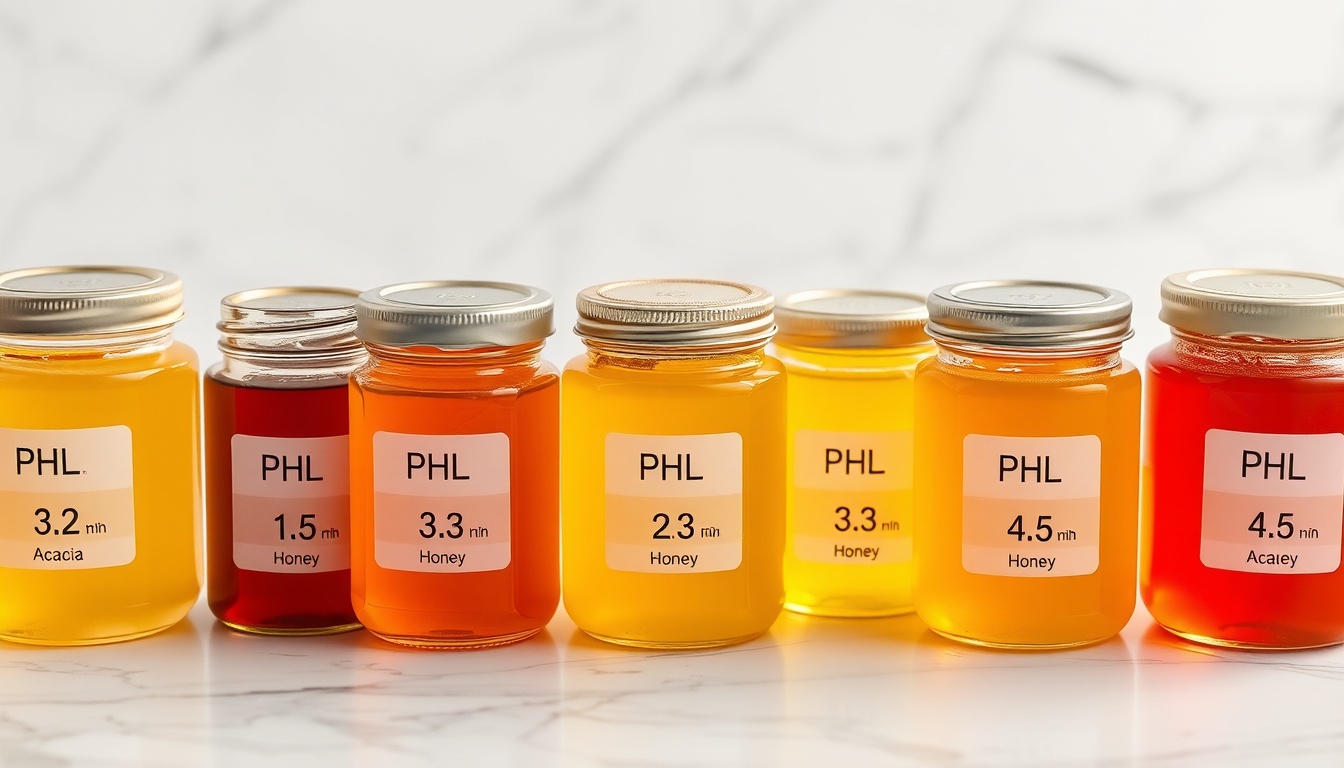
The following pH ranges are compiled from published peer-reviewed research including studies in Food Chemistry, the Journal of the Science of Food and Agriculture, and the European Food Research and Technology journal, along with Codex Alimentarius working group data. All figures reflect measurements from raw, unprocessed honey samples; commercial processing can shift pH slightly. Ranges reflect natural variation across geographic origin, harvest season, and botanical purity.
- Manuka (Leptospermum scoparium, New Zealand): pH 3.2–3.7 — consistently the most acidic common honey; methylglyoxal (MGO) contributes additional antimicrobial activity beyond pH alone
- Buckwheat (Fagopyrum esculentum, USA/Europe): pH 3.4–3.9 — high in organic acids, notably gluconic and malic; correlates with buckwheat's distinctive malty-earthy intensity
- Orange Blossom (Citrus sinensis, USA/Spain/Italy): pH 3.6–3.9 — mid-range acidity; citrus-derived acids (citric, malic) supplement the gluconic acid base
- Lavender (Lavandula angustifolia, France/Spain): pH 3.5–4.0 — moderate acidity with consistent gluconic acid base; aromatic profile masks perceived tartness
- Eucalyptus (Eucalyptus spp., Australia/Spain): pH 3.4–4.0 — variable depending on eucalyptus species; some lots are among the sharper-tasting commercial honeys
- Clover (Trifolium repens, USA/Canada/New Zealand): pH 3.6–4.1 — mild acidity; the familiar sweetness of commercial clover honey reflects its moderate pH and high fructose content
- Linden/Lime Blossom (Tilia spp., Eastern Europe/Germany): pH 3.5–4.0 — moderate; the characteristic menthol-like note is separate from acidity, driven by terpene compounds
- Wildflower/Polyfloral (mixed sources): pH 3.5–4.5 — widest pH range of any category; reflects the botanical diversity of the regional flora; single-origin artisan lots often cluster tighter
- Heather (Calluna vulgaris, UK/Scandinavia): pH 3.7–4.2 — the thixotropic gel structure (from protein content) complicates pH measurement; acidity is moderate with a characteristic phenolic contribution
- Acacia/Black Locust (Robinia pseudoacacia, Hungary/China/Italy): pH 3.5–4.3 — wide range, but commercially traded lots are typically 3.8–4.2; known for mild flavor despite its pH range
- Tupelo (Nyssa ogeche, USA/Southeast): pH 3.9–4.3 — among the least acidic of premium honeys; contributes to Tupelo's famous resistance to crystallization (high fructose:glucose ratio)
- Chestnut (Castanea sativa, Italy/France/Spain): pH 4.0–4.5 — the least acidic in this survey; bitter, tannic notes from chestnut phenolics are not related to organic acid acidity
Pro Tip
pH below 3.5 is exceptionally acidic for honey and often signals high gluconic acid production, excellent raw quality, or high enzymatic activity. pH above 4.5 in a claimed raw honey can indicate dilution or adulteration — HFCS has a pH of approximately 6.5 and raises honey pH when added.
Free Acidity Data: What the EU Standard Measures
pH alone does not capture honey's full acid profile. Free acidity — measured in milliequivalents per kilogram (meq/kg) — quantifies the total titratable acid content, which correlates more directly with organic acid concentration than pH does. The EU Honey Directive sets a maximum free acidity of 50 meq/kg for retail honey and 80 meq/kg for baker's honey (industrial use). Both Codex Alimentarius and the US National Honey Board use similar thresholds. Exceedance of the 50 meq/kg limit suggests over-fermentation (excess acetic acid from yeast activity in high-moisture honey) or adulteration.
Free acidity data for the same 12 floral sources (meq/kg ranges from published research and European honey quality studies):
- Manuka (NZ): 25–48 meq/kg — among the highest of any monofloral; the combination of gluconic acid, additional organic acids, and MGO-related chemistry drives this; close to the EU 50 meq/kg limit in some high-grade lots
- Buckwheat (USA/Europe): 25–40 meq/kg — consistently high, explaining why buckwheat honey has the sharpest acid-driven flavor of common American honeys
- Heather (UK/Scandinavia): 25–38 meq/kg — elevated free acidity combined with the phenolic/resinous notes creates the complex bitter-tangy character experienced tasters expect
- Eucalyptus (Australia/Spain): 18–32 meq/kg — moderate-to-high, variable by species; Spanish eucalyptus lots tend toward higher readings
- Wildflower/Polyfloral (mixed): 15–45 meq/kg — broadest range; the upper end approaches single-source honeys with high organic acid content
- Lavender (France/Spain): 18–30 meq/kg — moderate; lavender mono-floral certification (pollen analysis) correlates with consistent acidity in this range
- Clover (USA/Canada/NZ): 15–30 meq/kg — low-to-moderate; contributes to clover's mild, approachable flavor profile
- Orange Blossom (USA/Spain/Italy): 15–28 meq/kg — moderate, consistent with the mid-pH range; citrus acids supplement the gluconic base
- Linden/Lime Blossom (Europe): 15–28 meq/kg — moderate; the menthol character dominates sensory perception despite the real but modest acidity
- Chestnut (Italy/France/Spain): 18–30 meq/kg — moderate; chestnut's bitter phenolics contribute to the flavor more than acidity does
- Acacia/Black Locust (Hungary/China): 10–20 meq/kg — consistently the lowest free acidity of major honey types; correlates with the notoriously mild, almost neutral flavor
- Tupelo (USA/Southeast): 12–22 meq/kg — very low free acidity; Tupelo's legendary sweetness and slow crystallization make more sense when you see how chemically mild it is
What Acidity Means for Flavor
Acidity is not just a preservation metric — it is a primary flavor variable. The relationship is not simple, because honey's sugar concentration (approximately 80 Brix) dramatically suppresses perceived sourness: at the same pH, honey tastes far less sour than a 5% citric acid solution, because the concentrated sugars overwhelm the sour signal. What acidity actually contributes to honey flavor is brightness — a freshness and complexity that prevents honey from tasting flat, cloying, or one-dimensional. This is why many experienced honey tasters describe premium raw honeys as "alive" compared to pasteurized commercial honey: the organic acid profile is intact and contributing to the sensory experience.
The flavor implications of the acidity data above are practical. Manuka and buckwheat, at the acidic end of the pH spectrum, are the most assertive and complex-tasting honeys — their organic acid profiles contribute to the flavors that make them polarizing but distinctive. Acacia and Tupelo, at the mild end, are the most approachable and universally liked honeys precisely because their low free acidity removes the slight "edge" that more acidic honeys carry. This is not a quality hierarchy — both ends of the spectrum represent high-quality honey. It is a flavor-diversity matrix, and the acidity data is one of the most useful tools for predicting how a honey will taste before you open the jar.
For cooking and pairing applications, acidity data is similarly useful. High-acidity honeys (buckwheat, manuka) work well in applications where the honey is meant to assert itself — marinades, strong cheese pairings, aged spirits. Low-acidity honeys (acacia, Tupelo) are better suited to delicate applications where you want sweetness without brightness — desserts, mild tea pairings, light pastries. Mid-range honeys (clover, orange blossom, lavender) are the workhorses of culinary honey use for exactly this reason: their moderate acidity makes them versatile.
Acidity and Antimicrobial Action: The pH–MGO–H₂O₂ Triangle
The preservation chemistry of honey operates through three overlapping mechanisms: low water activity (Aw), hydrogen peroxide production (from glucose oxidase activity), and organic acid acidity. All three are required for the full effect — removing any one reduces but does not eliminate antimicrobial activity. This explains why diluted honey (higher Aw, but still acidic and still producing H₂O₂) has reduced preservation efficacy, and why pasteurized honey (reduced enzyme activity, lower H₂O₂ output) requires the other two factors to carry more of the load.
Manuka honey is the canonical case where a fourth mechanism — methylglyoxal (MGO) — adds a layer of antimicrobial activity that operates independently of pH and glucose oxidase. MGO forms from dihydroxyacetone (DHA) in Leptospermum scoparium nectar through a non-enzymatic Maillard-type reaction. MGO is stable to heat and light and does not depend on glucose oxidase; it remains active in pasteurized manuka honey when H₂O₂ activity is diminished. This is the chemical basis for manuka's "non-peroxide antimicrobial activity" — the property that the UMF (Unique Manuka Factor) rating system is designed to quantify. UMF 10+ corresponds to approximately 100 mg/kg MGO; UMF 20+ corresponds to approximately 800 mg/kg MGO. At these concentrations, MGO contributes antimicrobial action against Staphylococcus aureus, Helicobacter pylori, and other organisms in ways that most other honeys cannot replicate through pH and H₂O₂ alone. For a full deep-dive see our manuka honey guide and manuka vs. clover comparison.
For honeys without elevated MGO — the vast majority — the pH and free acidity data in this guide are the most relevant predictors of antimicrobial and preservation potency. A raw honey with pH 3.5 and free acidity 35 meq/kg is meaningfully more antimicrobially active than a pasteurized honey with the same pH (because H₂O₂ is reduced) or than the same honey diluted with water (because Aw rises). This is why wound-care and clinical honey research consistently emphasizes raw, unprocessed honey: the full triangle of antimicrobial mechanisms needs to be intact.
Acidity as an Adulteration Signal
Food scientists and honey authentication researchers have long used free acidity and pH as components of adulteration detection panels. High-fructose corn syrup (HFCS), the most common adulterant globally, has a pH of approximately 6.0–6.5 — adding it to honey raises the pH detectably. Rice syrup, beet syrup, and invert sugar syrup all have higher pH than authentic honey. A laboratory pH reading above 4.5 in a claimed raw monofloral honey without an obvious botanical explanation (chestnut is a legitimate exception) is a flag worth investigating with additional testing.
However, pH alone is insufficient for adulteration detection — sophisticated adulteration using acidified syrups can mimic normal pH ranges. The complete authentication toolkit uses: pollen analysis (melissopalynology) to verify botanical and geographic origin; carbon isotope ratios (δ¹³C, AOAC method 998.12) to detect HFCS addition (HFCS comes from C4 plants with a distinctive ¹³C signature vs. honey's C3 plant signature); NMR profiling for a complete metabolic fingerprint; and diastase/invertase enzyme activity (which is absent in syrups). Free acidity and pH are quick first-pass indicators, not standalone proof. See our honey authenticity guide for the full testing framework.
One practical application of pH knowledge for everyday buyers: if you can safely run a very basic test, authentic raw honey in water produces a measurably acidic solution. A pH strip (pool/spa test strip) dipped in a 1:5 honey:distilled-water solution should read pH 3.5–4.5 for authentic raw honey. Readings above 5.0 are worth noting — not conclusive, but an indicator to seek additional authentication. This is not a substitute for laboratory analysis, but it is a $2 test that provides directional information.
Reading Acidity in a Raw Honey You're Evaluating
Most honey producers do not publish pH or free acidity data on their labels — there is no regulatory requirement to do so in the US, EU, or most other markets. However, the acidity data in this guide can be used as a reference expectation. If you are evaluating a claimed buckwheat honey that tastes completely flat and un-sharp, that is a sensory inconsistency with the expected pH 3.4–3.9 profile. If an acacia honey has an aggressive tartness, that is similarly inconsistent with acacia's characteristically mild pH 3.5–4.3 profile (which, in typical commercial lots, clusters toward the mild end).
Premium producers in the European raw honey market — particularly those targeting the UK, German, and French specialty food channels — are increasingly including COA (Certificate of Analysis) data with their products, listing pH, free acidity (meq/kg), moisture content, HMF, diastase number, and pollen analysis results. This level of documentation is the gold standard for any honey claiming premium monofloral status. If a producer cannot provide COA data from an accredited laboratory on request, that is relevant information about the provenance of their product.
For wound-care applications, clinical nutrition, or any use where antimicrobial potency matters, the takeaway from this data is direct: choose raw honeys at the acidic end of the spectrum (pH 3.2–3.8, free acidity 25–48 meq/kg), confirm raw status (glucose oxidase activity intact), and for the highest antimicrobial activity, choose either a medical-grade manuka with documented MGO content or a clinical-grade raw honey from a supplier that tests and certifies H₂O₂ activity.
Methodology: How This Data Was Assembled
This guide synthesizes published data from peer-reviewed food science literature. Primary sources include: Bogdanov et al. (2008) "Honey quality, methods of analysis and international regulatory standards: review of the work of the International Honey Commission" (Bee World); Bertoncelj et al. (2011) "Physicochemical and sensory properties of Slovenian honeys" (Food Chemistry); Terrab et al. (2004) "Characterisation of Moroccan unifloral honeys by their physicochemical characteristics" (Food Chemistry); Nanda et al. (2003) "Physicochemical properties and estimation of mineral content in honey produced from different plants in Northern India" (Journal of Food Composition and Analysis); and Codex Alimentarius Commission (2001, revised 2019) Standard for Honey (CXS 12-1981). EU Honey Directive (2001/110/EC, amended 2014/63/EU) provided the free acidity threshold and quality parameter framework.
Ranges reported are the span observed across multiple studies with sample sets from the relevant production regions — they do not represent any single study. Values at the extreme ends of each range may reflect unusual production conditions, atypical floral access, or measurement methodology differences across labs. For authoritative product-specific data, request a COA from the producer. If you want to cite this survey in research or journalism, link to this page and note the synthesis methodology. For our broader data methodology, see how we research and source honey information.