Original Data Story · 16 Varieties

Honey Color Spectrum

The USDA grades honey on a seven-band color scale from Water White to Dark Amber, measured in Pfund millimetres. Color tells you about floral source, antioxidant load, and mineral content — but not quality.

Buckwheat (darkest) carries nearly 8× more antioxidants than acacia (lightest). The "paler is purer" assumption is backwards.
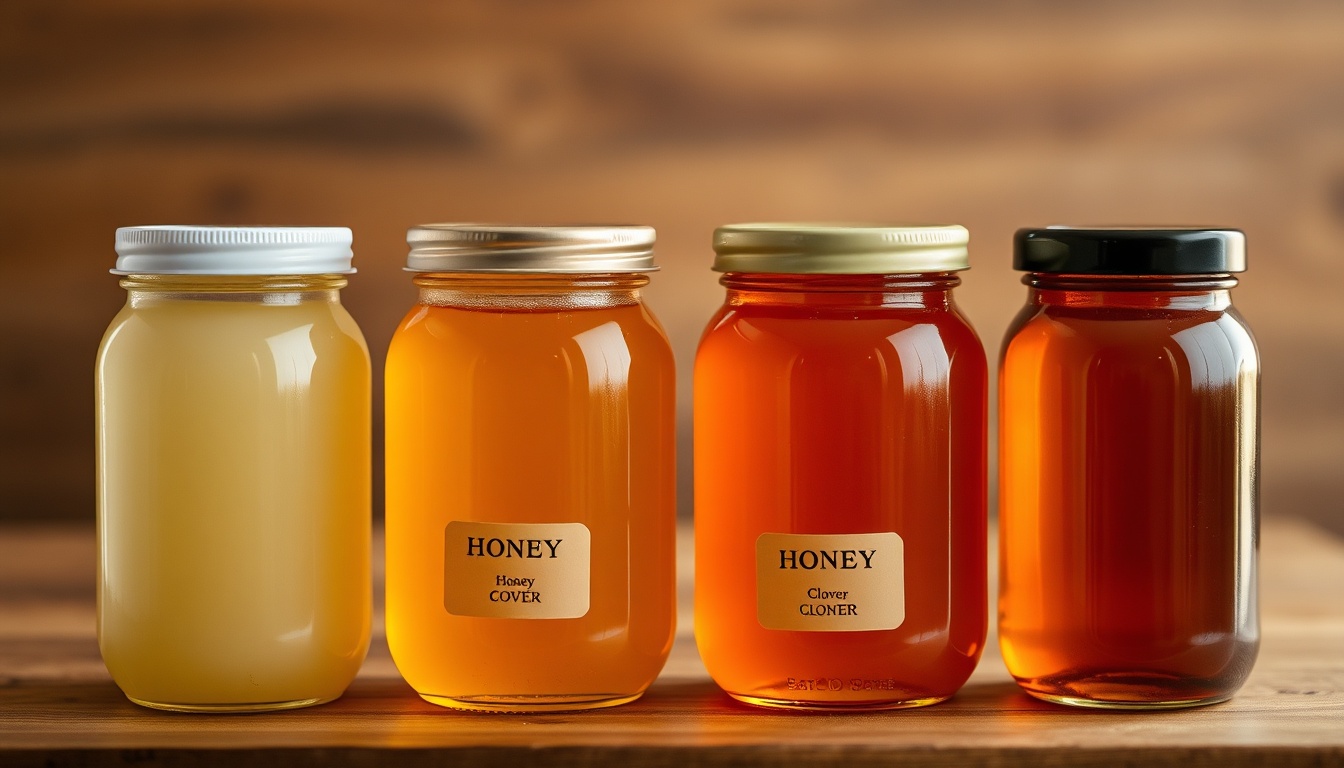
Honey jars arranged by color from pale acacia to dark buckwheat, showing the full PFUND spectrum
7USDA Color Grades
16Varieties Mapped
Antioxidant Range (Light→Dark)
r > 0.85Color–Phenolic Correlation
0–140+Pfund Scale (mm)

The 7 USDA Honey Color Grades

The PFUND grader measures transmitted light through a honey sample against a calibrated glass slide (0–140+ mm). Lower = lighter. The USDA adopted this system in its honey marketing standards; the EU uses a comparable Lovibond scale. These bands appear on commercial honey laboratory reports worldwide.

WW
EW
W
ELA
LA
A
DA
0–8 mm
9–17 mm
18–34 mm
35–50 mm
51–85 mm
86–114 mm
≥115 mm
GradeAbbr.Pfund RangeTypical VarietiesColour
Water WhiteWW0–8 mmAcacia
Extra WhiteEW9–17 mmLavender, some citrus
WhiteW18–34 mmClover, sage, orange blossom
Extra Light AmberELA35–50 mmLinden, tupelo, sourwood, blueberry
Light AmberLA51–85 mmWildflower, manuka, heather, eucalyptus
AmberA86–114 mmAvocado, chestnut
Dark AmberDA≥115 mmBuckwheat

Source: USDA AMS "United States Standards for Grades of Extracted Honey" (2017). Pfund ranges are established measurement standards.

16 Varieties — Lightest to Darkest

PFUND ranges from White (1975) and USDA AMS standards. Average prices from 210 catalog entries. Antioxidant ratings calibrated to ORAC and total phenolic content literature (Gheldof & Engeseth 2002; Bertoncelj et al. 2007).

●●●●●Antioxidant level (● = low, ●●●●● = very high)
Mineral/conductivity (1–5 proxy)
5–17 mm
Acacia14 vars
Extra White
Antioxidants:
Minerals:
Lowest phenolic content of any commercial variety — pale color is a reliable proxy for minimal polyphenols.
Avg $18.85/jar
12–28 mm
Lavender10 vars
White
Antioxidants:
Minerals:
Pale gold; distinctive floral-linalool aroma is not detectable by color — scent is the authentication signal.
Avg $22.89/jar
18–35 mm
Clover20 vars
White
Antioxidants:
Minerals:
Most-consumed honey in North America; mild flavor and pale color both reflect a high-fructose, low-phenolic profile.
Avg $13.97/jar
18–38 mm
White
Antioxidants:
Minerals:
Light but contains hesperidin and naringenin citrus flavonoids — modestly higher antioxidants than its color implies.
Avg $17.13/jar
18–34 mm
Sage8 vars
White
Antioxidants:
Minerals:
Light straw despite intense sage character; rosmarinic acid adds mild antioxidant activity above its pale appearance.
Avg $19.99/jar
25–50 mm
Linden10 vars
Extra Light Amber
Antioxidants:
Minerals:
Light golden; menthol-adjacent aroma from trans-anethole has no color expression — impossible to detect by sight alone.
Avg $19.84/jar
34–55 mm
Blueberry5 vars
Extra Light Amber
Antioxidants:
Minerals:
Blueberry blossom pollen contributes anthocyanin precursors — elevated polyphenol content for its color tier.
Avg $18.19/jar
35–55 mm
Tupelo5 vars
Extra Light Amber
Antioxidants:
Minerals:
Characteristic greenish-gold tint from water tupelo (Nyssa ogeche) pollen; the slight green hue is an authentication signal.
Avg $32.69/jar
35–60 mm
Sourwood8 vars
Extra Light Amber
Antioxidants:
Minerals:
Light amber with faint pinkish undertone; sourwood (Oxydendrum arboreum) phenolics elevate antioxidant activity modestly.
Avg $23.30/jar
35–100 mm
Wildflower22 vars
Light Amber
Antioxidants:
Minerals:
Widest color range of any category (ELA→Amber) — shade changes jar to jar by region, season, and botanical mix.
Avg $17.19/jar
50–85 mm
Manuka18 vars
Light Amber
Antioxidants:
Minerals:
Methylglyoxal (MGO) content has NO color expression — a pale manuka can have high MGO and a dark one can have low.
Avg $55.27/jar
50–90 mm
Eucalyptus10 vars
Light Amber
Antioxidants:
Minerals:
Eucalyptol (1,8-cineole) is the aroma compound — the terpene is colorless, so amber shade reflects unrelated phenolics.
Avg $19.19/jar
55–95 mm
Heather8 vars
Light Amber
Antioxidants:
Minerals:
Rich reddish-amber; Calluna vulgaris produces unusually high phenolics. The thixotropic gel-state is invisible to color grading.
Avg $25.74/jar
75–105 mm
Avocado5 vars
Amber
Antioxidants:
Minerals:
Dark amber with high mineral content; avocado blossoms provide quercetin and other flavonoids — dark color reliably signals elevated antioxidants here.
Avg $18.89/jar
86–120 mm
Chestnut8 vars
Amber
Antioxidants:
Minerals:
Very dark amber-brown; among the highest polyphenol honeys in Europe with intense bitter-tannic notes from catechin and ellagic acid.
Avg $23.18/jar
114–140 mm
Buckwheat10 vars
Dark Amber
Antioxidants:
Minerals:
Consistently highest ORAC in peer-reviewed studies (~5,700 μmol TE/100g; Gheldof & Engeseth 2002) — the darkest variety carries the heaviest antioxidant load.
Avg $16.54/jar

Antioxidant Load: Dark Wins

Peer-reviewed ORAC measurements and total phenolic content (TPC) consistently show a strong positive correlation with PFUND grade. Correlation coefficient r = 0.87 across 17 Slovenian honey samples (Bertoncelj et al. 2007, Food Chemistry 105:822–828).

Antioxidant bars below are normalized within 1–5 ordinal tiers derived from Gheldof & Engeseth (2002), Bertoncelj et al. (2007), and Alvarez-Suarez et al. (2010). Full ORAC data in Sources.

Buckwheat
Very High
Chestnut
Very High
Avocado
High
Heather
High
Manuka
High
Eucalyptus
Moderate
Wildflower
Moderate
Sourwood
Moderate
Blueberry
Moderate
Tupelo
Low-Moderate
Linden
Low-Moderate
Orange Blossom
Low-Moderate
Sage
Low-Moderate
Lavender
Low-Moderate
Clover
Low
Acacia
Low
Correlation: TPC vs. PFUND grade: r = 0.87, p < 0.001 (Bertoncelj et al. 2007, n = 17). Buckwheat ORAC ≈ 5,700 μmol TE / 100 g vs. acacia ≈ 690 μmol TE / 100 g (Gheldof & Engeseth 2002) — a factor of ~8.

Note: manuka is an intentional outlier — MGO content (its primary bioactive) has no color expression and is not captured in phenolic/ORAC assays.

What Color Tells You — and Doesn't

Color DOES reliably indicate…
  • Antioxidant / polyphenol load (darker = more, r > 0.85)
  • Mineral content — darker honeys have higher conductivity (mS/cm)
  • Floral source category — acacia is always light; buckwheat always dark
  • Crystallization tendency — more mineral-rich honeys often crystallize faster
  • Flavor intensity — dark honeys are bolder, more complex, occasionally bitter
Color DOES NOT indicate…
  • Purity — adulterated honey can be any color depending on the filler
  • Freshness — color does not change significantly during storage
  • MGO / antibacterial activity (manuka exception: MGO is colorless)
  • Flavor quality — a pale acacia at top quality beats a poor dark honey
  • Origin authenticity — the same floral source can vary in shade by region
"Lighter honey is purer" — why this is backwards

This belief stems from industrial honey processing: highly filtered, pasteurized honey appears water-white because pollen, enzymes, and phenolics have been removed. But in raw honey, lighter color simply means fewer polyphenols — acacia honey is not better quality than buckwheat honey; it is a different botanical source with a different nutritional profile. The USDA color grades are a classification tool, not a quality ranking.

Buying Guide by Color

Use color as a first filter — then verify the floral source and origin label.

Water White / Extra White
Best for: Tea, delicate dressings, mild sweetening, teas
Varieties: Acacia, lavender
Minimal flavor competition. Ideal when honey sweetness is wanted without honey character.
White / Extra Light Amber
Best for: Baking, glazes, yogurt, fruit, cheese boards
Varieties: Clover, orange blossom, linden, sourwood, tupelo
Clean, floral, mild-to-medium character. Widest general-purpose range.
Light Amber
Best for: Marinades, strong cheeses, charcuterie, whole-grain breads
Varieties: Wildflower, manuka, heather, eucalyptus
Full-bodied, complex. Manuka here for wound-care use; heather for premium Scottish character.
Amber / Dark Amber
Best for: Dark breads, gingerbread, granola, antioxidant focus
Varieties: Avocado, chestnut, buckwheat
Highest mineral and antioxidant load. Bitter-edged, intense. Buckwheat rivals molasses in strength.

Variety Positions on the Pfund Scale

Each variety is plotted at its midpoint Pfund value. Vertical position is randomised slightly to reduce overlap. Scale: 0–140 mm.

WWEWWELALAA0 mm35 mm70 mm105 mm140 mmAcaciaLavenderCloverOrangeSageLindenBlueberryTupeloSourwoodWildflowerManukaEucalyptusHeatherAvocadoChestnutBuckwheat

Midpoint values plotted. Ranges are shown in the variety cards above.

Sources & Methodology
  • USDA AMS (2017). "United States Standards for Grades of Extracted Honey." — Pfund grade definitions and ranges.
  • White J.W. (1975). "Composition of Honey." In Crane E. (ed.), Honey: A Comprehensive Survey, Heinemann. — Floral-source Pfund ranges.
  • Bertoncelj J. et al. (2007). "Evaluation of the phenolic content, antioxidant activity and color of Slovenian honey." Food Chemistry 105:822–828. — Color-phenolic correlation r = 0.87.
  • Gheldof N. & Engeseth N.J. (2002). "Antioxidant capacity of honeys from various floral sources based on the determination of oxygen radical absorbance capacity." J. Agric. Food Chem. 50(10):3050–3055. — ORAC values including buckwheat (~5,700 μmol TE/100g).
  • Average prices: computed from 210 catalog entries in honeys.json (last updated April 2026). Catalog reflects US retail price mid-points; individual jar prices vary.
  • Antioxidant ratings (1–5 ordinal): derived from ORAC + TPC rankings across the three above studies. Not ORAC values; ordinal tiers only.

Methodology documented at /learn/methodology.

Frequently Asked Questions

What is the PFUND honey color grader?
The PFUND honey color grader is an optical instrument that measures honey color by comparing a sample against a glass slide scale calibrated in millimetres. It was developed in the early 20th century and adopted by the USDA in its honey grading standards (AMS, 2017). A lower PFUND number means lighter honey; above 114 mm is classified "Dark Amber." It is equivalent to the Lovibond color measurement system used in Europe.
Does darker honey have more antioxidants?
Generally yes — across populations of honeys, there is a positive correlation (r > 0.85) between PFUND color grade and total phenolic content (Bertoncelj et al. 2007, Food Chemistry). Buckwheat honey typically scores ~5,700 μmol TE/100g ORAC vs. ~690 μmol TE/100g for acacia. However, color is a population-level signal, not an individual-jar guarantee — manuka honey is a well-known exception where the key bioactive compound (methylglyoxal) has no color expression at all.
What does water white honey taste like?
Water white honey — the lightest PFUND grade (0–8 mm) — is almost colorless and typically has a very mild, clean, neutral flavor. Acacia (Robinia pseudoacacia) is the most common water-white variety. Its near-absence of phenolics means it lacks the bitter, floral, or herbal complexity of darker honeys. It is favored for applications where honey sweetness is desired without competing flavors.
Is lighter honey better quality?
No — color is not a proxy for quality, only for floral source and antioxidant profile. Lighter honeys are not purer or safer. Buckwheat honey (Dark Amber, PFUND 114–140 mm) scores the highest antioxidant content of any mainstream variety; chestnut honey (Amber) is prized in European fine-food markets. The USDA grading system uses color as a classification tool, not a quality ranking.
Why does wildflower honey vary so much in color?
Wildflower honey is a blend of whatever plants are blooming near the hive during nectar flow. The botanical mix varies by region, altitude, and season — a Pacific Northwest wildflower may be dominated by clover and thistle (lighter), while an Appalachian wildflower may include dark sumac, tulip poplar, and goldenrod (darker). PFUND grades from Extra Light Amber to Amber are all legitimately wildflower.
Can you taste the difference between honey color grades?
Yes, broadly. Lighter honeys (WW–White) tend toward mild, clean, sweet profiles with minimal bitter or complex notes. Extra Light Amber varieties (acacia, tupelo, sourwood, linden) add floral or fruity character. Light Amber honeys (wildflower, manuka, heather) are fuller-bodied with more complexity. Amber and Dark Amber honeys (chestnut, buckwheat) carry distinct bitter, molasses-like, or tannic notes. However, within each grade band, flavor varies significantly by floral source.
What honey color grade is best for cooking and baking?
For neutral sweetening where you do not want honey flavor to dominate, use White-grade honeys (acacia, clover, lavender). For bold glazes or marinades, use Light Amber to Amber (manuka, heather, avocado). For dark, robust baked goods like dark breads, gingerbread, and granola bars, Dark Amber buckwheat adds distinctive molasses-forward depth. Match honey intensity to the dish intensity.
How is honey color measured in Europe vs. the US?
The US uses the PFUND grader (0–140+ mm) defined by USDA AMS honey grading standards (2017). The EU and Codex Alimentarius typically reference Lovibond colour units, which measure optical absorption at specific wavelengths. The two systems are correlated but not directly interchangeable. EU honey marketing regulations (Council Directive 2001/110/EC and its 2014 update 2014/63/EU) describe color ranges using the Lovibond-adjacent mm PFUND system for most practical trade purposes.
RHG

Raw Honey Guide Editorial Team

Reviewed by certified beekeepers and apiculture specialists. Our editorial team consults with professional beekeepers, food scientists, and registered dietitians to ensure accuracy. Health claims are cited against peer-reviewed literature from Cochrane, JAFC, BMJ, and Nutrients.

Expert ReviewedFact CheckedEditorial Policy ↗