The Co-Princedom Customs Paradox
Andorra is one of the smallest and most unusually-governed countries in Europe — a 468 km² Catalan-speaking microstate wedged in the eastern Pyrenees between France and Spain, with a population of roughly 80,000 distributed across seven parròquies (parishes): Andorra la Vella, Escaldes-Engordany, Encamp, Canillo, Ordino, La Massana, and Sant Julià de Lòria. Since the 1278 Pareatges (Pariatges) treaty, Andorra has operated as a co-princedom: its two heads of state are the President of the French Republic and the Catholic Bishop of Urgell (in Catalonia, Spain). Catalan is the sole official language; the country is not an EU member but has used the euro as its de facto currency since 2002 and signed a formal monetary agreement with the EU in 2011.
The customs framework is doubly hybrid. The 1990 Customs Union Agreement with the EU brought Andorra into the EU customs territory for industrial goods, allowing duty-free movement of manufactured products with the rest of the EU. Agricultural products — including honey — were explicitly excluded and remain subject to Andorra's own import tariffs (typically 1–3% on honey, with WTO most-favored-nation status applied to non-EU origins). This makes Andorra one of the few European countries where small-batch beekeepers operate effectively outside both EU honey-quality directives (Directive 2001/110/EC, as amended) and the Spanish or French national implementations of those directives.
Practical consequence: Andorra has no national honey standard, no national food-quality testing laboratory equipped for honey-specific analyses (HMF, diastase, electrical conductivity, pollen morphology), and no PDO or PGI designation for any honey variety. Honey labeled 'Mel d'Andorra' is governed by general Andorran consumer-protection law (Llei 13/2013 sobre comerç) and by truthful-origin requirements, not by a specific honey-composition regulation. Most Andorran beekeepers voluntarily reference Spanish (Real Decreto 1049/2003) or French (Décret 2003-587) honey-composition standards — but the choice is theirs, and there is no inspection regime that mandates either.
Mel de Mil Flors and Mel de Bosc: The Two Pyrenean Workhorses
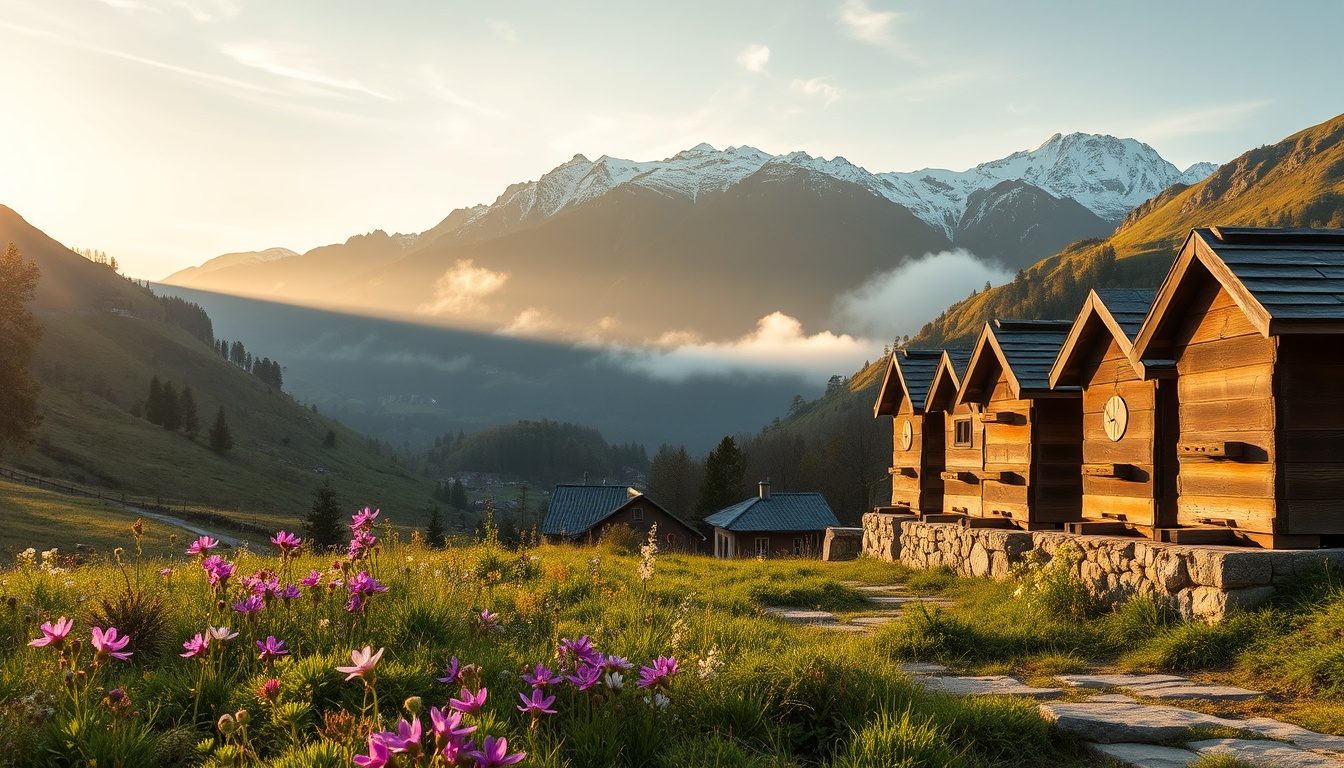
Andorran honey production is overwhelmingly dominated by two styles, both Pyrenean. Mel de mil flors (literally 'thousand-flowers honey' — multifloral mountain wildflower) is the volume variety, harvested between June and August from apiaries placed at 1,200–2,000 m elevation across the upper valleys of the Valira del Nord (Ordino, La Massana) and Valira d'Orient (Encamp, Canillo). Pollen analysis of comparable French Pyrenean and Catalan miel de mil flores (Persano Oddo and Piro 2004; González-Porto et al. 2010) consistently shows contributions from white clover (Trifolium repens), wild thyme (Thymus serpyllum and T. vulgaris), Lotus corniculatus, dandelion (Taraxacum), Asteraceae meadow species, and — at higher elevations — alpine rose (Rhododendron ferrugineum) and Genista species (broom). The honey is amber, complex-floral with herbal undertones, and crystallises moderately within 4–8 months at room temperature.
Mel de bosc (forest honeydew honey) is the prestige variety. The south-facing fir-and-pine forests of the Madriu-Perafita-Claror valley (a UNESCO World Heritage cultural landscape since 2004, covering 9% of Andorra's territory) and the upper Valira d'Orient produce honeydew from aphids feeding on Pinus sylvestris (Scots pine), Pinus uncinata (mountain pine), and Abies alba (silver fir). The chemistry parallels the Catalan miel de bosc, French miel de sapin des Pyrénées (which holds an IGP), and German Schwarzwälder Tannenhonig PGI: amber-to-dark colour, electrical conductivity above 0.8 mS/cm (the EU honeydew threshold), elevated melezitose content (1–4% from Pinus-dominant sources, 5–15% from Abies-dominant — Ruiz-Matute et al. 2010), high mineral content, and a distinctive resinous-malty profile.
Two smaller-volume varieties round out the catalogue. Mel de bruc (heather honey, Calluna vulgaris and Erica species) is produced in modest quantities from late-summer heath stands above 1,500 m on the slopes of the Coma Pedrosa massif and around the Comapedrosa Communal Park; production rarely exceeds 200–400 kg per year and the honey is typically blended into mil flors rather than sold monofloral. Mel de castanyer (chestnut honey, Castanea sativa) is harvested from chestnut groves in the lower-elevation Sant Julià de Lòria parish and from the Spanish-side Alt Urgell border zone — a small-batch artisanal product. Rosemary (mel de romaní) and lavender are essentially absent because Andorra's lowest elevation (Sant Julià de Lòria, 840 m) is already too cool and humid for commercially significant rosemary or true-lavender bloom.
The Three-Country Catalan Forage Zone
Like Liechtenstein's Rätikon Waldhonig forage zone (Liechtenstein–Vorarlberg–Sarganserland) and Luxembourg's Dreiländereck near Schengen, Andorra has its own three-country forage-overlap zone — though shaped by the Catalan cultural geography that pre-dates the modern political borders. Andorra borders France's Ariège département to the north (Aulus-les-Bains, Ax-les-Thermes, Bourg-Madame in the Cerdagne) and Catalonia's Alt Urgell and Cerdanya comarques to the south (La Seu d'Urgell, Puigcerdà). Bee colonies maintained near the Andorran-French border in Canillo (Pas de la Casa, Soldeu) forage routinely across the political boundary into the Cerdagne high pastures, and apiaries in the Sant Julià de Lòria parish forage south into Alt Urgell.
The forage-overlap matters most for mel de bosc. The mountain-pine and fir forests of the Pyrenean axis straddle the Andorra–France–Spain triple boundary and produce a single ecologically continuous honeydew honey region across all three jurisdictions. Honey labeled 'Mel d'Andorra de bosc' from a Canillo or Encamp apiary may contain honeydew from forest stands physically located in Ariège or Cerdagne, France, or in Alt Urgell, Spain — botanically and chemically identical to French miel de sapin des Pyrénées IGP and Catalan mel de bosc del Pirineu, jurisdictionally Andorra's. The Apicultors d'Andorra producer association does not market 'Mel d'Andorra' as a denomination of origin protection because the underlying ecology does not respect the border.
The cultural overlap is even older. Catalan-language pastoral and apicultural manuscripts from the 13th–17th centuries (held at the Arxiu Nacional d'Andorra and the Arxiu Comarcal de l'Alt Urgell in La Seu d'Urgell) document continuous beekeeping across the high Pyrenees from at least the medieval period, with shared technical vocabulary (cofí for the woven straw skep, banc d'arnes for the apiary stand, encerar for the practice of waxing the inside of clay or wooden hives) that crosses what are now three modern states. The bee subspecies in modern Andorran apiaries is predominantly Apis mellifera iberiensis (the Iberian honey bee, native south of the Pyrenees) with hybridisation from A. m. mellifera (the European dark bee, native north of the Pyrenees) — biological evidence of the same border-permeable forage continuity.
Apicultors d'Andorra and Beekeeper-Density Reality
Beekeeping in Andorra is small-scale by every measure. The Associació d'Apicultors d'Andorra is the country's beekeeper association, with a membership of approximately 30–60 active beekeepers managing an estimated 300–600 colonies (figures vary year-to-year and are not collected by a national agricultural census of the kind found in EU member states). The Departament d'Agricultura within the Ministry of the Environment, Agriculture and Sustainability provides modest extension support, including Varroa monitoring guidance aligned with Spanish and French regional protocols, and a small annual subsidy for queen-rearing initiatives in the upper Valira parishes.
Per-capita beekeeping density is genuinely high — roughly one beekeeper per 1,500–2,500 residents — but absolute numbers are low enough that the entire Andorran honey output of 3–6 tonnes per year is essentially consumed within the country, primarily through the Saturday morning Mercat de la Plaça del Poble in Andorra la Vella, the Ordino farmers' market, the Encamp festival weekends, and direct-from-apiary sales at country roadside stands. Andorran honey is not exported in commercial quantities and is not stocked in the duty-free supermarkets and big-box retailers that draw approximately 9–10 million annual cross-border shoppers from France and Spain — those shelves carry primarily large-volume Spanish, Argentinian, and Eastern European honey.
This creates a quietly characteristic retail asymmetry. A traveller passing through Andorra la Vella's tax-advantaged retail aisles will find imported supermarket honey at substantially below-Spanish-RRP prices, while genuine Andorran-produced honey costs €11–18 per 500g jar at the parish farmers' markets and is only intermittently available. The Apicultors d'Andorra association recommends asking explicitly for 'mel artesana del país' (local artisanal honey) and looking for the apiary name and parish on the label — the small national producer base means individual beekeeper-family attribution is the practical authentication signal, just as in Liechtenstein and Luxembourg.
Climate, Bloom Calendar, and the Altitude Gradient
Andorra's elevation profile is dramatic for its size. The lowest point is the Spanish-border bridge at Sant Julià de Lòria (840 m); the highest is Coma Pedrosa (2,942 m). Average elevation is approximately 1,996 m — among the highest of any country in the world by mean elevation, behind Bhutan, Nepal, Tajikistan, Kyrgyzstan, and Lesotho. The bloom calendar accordingly stretches over more than four months by elevation rather than over distinct seasonal regions, the way it does in flatter countries.
Lowland orchard and meadow bloom in the Sant Julià de Lòria valley begins in mid-to-late April with apple, cherry, and meadow Trifolium and runs through May. Mid-elevation broom-and-meadow bloom (Genista, Cytisus, Lotus, Sarothamnus) covers the 1,400–1,800 m belt from late May into early July. High-elevation rhododendron-and-alpine-meadow bloom (Rhododendron ferrugineum, Genista pilosa, alpine clover Trifolium alpinum, Asteraceae meadow species) is the headline summer event — late June through early August, depending on snow-melt timing in the upper Madriu-Perafita-Claror, Sorteny, and Comapedrosa valleys. Calluna and Erica heath bloom on the south-facing slopes above 1,500 m runs from August into early September.
Honeydew production from Pinus and Abies aphid populations is concentrated in the south-facing forests of the central and southern parishes between mid-July and late August in good aphid years; weak aphid years produce essentially no commercial mel de bosc and beekeepers fall back on multifloral. Climate variability is increasing: 2022 and 2023 were unusually dry years in the Pyrenees with reduced honeydew production, while 2021 had strong Abies aphid populations and a higher-than-average mel de bosc share of the regional Catalan-Pyrenean output. The Andorran Department of Environment publishes annual phenological reports through the Centre d'Estudis de la Neu i de la Muntanya d'Andorra (CENMA) that include flowering-date trends usable for bloom-calendar planning.
Why Andorra Has No PDO or PGI
As a non-EU member state, Andorra cannot directly register Protected Designation of Origin (PDO) or Protected Geographical Indication (PGI) protections under EU Regulation 1151/2012. The 1990 Customs Union Agreement does not extend EU agricultural-quality regimes to Andorran products, and there is no parallel domestic geographical-designation system of the kind that exists in Switzerland (AOP/IGP) or Liechtenstein-via-Switzerland. The neighbouring French miel de sapin des Pyrénées IGP and the Spanish miel de la Alcarria DOP exist within their respective national frameworks but do not extend across the Andorran border.
There is also a practical-volume reason. PDO and PGI certifications carry annual inspection and labelling-compliance costs that are difficult to amortise over 3–6 tonnes of national production. The closest French and Spanish certified-honey schemes (miel de sapin des Pyrénées IGP, Miel d'Espagne / mieles de España certified-origin labels) operate at orders-of-magnitude larger production volumes, where per-jar certification cost falls below 1% of retail price. For Andorran producers, the same per-jar cost would exceed 5–8%, and the national market is small enough that the price-premium return on certification is uncertain.
Practical consumer guidance: when buying Andorran honey, look for the Apicultors d'Andorra association sticker (where members display it), the apiary-family name on the label, and a clear parish-of-origin (Canillo, Ordino, La Massana, Encamp, Sant Julià de Lòria, Andorra la Vella, or Escaldes-Engordany). The combination of an 80,000-resident country, ~30–60 active beekeepers, and a small geographic area means Andorran producers are essentially impossible to anonymise — the Apicultors d'Andorra publishes an informal member directory and almost every jar of genuine Andorran honey carries a beekeeper-family name and a parish location.
