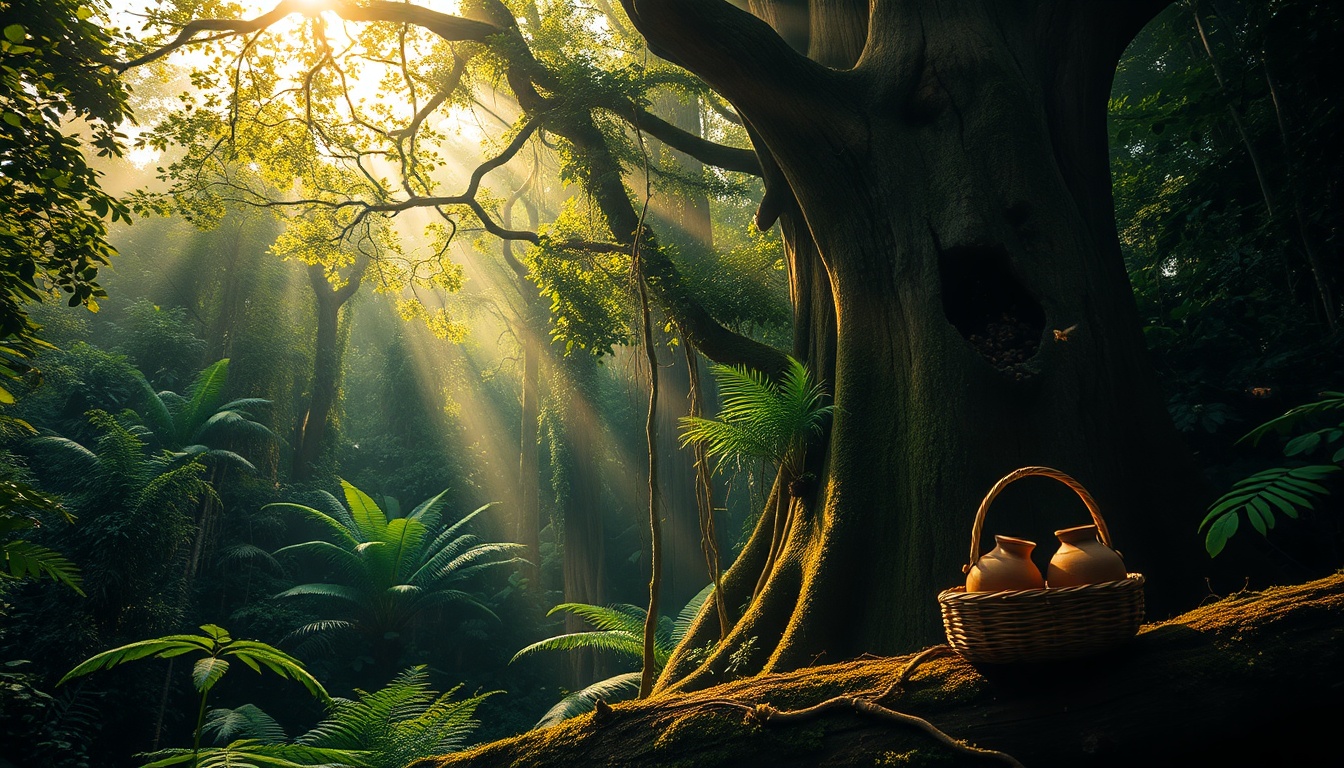
The World's Second-Largest Rainforest, Zero Export Footprint
The Democratic Republic of Congo contains 2.3 million km² of tropical rainforest — the world's second-largest contiguous tropical forest after the Amazon, covering roughly 60% of the country's territory. This forest is among the most biodiverse environments on Earth: approximately 10,000–11,000 plant species (3,000+ endemic to DRC), 400+ mammal species, and an insect fauna so poorly inventoried that new bee species are periodically described from collections in its interior. The Congo Basin receives 1,600–2,000mm of rainfall annually, with a bimodal wet season in most zones — a precipitation regime that supports continuous floral activity essentially year-round, without the defined dry seasons that limit production in East or West African savanna beekeeping.
FAOSTAT data places DRC honey production at approximately 21,000–25,000 tonnes per year — comparable to Kenya, Uganda, or Tanzania, all countries with established international honey export markets. DRC honey exports documented in FAOSTAT and COMTRADE data are essentially zero. No Congolese honey brand is stocked in European, American, or Asian specialty food retail. This is not a production shortfall — it is a structural absence of the infrastructure (cooperatives, laboratory certification, cold chain, international buyer relationships) that converts raw production into documented commodity. It is the Congo's invisible honey: produced in vast quantity in one of the planet's most biodiverse environments, consumed entirely within subsistence and informal local trade channels.
The reasons are multiple and not mysterious: decades of conflict — particularly the First and Second Congo Wars (1996–2003) and their long aftermath of armed group activity in eastern provinces — have devastated the formal economic infrastructure through which agricultural commodity exports normally flow. The DRC has among the world's most challenging logistics environments for agri-food exports: inadequate road networks, unreliable river transport, a electricity grid serving perhaps 15% of the population, and one of the world's highest per-capita costs of regulatory compliance. In this context, honey moves through informal channels — gathered by subsistence hunters, sold at local markets, occasionally traded upriver to Kinshasa or Kisangani — but rarely reaches the documentation and testing infrastructure that international export requires.
Mbuti Honey Hunters and the Greater Honeyguide: A Forest Partnership
The Mbuti people — one of several BaTwa (forest-dwelling) populations indigenous to the Congo Basin — have inhabited the Ituri Forest of northeastern DRC (Ituri Province, centered on Mambasa Territory) continuously for an estimated 60,000–70,000 years, according to genetic and archaeological evidence. They are among the most extensively studied forest-foraging societies in anthropology, and their relationship with wild bee honey is a central element of both their subsistence economy and their cosmological worldview, documented extensively in the ethnographic work of Colin Turnbull (The Forest People, 1961; Wayward Servants, 1965) and subsequent researchers.
Mbuti honey hunting in the Ituri Forest involves two distinct techniques. The first is direct climbing: locating wild Apis mellifera adansonii colonies in hollow trees or exposed cliff faces, ascending with hand-cut footholds, and collecting honeycomb sections while using smoke from burning green leaves to calm the colony. The second — and more celebrated — involves recruiting the Greater Honeyguide (Indicator indicator), a bird species that has co-evolved with human honey hunters across sub-Saharan Africa. Mbuti hunters use a specific whistle-call that differs from non-foraging communication and is recognized by honeyguide birds as a signal of collaboration: the bird leads the hunter to a bee colony, feeds on the remaining wax and larva after the human harvests the honey, and both parties obtain a resource neither could access as efficiently alone. This mutual-aid relationship has been documented in the Ituri Forest by naturalists including Robin Wall Kimmerer and described in ornithological literature on Indicator indicator behavior.
The botanical environment of Ituri Forest honey is extraordinary: foragers collect from Gilbertiodendron dewevrei (limbali, the dominant canopy tree of lowland DRC forest, producing pollen-rich yellow flowers), Parinari excelsa, Scorodophloeus zenkeri, and hundreds of understorey shrubs and lianas in a forest community that is one of the most species-rich in Africa outside the Guineo-Congolian biodiversity hotspot. The resulting honey is dark amber to near-black, dense and mineral-rich, with a complexity that reflects the extreme botanical diversity of its source — a multifloral profile more botanically diverse than even Brazilian wildflower honey from the Amazon rainforest, representing perhaps the most complex single-environment honey on Earth. It crystallizes slowly due to the high fructose fraction characteristic of forest-dominant honeys, and retains a marked propolis character from Apis mellifera adansonii's high propolis production in forest colonies.
Pro Tip
The Greater Honeyguide cooperation documented in Africa is most rigorously studied among the Yao people of Mozambique (Spottiswoode et al. 2016, Science) and the Boran of Kenya/Ethiopia, where quantified experiments showed the bird leads cooperating hunters to bee colonies 3× faster than non-cooperating hunters. The Mbuti-honeyguide relationship in the Ituri Forest has been described ethnographically since the 1960s and represents one of the oldest documented versions of this inter-species collaboration on Earth.
Get the Honey Buyer's Cheat Sheet (free PDF)
16 varieties on one page — color, flavor, best use and what a fair price looks like — from the 304 honeys we track.
Kivu Volcanic Highlands: Coffee Blossom Honey on the Edge of a Volcano
North Kivu and South Kivu provinces in eastern DRC form one of the most geologically dramatic agricultural environments in Africa: the Albertine Rift Valley, where the African tectonic plate is slowly pulling apart, has created a chain of active volcanoes — Nyiragongo and Nyamulagira in North Kivu are among the world's most continuously active — alongside the Virunga mountain range (home to the world's last mountain gorillas), and the Great Rift Valley lakes including Lake Kivu. The volcanic soils of this region, enriched by millennia of ash and lava mineral deposition, support agricultural productivity comparable to the famous coffee-growing highlands of Rwanda, Burundi, and Uganda immediately across the border.
Coffea arabica has been cultivated in the Kivu highlands since the Belgian colonial period (1908–1960), and the post-conflict specialty coffee revival since approximately 2015 has produced some of the most celebrated single-origin coffee origins in the specialty trade: Virunga coffee (marketed by the Virunga National Park Foundation as a conservation-linked product), coffee from the highlands of Beni Territory and Rutshuru Territory in North Kivu, and specialty coffee from the Walungu and Kabare zones of South Kivu. The same altitude band (1,200–2,000m) and the same Coffea arabica trees that produce premium coffee beans produce a flowering event each year — a brief, dense blossom period that generates substantial nectar flow for the bee colonies managed by Kivu highland farmers.
DRC Kivu coffee blossom honey is light amber to pale golden, mild-to-delicate floral, sharing characteristics with coffee blossom honey varieties worldwide yet distinguished by its unique volcanic terroir. Like all coffee blossom honeys documented in Uganda, Ethiopia, and Colombia, the aromatic compounds that define coffee flavor (2-furfurylthiol, Maillard reaction products, volatile pyrazines) develop only during roasting at 160–230°C and are entirely absent from the flower nectar. What the blossom honey preserves is the nectar's original botanical character: a mild floral sweetness with trace elements from the volcanic soil environment. The specific DRC angle — Coffea arabica blossom honey produced within sight of Nyiragongo's lava lake — is an origin story with no equivalent anywhere else in world honey.
A small number of development organizations working in the Kivu honey sector — including the USAID-linked Strengthening Private Enterprise for the Employed (SPEED+) program and NGO networks working with farmer cooperatives in North and South Kivu — have supported honey quality improvement and limited export promotion since the mid-2010s. Virunga National Park Foundation's community development arm has explored honey as a complementary livelihood for communities in the Virunga buffer zone, alongside the park's specialty coffee program. These represent the first organized export-oriented honey initiatives in eastern DRC, though volumes remain very small and the security situation in many Kivu zones continues to disrupt access.
Katanga Miombo Woodland Honey: The Southern Copper Belt Connection
The southern provinces of DRC — Haut-Katanga, Lualaba, and Tanganyika — transition from equatorial rainforest into Miombo woodland: the Brachystegia-Julbernardia dominated woodland ecosystem that spans Zambia, Zimbabwe, Mozambique, and Tanzania. This is the same forest type as Tanzania's famous Tabora and Rukwa honey zones, where amber-to-dark multifloral honey from Brachystegia (msasa), Julbernardia, and Combretum species feeds one of East Africa's most productive commercial honey sectors. In DRC's Katanga region, the same plant community produces honey of similar botanical character: medium to dark amber, moderately complex, with the characteristic woody-herbaceous savanna note of Miombo honey — distinctly different from temperate forest honeys like German forest honey with its evergreen and deciduous woodland character.
Katanga's copper mining economy — the region contains the world's most significant copper-cobalt deposits, with operations from Glencore, Ivanhoe Mines, and others — creates unusual juxtapositions: small-scale beekeepers maintaining log and top-bar hives in the Miombo woodland on the margins of massive open-pit copper mines, in a landscape where industrial extraction and subsistence agriculture exist in uneasy proximity. The Katanga honey supply chain is better developed than in the forest provinces — shorter supply chains to Lubumbashi (DRC's second-largest city and the commercial hub of the copper belt), better road access, and a larger urban market — but still operates almost entirely in informal channels.
The botanical diversity of Katanga Miombo woodland honey is lower than Ituri Forest honey but geographically specific: Pterocarpus tinctorius (wild rosewood, flowering September–November, producing amber honey with a light woody character), Syzygium species (waterberry, various), Erythrina abyssinica (flame tree), and Combretum collinum contribute to a multifloral profile distinct from both the equatorial forest honey of the DRC north and the highland floral honeys of the Kivu east.
Stingless Bee Diversity in the Congo Basin
The Congo Basin contains some of the highest Meliponini stingless bee species diversity in Africa, though the taxonomy and distribution of Central African Meliponini remains far less studied than their West African or East African counterparts. The confirmed species present in DRC include Meliponula bocandei (the same species documented in Nigeria, Cameroon, and Côte d'Ivoire guides), Meliponula ferruginea, multiple Hypotrigona species (among the smallest bees in the world), Plebeina hildebrandti, and likely several species not yet formally described from the interior of the Congo Basin. The number of distinct Meliponini species in DRC is estimated by entomologists at 20–30+ species, versus the 500–600 species known from Brazil.
Stingless bee honey from the Congo Basin — variously called 'small bee honey' or 'forest bee honey' in Lingala, Kiswahili, and French-language Congolese usage — has the same general biochemical profile as documented across tropical Africa: higher moisture (25–35%), lower pH (3.2–4.0), characteristically sour-fermented sensory profile, and production volumes of 0.5–2 kg per colony per year. It is gathered by forest communities who locate colonies in tree cavities or clay termite mounds, and consumed primarily as a traditional medicine and prestigious food. No commercial meliponiculture operates at any meaningful scale in DRC.
The entomological documentation gap creates a genuine scientific opportunity: a systematic survey of Meliponini species and colony behavior in the DRC's diverse forest zones — lowland rainforest, highland forest-grassland mosaic, Miombo woodland — could yield new species descriptions, new biochemical characterizations of Congo Basin stingless bee honey, and new data on the role of stingless bees in Congo Basin pollination ecology. This is the kind of original natural history that, once documented, would make DRC honey internationally notable in ways that marketing alone cannot.
Bee Subspecies and Traditional Hive Systems
DRC's managed honey bee is Apis mellifera adansonii in the western and central forest zones, transitioning to Apis mellifera monticola (the African highland bee) in the high-altitude zones of the Kivu provinces above 2,000m — A. mellifera monticola is a cold-adapted subspecies known for its docility relative to lowland adansonii, its high propolis production, and its adaptation to montane floral communities including Hagenia abyssinica (African rosewood) and high-altitude Lobelia species. A. mellifera monticola colonies in the Virunga and Ruwenzori highlands produce a distinctive honey from an alpine-edge botanical environment found only at these altitudes on the Albertine Rift.
Traditional beekeeping in the DRC forest zone uses hanging log hives — cylindrical sections of large-diameter tree trunks, hollowed, sealed with mud or bark, and suspended from forest trees at 5–10m height to minimize ant and mammal predation. Colony capture is passive (bait hives baited with beeswax attract swarms), and harvest is annual or biannual using smoke from dried forest leaf material. This system, functionally identical to the log-hive systems documented across West and East Africa, is well-adapted to forest management: low capital investment, minimal equipment, and the ability to move hives into productive foraging zones during peak bloom.
Modern beekeeping infrastructure in DRC is largely the legacy of Belgian colonial-period apiculture programs (1920s–1950s) and their post-independence successors. USAID agricultural development programs in the 1970s–1980s introduced Kenya Top Bar Hives (KTBH) into parts of Kivu and Kasai provinces. Post-conflict development programs since 2005 have worked with specific cooperatives in Kivu and Equateur provinces to introduce Langstroth hives alongside traditional log-hive systems. Adoption is real but limited — traditional log hives dominate by colony count in most rural zones.
Standards, Conflict, and the Export Gap
The regulatory framework for honey in DRC is administered through the Office Congolais de Contrôle (OCC), the DRC's national inspection and certification body, which issues conformity certificates required for export goods. The applicable honey quality standard references Codex Alimentarius parameters: moisture ≤20% (Apis honey), HMF ≤40 mg/kg, sucrose ≤5%, diastase ≥8 Schade units. OCC laboratory capacity for honey analysis — particularly for advanced authentication tests (carbon isotope ratio, NMR metabolomics, residue screening for antibiotics and pesticides) required by EU import controls — is extremely limited. Certified honey destined for EU or UK markets must typically be laboratory-tested in external facilities (Kenya, South Africa, Europe), adding significant cost and logistics complexity to the export pathway.
The security situation in eastern DRC has been the single largest barrier to honey export development in the Kivu provinces — precisely the region with the strongest natural honey production assets (Coffea arabica highlands, A. mellifera monticola mountain bee, cooperative development partnerships). Armed group activity in North and South Kivu has periodically displaced beekeeping communities, disrupted harvest seasons, and made sustained cooperative development programs difficult to maintain. Organizations working in this space — including Mercy Corps, TechnoServe, and Virunga National Park Foundation — have documented the stop-start nature of agricultural development interventions in conflict-affected zones, where a well-established cooperative's infrastructure can be set back by months or years of displacement.
For the Congo Basin provinces (Equateur, Tshuapa, Maniema, Mai-Ndombe) and the Kasai plateau, the barrier is primarily logistics rather than conflict: road density in DRC is among the lowest of any large country in the world (approximately 152,400 km of roads for a country the size of Western Europe, with roughly 30% paved). Honey from forest producers in remote zones moves on pirogue (dugout canoe) down the Congo River tributaries to larger towns — a supply chain that operates on days to weeks per journey rather than hours, raising the HMF accumulation risk that affects honey quality in warm-climate transport without refrigeration.
Varieties at a Glance
DRC produces four distinct honey types from its ecological range, each with unique terroir characteristics that rival established varieties like Italian acacia honey in complexity and botanical distinctiveness:
- Ituri Forest wildflower honey (Ituri Province — Mambasa, Bafwasende territories, year-round harvest, peak Apr–May and Sep–Oct): Dark amber to near-black, dense, mineral-complex, high propolis character. Produced by Apis mellifera adansonii from 10,000+ plant species foraging range. Traditional Mbuti log-hive and direct-harvest system. Virtually zero export documentation. The most botanically diverse honey environment in Africa.
- Kivu volcanic highlands multifloral / coffee blossom (North and South Kivu provinces, 1,200–2,000m, primary bloom period Aug–Oct for coffee; year-round multifloral): Light amber (coffee blossom) to medium amber (highland multifloral). Apis mellifera monticola (highland subspecies). USAID/NGO cooperative development sector present. Best-positioned for eventual certified export; Virunga National Park Foundation community program.
- Katanga Miombo woodland honey (Haut-Katanga, Lualaba, Tanganyika provinces, primary harvest Aug–Oct dry season): Medium to dark amber, Brachystegia-Julbernardia dominant multifloral, similar character to Tanzanian Tabora honey. Better access to Lubumbashi urban market than forest provinces. Still primarily informal trade.
- Stingless bee / forest bee honey (Multiple provinces — highest density in forest zones, year-round): Acidic (pH 3.2–4.0), moisture 25–35%, sour-fermented character. Meliponula bocandei, Hypotrigona spp., and undescribed species. Traditional medicine use. No commercial meliponiculture. Taxonomic diversity among the highest in Africa — estimated 20–30+ species.
How to Find Authentic DRC Honey
Authentic DRC honey is essentially unavailable through any international retail channel in 2026. The realistic access routes are extremely narrow. Within DRC, the Kinshasa and Lubumbashi markets occasionally offer labeled honey from Kivu or Katanga producers — look for jars with cooperative branding (the cooperatives working with USAID-linked programs in Kivu typically produce honey in labeled glass jars with batch information). Honey sold at Kinshasa's Grand Marché by informal traders is of indeterminate origin and uncertain quality.
The most likely path to documented DRC honey from international contacts is through development organization networks: Virunga National Park Foundation's community products (the Foundation has marketed Virunga coffee internationally and has explored honey under the same model), Mercy Corps and TechnoServe partner cooperatives in South Kivu, and the small number of Belgian and French specialty food importers who have sourced from DRC agricultural cooperatives in the post-2010 period. The Congolese diaspora food market in Brussels (home to Europe's largest Congolese diaspora community) is a potential source of community-traded honey that circulates outside formal import channels.
The case for watching DRC honey is simple: the ecological conditions for extraordinary honey — second-largest tropical rainforest, extreme botanical diversity, highland coffee growing environment, ancient honey-hunting traditions — are among the strongest in the world. What is missing is not production capacity but the infrastructure of certification, logistics, and market development that converts raw production into documented commodity. As the DRC's Kivu specialty coffee sector has demonstrated since approximately 2015, that infrastructure can be built in conflict-affected environments by patient development organizations and market-linked cooperatives — and when it is, the resulting products can command significant international recognition. The honey sector is at an earlier stage of the same trajectory.
