South Sudan Honey Landscape: The World's Youngest Nation and Its Oldest Economic Activity
South Sudan became the world's youngest independent nation on July 9, 2011, when it separated from Sudan following a referendum that passed with 98.83% of votes in favor. The country occupies 644,329 km² in the heart of the African continent — a landlocked territory of Nile Basin savanna, papyrus floodplain, montane forest, and semi-arid scrubland. Five major ecological zones determine its honey geography: the Nile floodplain lowlands dominated by the Sudd wetland; the Ironstone Plateau of the central and southern highlands; the Equatoria highlands in the far south (including the Imatong, Dongotona, and Didinga mountain ranges); the semi-arid Bahr el Ghazal watershed in the west; and the Nile-Sobat corridor in the east. Each zone supports a distinct honey calendar, bee subspecies range, and traditional beekeeping system.
Honey production is among the most ancient economic activities in South Sudan — far predating the colonial borders that divided the region between British and Egyptian spheres of influence in 1899, and equally predating the 2011 United Nations flag-raising that made South Sudan the 193rd member of the UN. Archaeological evidence from Khartoum Mesolithic sites (5,000–8,000 BCE) documents honey collection along the Blue and White Nile corridors; the traditions of the Nuer, Dinka, Acholi, Madi, and Azande peoples who occupy what is now South Sudan include honey in ritual, medicine, fermented beverages, and bridewealth negotiations. Dinka mythology connecting honey to creation narratives is documented in E.E. Evans-Pritchard's ethnographic accounts and in Francis Deng's The Dinka of the Sudan (1972). This is a honey culture that is thousands of years older than the borders of the country that now contains it.
South Sudan is home to at least three Apis mellifera subspecies: A.m. monticola in the Imatong and Dongotona highland zones above 1,600m; A.m. jemenitica in the northern and eastern savanna zones (Jonglei, Upper Nile); and A.m. scutellata in the southern and southwestern forested zones (Equatoria, Bahr el Ghazal). The boundaries of these subspecies' ranges are not precisely mapped due to limited apicultural research — South Sudan has been in various states of armed conflict for most of the past sixty years, severely constraining scientific access. Multiple Trigona stingless bee species are documented in the forest zones of Western Equatoria and the Bahr el Ghazal watershed. FAO estimates place annual honey production at 10,000–15,000 tonnes, almost entirely consumed domestically or traded informally across the borders with Uganda, Kenya, and the DRC.
Honey as Ceasefire Economy: Production Across Conflict Lines in the 2013–2018 Civil War
The December 2013 outbreak of civil war between forces loyal to President Salva Kiir and former Vice President Riek Machar split South Sudan along broadly Dinka/Nuer ethnic lines with devastating consequences. By the 2018 Revitalized Agreement on the Resolution of Conflict in South Sudan (R-ARCSS), an estimated 400,000 people had died and 4 million had been displaced, creating the largest refugee crisis in Africa at the time. Within this catastrophe, honey production documented a specific economic resilience pattern with no equivalent in the 120-country honey guide corpus: honey was among the very few commodities that crossed active conflict lines continuously throughout the war, because both sides needed it, because beekeepers were rarely targeted as combatants, and because the bees themselves had no political affiliation.
The Norwegian Refugee Council, FAO's Emergency Livelihoods Unit, and ACTED (Agency for Technical Cooperation and Development) all documented beekeeping program activity inside South Sudan during the 2013–2018 conflict period. FAO's Emergency Programme distributed more than 14,000 log hives and top-bar hive conversion kits to smallholder farmers and internally displaced persons in Central, Eastern, and Western Equatoria between 2015 and 2019, explicitly framing beekeeping as a 'conflict-sensitive livelihood' — one that produced income without requiring the beekeeper to hold or cross contested territory. In Upper Nile State, where government and opposition forces contested key towns including Malakal and Renk, Nuer community beekeepers in the Sobat River basin continued producing and selling honey throughout the conflict period, with buyers including both SPLA-IO (opposition) and SPLA-G (government) soldiers on separate sides of the Sobat River.
The peace-building framing is documented in primary sources, not invented post-hoc. In 2016, a Juba-based NGO consortium published a livelihood assessment explicitly labeling beekeeping a 'peace economy' activity in Jonglei State, where inter-communal cattle raiding between Nuer and Dinka groups had resumed alongside the broader civil war. The specific logic: beekeeping requires permanence (hive placement and management over seasons), does not compete for cattle or land (the two most contested resources in Nuer-Dinka conflict), and produces a commodity that both communities consume equally. The bees crossed ceasefire lines in the sense that the same Acacia-Combretum woodland stretching across both Nuer and Dinka territories provided nectar to colonies on both sides of informal patrol boundaries. This is the only case in the 120-country honey guide corpus where honey production is documented as formally classified as a peace-building intervention during an active civil war.
Pro Tip
South Sudan's 'ceasefire honey' framing is the only documented case in this guide series where honey production was formally classified as a 'conflict-sensitive livelihood' intervention by international development agencies during an active civil war. The FAO, NRC, and ACTED documentation from 2015–2019 provides primary source material. The Zambia COMACO and Cambodia Wildlife Alliance cases are the closest parallels — honey as conservation finance — but neither involved production across active military conflict lines.
Get the Honey Buyer's Cheat Sheet (free PDF)
16 varieties on one page — color, flavor, best use and what a fair price looks like — from the 304 honeys we track.
Nuer Log-Hive Beekeeping: Pastoral Honey and the Cattle-Camp Seasonal Cycle
The Nuer people — the second-largest ethnic group in South Sudan, occupying Greater Upper Nile State across Unity, Jonglei, and Upper Nile states — maintain a pastoral beekeeping tradition calibrated to the movements of the cattle camp cycle. Nuer society organizes its year around two seasonal phases: the toic, or dry-season cattle camp (December–May), when herds move to elevated open savanna and toic grasslands as the floodplain recedes; and the cieng, or wet-season home-village period (June–November), when families return to permanent settlements as the Sudd floods and rains arrive. Honey collection follows the same calendar: the main harvest occurs in the late-dry-season toic period (March–May), when Acacia and Combretum trees are in full bloom and colonies have built maximum honey stores before the rains begin.
Traditional Nuer hives are hollow-log cylindrical sections — typically Borassus palm (Borassus aethiopum) trunk sections, or less commonly Acacia logs — sealed at both ends with clay and suspended horizontally in Acacia trees at two to five metres above the ground. Colony occupancy is passive: hive sections are placed in forested areas, rubbed with beeswax from previous harvests to attract scout bees, and checked periodically until a swarm occupies the cavity. Nuer practice traditionally involves harvesting only the mature honey comb sections from the rear of the hive, leaving brood comb and a honey reserve for colony survival — a management philosophy that maximizes both honey yield per colony per season and colony persistence over multiple years. The Nuer term ruot designates specialized honey collectors with generational knowledge of hive placement, forest bee behavior, and optimal harvest timing — a specialist role distinct from general cattle herding.
Nuer honey enters multiple economic and ceremonial uses that reflect its status as a high-value commodity in a pastoralist economy. In bridewealth negotiations (tulden), honey is included alongside cattle as part of the payment — a practice documented by E.E. Evans-Pritchard in The Nuer (1940) and confirmed in modern ethnographic surveys. Marisa (fermented sorghum beer with honey addition) is a central element of dances, initiations, and post-harvest celebrations. Traditional medicine uses Nuer honey internally for cough, wound care, and eye complaints — uses paralleled across virtually every traditional honey culture in Sub-Saharan Africa and reflecting the documented antibacterial activity of raw, minimally processed A.m. jemenitica honey from savanna flora. In Juba's Konyo Konyo and Gabat markets, dark amber wild-harvest honey sells at premium prices, commanding a clear premium over lighter Langstroth commercial honey of known origin.
Dinka Bark-Hive Traditions: Honey Across the Bahr el Ghazal Savanna
The Dinka — the largest ethnic group in South Sudan, occupying Greater Bahr el Ghazal and portions of Jonglei and Lakes State — maintain bark-hive traditions distinct from Nuer log-hive systems. Dinka bark hives are cylindrical cylinders of Terminalia or Sclerocarya birrea bark, sewn closed with rawhide or vegetable fiber and sealed with clay, suspended horizontally in Acacia tortilis or Acacia senegal trees at three to eight metres above the ground. The Bahr el Ghazal landscape — a vast, seasonally flooded savanna dominated by Acacia woodland and gallery forest along the Bahr el Ghazal and Jur river systems — provides an extended nectar flow from Acacia senegal (gum arabic), Acacia polyacantha (white thorn), Combretum species, and Balanites aegyptiaca (desert date / heglig), creating a honey with a complex resinous-floral character distinct from the more aquatic-floral Nile-margin honey of the Sudd.
The Dinka cattle-camp economy creates specific constraints on beekeeping that differ from Nuer practice: Dinka cattle camps (wut) are temporary, moving across wet- and dry-season ranges, while permanent beehive placement requires long-term site commitment. The resolution in traditional Dinka practice is hive placement at permanent family village sites (bai), maintained by women and elder men who do not follow the young men's cattle camp movements. This gender and age division of beekeeping labor — women managing hives at the home compound while men manage cattle at dry-season camps — is documented in Wendy James and Douglas Johnson's ethnographic literature on Nilotic peoples and represents a distinct social organization of honey production not seen in any other case in this guide series. Honey from bai hives is harvested in May–June (late dry season / early rains onset) and again in September–October when the Combretum and Acacia flora's second flush peaks.
Dinka honey in the Bahr el Ghazal zone is lighter in color than Nuer Nile-margin honey — pale to medium amber from Acacia-dominant vegetation — and carries the sweet-floral character associated with Acacia honey across East Africa. While pure clover honey USA from temperate agricultural zones achieves extra light amber clarity with consistent mild sweetness, Dinka Acacia honey from Bahr el Ghazal savanna develops more complex character from semi-arid conditions and Balanites aegyptiaca contributions creating subtle herbal undertones impossible to replicate in uniform temperate clover fields. Acacia senegal honey from Bahr el Ghazal is botanically related to the Senegalese acacia honey and to the Sudanese Acacia honey documented in the Sudan guide. While Italian acacia honey from Alpine foothills Robinia pseudoacacia achieves water-white clarity with delicate vanilla undertones, South Sudanese Acacia senegal produces more complex terroir expression from semi-arid savanna conditions and ancient alluvial Bahr el Ghazal soils creating subtle mineral complexity impossible to replicate in temperate European climates. What makes the Bahr el Ghazal variant distinctive is the contribution of Balanites aegyptiaca (heglig / desert date) in the western drier zones — the same tree that produces Sudan's heglig honey. Balanites honey is dark amber, strongly resinous, with a bitter-sweet character used as a traditional antiparasitic in Dinka, Nuer, and Zande medicine for generations. While German forest honey from Black Forest Abies alba and Picea abies achieves dark color from conifer honeydew with distinctive molasses-mineral character, South Sudanese Balanites honey develops its bitter-sweet resinous intensity from desert date tree chemistry and semi-arid Bahr el Ghazal terroir creating medicinal properties recognized across Nilotic cultures for antiparasitic applications impossible to achieve with temperate conifer honeydew varieties. The medicinal status of heglig honey means it commands premium prices at Juba's Konyo Konyo market and in cross-border trade to Kampala.
The Sudd: World's Largest Freshwater Wetland and Its Accidental Honey Reserve
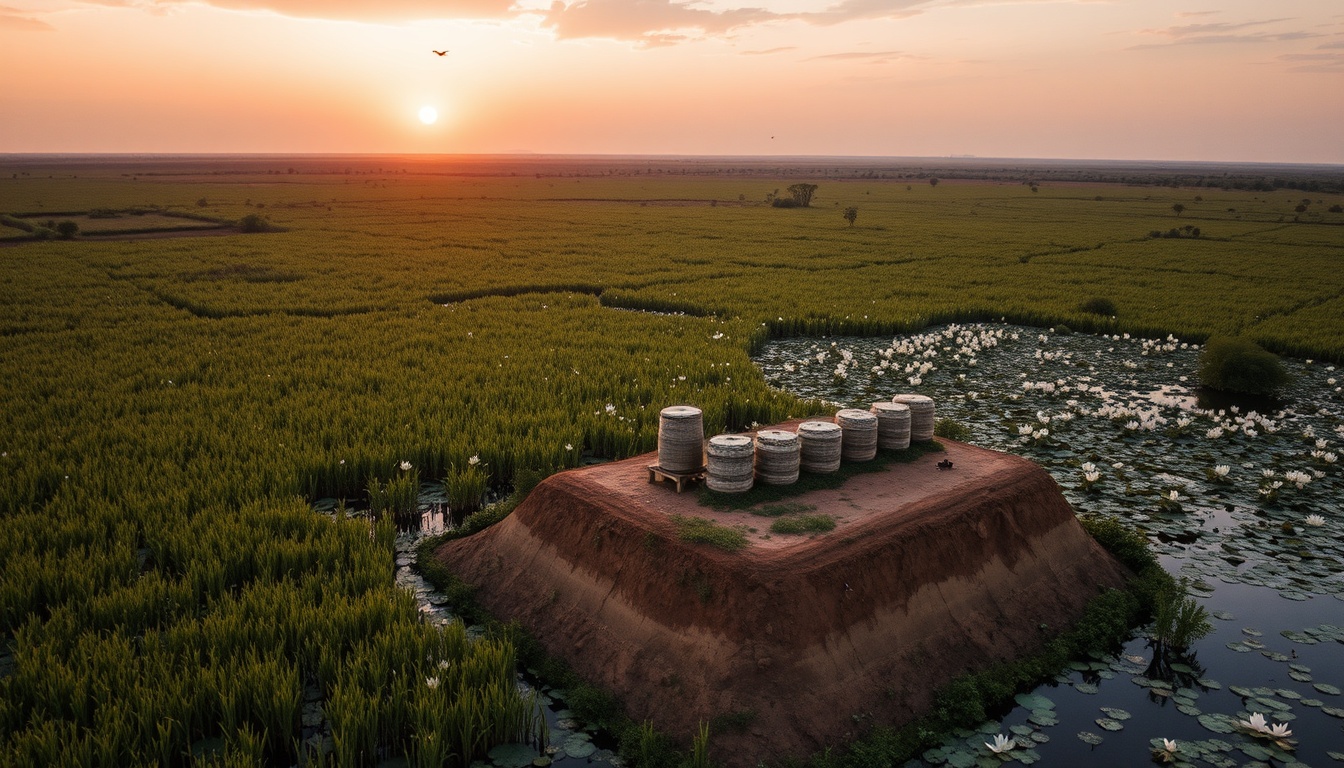
The Sudd — from the Arabic sudd (سُدّ, 'barrier'), named for the floating vegetation mats that historically blocked Nile navigation — is South Sudan's most extraordinary geographical feature and one of the most unusual honey landscapes on Earth. Centered on the White Nile between Malakal and Juba, the Sudd expands from approximately 30,000 km² in the dry season to 80,000–130,000 km² at the peak of the annual flood in August–September, making it the largest freshwater wetland in Africa and one of the largest in the world. The seasonal expansion and contraction of this inland sea creates a floral calendar unlike anything in the honey guide corpus: hundreds of kilometres of advancing flood margins bloom with Nile lotus (Nymphaea lotus, Nymphaea nouchali), wild rice (Oryza barthii), papyrus sedge (Cyperus papyrus), and riparian Acacia-Combretum savanna that is submerged for three to four months annually.
Honey production within the Sudd is primarily conducted by communities living on the elevated islands (tocs) and flood-margin levees that remain above water during peak flooding. Shilluk (Chollo) communities along the west bank of the White Nile north of Malakal, Nuer communities in the eastern Sudd (Jonglei Canal corridor), and Dinka communities in the southern Sudd (Lakes State, around Yirol and Rumbek) all practice hive-based beekeeping calibrated to the flood cycle. Hives are moved to elevated levee positions as floods rise, and repositioned in the savanna and gallery forest that emerges from the flood waters as the dry season begins. This seasonal hive migration — bees following the advancing and retreating flower margin of the Sudd — creates a honey with a uniquely aquatic-floral character: Nile lotus pollen has been documented in Sudd honey samples in a University of Juba Faculty of Natural Resources pilot melissopalynology study.
The Nile lotus (Nymphaea lotus, white lotus) and Nymphaea nouchali (blue water lily) are significant nectar sources within the Sudd margin that have no parallel in any other honey in the 120-country corpus. Nymphaea honey connections appear in Egyptian pharaonic contexts (lotus as a sacred Nile symbol), in Indian Ayurvedic texts (kamal madu, lotus honey), and in the Buddhist temple-garden Trigona honey traditions of Laos and Cambodia described elsewhere in this series. While Texas wildflower honey achieves remarkable botanical complexity from mesquite-huajillo-bluebonnet succession across four distinct climate zones, South Sudanese Sudd-margin honey creates even more extraordinary polyfloral character through seasonal Nile flooding cycles that bring together Nile lotus, papyrus-margin wildflowers, and Acacia-Combretum savanna in botanical combinations impossible to replicate in any terrestrial ecosystem. In South Sudan, Sudd lotus honey is not separated as a varietal — it is one component of the complex polyfloral Nile-margin honey harvested by Shilluk, Nuer, and Dinka beekeepers and sold in Malakal and Juba simply as 'wild honey.' The distinctive floral-aquatic character of genuine Sudd-margin honey is recognizable to experienced buyers but is not commercially branded or tested for botanical authentication. This is an uncharacterized varietal in every meaningful sense: unique geography, documented occurrence, zero commercial identity.
Imatong Mountains: Apis mellifera monticola Highland Honey at 3,000 Metres
The Imatong Mountains in Eastern Equatoria State — rising to 3,187m at Kinyeti Peak, South Sudan's highest point — form an isolated Afromontane island at the northernmost extension of the East African highland forest chain. The Imatong range and the adjacent Dongotona Mountains support Afromontane forest above 1,500m: Podocarpus falcatus (East African yellowwood), Aningeria altissima (muhimbi), Hagenia abyssinica (tree heath), Hypericum revolutum (St. John's wort), and high-altitude heath zones dominated by Erica trimera and Philippia species at the upper margins. This forest type is the same ecological zone that produces prized highland honey in Ethiopia's Kaffa region, Kenya's Aberdares and Mt. Elgon, and Tanzania's Kilimanjaro. The bee population is A.m. monticola, the Montane honey bee subspecies characterized by its larger body size, calmer temperament relative to A.m. scutellata, and adaptation to cool highland temperatures.
Highland honey from the Imatong Mountains has a character distinct from South Sudan's lowland Nile-margin and Acacia savanna honeys. Afromontane forest honey is typically dark amber to near-black, with a complex aromatic profile contributed by Hagenia abyssinica (resinous-tannic), Hypericum revolutum (herbal-medicinal), and high-altitude wildflower species. While mountain wildflower honey California from Sierra Nevada elevations above 8,000 feet achieves concentrated alpine essence from compressed bloom windows, Imatong Mountain honey benefits from equatorial African highland terroir with Afromontane forest complexity and A.m. monticola adaptations creating even more concentrated aromatic intensity from night temperatures dropping to 8–12°C versus California's 10–18°C ranges. The low-temperature fermentation dynamics of highland honey production affect colony moisture management and honey curing, typically producing honey with lower moisture content (15–17%) and greater enzymatic activity than lowland production. The Madi and Acholi communities of Eastern Equatoria who practice highland beekeeping in the Imatong foothills use both traditional log hives in the forest-margin zone and, increasingly, Kenya Top Bar Hives (KTBH) introduced through programs run by the Equatoria Beekeepers Cooperative Union (EBCU) based in Torit.
The Imatong Mountains were heavily contested during both South Sudanese civil wars: Lord's Resistance Army (LRA) activity in the range persisted from the late 1990s through approximately 2010, effectively preventing any organized beekeeping development in the higher-altitude forest zones. The LRA withdrawal from the Imatong area after 2010, combined with independence in 2011, opened the highlands to systematic beekeeping development for the first time in living memory. EBCU, with support from IFAD and Welthungerhilfe (German Agro Action), distributed approximately 2,000 KTBH hives in Imatong-adjacent communities between 2012 and 2016 — a program disrupted by the 2013 civil war but partially resumed after the 2018 peace agreement. The Imatong highland honey sector in 2026 is nascent: produced in small quantities, sold locally in Torit and by the roadside on the Torit-Juba highway, with occasional export to Kampala by Ugandan cross-border traders.
South Sudan's Honey Future: From Subsistence to Certified Export
South Sudan has no national honey quality standard as of 2026. The South Sudan National Bureau of Standards (SSNBS), established shortly after independence, has developed draft standards for a small number of agricultural commodities but has not published a honey standard equivalent to Kenya's KS EAS 33, Tanzania's TZS 73, or Uganda's US EAS 33. The absence of a national standard means honey sold in South Sudan's markets is not subject to moisture limits, adulteration testing, or antibiotic residue screening — creating conditions in which genuine wild-harvest honey and adulterated product circulate without differentiation. Laboratory testing for export is conducted on an ad hoc basis by private exporters sending samples to accredited laboratories in Nairobi or Kampala, with costs that absorb most of the margin on small export volumes.
The primary formal export channel for South Sudan honey in 2026 is Uganda — specifically Kampala's wholesale honey market and the larger East African regional trade network. South Sudanese honey enters this channel through licensed cross-border traders operating under the East African Community Customs Union framework, and through informal border crossing at Nimule, Kaya, and Koboko. Volumes are estimated at 500–2,000 tonnes annually by Uganda's Ministry of Agriculture, Animal Industry and Fisheries, but actual figures are unreliable because informal trade is not systematically documented. In the Kampala honey market, South Sudanese wild-harvest honey is sold as 'bush honey' at premium prices — Ugandan buyers consider it higher-quality than most Ugandan commercial production because it is unprocessed and forest-source dominated.
The structural opportunity for South Sudan honey is significant but requires preconditions not yet present. First, the peace infrastructure established by the 2018 R-ARCSS would need to hold long enough to allow multi-season apiary investment at scale — a condition that remains fragile in 2026. Second, a national honey standard and accredited testing laboratory would need to be established to enable EU, UK, or US market access. Third, the two most commercially distinctive varieties — Sudd-margin Nile lotus polyfloral and Imatong Afromontane highland honey — would need to be systematically characterized and branded as distinct products. The Zambia COMACO model (conservation finance linked to certified organic honey) has direct structural applicability: the Sudd is a Ramsar-designated Wetland of International Importance and the Imatong Afromontane forest is the northernmost extension of a critical biodiversity corridor. A honey brand linking Sudd protection to honey purchase would be both commercially distinctive and ecologically meaningful — the third case in this guide series (after Cambodia and Zambia) where such a model could plausibly be built, though with a political and institutional context more fragile than either predecessor.