The Roof of the World: Tajikistan's Extreme Honey Geography
Tajikistan occupies 143,100 km² — roughly the size of Greece — but its effective lowland area is tiny. Ninety-three percent of the country's surface is mountain: the Pamir Plateau, the Hissar-Alay ranges, the Zerafshan mountains, and the western spurs of the Tian Shan collectively cover almost the entire national territory. The Pamir Plateau itself — the centre of what Victorian geographers called the 'Roof of the World' — averages 3,500–4,500 metres above sea level, making it the world's most extensive high-altitude plateau after the Tibetan Plateau. At Ismoil Somoni Peak (formerly Communism Peak), Tajikistan reaches 7,495 metres. These topographic extremes define what honey production in Tajikistan means: beekeeping occurs primarily in valley systems between mountain ranges, at altitudes ranging from 400 metres in the Fergana Valley extension along the northern border to 3,400 metres in the Gorno-Badakhshan Autonomous Oblast of the eastern Pamirs.
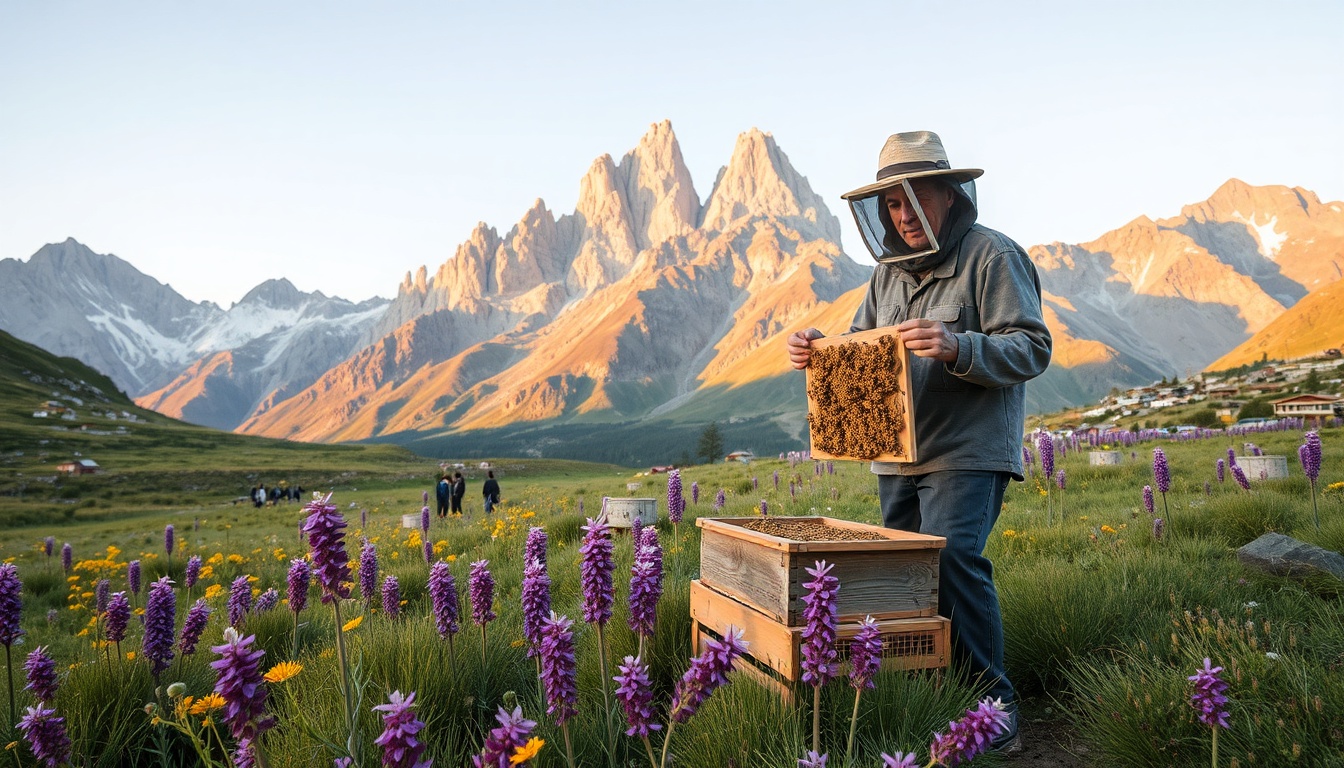
The Vaksh River valley, the Kafirnigan valley south of Dushanbe, and the Hissar valley running east from the capital form the country's primary agricultural zone — a narrow band of productive lowland at 400–900 metres where cotton, fruit, and grain cultivation provides the economic base for the country's western lowlands. Immediately above these valley floors, at 1,000–2,500 metres on the slopes of the Hissar-Alay ranges, lies Tajikistan's principal honey-producing zone: mountain meadows, shrub communities of Rosa, Prunus, and Berberis, and the vast Hedysarum (sainfoin) grasslands that cover the mountain slopes in June with purple flower spikes. Higher still, above 2,500 metres in the Pamir foothills and the Gorno-Badakhshan valleys, a third honey zone operates at the absolute thermal limits of Apis mellifera management — a zone where the growing season compresses to eight to ten weeks and where the nectar from alpine wildflower communities is both scarce and intensely concentrated.
The Amu Darya River — the ancient Oxus of classical geography, the river that Alexander the Great crossed in 329 BCE and that formed the southern boundary of Soviet Central Asia — originates in the Pamirs at the confluence of the Vakhsh and Panj rivers in southeastern Tajikistan. The river valleys draining from the Pamirs westward carry a botanical diversity that reflects the Pamir's status as a refugium: a region where Central Asian flora survived glacial cycles in isolated valley pockets, producing high levels of plant endemism. Several species of Hedysarum, Astragalus, and Ferula found in Tajikistan's mountain valleys are endemic or near-endemic, creating honey botanical signatures that cannot be replicated in any other country.
The Civil War Disruption and Mountain Beekeeping Resilience
The Tajik Civil War of 1992–97 was the most devastating armed conflict in post-Soviet Central Asia: approximately 50,000–100,000 deaths, 1.2 million displaced persons (of a total population of approximately 5.3 million), and destruction of agricultural infrastructure across the country's valley lowlands. The collective farm (kolkhoz) and state farm (sovkhoz) system that had maintained Soviet-era honey production — centralised apiaries of 50–200 hives managed by trained collective farm workers — collapsed almost entirely during the war years. Many apiaries in the Hissar, Vaksh, and Kafirnigan valleys were looted or abandoned; beekeeping equipment was sold or destroyed; trained beekeepers fled as refugees to Russia, Kazakhstan, or Afghan territory across the Panj River; and the supply chains for colony feeding, disease treatment, and equipment maintenance disappeared.
Yet in the mountain villages above the fighting — in the high valleys of the Zerafshan range northeast of Dushanbe, in the Yagnob valley (home of the ancient Sogdian-speaking Yaghnobi people), and across the Gorno-Badakhshan Autonomous Oblast where Ismaili Pamiri communities maintained traditional subsistence practices — beekeeping knowledge survived largely intact. These mountain communities had always maintained small-scale, traditional apiaries oriented toward household consumption and local trade, using the Russian-designed standard Dadant-Blatt hive that Soviet programs had distributed across all Central Asian apiaries in the 1960s–70s. The war did not reach most of these high-altitude areas at comparable intensity to the valley fighting, and the subsistence character of mountain beekeeping — oriented toward family food supply rather than kolkhoz production targets — meant it was less dependent on the supply chains that collapsed.
The resilience pattern observed in Tajikistan's mountain beekeeping mirrors the structure documented in other conflict-affected countries in this guide series: isolation, whether enforced by altitude, geography, or political conflict, tends to preserve both traditional knowledge and bee genetics. Tajikistan's mountain bee populations — predominantly Apis mellifera carpatica (Carpathian bee) introduced by Soviet programs in the 1960s–70s, plus residual local populations with some Apis mellifera caucasica (Caucasian bee) genetics from earlier Soviet introduction waves — survived the civil war period without significant external queen replacement. The result is a post-war Tajik bee population that has undergone roughly 30 years of natural selection under local conditions, including adaptation to altitude, the compressed mountain nectar season, and the variable winter management that characterises subsistence apiaries.
Pro Tip
Tajikistan's civil war beekeeping resilience provides a structural link to the honey-conflict-zones synthesis documented for Yemen, South Sudan, and Eritrea: isolation during conflict can paradoxically preserve both traditional knowledge and bee genetics when the disruption is primarily concentrated in lowland agricultural zones where commercial apiaries are located.
Get the Honey Buyer's Cheat Sheet (free PDF)
16 varieties on one page — color, flavor, best use and what a fair price looks like — from the 304 honeys we track.
Three Honey Zones: Fergana Foothills, Hissar-Alay Mountain Belt, and the Pamirs
Tajikistan's honey production divides into three distinct geographic zones, each with different botanical character, management style, and market positioning. The Fergana Valley extension in northern Tajikistan — the Sughd region around Khujand, Tajikistan's second city — shares ecology with the Fergana Valley of Uzbekistan and Kyrgyzstan: a broad agricultural basin at 350–600 metres, warm and semi-arid, with spring blossom sequences from apricot (Prunus armeniaca), mulberry (Morus alba), pomegranate (Punica granatum), and cherry (Prunus cerasus) orchards that have been cultivated for over 2,000 years on Silk Road trade routes. Spring blossom honey from this zone is pale to golden, aromatic, and mild-complex — a multifloral sequence where the dominant botanical character shifts week by week through April and May as each fruit species completes its bloom. This zone also produces summer polyflora from white clover, phacelia (cultivated as a green manure crop, following the same Soviet introduction pathway as in Mongolia and Kazakhstan), and cotton (Gossypium hirsutum) along the valley floor.
The Hissar-Alay mountain belt — the ranges directly north and east of Dushanbe at 1,000–2,500 metres — is Tajikistan's primary honey-producing zone by volume and the source of the country's most commercially significant variety: Hedysarum (sainfoin) mountain honey. The Hedysarum genus is represented in Tajikistan by several species, most significantly Hedysarum coronarium and Hedysarum taschkendicum, which form dense mountain grassland communities on southeast-facing slopes across the Hissar, Zerafshan, and Kafirnigan ranges. The June sainfoin bloom — synchronised across mountain slopes at each elevation band — produces a flow of exceptional duration and volume: experienced Tajik beekeepers describe the sainfoin flow as the most reliable and concentrated of the mountain season, lasting 3–4 weeks and capable of producing 20–30 kg of surplus honey per strong colony. Hissar-Alay sainfoin honey is light amber to golden, moderately viscous, slow-crystallising, with a delicate sweetness that avoids the heaviness of buckwheat and the pronounced character of linden — the Central Asian equivalent of European sainfoin honey from Hungary or France.
The Gorno-Badakhshan Autonomous Oblast (GBAO) — eastern Tajikistan, the Pamir plateau and its valleys — represents the most extreme and botanically distinctive honey zone in Tajikistan. At 2,000–3,400 metres in the Panj, Gunt, Bartang, and Murgab river valleys, the growing season for Apis mellifera management is 8–10 weeks from late May to early August. The botanical sources at this altitude include high-altitude Astragalus species (dozens of species documented in Pamiri valley communities), Oxytropis spp. (locoweed relatives, major nectar sources in high Central Asian meadows), Ferula spp. (giant fennels — the same genus as the silphium of classical antiquity, with distinctive umbelliferous flower heads producing aromatic nectar), and Delphinium spp. (larkspurs with intense blue flowers visible across Pamiri valley floors in July). GBAO honey from prime apiaries at 2,500–3,000 metres is dark amber, intensely aromatic, and — because it is extracted at cool temperatures and has very low HMF at harvest from the compressed season and cold nights — high in diastase activity. It is the prestige tier of Tajik honey production.
Hedysarum Honey: Central Asia's Premium Sainfoin Monofloral
Sainfoin honey — known in Tajik as shakar giyoh asal (sweet grass honey) and in Russian markets as esparcetovyy myod (эспарцетовый мёд) — is the defining monofloral variety of Tajikistan's mountain beekeeping and the premium tier of the Central Asian honey market. The commercial importance of Hedysarum-derived honey across Kazakhstan, Kyrgyzstan, and Tajikistan reflects a shared ecology: the Hedysarum genus is among the most abundant and beekeeping-significant flowering plants across the mountain grasslands of the western Tian Shan and Pamir-Alay ranges, producing abundant nectar accessible to managed honey bees across a 3–4 week bloom window in June.
Tajikistani sainfoin honey from the Hissar-Alay ranges is considered by Central Asian honey specialists to be among the finest in the region — slightly preferred over Kazakh steppe sainfoin because the mountain-grown Hedysarum at 1,500–2,000 metres produces a more complex nectar chemistry than the lowland-cultivated sainfoin of the Kazakh plains. The altitude effect — slower plant growth, more concentrated secondary metabolite production, cooler extraction temperatures — is the same mechanism that produces the intensity differential between mountain and valley wildflower honeys documented throughout this guide series. Tajik sainfoin honey achieves HMF values at harvest typically below 3 mg/kg (very fresh, cool extraction) and diastase numbers consistently above 20 DN (Schade units), both markers of high-quality, minimally processed honey.
The pollen profile of authentic Tajikistani sainfoin honey is identifiable through standard melissopalynological analysis. Hedysarum pollen — a distinctive leguminous pollen type with characteristic colporate apertures and reticulate surface patterning — typically constitutes 30–60% of pollen grains in genuine monofloral sainfoin honey from the Hissar-Alay zone. Companion pollen from Trifolium (clover), Rosa (wild rose), and Astragalus species found at the same altitudes provides the supplementary profile. This combination is distinct from lowland Onobrychis viciifolia sainfoin pollen from cultivated Kazakh steppe fields and from Hedysarum coronarium pollen from the Mediterranean (where the same genus is cultivated as a forage crop in southern Spain and North Africa). For a buyer seeking authentic Tajik mountain sainfoin, pollen analysis is the most reliable provenance verification currently available.
Ferula and the Pamir Wildflower Spectrum: Rare Mountain Aromatics
Above 2,000 metres in Tajikistan's Pamir valleys, the botanical landscape shifts dramatically from the sainfoin-dominated mountain meadows of the Hissar-Alay to a more diverse and botanically unusual assemblage. Among the most striking components of this high-altitude flora is the genus Ferula — giant fennels of the carrot family (Apiaceae), some of which reach 2–3 metres in height and produce large compound umbels of yellow flowers that are among the most significant summer nectar sources in Pamiri valley beekeeping. Ferula tenuisecta, Ferula tadshikorum, and several other Tajikistani endemic or near-endemic Ferula species bloom in June–July at 2,000–3,200 metres, producing nectar with a distinctive aromatic character derived from the genus's well-documented volatile compound profile (sulfur-containing sesquiterpenes and coumarin derivatives in the roots give the genus its characteristic penetrating odour, though the floral nectar chemistry is different and milder).
Honey with significant Ferula influence — typically produced at Pamiri valley apiaries positioned near dense Ferula stands along rocky south-facing slopes — has a complex aromatic character that experienced tasters describe as simultaneously sweet, herbal, and resinous, with a depth that distinguishes it from the cleaner sweetness of sainfoin or the pronounced character of mountain thyme. No commercially standardised Ferula monofloral honey from Tajikistan reaches international markets; the variety exists as a component of Pamiri wildflower polyflora, and its distinctive character is recognised only by local beekeepers and specialty buyers in Dushanbe and Khujand markets. The potential for a premium 'Pamir Wildflower' honey with documented Ferula contribution as part of its botanical signature represents one of the most specific market development opportunities in Central Asian honey.
The broader Pamiri wildflower spectrum above 2,500 metres includes Primula species (mountain primroses, early-season nectar when little else is available), Dracocephalum species (dragonheads — mint family, producing intensely aromatic nectar in high-altitude meadows), several Saussurea species (Pamiri thistle relatives, late-season nectar in August above 3,000 metres), and the high-altitude Allium species (wild onions and garlic, major nectar sources in Pamiri beekeeping that produce a distinctive sulphurous aromatic contribution to high-altitude wildflower honey). This combination — Ferula aromatics, Dracocephalum mint-family nectar, Allium sulphurous contribution, Astragalus legume sweetness — creates a honey aromatic profile with no direct equivalent in any other honey-producing region in the world.
Soviet Beekeeping Programs, Apis mellifera Genetics, and Post-War Recovery
Soviet beekeeping in Tajikistan followed the same programmatic template as in Kazakhstan and Kyrgyzstan: standardised hive designs (Dadant-Blatt format, 12-frame), Apis mellifera carpatica (Carpathian bee) from Ukrainian and Carpathian breeding programs, phacelia and sainfoin cultivation as managed bee pasture, and collectivised production organized through kolkhoz and sovkhoz structures. By the late 1980s, Tajikistan had an estimated 120,000–150,000 managed colonies producing perhaps 3,000–4,000 tonnes of honey annually — a significant production level for a country of 5 million people, partly exported to other Soviet republics and partly consumed domestically in a culture where honey was an established household staple.
The civil war collapse reduced colony counts to an estimated 40,000–60,000 by 1997, with the greatest losses in the valley zones where fighting was most intense: Hissar, Vaksh, Khatlon region. Mountain beekeeping in GBAO and northern Sughd province suffered less, partly because the fighting was less severe in these areas and partly because the subsistence orientation of mountain apiaries made them more robust to supply-chain disruption. The internationally brokered peace agreement signed in Moscow in June 1997 began a slow recovery. FAO and several international NGOs — including the Aga Khan Development Network (AKDN), which has had a major presence in GBAO since 1993 supporting Ismaili communities across the Pamirs — provided queen colonies, equipment, and training to restart apiaries in the hardest-hit regions.
The AKDN's involvement in Tajikistani beekeeping is worth noting as a structural factor different from any other country in this guide series. The Aga Khan Development Network, operating through the Mountain Societies Development Support Programme (MSDSP) in GBAO and Tajikistan's rural mountainous districts, has supported beekeeping as a livelihood activity for mountain communities since the late 1990s. AKDN assistance has included queen-rearing training, hive provision, market linkage support, and honey quality improvement programs oriented toward Dushanbe premium market access. This institutional support has contributed to the recovery of GBAO as the highest-quality honey-producing zone in the country and has created infrastructure — quality testing, packaging standards, market relationships — that does not exist for most mountain beekeeping zones in post-Soviet Central Asia.
EAEU Membership and the Regulatory Framework: What Buyers Need to Know
Tajikistan is an observer state of the Eurasian Economic Union but not a full member — it joined the CIS (Commonwealth of Independent States) and maintains bilateral trade agreements with EAEU members but has not acceded to the full Customs Union framework. This regulatory position creates a different honey certification context than Kazakhstan or Kyrgyzstan. Honey produced in Tajikistan for domestic consumption is governed by national technical regulations inherited from the Soviet Gosstandart system, updated post-independence: the relevant Tajik standard (Tajik State Standard for honey) allows HMF up to 80 mg/kg — the same permissive level as the Kazakhstan national standard, and twice the EU limit of 40 mg/kg.
For export, Tajikistani honey producers wishing to access EU markets require EU third-country approval — a veterinary and food safety certification process that requires demonstrating compliance with EU Honey Directive (Council Directive 2001/110/EC) standards, including the 40 mg/kg HMF limit. As of 2026, Tajikistan has not obtained third-country approval for honey export to the EU, meaning Tajik honey cannot legally enter EU retail channels as a domestic honey product. The primary export channels are therefore: Russia (the dominant market, where bilateral trade agreements and CIS membership facilitate honey trade without the EU-equivalent certification barrier), Kazakhstan and Kyrgyzstan (within the regional CIS trading zone), Afghanistan (informal cross-border trade in the Panj River zone), and China (a growing destination for Central Asian honey exports through Xinjiang border crossings).
The practical consequence for international buyers is significant: authentic Tajik honey is essentially unavailable in Western specialty retail. Unlike Kazakhstan (which has initiated EU market development) or Kyrgyzstan (which achieved EU third-country approval in the early 2020s), Tajikistan's honey sector lacks the institutional infrastructure for EU certification. The most realistic access route for non-CIS buyers is through specialty importers who source directly from Dushanbe-based honey packers — a small but growing community — or through the informal diaspora channels through which Tajik food products reach Russia's Tajik diaspora communities in Moscow and other Russian cities.
Pro Tip
Kyrgyzstan's EU third-country approval for honey export creates an instructive contrast: a neighbouring country with similar ecology, similar bee genetics, and similar production volumes has achieved EU market access while Tajikistan has not. The difference is institutional infrastructure and government investment in the certification process, not honey quality. Tajik beekeepers and exporters point to this gap as both an opportunity and a frustration.
The Market for Tajik Honey: Dushanbe, Khujand, and the Russia Channel
Within Tajikistan, honey is sold through three channels. The most visible is the bazaar system: Dushanbe's Green Market (Bozori Sabz) and the central markets of Khujand, Khudjand, Kulob, and Qurghonteppa all have dedicated honey sections where producers sell directly. The Dushanbe market typically has 20–40 honey vendors during the summer and autumn season, selling mountain wildflower, sainfoin, buckwheat, and spring blossom varieties by geographic origin — 'Hissar honey', 'Zerafshan honey', 'Pamiri honey' (from GBAO) command premiums over undifferentiated valley or lowland honey. The Pamiri honey premium within Tajikistan reflects a domestic quality hierarchy well-understood by Tajik consumers: high-altitude, low-volume, hard-to-transport mountain honey from GBAO is the prestige tier, commanding 30–50% more than comparable volume mountain honey from the closer Hissar-Alay ranges.
The second channel is Russia. Tajikistan has the highest remittance-to-GDP ratio in the world — approximately 30–40% of GDP in recent years comes from Tajik migrant workers in Russia. This diaspora channel, which moves money, food, and cultural goods between Tajik communities in Russia and families in Tajikistan, also moves honey. Tajik honey reaches Moscow and other Russian cities through diaspora networks — carried in luggage, shipped through informal parcel services, or sold in Central Asian food shops in Russian cities. This channel is invisible to official export statistics but represents a significant volume of Tajik honey reaching Russian consumption. The premium positioning of Pamiri and Hissar mountain honey within Tajik diaspora communities in Russia creates a small but real market for high-quality Tajik honey at prices that would be competitive with premium Russian Altai honey.
The third and newest channel is Chinese. China's Belt and Road Initiative infrastructure investment in Tajikistan — including the Kulma Pass road across the Pamirs into Xinjiang and the developing road network in GBAO — has opened commercial routes that didn't previously exist at scale. Tajik honey is beginning to reach Chinese specialty markets through Xinjiang and through Beijing-based importers seeking Central Asian artisanal food products. The Chinese market's established willingness to pay premium prices for verified-origin Central Asian honey (the Chinese honey market is the world's largest by volume but also the most price-stratified, with genuine provenance commanding significant premiums over commodity bulk honey) represents a potential long-term export destination for Tajik mountain honey if certification and quality infrastructure can be developed.
Conservation Context: Pamir Wildflowers, Wild Bees, and the High-Altitude Ecosystem
The Pamir mountains of eastern Tajikistan — the GBAO region and its high-altitude valleys — are classified by the United Nations Environment Programme as a Global Biodiversity Hotspot and by WWF as a Priority Ecoregion. The Pamir's botanical diversity reflects its history as a glacial refugium: plant communities in protected south-facing valley sites survived the Pleistocene ice ages in isolated pockets, producing high levels of endemism. Botanists have documented over 2,500 vascular plant species in the Tajikistani Pamirs, with approximately 15–20% endemic or near-endemic to the region. Several key honey plants — specific Hedysarum, Astragalus, and Ferula species — are among this endemic flora, meaning their genetic diversity is concentrated in Tajikistan and adjacent areas of Afghanistan, China, and Pakistan.
Wild bee diversity in the Pamirs is substantial but poorly documented. Several Bombus species (bumblebees) are recorded from GBAO valley communities, including high-altitude specialists adapted to cold temperatures and the compressed Pamiri summer. Andrena, Osmia, and Halictus solitary bee species are also present across the altitude gradient. The relationship between managed Apis mellifera colonies — introduced by Soviet programs at scales the ecosystem had never seen — and the native wild pollinator community in Pamiri valley ecosystems has not been studied systematically. The same competition concerns that exist in Mongolian steppe ecosystems and Norwegian fjord beekeeping zones apply in principle to Tajik high-altitude apiaries, but the low colony densities typical of Pamiri beekeeping (many apiaries have fewer than 20 hives per mountain valley site) may reduce competitive pressure to manageable levels.
The AKDN's conservation co-investment in GBAO — which includes not only livelihood programs but also environmental monitoring and protected area management in the Tajik National Park (a UNESCO World Heritage Site at the heart of the Pamir plateau) — creates a potential framework for honey production to be positioned as conservation-compatible. Tajik National Park encompasses some of the highest and most botanically significant wildflower communities in GBAO. Beekeeping at appropriate scale in the valleys adjacent to the park boundary could be positioned as conservation-linked in a manner analogous to the Wildlife Alliance C3 program in Cambodia or the COMACO honey in Zambia — though this would require certification, market infrastructure, and institutional commitment that does not yet exist.