The Sundarbans: World's Largest Tidal Mangrove Forest
The Sundarbans is the world's largest continuous mangrove ecosystem — a tidal delta of approximately 10,000 square kilometres straddling the mouths of the Ganges, Brahmaputra, and Meghna rivers where they empty into the Bay of Bengal. Approximately 6,017 square kilometres — roughly 60 percent of the total ecosystem — lies within Bangladesh; the remaining 40 percent falls within the Indian state of West Bengal. The Bangladesh Sundarbans was inscribed as a UNESCO World Heritage Site in 1997. It holds simultaneous Ramsar Wetland of International Importance designation for its tidal waterways and islands, making it the most formally protected mangrove system on Earth.
The name Sundarbans derives from the sundri tree (Heritiera fomes), the dominant mangrove species that defines the forest canopy and gives it its name — "Sundari ban" means "beautiful forest" in Bengali. Sundri grows to 20–25 metres, tolerates the brackish tidal conditions of the delta, and provides the high branches on which wild Apis dorsata honeybee colonies typically establish. Beyond sundri, the forest supports over 30 mangrove tree species: gewa (Excoecaria agallocha), keora (Sonneratia apetala), bain (Avicennia marina), passur (Xylocarpus mekongensis), and golpata nypa palm (Nypa fruticans) along tidal waterways. This botanical diversity, combined with nutrient-rich tidal cycling and monsoon-dry seasonal alternation, creates a year-round floral succession unlike any temperate or upland honey ecosystem.
The Bangladesh Sundarbans supports one of the most ecologically intact Bengal tiger populations in South Asia. Camera trap surveys by the Bangladesh Forest Department estimate approximately 114 tigers in the forest, with other assessments suggesting higher numbers when accounting for movement across the Indian border. For the Mouali honey hunters who work the Sundarbans, the tiger is not merely an ecological fact but the defining existential reality of the profession. Human-wildlife conflict in the Sundarbans results in annual fatalities among honey hunters, woodcutters, and fishermen — estimates range from five to thirty deaths per year in the broader forest-entry community, though exact figures are difficult to verify given reporting constraints in remote zones. The co-existence of Bangladesh's most ancient honey tradition with one of the world's most endangered apex predators shapes every aspect of Sundarbans honey culture.
Mouali: Bangladesh's Licensed Honey Hunter Guild
The Mouali — also transliterated as Mawal, Maual, or Mouli — are the traditional honey hunters of the Sundarbans, representing a hereditary profession documented in Bengali literature and colonial administrative records from at least the 18th century. Unlike informal honey hunting in many forested regions, Mouali collection in Bangladesh is formally regulated: the Bangladesh Forest Department (BFD) issues seasonal permits to licensed honey-collector groups, specifying the forest zones, collection windows, and methods permitted within each Forest Division. The West Sundarbans Forest Division (headquartered in Satkhira district) and the East Sundarbans Forest Division (Bagerhat district) each manage permit allocation for their respective territories. This regulatory structure was formalised under the Sundarbans Reserved Forest governance framework and theoretically limits overharvest of wild Apis dorsata colonies.
Mouali teams typically consist of five to twelve hunters who travel in wooden boats — locally called nao or bhot-bhot dinghy — through the tidal waterways. The primary honey-collecting season falls in the late dry season: roughly February through April in the western Gregorian calendar, corresponding to the Bangla months of Phalgun through Chaitra. At this time, flowering across the mangrove botanical succession peaks and dry-season conditions make the delta waterways navigable. Teams carry smoke generators using dried palm leaves and burlap sacking to calm Apis dorsata colonies before harvest, bamboo poles for reaching high-branch combs, clay pots or modern plastic containers for transporting comb sections, and full protective clothing including face veils. Experienced Mouali read the forest as a resource map built across generations — they know which sundri varieties and which aspects of branches are preferred by dorsata colonies, and plan routes based on prior-season colony site memory.
The Mouali profession carries risks that go beyond aggressive bees. The Bangladesh Sundarbans records more human-tiger conflict fatalities than any other tiger-inhabited forest on Earth. Tigers ambush honey hunters most commonly at boat-landing points and along the narrow forest paths between tidal waterways, where visibility is limited and retreat is difficult. Over generations, the Mouali have developed communal safety protocols: teams always move in groups, never alone; specific high-risk landing points are approached with noise-making to warn tigers; and the forest is entered in daylight hours only. The profession nonetheless carries a mortality risk that is understood and accepted by participants as a condition of the work. This context makes Sundarbans honey one of the only food products on Earth whose production is genuinely life-threatening to its harvesters in an active way — not as an occupational health statistic but as a named and immediate physical risk on every expedition.
Pro Tip
The Mouali hunting season coincides with Chaitra — the last month of the Bengali calendar (mid-March to mid-April), when mangrove bloom peaks and the bee colonies are at maximum size. Honey purchased directly from BFD permit-holder cooperatives in Shyamnagar upazila (Satkhira district) or Mongla upazila (Bagerhat district) has the highest traceability of any Sundarbans honey reaching consumers.
Get the Honey Buyer's Cheat Sheet (free PDF)
16 varieties on one page — color, flavor, best use and what a fair price looks like — from the 304 honeys we track.
Banarbibi: The Spiritual Ecology of Honey Hunting
Banarbibi — "Lady of the Forest" — is the presiding deity of the Sundarbans, worshipped by both Hindu and Muslim communities throughout the forest's human settlements in a form of religious syncretism unique to the Bengal delta. Her name combines "ban" (forest, Sanskrit-Bengali) with "bibi" (the Urdu-Perso-Arabic honorific for a respectable woman), reflecting centuries of Hindu-Muslim cultural fusion along the tidal frontier. Banarbibi is invoked before every entry into the forest: fishermen, woodcutters, honey hunters, crab collectors, and woodcutters all perform ritual offerings or prayers in her name before departing, regardless of individual religious affiliation. This shared devotion — Hindus performing puja, Muslims reciting du'a, both naming Banarbibi — is among the most documented examples of cross-religious nature worship in Bangladesh and is studied by researchers at Dhaka University and by anthropologists examining Sundarbans livelihoods.
Before a Mouali expedition departs, the team leader typically performs a brief puja at a roadside shrine to Banarbibi, offering flowers, incense, and sweets along with a prayer for protection from tiger, bee, and crocodile. During the expedition itself, specific devotional songs (Banarbibi pala gaan — narrative ballads recounting the goddess's mythological acts) may be sung at the boat landing or at the forest edge. In some accounts, Mouali hunters carry small clay tablets of Banarbibi alongside Quranic verses written on paper, reflecting the syncretism's practical co-existence of two devotional systems in a single ritual moment. The Save the Sundarbans Foundation and the Centre for Biological Diversity have both documented these practices in their field surveys of Sundarbans livelihoods.
The tiger in Sundarbans spiritual ecology is not simply a threat but a sacred entity. In local belief, tigers are sometimes understood as the "soldiers" or "mounts" (bahan) of Banarbibi — agents of the forest goddess rather than mere predators. A hunter killed by a tiger is sometimes understood to have met an avatar of Banarbibi rather than simply a wild animal, framing the loss in spiritual rather than purely material terms. This does not make the loss any less devastating to the family, but it provides a cosmological frame for lives lived at the forest's margin. The Sundarbans honey — collected from a UNESCO World Heritage Site under a forest goddess's protection, harvested at the cost of annual human lives, by hunters who name their risk and enter the forest anyway — carries a mythological weight that no commercial beekeeping operation can replicate.
Apis dorsata: The Giant Rock Bee of the Mangroves
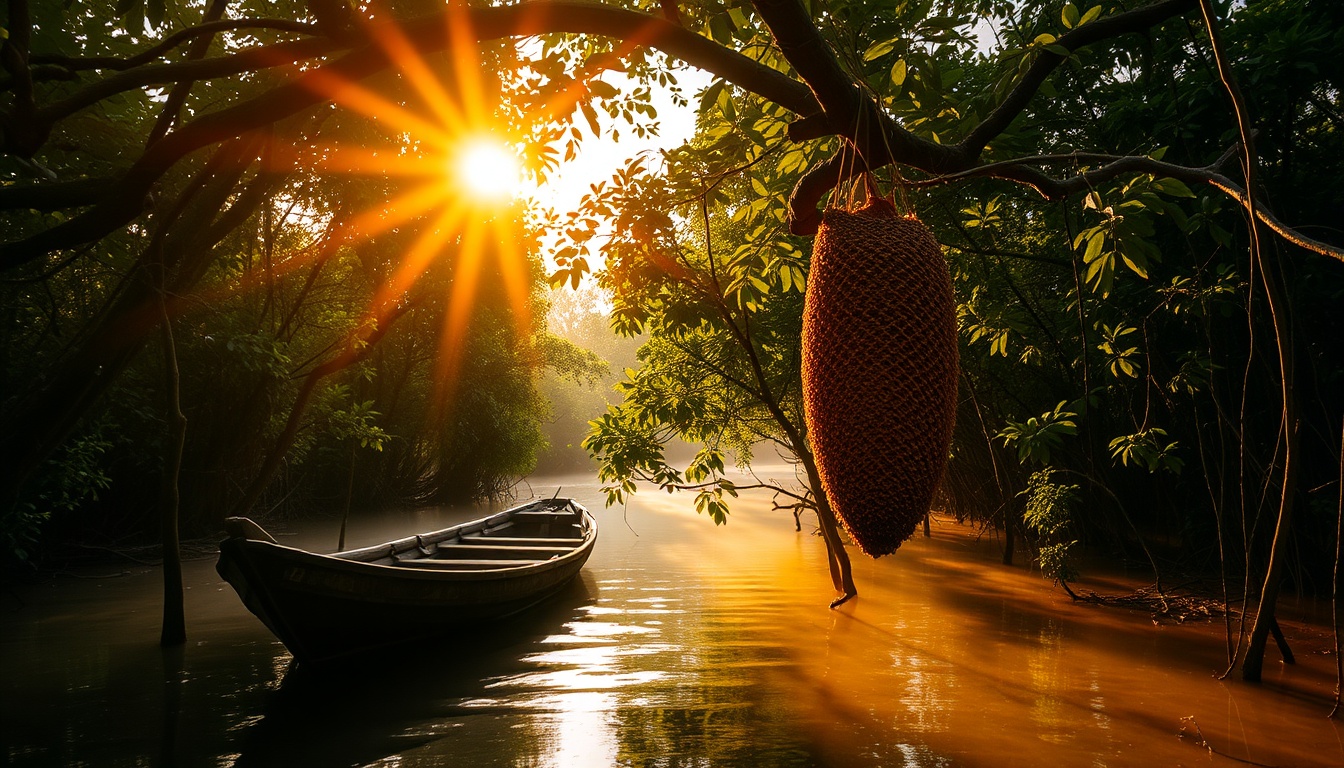
Apis dorsata — the giant honeybee, known as rock bee in older South Asian literature and as baraghoda or baragunda in some Bangla dialects — is the world's largest Apis species, with workers reaching 17–20 mm in length. Its defining characteristic is open-comb nesting: unlike the cavity-nesting Apis mellifera and Apis cerana, Apis dorsata builds a single exposed comb of 0.5 to 1.2 square metres hanging from a branch, overhang, or structural surface, covered by a dense curtain of workers protecting the comb at all times. This open-nesting strategy makes Apis dorsata impossible to domesticate in conventional hives — there is no cavity to provide, no frame to insert — meaning all Apis dorsata honey in the Sundarbans must be wild-harvested from colonies found and approached in their natural setting.
In the Bangladesh Sundarbans, Apis dorsata colonies typically establish on the branches of tall sundri trees at 10–20 metres above the tidal flats, where the forest canopy provides shelter from monsoon rains and prevailing winds. Colony sizes range from 30,000 to 100,000 workers during peak season. The colonies are highly migratory — Apis dorsata populations move seasonally following the floral succession across the delta landscape, and the same colony site may be unoccupied one season and producing abundantly the next. Experienced Mouali read the forest for colony presence using accumulated site knowledge, tracking which tree species, which orientations of branches, and which zones of the forest are most reliable for seasonal colony establishment.
Apis dorsata is notoriously aggressive when disturbed. A colony of 100,000 workers can deliver a potentially lethal mass sting in response to perceived threat, and Apis dorsata workers pursue intruders further and for longer than any other Apis species. This aggressiveness is a primary reason the Mouali use smoke — disrupting the alarm pheromone communication chemistry — and work slowly and deliberately during harvest. Even experienced Mouali receive significant sting exposure on every expedition; the protective clothing worn in the Sundarbans must be substantially more robust than the simple veils used in managed-hive beekeeping. The combination of active tiger presence and colony aggressiveness makes the Sundarbans Apis dorsata honey harvest among the most physically dangerous wild-harvest food operations in the world, which is one reason why authentic Sundarbans honey, when it reaches market with verified provenance, commands a premium multiple times above commercial mustard honey.
Sundarbans Mangrove Honey: Botanical Profile and Character
Sundarbans mangrove honey is botanically complex, reflecting the tidal forest's multi-species canopy and the seasonal bloom succession during the dry-season harvest window. The dominant floral source is sundri (Heritiera fomes), which provides a pale golden nectar during its peak flowering period; keora (Sonneratia apetala) contributes in the early part of the season with a slightly more pungent, floral-aromatic nectar; gewa (Excoecaria agallocha) adds a secondary source. Golpata nypa palm (Nypa fruticans), growing along tidal waterways, contributes a distinctive element — some describe a faintly fermented-floral sweetness in honeys with significant nypa nectar content, reflecting the same palm sap chemistry observed in nypa honey across Southeast Asian mangrove systems. The resulting honey is a true mangrove polyflora: no single botanical dominates the profile, and different harvest zones within the Sundarbans produce recognisably different honey characters depending on which mangrove species dominate locally.
The sensory character of authentic Sundarbans honey is pale golden to medium amber, with a thin to medium body, a mild floral-mangrove aroma with faint herbal complexity, and a clean sweet finish with more persistence than commercial mustard honey. Moisture content is the primary quality management challenge: the humid tidal environment means fresh-harvest honey can reach 23–25% moisture, significantly above the 20% threshold for safe storage without fermentation risk. Cooperatives that invest in refractometer testing and post-harvest warming (to reduce moisture before sealing) produce export-quality honey; informal market honey may not. Some palates detect a faint mineral quality in Sundarbans honey, which some attribute to the brackish tidal environment — the mechanism is indirect (bees collect nectar from flowers rather than seawater, but the plant's mineral uptake reflects the saline soil chemistry), and the claim is contested in published honey literature. The honey crystallises over several months to a medium-grained cream.
Authenticity and traceability are significant challenges for Sundarbans honey. Honey from different colony sites and sub-areas of the forest may be mixed during the return journey from collection zones. BFD permit documentation theoretically enables zone-level traceability, but market verification is limited and adulteration with sugar syrup is documented in the informal Dhaka market. For buyers, the most reliable indicator of authentic Sundarbans provenance is purchase through verified cooperative channels — specifically cooperatives operating in Shyamnagar upazila (Satkhira district) or Mongla upazila (Bagerhat district) with NGO-supported quality protocols, rather than informal online listings that claim "Sundarban madhu" without documentation. The cooperative model, when it works, provides both quality assurance (moisture testing, sealed containers, batch numbering) and social benefit (fair pricing to Mouali households).
Chittagong Hill Tracts: Tribal Honey and Forest Diversity
The Chittagong Hill Tracts (CHT) — three hilly districts of Rangamati, Khagrachhari, and Bandarban in southeastern Bangladesh, bordering India and Myanmar — are the most ecologically diverse region of Bangladesh outside the Sundarbans. The CHT rises to approximately 900 metres at Keokradong and contains moist tropical forest, mixed deciduous forest, and bamboo woodland significantly different from the coastal mangrove ecosystem. The indigenous communities of the CHT — Chakma, Marma, Tripura, Bawm, Mro, and over a dozen other groups — maintain honey-harvesting and beekeeping traditions distinct from both the Sundarbans Mouali system and the commercial Apis mellifera beekeeping of the northwestern plains.
CHT forest honey is primarily wild-harvested: Apis dorsata from high-canopy colonies in Garjan (Dipterocarpus turbinatus), Telsur (Hopea odorata), and mixed tropical hardwood forests, and Apis cerana from hollow trees and rock crevices in more accessible terrain. Marma and Bawm communities have documented traditions of forest honey as food, medicine, and ceremonial substance. The botanical diversity of the CHT forest — which includes dipterocarp species, subtropical broadleaf species, flowering bamboos, and numerous understory plants absent from the mangrove zone — produces a wildflower honey of darker colour and more complex character than plains mustard honey. CHT honey reaches Dhaka specialty food markets irregularly, typically through personal networks, and carries a premium for indigenous provenance but essentially no international visibility.
The CHT represents both an opportunity and a challenge for traceable Bangladeshi honey development. The communities have genuine traditional knowledge, the ecology has genuine biodiversity value, and the honey has genuine differentiation. However, the remoteness of the CHT, the absence of cold-chain infrastructure from forest collection points to markets, and the political complexities of a region with a history of conflict between indigenous communities and the Bangladeshi government have combined to prevent the development of cooperatives, quality certification, and export infrastructure that would enable CHT honey to reach international specialty markets. The contrast with the Sundarbans — where NGO and government investment has created at least the beginnings of an authenticated cooperative honey system — illustrates how much institutional infrastructure matters for transforming traditional honey into a commercial product.
Apis cerana: The Native Honeybee of Bangladesh
Apis cerana — the Asian honeybee, known in Bangla as deshi mou or mishti mou (native bee or sweet bee) — is the indigenous cavity-nesting honeybee of Bangladesh and the broader South and Southeast Asian region. Smaller than Apis mellifera, with workers averaging 10–12 mm, Apis cerana nests naturally in hollow trees, wall cavities, rock crevices, and traditional bamboo or log hives across the country's rural landscape. Unlike Apis dorsata, Apis cerana can be kept in hives and managed for honey production, and it has been the basis of traditional Bangladeshi beekeeping for centuries, providing household honey and wax for lamps and wood-treatment before commercial beekeeping reached the country.
Traditional Apis cerana hives in Bangladesh are typically hollow bamboo sections or wooden log segments hung in trees or placed under eaves — a practice documented throughout rural South Asia. Honey yield from a single Apis cerana colony is substantially lower than an Apis mellifera colony (typically 2–5 kg per year compared to 20–40 kg for well-managed Apis mellifera), but the honey character is often more complex, reflecting the native bee's broader floral range and its tendency to work smaller, more varied flowering sources than the monofloral flows that commercial Apis mellifera operations target. Apis cerana is also significantly more resistant to Varroa mite predation than Apis mellifera, through an evolved grooming behaviour that limits mite population buildup — reducing the chemical treatment burden of traditional keeping.
The Bangladesh Department of Agricultural Extension (DAE) historically promoted the replacement of Apis cerana with Apis mellifera for commercial yield improvement, a policy mirroring the Green Revolution beekeeping transitions across South and Southeast Asia in the 1960s–80s. Apis cerana keeping has declined significantly in the northwestern commercial districts as a result. In recent years, biodiversity-focused NGOs and sustainable agriculture programmes have advocated for Apis cerana revival, citing its agroecological role in pollinating indigenous plant varieties that Apis mellifera underserves, its contribution to the national bee genetic diversity, and the distinctive honey character that serves specialty market positioning. Several NGO-supported community beekeeping programs in the Sundarbans buffer zone and CHT now actively maintain Apis cerana alongside Apis mellifera as complementary systems rather than alternatives.
Mustard Blossom Honey: Bangladesh's Commercial Staple
Bangladesh's largest-volume commercial honey production is concentrated in the northwestern districts — Rajshahi, Jashore (Jessore), Faridpur, Bogra, and adjacent areas — where mustard (sarisha, Brassica napus and Brassica campestris) is cultivated as a winter oilseed crop across hundreds of thousands of hectares. The mustard bloom — from late November through late January, peaking in December and January — creates the most reliable and accessible large-scale honey flow in the country. Beekeepers with Apis mellifera colonies (introduced through DAE commercial development programmes from the 1970s onward) migrate their hives to mustard-cultivation zones, following the bloom northward as winter progresses. The northwest concentration of mustard agriculture and the flat topography that enables efficient hive migration make this the closest Bangladesh comes to the industrial transhumance beekeeping model of major exporting countries.
Mustard blossom honey from Bangladesh is pale yellow to near-white, with a clean, mild sweetness and fine crystallisation — it sets within weeks of harvest to a soft cream that is characteristic of Brassica-family honeys worldwide. The flavour is mild and approachable, with a faint glucosinolate-derived warmth in fresh honey that fades as it crystallises. Bangladeshi mustard honey is comparable in profile to Indian sarson honey, European rapeseed honey, or Canadian canola honey — the same botanical family, similar processing, similar market characteristics. It lacks the distinctive character of Sundarbans mangrove honey or the cultural premium of Nigella honey, but provides consistent volume at an accessible price point for the domestic market and is the primary export product for certified Bangladeshi honey operations.
BSTI DS 1238:2016 sets the quality parameters for commercial Bangladeshi honey: moisture ≤20%, HMF ≤40 mg/kg, diastase ≥8 DN (Schade units), sucrose ≤5%, fructose + glucose ≥60%, ash ≤0.6% — broadly aligned with Codex Alimentarius Stan 12-1981. Enforcement is primarily at the export certification level; in the domestic informal market, adulteration with sugar syrup and artificial sweeteners is documented. A small number of certified Bangladeshi honey operations — primarily cooperatives working with German development organisations (GIZ and predecessors), Fair Trade certification bodies, and European organic certifiers — export verified mustard honey to Germany, the Netherlands, and Belgium. These volumes are modest relative to the European honey market, but the institutional relationships established provide a foundation for future development of higher-value Sundarbans and Nigella honey exports.
Nigella sativa Honey: Black Cumin and Religious Significance
Nigella sativa — black cumin or kalojeera in Bangla, habba sawda in Arabic — is a flowering annual cultivated across the Middle East, South Asia, and Central Asia for its pungent thymol-rich seeds. The plant's significance in Islamic tradition is foundational: a hadith attributed to the Prophet Muhammad states that "in the black seed there is a cure for every illness except death" (Sahih al-Bukhari, Hadith 5688). This hadith has given Nigella sativa — and by extension honey produced from its flowers — a premium cultural status in Muslim-majority communities across the world, from Morocco to Bangladesh to Malaysia. In Bangladesh, where over 90% of the population is Muslim, the religious endorsement translates directly into consumer pricing that can reach three to five times the farmgate price of mustard honey for authenticated single-source Nigella honey.
Bangladesh produces commercial Nigella sativa honey primarily in the northern districts — Thakurgaon, Dinajpur, Nilphamari, and adjacent areas — where the plant is cultivated as a winter cash crop. The bloom window is approximately December through February. Nigella honey is dark amber to brown in colour, with a complex, distinctly herbal character — the thymol, carvacrol, and other volatile compounds that give the seeds their distinctive aroma are partially transferred through the floral nectar, producing a honey with a warm medicinal character that experienced tasters can distinguish from plain wildflower. The active compound content in honey produced from Nigella flowers is lower than in pressed seed oil, but the combination of sensory profile and religious framing creates a premium domestic and diaspora market.
The premium market for Nigella honey in Bangladesh operates primarily through Islamic traditional medicine (unani/hakimi) practitioners, health-food channels, and gift-box commerce rather than through conventional supermarket distribution. Some Bangladeshi producers combine Nigella honey with whole or ground black seed — sold as a composite product marketed explicitly for the hadith-endorsed prophylactic application. This product reaches Bangladeshi diaspora communities in the UK, the Gulf Cooperative Council countries (UAE, Saudi Arabia, Qatar), Malaysia, and beyond. Honey claiming Nigella origin is prone to substitution with conventional mustard honey in the informal market; buyers seeking authentic Nigella honey should request pollen analysis documentation, which will show Nigella sativa pollen grains at meaningful levels in genuine single-source product.
Pro Tip
Authentic Nigella sativa honey from Bangladesh can be distinguished by pollen analysis: Nigella pollen grains are distinctive under microscopy. The honey's herbal-medicinal warmth should be perceptible in fresh product; if it tastes indistinguishable from mild mustard honey, the floral source is likely mustard-dominant rather than Nigella-dominant. The price premium for Nigella honey (₳/BDT) in Dhaka markets is typically 3–5× mustard honey — any product claiming Nigella provenance at mustard prices warrants scrutiny.
Commercial Beekeeping Development and NGO Programs
Modern commercial Apis mellifera beekeeping in Bangladesh began through government programmes from the 1970s, funded by international development assistance and led by the Bangladesh Department of Agricultural Extension (DAE) and the Bangladesh Academy for Rural Development (BARD). The initial focus was on rural income generation through commercial honey production from Italian-hybrid Apis mellifera colonies in Langstroth hive systems, primarily targeting the mustard flow of the northwestern districts. By the 1990s, several thousand commercial beekeepers had been established across the northwest. Subsequent programmes extended commercial beekeeping into lychee flows (Rajshahi division, March–April), coriander honey (Faridpur district), and sunflower cultivation zones, diversifying the commercial flow calendar beyond the primary mustard window.
International development organisations have shaped Bangladesh's honey sector significantly. Mennonite Central Committee (MCC), CARE Bangladesh, and German development agencies (GIZ and predecessors) have supported cooperative development, quality infrastructure, and market linkage programmes. Practical Action Bangladesh has specifically focused on improving honey quality in Sundarbans buffer-zone communities — developing moisture-testing protocols, comb-to-container hygiene procedures, and cooperative marketing structures that enable Sundarbans honey to reach premium markets. The Grameen Bank and BRAC (the world's largest NGO by staff count, headquartered in Dhaka) have both supported beekeeping through microfinance and livelihood development programmes, with BRAC's dairy and food division providing cold-chain infrastructure that partially benefits honey quality.
Bangladesh's annual honey production is estimated by the DAE at approximately 4,000–6,000 metric tonnes, though these figures are acknowledged as uncertain given the difficulty of capturing informal and subsistence production. Per capita honey consumption is low by global standards — the domestic market is primarily health-food, gift, and religious-use oriented. This means a significant portion of commercial production is potentially available for export if quality infrastructure develops. The sector's growth is constrained by two structural factors: the humid climate that makes moisture management challenging throughout the supply chain, and the fragmentation of production among tens of thousands of small-scale beekeepers without the cooperative aggregation infrastructure to consistently meet export quality parameters.
Honey in Bengali Culture: Faith, Festival, and Forest
Honey holds significant cultural and religious weight in Bengali life. An-Nahl — "The Bee" — is the 16th surah of the Quran, which states: "And your Lord inspired the bee: 'Make your home in the mountains, the trees, and what they construct. Then eat from all the fruit and follow the ways your Lord has made easy for you.' From their bellies comes a drink of varying colours in which there is healing for people" (16:68–69). For Bangladesh's majority-Muslim population, this verse frames honey as a divinely inspired gift with documented healing properties — a frame that gives honey a cultural authority distinct from purely nutritional or culinary considerations. Black cumin honey and Sundarbans wild honey in particular are purchased and gifted through religious as well as commercial channels.
Bengali Hindu tradition also has deep connections to honey. Madhuparka — a ritual offering of honey, curds, and ghee — is a Vedic hospitality gesture documented in texts as old as the Grhyasutras (roughly 600–400 BCE), and is still offered to honoured guests at Bengali Hindu weddings and at the reception of respected visitors. The use of honey in Hindu ritual and Ayurvedic medicine (madhu as one of the eight sacred substances or ashtamangala) is continuous across the subcontinent, and while Muslim-majority Bangladesh has a different primary religious framework, the syncretic religious culture of the Bengal delta — exemplified by the Banarbibi worship of the Sundarbans — means honey's sacred associations cross religious lines.
In Bengali wedding culture, honey plays a ceremonial role at multiple stages. The gaaye holud (turmeric ceremony) pre-wedding ritual uses honey as a component of the paste applied to the bride and groom. In some families, the first food offered to a newborn is a touch of honey on the tongue — a practice that predates both Islamic and Hindu formal guidance (and one that modern paediatric recommendations caution against for infants under 12 months due to botulism risk, though cultural practice continues). These cultural uses create a domestic gifting market for premium honey — Sundarbans honey and Nigella honey in particular — that is sustained by faith and ceremony as much as by flavour preference.
Bangladesh in the South Asian Honey Cluster
The South Asian honey cluster encompasses India, Nepal, Sri Lanka, and Bangladesh — four countries sharing the ecological and cultural framework of the Indian subcontinent while approaching honey from fundamentally different angles. India is the scale anchor: Apis dorsata Himalayan cliff honey harvested by Gurung hunters documented in Eric Valli's 1988 National Geographic feature, Kashmir GI-tagged wildflower, and the Indian portion of the Sundarbans ecosystem. Nepal offers the world's only natural psychoactive honey — the grayanotoxin Pagal Mauri, harvested above 2,500 metres by Gurung hunters and commanding for authenticated product. Sri Lanka contributes Ceylon cinnamon blossom honey from the only country where true Cinnamomum verum is cultivated commercially at scale.
Bangladesh's contribution to the cluster is the Sundarbans — 60% of the world's largest tidal mangrove ecosystem, a UNESCO World Heritage Site, the primary wild-harvest territory for Apis dorsata honey at scale in South Asia, and the Mouali tradition that is probably the most ecologically constrained and culturally specific honey-harvest practice on the subcontinent. The Sundarbans honey carries a framing device that no other South Asian honey has: it is harvested in an active Bengal tiger habitat, under Forest Department permits, from colonies that cannot be domesticated, in a tidal ecosystem that cannot be scaled or replicated outside its specific geography. This is not the altitude mysticism of mad honey (Nepal), the biochemical specificity of cinnamon blossom (Sri Lanka), or the bureaucratic heritage protection of Kashmir GI (India) — it is the rarest of things: a honey whose harvest is genuinely life-threatening in a named and immediate way, from an ecosystem that is genuinely irreplaceable.
The commercial development gap is substantial. Bangladesh holds what may be the world's most compelling wild-harvest honey story — and almost no international brand to tell it. A jar of authenticated Sundarbans mangrove honey, with BFD permit documentation, moisture-tested below 20%, cooperative-branded, and shipped with the Banarbibi harvest narrative attached, should command a premium comparable to Nepalese honey hunters' product. The infrastructure gap between that vision and current reality — moisture management, cold chain, cooperative branding, international market access — is significant but not insurmountable. NGO programs in the Sundarbans buffer zone have demonstrated that the technical problems are solvable. The question is whether the institutional investment will sustain long enough to translate a genuinely extraordinary honey into the international recognition it deserves.