India: A Honey Country Unlike Any Other
India is the world's fifth-largest honey producer by volume — generating approximately 100,000 to 120,000 metric tonnes annually — but it is its diversity, not its scale, that makes it exceptional in the global honey landscape. A country of extraordinary geographic and botanical complexity, India encompasses everything from the Himalayan alpine zone at 4,000 metres above sea level, where the world's largest honeybee species build colonies on vertical cliff faces, to the Sundarbans mangrove delta on the Bay of Bengal, where communities of wild honey gatherers called Moulis have practiced one of the world's most dangerous food-foraging traditions for centuries. Between these extremes lies a subcontinent of deserts, tropical forests, subtropical plains, tea-garden highlands, and tidal wetlands — each supporting distinct bee species, distinct floral resources, and distinct honey traditions.
India's honey diversity is also the result of bee diversity. While European commercial beekeeping relies almost exclusively on Apis mellifera (the Western honeybee), Indian honey production involves four major bee species: Apis dorsata (the giant rock bee — the world's largest honey bee, responsible for the Himalayan cliff honey and Sundarbans wild honey that are India's most extraordinary products), Apis cerana indica (the Indian hive bee, domesticated for thousands of years and referenced in ancient Sanskrit texts), Apis florea (the dwarf honey bee, producing very small quantities of low-yield honey in dryland regions), and the introduced Apis mellifera (now dominant in commercial operations). Each species produces honey with distinctive characteristics shaped by its foraging range, colony structure, and preferred habitat.
This guide covers the varieties that define India as a honey country: the Himalayan wild cliff honey whose harvest ritual was documented by National Geographic in 1988; the Sundarbans mangrove honey whose extraction has been practiced in the world's largest tidal mangrove forest for centuries; the litchi honey from Bihar that represents one of the world's finest monofloral varietals; and the distinctly Indian varieties — ajwain, sidr/beri, mustard — that are largely unknown outside South Asia but deeply embedded in Indian food and Ayurvedic tradition. For comparison with other internationally recognized premium honey-producing regions, see our guides to Greek honey, New Zealand honey, Australian honey, and the World Honey Guide.
The Himalayan Cliff Honey: India's Most Spectacular Wild Variety
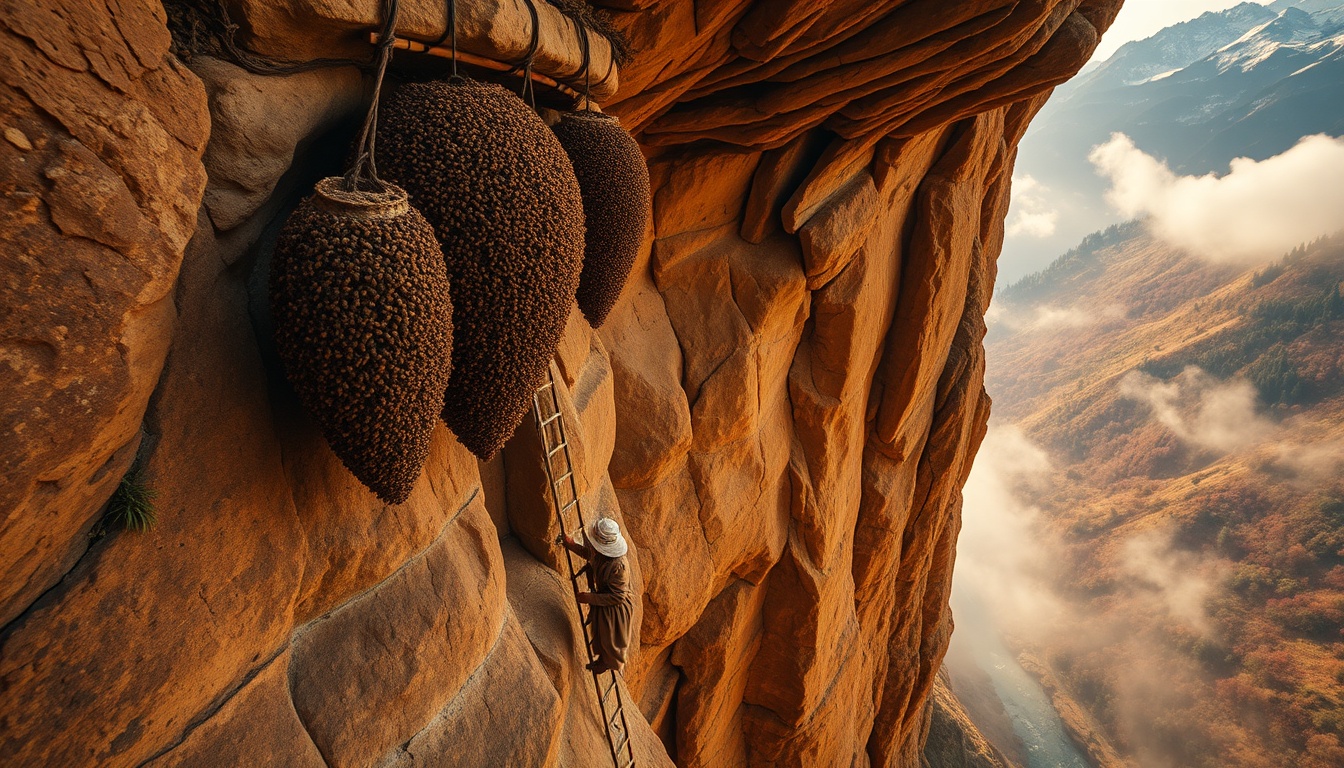
No honey in the world is produced under circumstances as dramatic as Himalayan cliff honey. The producer is Apis dorsata — the giant rock bee — which is not only the world's largest honeybee (workers average 17–20mm in length, roughly twice the size of a Western honeybee) but also one of the most formidable. Apis dorsata colonies do not use enclosed cavities; they build single open-comb structures — flat, roughly oval combs up to two metres in width — suspended from cliff overhangs, rock ledges, and occasionally large tree branches at altitudes between 1,200 and 3,500 metres across the Himalayan foothills and mountain ranges of Nepal, the Indian states of Uttarakhand, Himachal Pradesh, and Sikkim, and into Bhutan.
The honey gatherers who harvest these combs — the Gurung community of the Nepal-India borderlands, documented by photographer Eric Valli in a celebrated 1988 National Geographic essay — represent one of the world's most vertically challenging food traditions. Using handwoven rope ladders and bamboo poles, they descend cliff faces dozens of metres above rocky river gorges to reach the hives, smoking the colonies with fire to drive the bees away before cutting and lowering sections of honeycomb. A single colony's comb may yield 20–30 kilograms of honey in a good season. The harvest occurs twice yearly — spring (March–May, coinciding with the rhododendron bloom) and autumn (October–November) — and the spring harvest, in particular, produces a honey that has earned global attention for reasons beyond its extraordinary origin story.
The spring Himalayan cliff honey from rhododendron-dominant zones has been documented to contain grayanotoxin — a naturally occurring cardiac glycoside produced by Rhododendron species including R. ponticum, R. luteum, and native Himalayan species. In sufficient quantities, grayanotoxin causes "deli bal" (mad honey) intoxication: dizziness, nausea, bradycardia, and hypotension. This is the same phenomenon responsible for the historic "mad honey" of Black Sea Turkey (documented by Xenophon in 401 BCE). Himalayan mad honey has been reported in case literature from Nepal (Gunduz A et al., 2011, Clinical Toxicology) and is sold as a psychoactive substance in small quantities to specialty buyers in Asia and Europe. However: the grayanotoxin content of any specific batch depends heavily on the proportion of rhododendron nectar in that season's forage. Much Himalayan cliff honey — particularly from autumn harvests or from regions with mixed botanical composition — contains no detectable grayanotoxin and causes no adverse effects. Vendors marketing "mad honey" for its intoxicating properties are selling a specific botanical product with known pharmacological risks, not a standard food; its consumption requires informed risk assessment and is not recommended in quantity. Most Himalayan wild honey sold commercially in India is not from rhododendron-dominant zones and does not carry significant grayanotoxin risk.
For buyers: authentic Himalayan cliff honey is dark amber to near-black in color, with an intensely complex wild flavor — floral, slightly bitter, earthy, and powerfully aromatic. It is sold primarily in small quantities through Indian specialty honey producers and artisan food importers, often at significant premiums (for authentic wild-harvested product). The extraordinary effort involved in harvesting, the logistical complexity of reaching cliff sites, and the seasonal availability genuinely justify the price premium on quality product.
Get the Honey Buyer's Cheat Sheet (free PDF)
16 varieties on one page — color, flavor, best use and what a fair price looks like — from the 304 honeys we track.
Sundarbans Wild Honey: The Mangrove Forest Harvest
The Sundarbans — from the Bengali "Shundorbon," meaning "beautiful forest" — is the world's largest tidal mangrove delta, spreading across approximately 10,000 square kilometres at the mouth of the Ganges, Brahmaputra, and Meghna river systems on the Bay of Bengal. Shared between India (West Bengal) and Bangladesh, and listed as a UNESCO World Heritage Site, the Sundarbans is among the most biodiverse coastal ecosystems on Earth — and one of the few places in the world where Apis dorsata maintains such large wild populations in a non-Himalayan landscape.
Honey collection in the Indian Sundarbans is conducted exclusively during the designated season (typically April and May, during peak sundarban flower bloom) by licensed honey gatherers called Moulis, who operate in groups, travelling by country boat through the labyrinthine tidal channels. The harvest is extraordinarily dangerous: the Sundarbans is the last large population of Bengal tigers (Panthera tigris tigris) in the world, and tiger attacks on honey gatherers are a documented and ongoing risk. Moulis traditionally wear masks on the back of their heads — tigers apparently prefer to attack from behind — and are believed to have the protection of Bonobibi, the forest goddess of the Sundarbans, before entering the forest. This combination of ecological, cultural, and human-risk factors makes Sundarbans wild honey one of the most contextually extraordinary food products on Earth.
The honey itself reflects its complex botanical environment. Sundarbans honey is produced primarily from Apis dorsata foraging on the blossoms of sundari trees (Heritiera fomes, after which the forest takes its name), goran (Ceriops decandra), gewa (Excoecaria agallocha), and numerous other mangrove and estuarine flowering plants. The resulting honey is typically dark amber to medium amber, with a complex, slightly mineral, and distinctly coastal character — more earthy and deep than most commercial honeys, with floral notes from the mangrove blossoms and occasional sea-salt undertones from the tidal environment. Crystallization is slow. Sundarbans honey has been studied for its antibacterial properties, which are above average for a non-medicinal commercial honey, attributable in part to the phenolic diversity of the mangrove flora. The West Bengal Forest Department regulates the seasonal harvest and issues quotas; authentic Sundarbans honey carries documentation from the Forest Department and the Honey Gatherers' Cooperative Society. Price in India: for authentic seasonal Sundarbans honey from verifiable cooperatives.
India's Major Honey Varieties at a Glance
Beyond the two iconic wild-harvest varieties, India produces a remarkable portfolio of domesticated and semi-wild honey varieties from Apis cerana indica and introduced Apis mellifera. These are the most important for buyers and food professionals:
- Kashmir Wildflower Honey — Jammu & Kashmir / Ladakh. India's most prestigious highland honey, produced from the extraordinarily rich alpine meadows and valley floors of the Kashmir Valley (elevation 1,600–1,800m), Gulmarg (2,650m), and the Zanskar highlands of Ladakh. Apis cerana indica dominates traditional Kashmiri beekeeping; introduced Apis mellifera hives are increasingly common in commercial operations. Kashmir's botanical wealth — white clover (Trifolium repens), alfalfa (Medicago sativa), apple blossom (the Valley's famous apple orchards), phacelia, borage, and dozens of alpine wildflower species — creates a complex, multi-floral nectar environment during the brief but intense highland summer. Color: pale to medium gold, water-white to warm amber depending on season and altitude. Aroma: delicate and multi-floral — mild floral sweetness with gentle alpine herbaceous notes; clean, fresh, refined. Flavor: smooth and subtly complex — gentle floral sweetness, very clean finish, mild herbal notes at higher altitudes; distinctly refined compared to plains honey varieties. Crystallization: medium to slow. Traditional Kashmiri honey is marketed under the GI tag "Kashmir Honey" (registered under India's Geographical Indications of Goods Act). Price: for verified single-origin Kashmir honey. Best: green tea, chamomile, yogurt, mild cheeses; any application where a refined, pale, multi-floral honey is preferred.
- Bihar Litchi (Lychee) Honey — Muzaffarpur / Vaishali / Samastipur districts, Bihar. One of the world's finest monofloral honey varietals, produced from the blossoms of the lychee (Litchi chinensis) orchards of Bihar's Muzaffarpur district — India's lychee capital, which produces over 70% of the country's total lychee crop. The litchi bloom occurs in February–March, a brief 3–4 week window when millions of trees in the Muzaffarpur-Vaishali-Samastipur belt erupt simultaneously in dense clusters of small white flowers, producing one of the most intense and reliable nectar flows in Indian beekeeping. Both Apis cerana indica and Apis mellifera are used; in recent years, commercial operators have moved predominantly to Apis mellifera for yield. Color: pale gold to very pale amber — notably light, sometimes nearly transparent at harvest. Aroma: the most distinctive characteristic — a fresh, clean sweetness with an unmistakable floral perfume that recalls the lychee fruit itself; slightly musky-floral, honey-sweet but with a distinctive tropical-fruity top note unlike any other honey varietal. Flavor: smooth, moderately sweet, with a delicate floral depth and a subtle fruity note that experienced tasters immediately associate with fresh lychee fruit; clean finish with no bitterness. Crystallization: medium-slow, forming a fine-grained golden cream. A 2014 study by Vinas et al. in Food Chemistry on Indian honey characterization identified litchi honey's distinctive polyphenol fingerprint — particularly kaempferol, quercetin, and their glycoside derivatives — as authentication markers consistent with its botanical origin. Bihar litchi honey is exported primarily to Europe, the Middle East, and Southeast Asia. Certified raw or cold-extracted jars are sold at a higher shelf price than blended jars of the same floral source. Best: yogurt, fresh cheese, tropical fruit desserts; green tea and jasmine tea; light pastry and morning applications.
- Rajasthan Ajwain (Carom) Honey — Rajasthan / Gujarat / Punjab. One of India's most uniquely distinctive monofloral honeys — a varietal that exists nowhere else in the world — produced from the blossoms of ajwain, or carom (Trachyspermum ammi), a small annual herb in the Apiaceae family cultivated across the arid plains of Rajasthan, Gujarat, and parts of Punjab and Haryana. Ajwain is one of India's most important culinary spices — its seeds are intensely pungent, with a thymol-dominant essential oil profile that gives them a sharp, medicinal-herbal character. The flowers, smaller and more delicate than the seeds suggest, produce significant quantities of nectar during the crop's spring bloom (February–March). Color: golden amber to dark amber, often with a reddish-brown hue. Aroma: immediately distinctive and unmistakably Indian — a warm, slightly pungent, herbal-spiced sweetness with thymol overtones from the plant's aromatic oils; complex and assertive; unlike any European or temperate monofloral honey. Flavor: bold and characterful — moderate sweetness up front, then a warm, slightly sharp herbal mid-palate depth; the thymol character is present but not dominant in good-quality ajwain honey, serving as a warming note rather than an overwhelming flavor; distinctive, satisfying, long finish with lingering herbal warmth. Crystallization: medium, forming a coarse golden paste. In traditional Ayurvedic practice, ajwain honey is used for respiratory complaints, digestive support, and as a carrier medium for herbal preparations — reflecting the overlap between ajwain's documented pharmacological properties (thymol is a recognized antiseptic) and honey's own properties. Price: for single-origin ajwain honey. Best: strong Indian chai; dark breads; robust meat marinades (particularly for lamb and chicken in North Indian cuisine); experimental cheese pairings with aged varieties; anywhere that a bold, characterful honey is desired as a featured ingredient.
- Rajasthan / Haryana Sidr / Beri Honey — from Ziziphus mauritiana (Indian jujube). The Indian equivalent of the revered Yemeni sidr honey, produced from the blossoms of the Indian jujube (Ziziphus mauritiana, called "ber" in Hindi — not to be confused with Ziziphus spina-christi, the Levantine Christ's thorn jujube of Yemen and the Arabian Peninsula). Indian sidr honey is produced primarily in Rajasthan's Thar Desert margins, Haryana, and parts of Madhya Pradesh, where Z. mauritiana grows as a semi-wild scrub tree and in agricultural hedgerows. The bloom occurs in autumn (October–November). Color: medium to dark amber, with characteristic warm golden-brown hues. Aroma: rich and complex — sweet, floral-fruity, slightly nutty depth reminiscent of the jujube fruit; less mineral than the Yemeni equivalent but similarly multi-layered. Flavor: smooth, moderately sweet, with a characteristic fruity-floral depth from the jujube blossom nectar; good length and complexity for an Indian commercial variety; more complex than plain wildflower honey, distinct botanical character. Crystallization: medium. Indian sidr/beri honey is positioned as a premium variety in the domestic market, particularly for buyers familiar with the Yemeni and Pakistani sidr tradition. Price. Best: traditional Ayurvedic preparations; desserts; warm drinks; wherever the Yemeni sidr honey's depth of character is desired at a more accessible price point. Compare with our dedicated Sidr Honey Benefits guide for full coverage of the international sidr tradition.
- Punjab / Haryana Mustard Honey — from Brassica juncea (Indian mustard) and B. napus (rapeseed). India's fastest-crystallizing commercial honey — a point of distinction that most buyers initially view as a defect but experienced honey users recognize as a quality marker of monofloral purity. Mustard (primarily Brassica juncea, also called "Indian mustard" or "brown mustard," plus B. napus/rapa rapeseed) is one of India's dominant rabi (winter-sown) crops, covering vast acreages across Punjab, Haryana, Rajasthan, and Uttar Pradesh. The winter bloom (December–February) produces a massive, reliable nectar flow. Color at harvest: pale golden — very light, almost translucent. After crystallization (which occurs within days to 2 weeks of extraction in warm conditions): creamy white to pale cream, with a fine, uniform grain. Aroma: mild, clean, slightly brassica-herbal. Flavor: smooth and mild — gentle sweetness, very clean, no dominant floral character; pleasant, neutral, slightly creamy in texture when crystallized. The rapid granulation of mustard honey is caused by its extremely high glucose content relative to fructose — the reverse of the ratio that keeps acacia honey liquid. This produces the fastest natural crystallization of any major honey varietal. Creamed mustard honey (controlled crystallization process) has a spreadable, buttery consistency that makes it highly practical for table use. Price: — one of India's most affordable premium honey varieties. Best: spreading on roti, paratha, or toast; cooking and baking where a mild, neutral honey base is preferred; everyday table use.
- Northeast India Forest Honey (Apis cerana / Apis dorsata) — Assam, Meghalaya, Manipur, Mizoram. A category of diverse, complex wild and semi-wild forest honeys from India's extraordinarily biodiverse northeastern states, which include some of the highest-rainfall areas on Earth (Cherrapunji, Meghalaya holds rainfall world records) and support tropical and subtropical forest ecosystems of exceptional botanical diversity. Wild Apis dorsata honey from the Brahmaputra valley, semi-wild Apis cerana honey from Khasi Hills bamboo-forest communities, stingless bee (Tetragonula laeviceps and allied species) honey from traditional Mizo bamboo-tube hives — all represent genuine artisan products from underexplored sourcing regions. Color: highly variable, from pale gold (spring bloom) to dark amber (monsoon and post-monsoon forest honey). Flavor: generally complex, multi-floral, earthy, with significant botanical character from the diverse forest flora. Availability: limited to specialty Indian honey producers and artisan importers. Price: for authenticated wild-harvest Northeast forest honey.
- Nilgiri (Blue Hills) Multiflora Honey — Tamil Nadu / Kerala borderlands. Produced from the extraordinarily diverse botanical environment of the Nilgiri Biosphere Reserve — India's first UNESCO Biosphere Reserve — at elevations between 1,500 and 2,600 metres in the Western Ghats. The Nilgiris support an unusual convergence of subtropical highland flora including native Nilgiri tea gardens, shola forests (stunted high-altitude forests endemic to the Western Ghats), and grasslands supporting hundreds of endemic plant species. Honey from the Badaga community beekeepers and Tamil Nadu's Forest Department apiaries reflects this botanical wealth. Color: medium amber. Flavor: complex, slightly astringent, floral-herbal with tea garden notes. Crystallization: medium. A genuine regional terroir honey with significant botanical uniqueness. Price.
The Science: Research on Indian Honey
Indian honey has been the subject of growing academic interest, driven by the country's extraordinary botanical and apicultural diversity. Several findings are well-supported in peer-reviewed literature:
Grayanotoxin in Himalayan spring honey: The presence of grayanotoxin I and III (also called andromedotoxin) in spring Himalayan honey collected from Apis dorsata colonies foraging on Rhododendron species is documented in regional toxicology case reports and pharmacological literature. Gunduz A, Turedi S, Russell RM, and Ayaz FA's 2011 review in Clinical Toxicology (Philadelphia) provides a comprehensive overview of grayanotoxin poisoning from "mad honey" across cultural contexts, including Nepal and northeastern India. The mechanism — binding to voltage-gated sodium channels in cardiac muscle, causing bradycardia and hypotension — is well-characterized. Importantly, the pharmacological effect is dose-dependent; small quantities (a tablespoon or less) of typical Himalayan honey rarely cause significant symptoms, and most Himalayan honey does not contain measurable grayanotoxin.
Litchi honey phytochemical profile: A 2014 characterization study published in Food Chemistry examined Indian monofloral honeys including litchi variety and identified distinctive polyphenol fingerprints — kaempferol-3-glucoside, quercetin-3-glucoside, and their derivatives — as botanical markers of litchi origin. This work contributes to authentication methodologies that are increasingly important as India's honey export market faces quality-assurance scrutiny. Subsequent pollen analysis work by Indian Council of Agricultural Research (ICAR) institutions has established melissopalynological reference data for major Indian monofloral honeys, enabling country-of-origin and botanical-source authentication for export markets.
Antibacterial properties of Sundarbans and Northeast forest honeys: Multiple studies from Indian academic institutions — including work from University of Calcutta and the Zoological Survey of India — have examined the antimicrobial activity of wild Apis dorsata honeys from the Sundarbans and Assam. These honeys typically show above-average minimum inhibitory concentrations (MIC) against common wound pathogens including Staphylococcus aureus and E. coli in disc diffusion assays, consistent with their high polyphenol content from diverse forest botanical sources. These are in-vitro findings and do not constitute clinical treatment evidence.
FSSAI honey quality standards and export issues: India's Food Safety and Standards Authority of India (FSSAI) revised its honey standards in 2020, including stricter requirements on adulteration detection (Nuclear Magnetic Resonance/NMR testing for rice syrup adulteration — a known industry issue) and antibiotic residue limits. The Indian honey export industry faced significant EU market access challenges in the 2010s due to documented antibiotic residues (particularly chloramphenicol and tetracyclines) in commercial Indian honey bound for European markets. The EU import ban, enforced between 2010 and 2014, prompted significant industry reform. Buyers sourcing Indian honey for health-conscious markets should look for producers who provide third-party lab testing documentation for antibiotic residues, NMR authenticity testing, and clear botanical-source documentation. Small-batch artisan Indian honey producers — particularly those supplying verified wild-harvest or organic-certified product — are generally not implicated in the adulteration issues that affected bulk commercial export honey.
Important general disclaimer: All health-related statements in this guide describe chemical properties, nutritional characteristics, or summarize peer-reviewed research findings. Nothing in this guide constitutes medical advice or implies that consuming Indian honey treats, cures, or prevents any disease. Honey of any type must not be given to children under 12 months due to risk of infant botulism. Himalayan spring honey with grayanotoxin content should be treated as a pharmacologically active substance and consumed only in small quantities by healthy adults who understand the risk. People with diabetes should monitor consumption of any honey variety as all honeys are primarily sugars.
Quick Comparison: Major Indian Honey Varieties
The following comparison covers the defining characteristics of India's most distinctive honey varieties:
- Himalayan Wild Cliff Honey — Color: dark amber to near-black | Source: Wild Apis dorsata (world's largest bee) | Crystallization: slow | Flavor: intensely complex, earthy, wild, slightly bitter | Region: Uttarakhand, Himachal Pradesh, Sikkim, Nepal border | Special note: spring harvest may contain grayanotoxin (rhododendron mad honey) — check provenance | Price: ₹₹₹₹
- Sundarbans Mangrove Honey — Color: medium to dark amber | Source: Wild Apis dorsata / cerana | Crystallization: slow | Flavor: complex, earthy, slightly mineral, coastal depth | Region: West Bengal Sundarbans (UNESCO World Heritage) | Special note: seasonal harvest, licensed Mouli collectors | Price: ₹₹₹
- Kashmir Wildflower Honey — Color: pale to medium gold | Source: Apis cerana / mellifera on alpine meadow flora | Crystallization: medium-slow | Flavor: delicate, clean, subtly multi-floral | Region: Kashmir Valley, Gulmarg, Ladakh | GI tag: Kashmir Honey | Price: ₹₹₹
- Bihar Litchi (Lychee) Honey — Color: very pale gold, near-transparent | Source: Apis cerana / mellifera on litchi blossoms | Crystallization: medium-slow | Flavor: smooth, delicately fruity-floral, fresh lychee perfume | Region: Muzaffarpur, Vaishali, Bihar | Export: Europe, Middle East, Southeast Asia | Price: ₹₹
- Rajasthan Ajwain (Carom) Honey — Color: golden to dark amber | Source: Apis mellifera on Trachyspermum ammi | Crystallization: medium | Flavor: warm, slightly pungent, herbal-spiced depth, thymol note | Region: Rajasthan, Gujarat | Uniqueness: only available from India | Price: ₹₹
- Sidr / Beri Honey — Color: medium to dark amber | Source: Apis mellifera on Ziziphus mauritiana | Crystallization: medium | Flavor: fruity-floral, nutty depth, complex | Region: Rajasthan, Haryana | Related: Yemeni sidr tradition | Price: ₹₹₹
- Mustard Honey — Color: pale cream when crystallized | Source: Apis mellifera on Brassica spp. | Crystallization: days to 2 weeks (fastest Indian honey) | Flavor: mild, clean, slightly creamy | Region: Punjab, Haryana, Rajasthan | Best as: creamed/spreadable | Price: ₹
- Nilgiri Blue Hills Multiflora — Color: medium amber | Source: Apis cerana / mellifera on Western Ghats shola flora | Crystallization: medium | Flavor: complex, slightly astringent, floral-herbal with tea notes | Region: Tamil Nadu/Kerala Nilgiri Biosphere Reserve | Price: ₹₹₹
How to Buy Authentic Indian Honey
The Indian honey market presents both extraordinary opportunity and specific quality risks. Here's what to look for:
Prioritize verified artisan and cooperative producers over bulk commercial honey. India's documented adulteration issues — primarily rice syrup adulteration in commercial honey and antibiotic residues in export-bound bulk honey — are concentrated in the industrial-commercial segment of the market. Small-batch artisan producers, tribal cooperative societies (particularly for Sundarbans and Northeast forest honey), and certified organic producers operate under significantly tighter quality controls and generally produce genuine, unadulterated honey.
Request laboratory testing documentation for high-value purchases. For Himalayan wild honey, Sundarbans honey, and premium monofloral varieties, reputable sellers can provide: (1) NMR (Nuclear Magnetic Resonance) analysis confirming the absence of added syrups — the most reliable adulteration detection method; (2) antibiotic residue testing (chloramphenicol, tetracycline, streptomycin); (3) melissopalynological (pollen analysis) report confirming botanical source and geographic origin. These tests are conducted by FSSAI-accredited laboratories and are standard practice among premium Indian honey exporters.
For Himalayan cliff honey: ask specifically about harvest season and botanical provenance. Spring harvest (March–May) from rhododendron-dominant zones carries grayanotoxin risk; autumn harvest (October–November) from mixed or non-rhododendron botanical zones is generally clear. Reputable sellers of Himalayan honey will be transparent about this. Any seller claiming that all Himalayan honey is psychoactive "mad honey" for marketing purposes is misrepresenting a genuinely variable and region-dependent phenomenon.
For Sundarbans honey: look for documentation from licensed Mouli collectors or the Honey Gatherers' Cooperative Society. The West Bengal Forest Department issues seasonal collection permits; authentic Sundarbans honey producers can trace their sourcing to licensed gatherers.
GI-tagged varieties (Kashmir Honey) carry official authentication from India's Geographical Indications Registry, managed under the Geographical Indications of Goods (Registration and Protection) Act, 1999. The GI tag means the product was produced in the designated geographic area using specified methods — it is a meaningful quality and provenance marker.
Beware of vague marketing around health claims, particularly for Himalayan honey marketed as having medicinal or psychoactive properties. All honey has nutritional properties; the specific antibacterial and biochemical properties of individual Indian varieties are described above with appropriate research citations. No Indian honey variety (including wild Himalayan honey) has been shown in clinical trials to treat any specific medical condition. Any seller making specific medical claims for raw Indian honey (beyond general nutritional properties) should be viewed with scepticism.
Indian Honey in the Kitchen: Pairing and Culinary Tradition
India has one of the world's oldest documented traditions of culinary and medicinal honey use — the Sanskrit term "madhuparka" (honey preparation) appears in the Rigveda, dating to approximately 1500–1200 BCE — but the culinary applications of distinct honey varietals are less formalized in Indian food culture than in, for example, French or Italian cheese-and-honey pairing tradition. Instead, honey in Indian cooking is used across a wide range of applications reflecting its dual identity as both a sweetener and a traditional medicine ingredient (particularly in Ayurveda).
Kashmir wildflower honey pairs exceptionally well with Kashmiri kahwa (saffron green tea) and noon chai (pink tea). Its delicate floral sweetness complements without overwhelming the complex spiced tea character. Kashmiri wazwan (the elaborate multicourse wedding feast) traditionally includes honey in some dessert preparations.
Bihar litchi honey is particularly striking when paired with fresh paneer (Indian cottage cheese) — the delicate lychee-floral perfume of the honey complements the mild dairy character in a way that echoes the French fresh-chèvre-with-acacia-honey tradition but with a distinctly tropical-South Asian sensory profile. It also works beautifully drizzled over kulfi (Indian ice cream) or mithai with fresh fruit.
Ajwain honey's bold, thymol-spiced character makes it a natural pairing for robust Indian breads — parathas, especially ajwain-flavored parathas; missi roti; and dark multigrain breads. Its herbal warmth complements aged hard cheeses (particularly aged Cheddar-style cheeses) in adventurous international pairing contexts. It is also used in Ayurvedic preparations for respiratory support, where its botanical properties align with ajwain's traditional uses.
Himalayan wild honey (non-grayanotoxin autumn harvest) is powerful enough to stand alongside India's bolder desserts — halwa, kheer, and milk-based sweets — as well as aged Manchego or Comté-style cheeses. Its earthy, complex character also lends depth to meat marinades for lamb and goat, traditional throughout the Himalayan hill cuisine of Uttarakhand and Himachal Pradesh.
Mustard honey (creamed) is India's most practical everyday table honey — spread on warm paratha or roti, used in marinades, drizzled over yogurt. Its rapid crystallization makes it less suitable for liquid applications unless gently warmed, but as a spreadable honey it is one of the world's best values: mild, clean, food-friendly, and produced in abundance from India's most important oilseed crop.