Why Greek Honey Has Been Prized Since Antiquity
Greece consumes more honey per person than any other country in Europe — roughly 1.5 to 1.7 kilograms per capita annually, nearly three times the EU average. That is not coincidence or marketing. It reflects a 3,000-year relationship between the Greek landscape and the honeybee, a tradition that Aristotle studied, that Pliny the Elder praised, and that modern food scientists are now analyzing in peer-reviewed journals.
Greek honey is among the most chemically complex in the world, for reasons that come down to geography and ecology. The Mediterranean climate — hot, dry summers alternating with mild, wet winters — produces intense aromatic plants: thyme, oregano, sage, lavender, chestnut, cistus, and hundreds of wild herbs that grow across a terrain covering more than 6,000 islands and a mainland stretching from subtropical coastal plains to alpine mountain zones above 2,000 meters. Greek bees, drawing from this botanical diversity, produce honeys with significantly higher polyphenol and antioxidant levels than most Northern European or North American equivalents.
Greece produces approximately 16,000 to 25,000 metric tons of honey annually and is the EU's third-largest producer. Unusually for a major honey nation, roughly 65 percent of that production is pine honeydew honey — not from flowers at all, but from tree resin excreted by a scale insect (Marchalina hellenica) that lives only on Greek, Turkish, and some Southern Balkan pine forests. This makes Greece the world's leading producer of pine honeydew honey, a varietal almost unknown outside the Mediterranean but deeply embedded in local culture. This guide covers all the major Greek varieties, the regions that define them, and what to look for when buying authentic product. For comparison with other premium international honeys, see our guides to Sidr honey, Waldhonig, Manuka, and Jarrah.
What Makes Greek Honey Exceptional: Climate, Flora, and Tradition
Three factors converge to make Greece an unusually productive honey environment. The first is floral biodiversity: the Greek flora is estimated at 5,500–6,000 plant species, around 1,500 of which are endemic (found nowhere else on earth). Many of these are aromatic lamiaceae — the mint family — including wild thyme (Thymus capitatus, also called Coridothymus capitatus or Greek thyme), oregano (Origanum vulgare and O. onites), sage, savory, and dozens of others. These plants are distributed across the rocky, exposed Greek landscape in dense stands that produce nectar intensely concentrated by sun and heat.
The second factor is climate. Mediterranean summers are long, hot, and rainless, which concentrates the sugars and aromatic volatiles in both nectar and resulting honey. Studies comparing thyme honey from different Mediterranean regions consistently find Greek thyme honey among the highest in total phenolic content and DPPH radical scavenging activity — a measure of antioxidant capacity. Research published in the journal Food Chemistry has found Greek thyme honey DPPH values averaging 30–60 percent higher than clover honey, with some Cretan samples exceeding the antioxidant activity of dark buckwheat honey from the United States.
The third factor is tradition. Greek beekeeping practices — keeping locally adapted Apis mellifera macedonica (the Greek strain of the Western honeybee), conducting transhumance (seasonal migration of hives from coastal lowlands to mountain meadows), and harvesting in small batches — have been maintained for generations. Many Greek beekeepers still practice minimal processing: cold extraction, no heating above ambient temperature, no filtration beyond coarse straining. The result is a genuinely raw honey with intact pollen, enzymes, and wax particles that modern Western processing often destroys.
Get the Honey Buyer's Cheat Sheet (free PDF)
16 varieties on one page — color, flavor, best use and what a fair price looks like — from the 304 honeys we track.
The 7 Major Greek Honey Varieties
While Greece produces dozens of regional and microclimate-specific honeys, seven varietals dominate the market and represent the breadth of Greek honey culture.
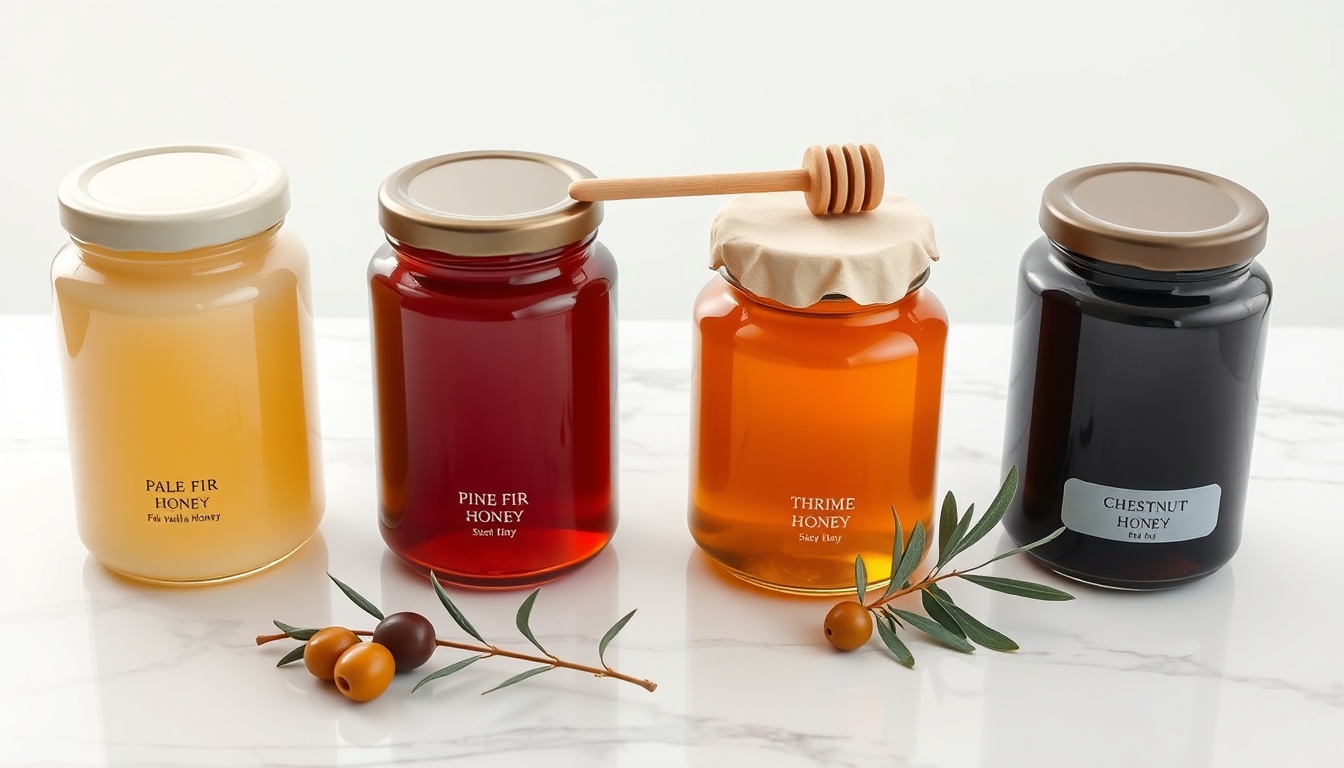
- Thyme Honey (Θυμαρίσιο μέλι / Thymari) — The flagship of Greek honey. Produced from Coridothymus capitatus (Greek/Spanish thyme), which blooms in June and July across rocky, exposed slopes throughout the islands and Peloponnese. Color: amber to dark amber, often with a reddish-golden tone. Aroma: intensely aromatic — herbal, floral, slightly medicinal, unmistakably thyme-forward. Taste: complex and assertive — sweet with pronounced herbal bitterness from thymol and carvacrol, plus floral undertones, notes of dried herbs and warm stone. Crystallization: slow to medium, forms a firm fine-grained crystal. Greek thyme honey shares antimicrobial characteristics with New Zealand Manuka honey, though achieving this through different chemical pathways — thymol and carvacrol compounds versus Manuka's unique methylglyoxal (MGO) system. For comparison with other aromatic Mediterranean varieties, Spanish rosemary honey offers similar herbal intensity but with mint-family cooling versus thyme's warming phenolic bite. Research: a 2013 study in the International Journal of Food Microbiology found Greek thyme honey inhibited growth of 8 tested foodborne pathogens, attributing activity to both hydrogen peroxide and high phenolic compounds. Best use: eaten by the spoon, paired with salty feta or aged graviera cheese, drizzled over yogurt, used in marinades for lamb and chicken. Buy a jar that names the place if the label claims thyme.
- Pine Honey (Πεύκη / Meli Pefkis) — Constitutes approximately 65 percent of all Greek honey production, making it the nation's defining varietal. Unlike blossom honeys, pine honey is a honeydew honey: bees collect the sweet excretions of Marchalina hellenica, a scale insect that feeds on sap inside Greek and Turkish pine trees (mainly Pinus brutia, the Turkish pine, and Pinus halepensis, the Aleppo pine). The insect concentrates plant sugars and minerals, producing a thick, mineral-rich exudate that bees collect and convert to honey. Color: dark amber to reddish-brown, often with greenish undertones when fresh. Aroma: resinous, slightly piney, mineral, less floral than blossom honeys — distinctive and complex. Taste: deeply mineral and complex with low sweetness, pine resin notes, mild bitterness, and a savory umami quality unusual in honey. Greek pine honey shares honeydew characteristics with German forest honey, though German Waldhonig typically comes from spruce and fir aphid secretions in temperate Black Forest conditions, creating more subdued resinous character compared to Greek pine's intense Mediterranean mineral concentration and distinctive Marchalina hellenica chemistry. Crystallization: very slow — the high mineral content and oligosaccharide composition inhibit crystal formation. Many pine honeys remain liquid for 2–3 years at room temperature. Nutrition: pine honey has significantly higher mineral content than blossom honeys, particularly potassium, magnesium, and trace elements from the tree sap. Research: a 2014 study in the Journal of the Science of Food and Agriculture found Greek pine honey had comparable antioxidant activity to dark blossom honeys and substantially higher mineral content. Best use: spoon honey, cheese pairings (particularly hard mountain cheeses), used medicinally in folk tradition for respiratory conditions (no clinical trials; use with appropriate caution), and as a sweetener in herbal teas. Price: for quality product.
- Fir / Vanilla Honey (Μέλι Βανίλια / Ελατόμελο) — One of Greece's most prized and rarest honeys, produced primarily in the Mainalo Mountains of the Peloponnese and the White Mountains (Lefka Ori) of Crete. Like pine honey, it is a honeydew variety — produced from exudates of insects on silver fir (Abies cephalonica, Greek fir, or Abies alba). Granted Protected Designation of Origin (PDO) status as "Meli Vanilias Kritis" (Vanilla Honey of Crete). Color: remarkably pale — creamy white to very light golden, almost white — which is visually unusual for a honeydew honey and the source of its "vanilla" name. Aroma: gentle, slightly woody, vanilla-like, with a distinctive resinous sweetness unlike any other Greek variety. Taste: smooth, delicately sweet, subtly woody and resinous, with no bitterness — perhaps the most approachable of the dark/complex Greek varieties. Crystallization: very slow, remains liquid for years. Production: extremely limited — fir forests cover a small fraction of Greek mountain terrain, and the specific insect populations depend on annual conditions. Best use: premium table honey, gifting, pairing with mild cheeses (ricotta, anthotypi), eaten pure to appreciate its unusual character. Price: for authentic PDO-certified product.
- Hymettus Thyme Honey (Μέλι Υμηττός) — A regional designation within thyme honey, from Mount Hymettus (Ύμηττος) — the limestone mountain range immediately southeast of Athens, rising to 1,026 meters. Hymettus honey has been recorded in literature since at least the 5th century BCE. Aristotle, in his Historia Animalium, described bees of Mount Hymettus as particularly industrious and their honey as exceptionally fine. Theophrastus, Virgil, Pliny the Elder, Horace, and Ovid all mention Hymettus honey as the finest in the ancient world. Historically, its exceptional quality was attributed to the dense carpets of wild thyme, oregano, rosemary, and sage that grow on Hymettus's rocky slopes. Color: pale to medium amber, golden. Aroma: highly aromatic, thyme-forward with floral complexity from the polyfloral input of Athens's surrounding hills. Taste: classic thyme character but with additional complexity from the diverse Mount Hymettus flora — wildflowers, sage, and cistus contribute layers absent in pure-island thyme honeys. Provenance: because Hymettus honey is a premium designation, labeling fraud exists — see the buying guide section below for how to verify authenticity. Price: for verified provenance product.
- Chestnut Honey (Μέλι Καστανιάς / Kastanomelo) — Produced from chestnut tree (Castanea sativa) blossom in June and July in the mountain forests of Epirus, Macedonia, and Pelion. An assertive, complex honey that challenges and divides tasters. Color: very dark amber to near-black, sometimes with reddish tones. Aroma: bold, tannic, woody, slightly astringent — reminiscent of dark roasted coffee or dark chocolate. Taste: pronouncedly bitter and tannin-rich with complex earthy undertones; low perceived sweetness relative to actual sugar content; long, drying finish. Greek chestnut honey shares intense dark complexity with New York buckwheat honey, though achieving this through different botanical chemistry — chestnut's tannin-rich tree blossom creating woody-astringent Mediterranean forest character versus buckwheat's molasses-like intensity from Fagopyrum grain flower enzymes enhanced by glacial till soil minerals impossible to replicate in limestone terroir. Crystallization: slow, may crystallize to a coarse-grained texture over time. Research: Greek chestnut honey has among the highest polyphenol content of any blossom honey tested in Mediterranean studies, with total phenolic content frequently exceeding 300 mg gallic acid equivalents per kg — placing it in the same range as buckwheat honey in antioxidant capacity. Best use: strongly paired foods — aged pecorino, gorgonzola, or kefalograviera; drizzled over dark bread; used as a complex sweetener in game marinades. Definitely an acquired taste — not recommended as a first Greek honey. Price.
- Heather Honey (Ερεικόμελο / Erikomelo) — Produced primarily in late August and September from Erica species (tree heather, E. arborea and E. manipuliflora) and Calluna vulgaris across higher mountain elevations in Epirus, Macedonia, and parts of Crete. Distinct from Scottish ling heather honey (also Calluna vulgaris) in flavor due to the warmer climate and different floral context. Color: amber with an orange-reddish hue, sometimes quite dark. Aroma: moderately herbal-floral with warm, woody notes and subtle smokiness. Taste: rich, warming, pleasantly bitter with a floral character; slightly less intense than Scottish heather honey; a savory warmth in the finish. Crystallization: medium speed, tends to produce a firm pasty texture due to high protein content from heather pollen. Best use: autumn teas, paired with strong hard cheeses, warm toasts with butter, used in baking where "dark honey" character is desired. Greek heather honey is less widely exported than thyme or pine, making it harder to find outside specialty shops. Price.
- Orange Blossom and Polyfloral Spring Honey (Ανθόμελο / Anthomelo) — Greece's spring honeys represent the floral bounty of the Mediterranean growing season (March–May) before the intense thyme bloom. These include single-variety orange blossom honey from citrus orchards in the Peloponnese, Crete, and Lesbos, and polyfloral spring honeys from the extraordinary diversity of spring-blooming plants. Orange blossom: pale golden, unmistakably citrus-floral aroma, clean bright sweetness, medium crystallization. Greek orange blossom honey shares Citrus aurantium nectar characteristics with Florida orange blossom honey, though Greek Mediterranean limestone terroir creates more complex mineral undertones and concentrated aromatics versus Florida's sandy coastal soil conditions producing cleaner, brighter citrus expression with year-round bloom concentration. Polyfloral spring: varies widely by region and year; often golden-amber with a complex bouquet of citrus, wildflowers, rosemary, and fruit blossom. These are the most accessible Greek honeys — milder, sweeter, and less confronting than pine or chestnut — and a good entry point for exploring Greek honey. They represent what global honey buyers typically expect: a refined, floral, aromatic honey that excels in cooking, baking, and everyday use. Price: for genuine Greek polyfloral spring honey.
Quick Comparison: Greek Honey Varieties at a Glance
The following table summarizes the key characteristics of the seven main Greek honey varieties to help with selection:
- Thyme — Color: amber/dark gold | Crystallization: medium-slow | Flavor intensity: bold | Best for: cheese pairing, spoon honey, marinades | Price: $$$ | Availability: widely exported
- Pine (Pefkis) — Color: dark amber/reddish | Crystallization: very slow | Flavor intensity: complex/mineral | Best for: medicinal tradition, table honey, tea | Price: $$ | Availability: widely exported
- Fir (Vanilla/Elatomelo) — Color: cream to pale gold | Crystallization: very slow | Flavor intensity: delicate/woody | Best for: gifting, fine cheese, tasting pure | Price: $$$$ | Availability: rare outside Greece
- Hymettus Thyme — Color: golden amber | Crystallization: medium-slow | Flavor intensity: bold, complex | Best for: premium gifting, pure eating | Price: $$$$ | Availability: specialty importers
- Chestnut — Color: near-black/dark amber | Crystallization: slow-medium | Flavor intensity: very bold, bitter | Best for: strong cheese, dark bread, game | Price: $$ | Availability: moderate export
- Heather — Color: amber-orange | Crystallization: medium, paste-like | Flavor intensity: rich, herbal | Best for: autumn use, tea, baking | Price: $$-$$$ | Availability: limited export
- Orange Blossom/Polyfloral — Color: pale to medium gold | Crystallization: medium | Flavor intensity: mild to moderate | Best for: everyday use, baking, gifting | Price: $ | Availability: common
Mount Hymettus: The World's Most Famous Honey Mountain
No discussion of Greek honey is complete without Mount Hymettus. Rising from the eastern suburbs of Athens, this 1,026-meter limestone massif has been associated with exceptional honey for at least 2,500 years — making it perhaps the world's oldest documented honey origin story.
In the 4th century BCE, Aristotle described Hymettus bees as uniquely industrious and "more thrifty" than bees of other regions, their honey as "white and thick." Theophrastus identified the dense thyme, rosemary, and sage of Hymettus as the source of its quality. Pliny the Elder, writing in 77 CE, ranked Hymettus honey first among all known varieties, above those of Pontus, Hybla (Sicily), and Corsica. The Roman poets Horace, Ovid, and Virgil used "Hymettus honey" as shorthand for supreme quality — Horace writing that "Hymettian honey surpasses the comb" (Epistles 1.7).
The mountain's honey quality comes from several convergent factors: its exposed limestone slopes support dense populations of Coridothymus capitatus (Greek thyme) at the optimal 400-900 meter altitude band; the proximity to the sea moderates temperature and creates morning mists that support nectar production; and the rocky, nutrient-poor soil encourages thyme to produce concentrated aromatic oils as a defense mechanism, making nectar particularly rich in thymol and phenolic volatiles that transfer into the honey. Athens's heat also concentrates the nectar before bees collect it.
Today, Mount Hymettus is officially protected as an archaeological and environmental site. Beekeeping continues under strict regulation, with traditional hive placement allowed on the mountain's north and east slopes. Annual production is small — perhaps 50 to 100 tons per year at most from verified Hymettus sources — making authentic Hymettus honey scarce. The PDO designation is pending further formalization, but several cooperatives already use Hymettus provenance as a premium designation. Expect to pay a significant premium for documented Hymettus-origin thyme honey.
Greek Honey PDO and Quality Standards
Several Greek honey varieties carry EU Protected Designation of Origin (PDO) status, meaning they must be produced in a defined geographic area using specific methods to carry the designation:
- Meli Vanilias Kritis (Vanilla Honey of Crete) — PDO for fir honeydew honey from the Cretan mountains, principally the White Mountains (Lefka Ori) and Psiloritis range. Must meet specific color, composition, and provenance requirements
- Meli Elatis Vanilias Mainaliou (Vanilla Honey of Mainalo) — PDO for fir honey from the Mainalo mountain range in the Peloponnese. Very limited production; considered among the finest honeydew honeys in Europe
- Numerous thyme honey PDO applications are under EU review for specific island origins including Crete, Kythira, and the Cyclades
- EU standard labeling requires country of origin to be declared on honey labels sold within Europe — a regulation that reduces some (but not all) blending of Greek honey with cheaper imports
- The Greek Institute of Apiculture (under the Ministry of Rural Development) publishes annual quality standards. Genuine premium Greek honey often carries Hellenic Apiculture Organization certification or independent laboratory analysis certificates
- When buying in person in Greece, look for "Ελληνικό μέλι" (Greek honey) labeling with beekeeper or cooperative name and region — small-batch regional honey is sold at farmers markets, monastery shops, and traditional grocery stores throughout Greece at prices far below specialty import prices
Pro Tip
The most reliable indicator of authentic single-origin Greek honey is a registered beekeeper name, specific mountain or island origin, and laboratory analysis confirming pollen profile. Generic labels reading only "Product of Greece" without variety or origin specifics are lower assurance — potentially blended or of uncertain quality.
The Science: What Research Says About Greek Honey Quality
Greek honey has been studied more extensively than most regional honey traditions, largely because Greek universities and the Aristotle University of Thessaloniki have active apiculture research programs and because the International Honey Commission has historically included significant Greek representation. The research findings are consistent and compelling.
A landmark 2009 study in Food Chemistry by Chinou et al. tested 115 Greek honey samples from 16 botanical and geographic origins. Key findings included: thyme honey had the highest total phenolic content (average 335 mg gallic acid equivalents per kg) and DPPH antioxidant activity; pine honey had the highest mineral content (particularly potassium and trace elements); fir honey had unique enzyme activity profiles. The study also found significant variation within variety by geographic origin, with mountain and island origins consistently outperforming lowland samples — supporting the premium placed on Hymettus, Cretan, and island honeys.
A 2016 meta-analysis in the journal Nutrients covering Mediterranean honey research found Greek thyme honey specifically among the top-studied honeys globally for phenolic compound diversity, with 18-22 identified phenolic acids and flavonoids in typical samples. The researchers noted that the high thymol content — transferred directly from thyme plant to nectar to honey — contributes both to the distinctive flavor and to antimicrobial properties that exceed those of most floral honeys.
Pine honey has been separately studied for its prebiotic potential: a 2020 study in the journal Foods found that Greek pine honey's oligosaccharide profile (which differs from blossom honey due to the honeydew origin) showed selective stimulation of Bifidobacterium and Lactobacillus species in in vitro gut microbiome assays. This is consistent with traditional Greek use of pine honey in digestive folk remedies.
Important note: this research documents chemical properties and in vitro / small-population findings. It does not demonstrate that eating Greek honey treats, prevents, or cures any medical condition. If you have health concerns, consult a healthcare provider. Honey is a food, not a medication.
How to Buy Authentic Greek Honey Outside Greece
Greek honey is widely exported, but the premium reputation has attracted significant fraud. Studies by the European Food Safety Authority and private laboratory testing services have found that honey labeled as Greek origin sometimes contains non-Greek additions or is blended without full disclosure. Here is how to protect yourself.
Red flags to avoid: vague origin labels ("Blend of EU honeys," "Product of Mediterranean Countries," or "Mediterranean Honey" without specific country); very low prices on a jar labeled as Greek thyme honey, which are not credible for an authentic single-source product; labels using "Greek style" or "Mediterranean style" language; no producer name or registration number on the label; overly clear honey (heavy processing/ultrafiltration removes pollen and destroys authenticity markers).
What to look for: explicit "Product of Greece" with specific region (Crete, Attica/Hymettus, Epirus, Chalkidiki, Lesbos); producer or cooperative name and contact information; specific botanical variety labeled (thyme, pine, fir/vanilla); pollen analysis certification or note that honey is unfiltered; appropriate color and texture for the stated variety (pine honey should be dark with greenish notes, not pale; genuine fir honey is remarkably white to cream-colored); reasonable price reflecting the small-batch, labor-intensive nature of authentic Greek honey.
Where to buy online: reputable Greek specialty importers, Greek food stores, beekeeping specialty retailers, and direct-from-farm websites. In the US, look for importers with established relationships with specific Greek cooperatives or family operations. Amazon listings are mixed — filter heavily by reviews discussing specific origin and cross-reference the producer's home website when possible.
Price reality check: authentic single-origin Greek thyme honey runs (equivalent to). Authentic fir/vanilla honey costs more. Pine honey is more affordable. If you see Greek thyme honey at dramatically lower prices, verify the origin credentials carefully.
Pairing Greek Honey with Food
Greek honey has been paired with cheese, bread, and fruit for thousands of years. The modern Greek table — particularly the meze tradition — still centers a honey component on any serious cheese board.
- Thyme honey + Feta — The classic Greek pairing. Drizzle thyme honey over a thick slab of barrel-aged feta, top with walnuts and a pinch of dried oregano. The salt-acid of the feta cuts the sweetness; the herbal intensity of the thyme honey amplifies the Mediterranean character of both
- Pine honey + Graviera — Hard mountain graviera cheese (the Greek Gruyère equivalent, made from sheep's milk in Crete and Amfilochia) pairs remarkably with the mineral complexity of pine honey. The savory, nutty cheese absorbs the pine honey's resinous notes into a genuinely extraordinary combination
- Fir honey + Mizithra or fresh ricotta — The delicate vanilla-woody character of fir honey needs a neutral canvas. Fresh white cheeses like soft mizithra, ricotta, or anthotyro allow the fir honey's unusual flavor to stand clearly without competition
- Chestnut honey + Aged pecorino or kefalograviera — Bold meets bold. The tannin-rich bitterness of chestnut honey is balanced by the fat and salt of hard, aged sheep's milk cheeses. A combination that wine and honey enthusiasts often rank as a revelation
- Thyme honey + Greek yogurt — The standard Greek breakfast pairing. Full-fat strained Greek yogurt (not American "Greek-style" yogurt) with a generous spoon of thyme honey and walnuts is one of the most nutritionally dense and flavor-satisfying breakfasts in the Mediterranean diet. The live cultures in yogurt complement the enzymatic complexity of raw honey
- Pine honey + Herbal tea — In Greek folk tradition, a teaspoon of pine honey in chamomile, sage, or savory tea is the standard domestic treatment for sore throats and congestion. No clinical trials support this specifically, but the antimicrobial phenolic compounds of Greek pine honey are documented; the tradition is at minimum plausible and centuries old
- Orange blossom or polyfloral honey + Loukoumades — Greek honey doughnuts (loukoumades) — small fried dough balls — are traditionally soaked in wildflower or orange blossom honey and topped with cinnamon and walnuts. This dish appears in ancient records (similar fritters were served at the ancient Olympics) and remains one of Greece's most beloved street foods
Regional Honey Map: Where Greek Honey Comes From
Greek honey quality varies significantly by geography. The following regions are the most recognized for premium production:
- Crete — Greece's largest island produces exceptional thyme honey (Cretan thyme is Coridothymus capitatus, dense on exposed limestone plateaus), the prized vanilla/fir honey from the Lefka Ori and Psiloritis mountains, and distinctive polyfloral wildflower honeys from the island's extraordinary endemic flora. Cretan honey commands premium prices and has PDO protection for fir honey. The Cretan beekeeping tradition is ancient — Minoan civilization left the earliest records of organized beekeeping in Europe (1400 BCE)
- Attica / Mount Hymettus — The historic heart of premium Greek honey. Urban sprawl has reduced the traditional Hymettus apiculture zone, but the mountain remains legally protected and produces genuine premium thyme honey. Bees also access the diverse flora of the surrounding Attica plain and other mountains (Pendeli, Parnitha)
- Peloponnese (Arcadia/Mainalo) — The mountainous interior of the Peloponnese, particularly the Mainalo range, is the source of PDO Mainalo fir honey and high-quality chestnut honey from the forests of Arcadia. The region also produces thyme honey from the lower, coastal Peloponnese hills
- Northern Greece (Epirus, Macedonia, Thrace, Chalkidiki) — These regions contribute significant volumes of chestnut honey, heather honey from mountain zones, and diverse polyfloral honeys. The Chalkidiki peninsula, home of Mount Athos monasteries, is associated with monastic honey of claimed extraordinary quality. Epirus produces some of the most complex mountain honeys from its diverse alpine terrain
- Aegean Islands (Lesbos, Chios, Samos, Cyclades, Dodecanese) — Pine honey is dominant in many of the island pine forests. Thyme honey from smaller islands (Kythira, Milos, Naxos, Ikaria) is considered exceptional due to the isolation, pure air quality, and intense island-climate aromatic herbs
- Thessaly and Central Greece — Lower-elevation polyfloral and orange/citrus blossom honeys from the agricultural plains and foothills. Less prestigious than island or mountain honeys but widely consumed domestically and exported as affordable Greek product