Why Geography Makes All the Difference in Honey
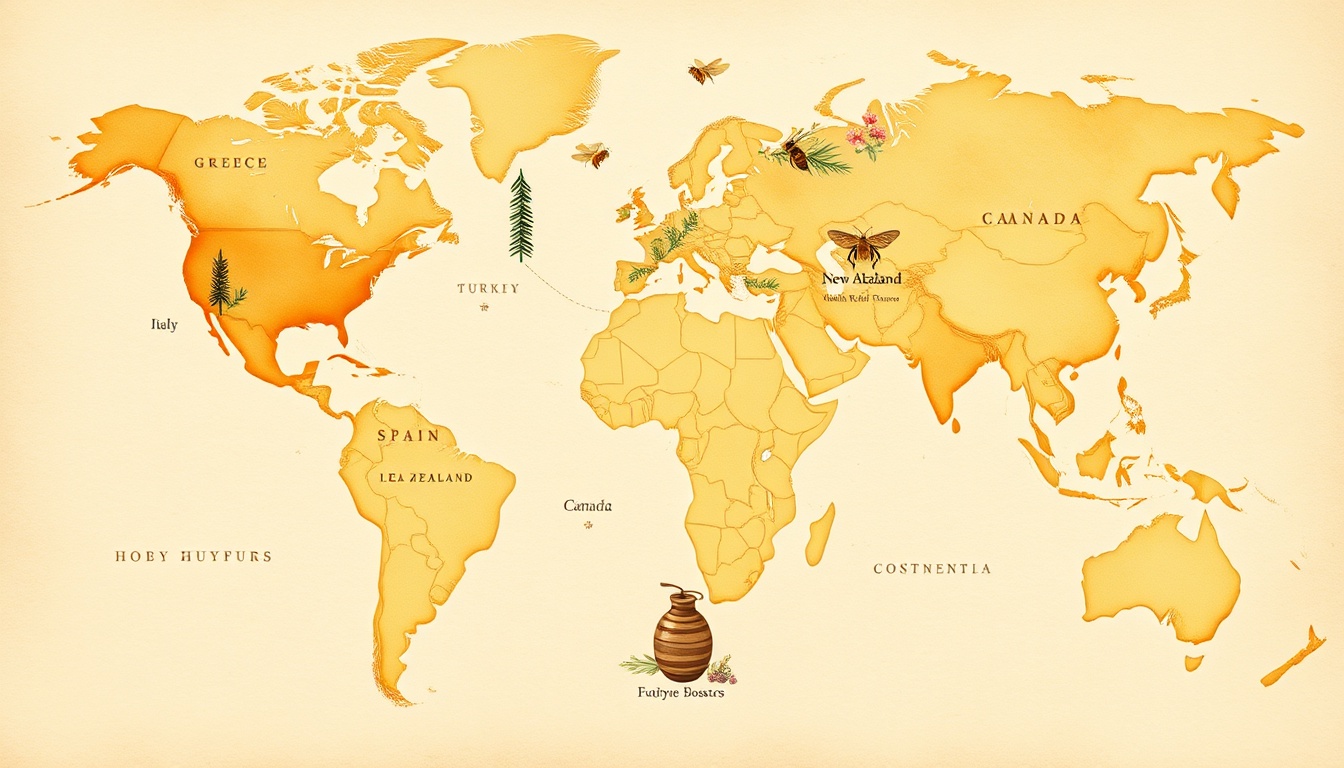
Honey is, at its most fundamental level, a geographic product. The flavor, color, aroma, crystallization rate, chemical composition, and even the antibacterial properties of any given honey are direct expressions of the nectar plants that bees visit — and those plants are determined entirely by geography. A bee foraging in the ancient thyme-covered hillsides above Athens produces something categorically different from one collecting nectar in a Tasmanian old-growth rainforest or a Canadian fireweed meadow recovering from a forest fire. These are not just flavor variations on a common theme; they are fundamentally different foods, shaped by millions of years of botanical evolution in wildly different ecosystems.
The global honey market has become increasingly sophisticated about this reality. Where once honey was simply sold as "wildflower" or "clover" with minimal provenance information, the premium honey segment now features region-specific, flora-specific, and even altitude-specific single-origin varieties with documentation systems (EU PDO designations, New Zealand's UMF certification, Australia's TA rating) designed to verify that the honey in the jar genuinely comes from where the label claims. This shift mirrors the transformation of the wine industry, where "table wine" gave way to appellation-controlled, terroir-defined varieties with dedicated followings.
This guide covers the world's most important and distinctive premium honey-producing countries — their signature varieties, the botanical and geographic conditions that make those varieties possible, what the science says about their properties, and how to buy authentic product. Each country section links to a dedicated in-depth guide for those who want to go deeper. Use the comparison table as a quick reference, then read the country sections for context and buying guidance.
How the World's Top Honey Producers Compare
The following overview maps each country's most distinctive honey varieties against their key characteristics. "Signature variety" refers to the most internationally recognized or botanically unique product; "flavor profile" reflects the dominant sensory character; and "PDO/certification" indicates whether formal authenticity systems exist.
Greece — Signature: Thyme honey (Hymettus) | Flavor: Intensely floral, herbal, complex | PDO/Certification: EU PDO for fir/vanilla varieties; GI for Hymettus | Price range: $$–$$$ | Best for: Cheese pairings, desserts, medicinal tradition
Turkey — Signature: Anzer (world's most expensive), pine honeydew | Flavor: Anzer: extraordinary complexity; çam balı: mineral, resinous | PDO/Certification: Anzer GI (Turkish government); Muğla pine certified | Price range: $$–$$$$ | Best for: Premium gifting, collectors, pine honey enthusiasts
Italy — Signature: Acacia (robinia), millefiori, sulla | Flavor: Acacia: neutral-sweet, floral; millefiori: complex seasonal; sulla: delicate white | PDO/Certification: Miele della Lunigiana DOP; Italian PAT system | Price range: $$–$$$ | Best for: Everyday premium table honey, cooking, cheese boards
Spain — Signature: Rosemary (romero), La Alcarria lavender | Flavor: Romero: herbal-delicate, white crystallized; heather: robust, thixotropic | PDO/Certification: EU's first honey DOP (Miel de La Alcarria, 1993) | Price range: $$–$$$ | Best for: Mediterranean cooking, cheese boards, gifting
New Zealand — Signature: Manuka (UMF/MGO-rated), kamahi, tawari | Flavor: Manuka: earthy, medicinal, rich; kamahi: butterscotch; tawari: pale, delicate | PDO/Certification: UMF certification; NZ Ministry for Primary Industries export standards | Price range: $$$–$$$$ | Best for: Medicinal tradition, wound care research, premium gifting
Canada — Signature: Fireweed (BC/Yukon), buckwheat (Ontario) | Flavor: Fireweed: buttery caramel, ultra-slow crystallizing; buckwheat: near-black, molasses | PDO/Certification: Canada No. 1/2/3 grading (CFIA) | Price range: $–$$ | Best for: Value-quality ratio, culinary use, antioxidant-seekers
Australia — Signature: Leatherwood (Tasmania), jarrah (WA), yellow box | Flavor: Leatherwood: intensely pungent-floral, exotic; jarrah: dark caramel-eucalyptus; yellow box: water-white elegance | PDO/Certification: TA rating (jarrah, independent labs); AMHA certification (Australian manuka) | Price range: $$–$$$ | Best for: Cheese boards, premium gifting, antibacterial properties
India — Signature: Himalayan cliff honey (wild Apis dorsata), Bihar litchi honey | Flavor: Cliff honey: dark amber, intensely complex, varies by season; litchi: golden, distinctive lychee-floral perfume | PDO/Certification: GI tags (Kashmir wildflower, Sundarbans); FSSAI standards | Price range: $–$$ | Best for: Wild honey enthusiasts, unique monofloral experiences, exotic gifting
Ethiopia — Signature: White highland honey (Tigray/Amhara), Kaffa coffee forest honey | Flavor: White honey: pale crystallized cream, delicate Thymus schimperi thyme; coffee forest: dark amber, coffee blossom/jasmine/citrus | PDO/Certification: Organic-certified wild-harvest; traditional log-hive gojo beekeeping; UEBT-certified coffee forest batches | Price range: $–$$ | Best for: Wild honey collectors, tej honey wine brewing, unique African terroir
Morocco — Signature: Euphorbia honey (asel n tafza, world's only Euphorbia monofloral), Atlas thyme honey | Flavor: Euphorbia: water-white crystallized, clean, mildly sweet, waxy-floral; Thyme: rich amber, powerful thymol aromatics, mineral depth | PDO/Certification: GI Taroudant (euphorbia, developing); ONSSA export standards | Price range: $–$$$ | Best for: Unique rare monofloral, Sidr honey alternatives, North African honey exploration
Portugal — Signature: Urze heather (thixotropic, Serra da Lousã DOP), cistus honey (Iberia-endemic rock rose), medronheiro (uniquely bitter Arbutus) | Flavor: Urze: dark amber gel, heathery-floral, mildly bitter; cistus: white paste, resinous-floral; medronheiro: dark amber, pronounced bitter | PDO/Certification: 7 EU DOP designations | Price range: $$–$$$ | Best for: Rare European varietals, heather honey enthusiasts, bitter honey exploration
Japan — Signature: Tochi honey (Aesculus turbinata / Japanese horse chestnut), Nihon mitsubachi honey (indigenous Apis cerana japonica) | Flavor: Tochi: amber, complex floral-caramel with mild bitterness; Nihon mitsubachi: dark amber, extraordinarily complex multi-floral, propolis depth | PDO/Certification: JAS (Japanese Agricultural Standards) for domestic honey; no international PDO | Price range: $$$–$$$$ | Best for: Rare artisan honey collectors, Japanese cuisine, Nihon mitsubachi enthusiasts, most expensive honey in the world by variety

Greece: Mount Hymettus and the Mediterranean's Most Celebrated Honeys
Greece occupies a position in honey culture so ancient and so deep that it borders on the mythological — and with reason. The country's extraordinary floral diversity, driven by its position at the intersection of European, Asian, and African plant communities, has produced a honey-producing tradition documented since antiquity. Aristotle wrote detailed observations about bee behavior in the fourth century BCE. The Romans imported Hymettus honey from the mountains above Athens as a luxury trade good. Modern Greece remains, by international consensus, one of the world's premier honey-producing countries — not in volume (production is relatively modest) but in quality, diversity, and the scientific documentation of its honeys' properties.
Greece's defining honey varieties are shaped by its Mediterranean climate: intensely hot, dry summers force many flowering plants to produce concentrated, highly aromatic nectar as a survival strategy — and bees collect this concentrated nectar into correspondingly dense, complex, antioxidant-rich honey. Thyme honey, produced from the small-leafed thyme (Thymus capitatus) that covers Greek hillsides, mountains, and Aegean islands, is characterized by extraordinarily high polyphenol content — particularly thymol and related phenolics — that gives it both its distinctive herbal-floral intensity and its documented antimicrobial properties. A 2013 study in the International Journal of Food Microbiology found Greek thyme honey effectively inhibited Staphylococcus aureus, E. coli, and Listeria monocytogenes in laboratory assays.
Pine honey (pefkis), produced from honeydew collected from pine forests across northern and central Greece, accounts for roughly 65% of Greek honey production and is the variety most commonly exported. Greek fir honey (elatomelo) and its sub-variety vanilla honey of Crete (Meli Vanilias Kritis, EU PDO-protected) represent the country's most delicate and rarest honeys — pale cream-white, slowly crystallizing, with a subtly woody-vanilla character that is among the most unusual in the world. The Hymettus mountain thyme honey holds its ancient prestige not as a legal PDO designation but as a geographic identifier with genuine distinction: the combination of thyme species, altitude, and Attic geology produces a honey with a recognizable character that has maintained its reputation for 2,500 years. For the complete variety-by-variety guide, food pairings, buying checklist, and scientific citations, see our comprehensive Greek Honey Guide.
Turkey: Anzer, Pine Honeydew, and the World's Most Expensive Honey
Turkey is the world's third-largest honey producer by volume, behind China and Turkey's near-neighbor Argentina, but its significance in the premium honey market far exceeds its volume ranking. The country's extraordinary geographic position — spanning Anatolia between the Mediterranean, Black Sea, and Aegean, with altitudinal gradients from sea level to mountain plateaus above 2,500 meters — creates an unmatched diversity of honey-producing ecosystems. Turkey's beekeeping tradition is among the oldest in the world; archaeological evidence of beeswax from Çatalhöyük dates to approximately 7,000 BCE. The country produces over 110,000 metric tonnes of honey annually, and its premium varieties command some of the highest prices on any honey market.
The world's most expensive honey — Anzer, from a remote plateau in Rize province on Turkey's Black Sea coast — is Turkish. Anzer honey is produced from a 40km² alpine plateau at 1,800–2,500 meters elevation, where over 400 plant species bloom in a compressed late-summer season of extraordinary botanical density. Total annual production is roughly 2–5 metric tons for the entire plateau, against domestic Turkish demand that already exceeds supply; authentic Anzer very rarely reaches international markets. Independent pollen analysis consistently confirms its extraordinary botanical diversity — over 40 distinct pollen types in single samples. Market price: $200–600+ per kilogram for verified product. Pine honeydew honey (çam balı), Turkey's other signature variety, is the world's largest-volume pine honeydew honey and is produced primarily from the Marchalina hellenica insect's exudates on Turkish pines (Pinus brutia) in the forests of Muğla and Izmir provinces. It has exceptional mineral content, very slow crystallization (often liquid for 2–3 years), and a distinctive resinous-mineral character unlike any floral honey.
Turkey also produces karakovan honey — a traditional product from the Kaçkar Mountains of Artvin province, harvested from hollow log hives using methods unchanged for centuries — and Kars highland honey from the 1,750-meter-altitude grasslands of northeastern Turkey, long considered one of the country's finest plateau varieties. For the complete guide including the science behind Turkish honey quality, the grayanotoxin ("mad honey") safety note, food pairings with Turkish cuisine, and buying tips, see our Turkish Honey Guide.
Italy: Acacia, Millefiori, and the European Gold Standard
Italy's honey tradition combines extraordinary geographic diversity — from the alpine forests of the Dolomites to the citrus groves of Sicily, the chestnut forests of Tuscany and Calabria to the sulla-carpeted plateaus of Sardinia — with a rigorous quality culture that has made Italian honey a benchmark for European premium food. The Italian beekeeping association (Unione Nazionale Associazioni Apicoltori Italiani, UNAAPI) and the national research body CREA-ZA (Research Centre for Animal Production and Aquaculture) have documented Italian honey types with scientific precision; Italian acacia honey in particular is among the most thoroughly studied monofloral honey varieties in the world.
Acacia honey (miele di acacia) — produced from black locust (Robinia pseudoacacia) blossoms in the forests of Friuli-Venezia Giulia, Veneto, Piemonte, and Umbria — is Italy's most prestigious honey export and arguably the world's most refined neutral-sweet monofloral honey. Its exceptional clarity, near-colorlessness, extremely high fructose content (making it slow to crystallize and remaining liquid for years), and clean sweet-floral taste make it the default pairing honey for Italian cheese culture: drizzled over aged Parmigiano-Reggiano, fresh ricotta, or Grana Padano at the Italian table. Millefiori (thousand flowers), Italy's beloved polyfloral, varies by region and season — a Tuscan spring millefiori is pale and herbal-citrus; an Umbrian summer version is deeper and more complex — making it the most honest expression of Italian landscape in honey form. Sulla honey, from the sulla legume (Hedysarum coronarium) that carpets Sicilian and Sardinian fields white in spring, produces one of Europe's most delicate table honeys: white, almost crystallized from harvest, with a flavor so gentle it is classically paired with fresh ricotta on warm bread.
Italy's only honey PDO designation — Miele della Lunigiana DOP — covers acacia and chestnut honey from the Lunigiana valley in northern Tuscany, where Ligurian Apennine conditions produce documented quality differentiation. The Italian PAT (Prodotti Agroalimentari Tradizionali) system recognizes over 40 additional traditional Italian honey types. For the complete guide including the culinary tradition (ricotta con miele, miele e pecorino, Neapolitan struffoli), the science of Italian acacia honey composition, and buying guidance, see our Italian Honey Guide.
Spain: La Alcarria, Rosemary, and Europe's Most Botanically Diverse Industry
Spain is the European Union's largest honey producer by volume, generating approximately 35,000–40,000 metric tonnes annually — more than twice Italy's output, significantly more than Germany's or France's. This volume reflects both Spain's extraordinary size and its extraordinary floral diversity: the country spans 8 recognized biogeographical zones, from the Atlantic-influenced Galician coast through the central Castilian meseta, the Mediterranean coast, the semiarid Murcian zone, the subtropical Canary Islands, and the alpine Pyrenees. Each zone contributes distinct nectar sources and distinct honey characters. Spanish beekeeping is ancient — Paleolithic cave paintings depicting honey collecting date to approximately 8,000 BCE in the Cova d'Ara Ranera (Valencia).
The centerpiece of Spanish honey culture is La Alcarria — a high plateau (900–1,200 meters) in the provinces of Guadalajara and Cuenca, east of Madrid, covered with lavender (Lavandula latifolia), rosemary (Salvia rosmarinus), thyme, and sage on poor, mineral-rich limestone soils. The Denominación de Origen Protegida "Miel de La Alcarria" was awarded in 1993 — the EU's first honey Protected Designation of Origin — recognizing the genuine quality differentiation of La Alcarria honey from its plateau floral sources. Authentic La Alcarria honey carries a numbered counter-seal from the Consejo Regulador and bears a characteristic pale gold to white crystallized appearance with a herbal-lavender-rosemary complexity that is unmistakably regional. Rosemary honey (miel de romero) from La Alcarria and neighboring regions is among Europe's most distinctive monofloral varieties: it crystallizes almost immediately into a fine white paste, with a delicate herbal-floral character that is clean, elegant, and unique. Spanish heather honey (miel de brezo) from the Atlantic north (Galicia, Asturias, Cantabria) exhibits thixotropic behavior — it gels when left undisturbed and liquefies when stirred — a physical property shared with only a small number of world honey varieties (all produced from Calluna vulgaris).
For the complete guide including La Alcarria DOP authentication, the science of Spanish thyme honey phenolics (research by Terrab et al., Food Chemistry 2003), Spanish culinary pairings (queso manchego + romero, pestiños), and regional buying guidance, see our Spanish Honey Guide.
New Zealand: Manuka and the Southern Hemisphere's Most Studied Honeys
New Zealand's honey story is, in the global market, almost entirely defined by one word: manuka. And for good reason — manuka honey (from Leptospermum scoparium, the tea tree native to New Zealand and parts of southeastern Australia) is the most scientifically studied honey in the world, the subject of hundreds of peer-reviewed publications, and the product that single-handedly transformed premium honey from a niche food product into a global health and wellness category. The key discovery — that manuka honey's antibacterial activity is not destroyed by the enzyme catalase that breaks down hydrogen peroxide in ordinary honey, and that this "non-peroxide activity" (NPA) derives from methylglyoxal (MGO) — was first reported by Professor Thomas Henle of the Technical University of Dresden in 2008 and rapidly led to systematic grading systems (UMF, MGO, NPA) and a global premium market exceeding $300 million annually.
The MGO content of manuka honey varies enormously with geography, season, and plant maturity — from under 100 mg/kg in lower-grade varieties to over 1,000 mg/kg in the highest-grade certified product. The Unique Manuka Factor (UMF) grading system, managed by the UMF Honey Association, is the most rigorous certification framework: it tests for MGO, DHA (dihydroxyacetone, MGO's precursor in the nectar), and leptosperin (a compound unique to Leptospermum nectar), providing triangulated verification of authentic manuka content. Beyond manuka, New Zealand's native forest honey landscape offers some of the world's rarest varieties: kamahi honey from the Weinmannia racemosa forest (a Gondwanan tree whose relatives are in South America) tastes of butterscotch and fine caramel; tawari honey from Ixerba brexioides — one of the rarest commercial honeys produced anywhere — is near-white and extraordinarily delicate; rewarewa honey, from the New Zealand honeysuckle (Knightia excelsa, Proteaceae family), is a dark, strikingly individual honey with caramel-woody complexity.
New Zealand honey's international credibility rests on the Ministry for Primary Industries' strict export standards, the UMF certification framework, and the genuine scientific documentation of its properties. Fraud is widespread in the manuka category — independent estimates suggest global "manuka honey" sales consistently exceed actual New Zealand manuka production, meaning a significant proportion of labeled manuka honey does not contain verified manuka components. The UMF label, the MGO number backed by a leptosperin certificate, and transparent producer sourcing are the keys to authentic purchase. For the complete guide including MGO/UMF/leptosperin explained, how to spot fake manuka, and the rare native varieties beyond manuka, see our New Zealand Honey Guide.
Canada: Fireweed, Buckwheat, and Prairie Wildflower Abundance
Canada is the world's ninth-largest honey producer and one of the most significant honey exporters, with approximately 80,000–90,000 metric tonnes produced annually — primarily from the Prairie provinces of Alberta, Saskatchewan, and Manitoba, which together account for roughly 80% of Canadian honey production. The vast agricultural landscapes of the Prairie provinces provide some of the world's most reliable nectar flows from canola (Brassica napus), sweet clover (Melilotus species), alfalfa (Medicago sativa), and wildflower meadows, supporting large-scale commercial operations that supply the domestic market and exports to the United States, Europe, and Japan.
Canada's most internationally distinctive honey variety is fireweed — produced from the tall perennial fireweed plant (Chamerion angustifolium) that colonizes post-fire forest clearings in British Columbia and the Yukon with remarkable speed and abundance. Fireweed honey is near-colorless to very pale gold with an extraordinary buttery-caramel flavor — entirely unlike most pale honeys, which tend toward neutral sweetness. Its very slow crystallization rate (due to an exceptionally high fructose-to-glucose ratio, sometimes 1.3:1 or higher) means it can remain liquid for 2–3 years in appropriate storage. Canadian buckwheat honey (primarily from Ontario, Manitoba, and Quebec) represents the opposite end of the honey spectrum: very dark, near-black, with a robust molasses-malt character and among the highest antioxidant contents of any commonly available honey variety. A 2002 study by Nele Gheldof at Cornell University published in the Journal of Agricultural and Food Chemistry found Ontario buckwheat honey had antioxidant activity comparable to many fruits and vegetables, significantly higher than lighter honey varieties. A 2007 RCT by Ian Paul et al. (Archives of Pediatrics & Adolescent Medicine) found a single 2.5mL dose of buckwheat honey outperformed dextromethorphan in a controlled trial of nocturnal cough suppression in children.
Canada's quality infrastructure includes the Canadian Honey Council, the Canadian Food Inspection Agency (CFIA)'s Canada No. 1/2/3 grading system for color, moisture, and foreign matter, and well-developed provincial beekeeping associations. Canadian honey represents exceptional value: fireweed and buckwheat honeys offer genuine premium character at prices significantly below comparable European PDO or New Zealand UMF products. For the complete guide including Canadian honey geography across 6 climate zones, regional specialties, and culinary pairings, see our Canadian Honey Guide.
Australia: Leatherwood, Jarrah, and the World's Most Botanically Unique Honeys
Australia occupies a singular position in the global honey landscape that no other country can replicate. The continent's 45–50 million years of geographic isolation following the breakup of Gondwana has produced approximately 700 species of Eucalyptus, Leatherwood (Eucryphia lucida) in Tasmanian old-growth rainforest, jarrah (Eucalyptus marginata) in Western Australia's southwest, and hundreds of other flowering plants found nowhere else on Earth. Australian honey varieties are not regional variants of species found elsewhere; many simply cannot be produced outside Australia. The result is a premium honey landscape with no international competition for its most distinctive products.
Leatherwood honey — produced from the ancient Gondwanan rainforest tree Eucryphia lucida in Tasmania's UNESCO World Heritage wilderness — is the most geographically circumscribed premium honey in the world. The leatherwood tree grows only in western Tasmania; its Gondwanan relatives are in South America and New Zealand. The honey's aroma and flavor are immediately extraordinary: powerfully pungent-floral, complex, with high-toned exotic notes that polarize first-time tasters and captivate those who appreciate bold character. It is, quite simply, unlike any other honey on Earth. Jarrah honey from Western Australia is prized for its antibacterial properties (rated using Australia's Total Activity system measuring both hydrogen peroxide and non-peroxide activity) and documented low glycemic index (GI 35–50). Yellow box honey (Eucalyptus melliodora — the Latin species name means "honey-scented") from the threatened box-gum woodland ecosystems of New South Wales and Victoria is universally regarded by Australian honey connoisseurs as the country's finest table honey: water-white, extraordinarily elegant, very slowly crystallizing, with a depth of character that belies its pale appearance.
Australia produced honey free from Varroa destructor longer than any other major honey country — until June 2022, when the mite was confirmed at the Port of Newcastle, NSW. While the eradication response ultimately failed and Varroa is now established, Australia's fundamental botanical advantage remains unchanged. For the complete guide including detailed variety profiles (leatherwood, jarrah, yellow box, ironbark, macadamia, Australian manuka/jelly bush, red gum, stringybark), the science behind jarrah's TA rating, and regional buying guidance, see our Australian Honey Guide.

India: Himalayan Cliff Honey, Litchi, and a 3,000-Year Beekeeping Tradition
India is one of the world's most significant honey-producing countries and, arguably, its most botanically diverse. With honey collected across five distinct climate zones — the Himalayan subalpine, the Indo-Gangetic Plain, the tropical Western Ghats, the arid Thar Desert of Rajasthan, and the mangrove-fringed Sundarbans delta — India produces honey varieties that collectively represent a greater range of floral sources, altitudes, and ecological contexts than almost any other country. The country's primary honeybee species, the indigenous Apis cerana indica, has co-evolved with Indian flora for millions of years; its wild cousin Apis dorsata — the world's largest honeybee, with workers up to 2 centimeters long — produces the Himalayan cliff honey that has fascinated ethnobotanists and honey collectors for decades.
Himalayan cliff honey is India's most dramatic and internationally recognized wild honey. Collected from the near-vertical rock faces of the Himalayan foothills by Gurung honey hunters in Nepal and related communities in Himachal Pradesh and Uttarakhand, using traditional smoke and hand-gathered comb methods documented by National Geographic photographer Eric Valli in 1988, this honey is unlike any commercial product: it is completely wild, completely raw, and in spring batches can contain significant grayanotoxin content from Rhododendron species nectar that causes the "mad honey" effect documented since antiquity. Spring cliff honey from certain high-altitude locations produces genuine psychoactive and cardiovascular effects at doses above 30 grams; autumn cliff honey from the same hives, produced predominantly from later-flowering non-toxic species, is safe and merely extraordinary in flavor complexity. A 2011 review by Gunduz et al. in Clinical Toxicology documented the grayanotoxin mechanism comprehensively. Bihar litchi honey, produced from the Muzaffarpur district of Bihar — which supplies over 70% of India's lychee crop — is the world's only major monofloral litchi honey: golden amber, with a distinctive perfumed lychee-floral character that is identifiable by trained tasters. Research by Vinas et al. (2014, Food Chemistry) identified specific polyphenol fingerprints — protocatechuic acid, p-coumaric acid, naringenin — that serve as authenticity markers for genuine litchi monofloral honey.
India's honey sector has faced significant international quality challenges: a 2010–2014 EU import ban following detection of chloramphenicol (a prohibited antibiotic) in Indian honey exports prompted major FSSAI (Food Safety and Standards Authority of India) regulatory reforms, and NMR spectroscopy testing revealed rice syrup adulteration in a substantial portion of Indian export honey (a 2020 CSE investigation found 77% of tested samples contained adulterated honey). The resulting enforcement push has significantly cleaned up the export supply chain, but buyers should still prioritize traceable, certifiable sources. Kashmir wildflower honey carries a Government of India Geographical Indication (GI) tag — one of the few officially certified Indian honey varieties. Rajasthan's ajwain (carom) honey, produced from Trachyspermum ammi, is perhaps India's most uniquely domestic variety: intensely thymol-characteristic, used in Ayurvedic tradition for respiratory and digestive applications, and unavailable outside South Asia in any significant volume. For the complete guide including variety-by-variety profiles, FSSAI quality standards, culinary pairings with Indian cuisine (kahwa, paneer, paratha), and buying guidance, see our Indian Honey Guide.
Ethiopia: Africa's Honey Capital and the World's Most Biodiverse Wild Honey
Ethiopia is Africa's largest honey producer and, by many measures, one of the world's most remarkable honey-producing countries — a status almost entirely unknown to international honey buyers and largely absent from mainstream honey literature. The country produces an estimated 40,000–55,000 metric tonnes of honey annually (figures vary by source and include both wild-harvest and managed apiaries), of which a significant proportion is wild-harvest log-hive honey of a quality that would command premium prices if it reached international markets with reliable provenance documentation. Ethiopia's beekeeping tradition is among the oldest documented in Africa: Aksumite manuscripts describe honey collection methods, and traditional log-hive (gojo) beekeeping remains essentially unchanged from ancient practice in many highland regions. Ethiopia's genetic honey bee diversity is extraordinary — the country hosts multiple native Apis mellifera subspecies (A. m. monticola, A. m. jemenitica, A. m. scutellata, and others) adapted to different altitude zones, identified through landmark genetic research by Jaffé et al. (2009, PLOS ONE) that found eastern Africa to be the center of origin for the entire Apis mellifera species.
Ethiopian white highland honey is the country's most internationally distinctive and sought-after variety. Produced from Thymus schimperi — an endemic Ethiopian thyme found only in the Tigray and Amhara highlands above 2,000 meters — and Eucalyptus globulus (introduced but thoroughly naturalized), this honey crystallizes almost immediately after harvest into a fine, pale cream paste with a delicate herbal character entirely unlike the robust European thyme honeys of Greece and Spain. The crystallization is so fast and consistent that it is used as an authenticity indicator by regional buyers: liquid Ethiopian highland honey is considered suspicious by knowledgeable traders. Kaffa coffee forest honey, from the UNESCO Biosphere Reserve forests of the Kaffa zone in southwestern Ethiopia, represents the most botanically complex honey produced anywhere on Earth: the forest contains wild Coffea arabica — the original genetic source of all the world's cultivated coffee — alongside hundreds of endemic forest species that bloom in overlapping seasons. Honey produced from these forests carries a complex dark amber character with coffee blossom jasmine-citrus-sweet notes that are unmistakably traceable to the wild coffee flowering season. A physicochemical quality analysis by Birhanu Tesfa et al. (2019, Heliyon) confirmed that Kaffa forest honey meets international premium quality standards for moisture content, HMF levels, diastase activity, and total phenolics.
Ethiopia's tej tradition — the national honey wine made from raw honey fermented with gesho (Rhamnus prinoides, an indigenous buckthorn-relative used as a bittering agent) — represents one of the world's oldest continuous honey wine traditions, predating European mead by centuries in documented Aksumite records. Tej is consumed fresh and unfiltered at tej bets (tej houses) across Ethiopia; it is not exported, which means the raw honey used in tej production is genuinely wild-harvest, genuinely raw, and genuinely complex. Buying Ethiopian honey presents significant traceability challenges: the market is fragmented across millions of smallholder and traditional beekeepers with minimal formal quality infrastructure, and the volume of honey entering international commodity channels is blended and anonymized. Buyers seeking authentic Ethiopian highland honey should look for specialty importers working directly with highland cooperatives (organizations like TechnoServe and SNV have worked to formalize supply chains), organic-certified batches from the Kaffa Biosphere Reserve, and UEBT-certified coffee forest sourcing. For the complete guide including variety-by-variety profiles, traditional gojo beekeeping, tej recipe and tradition, and buying guidance, see our Ethiopian Honey Guide.
Other Notable Honey Producers Worth Knowing
Beyond the seven countries with dedicated guides, several other honey-producing nations deserve mention for their distinctive varieties.
Morocco is one of Africa's top honey-producing nations and home to a variety with no equivalent anywhere on Earth: euphorbia honey (miel d'euphorbe / asel n tafza in Tamazight), produced from Euphorbia resinifera — a cactus-like succulent endemic to the Anti-Atlas foothills around Taroudant province. It is the world's only Euphorbia monofloral honey, crystallizing brilliant white with a clean, mildly sweet, slightly waxy-floral character. Morocco also produces exceptional Atlas thyme honey from wild Thymus atlanticus on the Middle Atlas limestone plateaux, jujube/sidr honey from the Draa Valley and Tafilalet oases (a traceable alternative to hard-to-authenticate Yemeni Sidr), orange blossom from the Souss citrus plain, and cedar forest honeydew from the world's largest surviving Cedrus atlantica stands. Traditional Amazigh beekeeping with native Apis mellifera intermissa is preserved across the High Atlas and Anti-Atlas. See our complete Moroccan Honey Guide.
Portugal has seven EU-protected DOP honey designations — among Europe's highest density — anchored by urze Calluna heather honey (thixotropic, from Atlantic mountain moors), cistus honey from Cistus ladanifer rock rose (endemic to Iberia, white crystallized, resinous-floral), and medronheiro honey from Arbutus unedo (one of the world's few genuinely bitter honeys, produced in November-December when all other sources have finished). The native Apis mellifera iberiensis bee is genetically distinct from mainland European stock, better adapted to Portugal's climate extremes. See our complete Portuguese Honey Guide.
Japan maintains one of the world's most sophisticated premium honey markets while producing only 5–10% of its own domestic consumption. Japanese domestic honey is an artisanal product of exceptional quality governed by JAS (Japanese Agricultural Standards): tochi honey (栃蜂蜜) from Aesculus turbinata — the Japanese horse chestnut, endemic to mountain forests of Tochigi, Nagano, and Tohoku — is a complex amber honey with a nuanced caramel-floral character and mild bitterness that differs significantly from aggressive European horse chestnut honey. Renge honey (蓮花蜂蜜) from Astragalus sinicus milk vetch — once Japan's most common spring honey, produced from renge-so cover crops in rice paddies across Kyushu and Shikoku — is now a rare delicacy, extraordinarily pale and delicate. But Japan's most remarkable honey tradition is Nihon mitsubachi keeping — beekeeping with Apis cerana japonica, the only native Japanese honeybee. Nihon mitsubachi honey, cold-pressed from natural round combs, has an extraordinary complexity unmatched by any Apis mellifera product, and commands ¥3,000–15,000 per 100 grams ($20–100/100g), making it among the world's most expensive commercially available honeys. See our complete Japanese Honey Guide.
Germany and Austria produce Waldhonig (forest honey) — a dark, mineral-rich honeydew honey from fir and spruce forests of the Black Forest, Bavaria, and Austrian Alps that is deeply embedded in central European food culture and tested to exacting standards by the DLG (Deutsche Landwirtschafts-Gesellschaft, German Agricultural Society). Its flavor is robustly earthy, resinous, and complex — one of the world's finest forest honeys. See our Waldhonig guide for the full profile.
Yemen produces Sidr honey (from the Ziziphus spina-christi tree, known as sidr or lote tree) that commands some of the world's highest prices — genuine Wadi Do'an Sidr from Yemen's Hadramaut Valley can exceed $200–300 per 500g for verified product. Its flavor is extraordinary: thick, golden-amber, intensely floral with a distinctive warm-complex character unlike any European or Oceanic variety. Yemen's ongoing political situation severely restricts supply of authentic product, making fraud common. See our Sidr honey guide for authentication guidance.
Hungary produces a distinctive white acacia honey (akácméz) from Hungary's extensive black locust (Robinia pseudoacacia) plantation forests that is considered one of Europe's finest neutral monofloral honeys — paler and more delicately flavored than most Italian acacia, with a slightly more floral character. Hungarian acacia honey is one of Europe's largest honey exports by value.
Argentina and Brazil are the Western Hemisphere's largest honey producers after the United States and Canada, with Argentina (primarily eucalyptus, clover, and mixed wildflower from the Pampas) being a major global commodity honey exporter. Brazilian honey from the Northeast's caatinga biome — particularly aromatic wildflower honey from native stingless bees (Meliponini) — is a growing premium niche with no international equivalent. Brazilian stingless bee honey is extremely limited in quantity, naturally fermented, and intensely aromatic, representing perhaps the next frontier in premium international honey exploration. See our stingless bee honey guide for more on this emerging category.
How to Buy Authentic International Honey: A Universal Guide
The premium international honey market is unfortunately plagued by fraud at every level — from sophisticated adulteration (blending high-fructose corn syrup or rice syrup into honey) to geographic mislabeling (selling Chinese bulk honey as Greek or New Zealand honey) to simple false botanical claims (labeling ordinary polyfloral honey as "manuka" or "Anzer"). The higher the price and prestige of a honey variety, the more likely it is to be counterfeited. These buying principles apply regardless of which country's honey you're purchasing.
Verify the producer. The strongest guarantee of authenticity is purchasing directly from a named beekeeper or small producer — someone with a physical address, an active website with photos of their apiaries, and ideally social media presence showing their operation. Large commercial honey brands with vague "sourced from" language offer weaker provenance guarantees than small artisanal operations with transparent sourcing.
Check for certification systems. EU PDO/PGI designations (look for the numbered seal from the Consejo Regulador for La Alcarria, or the official EU PDO logo) are legally enforceable in the EU. New Zealand UMF certification requires third-party testing of MGO, DHA, and leptosperin — the UMF number on the jar should be verifiable through the UMFHA database. Australian TA ratings should come with laboratory test certificates from independent testing facilities. For Anzer honey, insist on Turkish government-approved pollen analysis confirming Anzer plateau pollen profile.
Understand price realities. Authentic premium honey from any of these countries cannot be sold cheaply. Genuine UMF 20+ manuka honey costs $60–150+ per 250g; authentic Anzer costs $200–600/kg; verified Tasmanian leatherwood costs AUD$20–40/500g even in Australia. Any honey claiming premium origin at bargain prices should be treated with extreme skepticism.
Look for sensory authenticity. Many premium honeys have self-authenticating sensory characteristics: leatherwood's extraordinary pungent-floral aroma cannot be faked; pine honeydew honey's distinctive dark amber color, mineral taste, and extreme slow crystallization are difficult to replicate; yellow box honey's near-water-white color and extraordinary cleanness are characteristic. Learn what genuine versions look, smell, and taste like before purchasing expensive varieties online.
Prioritize raw and minimally processed. All premium international honeys are best purchased raw (unheated above 40°C, unpasteurized) to preserve volatile aromatics, enzymes, pollen, and the heat-sensitive chemical compounds that define their character. Heating destroys the precise compounds that make leatherwood smell like leatherwood and manuka's MGO-active properties function. Filtration removes the pollen that can be used to verify geographic origin. Raw, unfiltered product is both more authentic and more characterful.