Morocco's Honey Geography: Five Ecological Zones
Morocco packs more ecological diversity into its 446,000 square kilometres than almost any country of comparable size. From the Atlantic coast to the Rif and Atlas mountain chains and then south to the Saharan pre-desert, Morocco crosses five distinct climatic and botanical zones — and each produces honey with a character so different from the others that they could come from separate continents. This is not an accident: the country sits at the convergence of Mediterranean, Atlantic, Saharan, and sub-Saharan botanical influences, with altitude ranges from sea level to 4,167 metres at Toubkal, and a biodiversity footprint that includes the world's only natural Argania spinosa forest, the northernmost Saharan flora, and several endemic species found nowhere else on Earth.
The five primary honey zones correspond to five distinct ecological systems. Zone 1 is the Anti-Atlas and its foothills — the cradle of euphorbia honey, where Euphorbia resinifera, a cactus-like succulent endemic to Morocco, blooms in sparse colonies on rocky hillsides between 1,000 and 1,500 metres. Taroudant province is the epicentre. Zone 2 is the Sous-Massa biosphere — the only place on Earth where argan trees (Argania spinosa) grow naturally in forest density, covering 800,000 hectares of the coastal plain between Agadir and Tiznit. Zone 3 encompasses the Middle Atlas and High Atlas mountain ranges, where wild thyme meadows at 1,200–2,800 metres produce Morocco's most prized everyday honey and cedar forest honeydew from Cedrus atlantica. Zone 4 is the Souss plain around Agadir, where orange and mandarin orchards produce Morocco's largest volume of commercial honey. Zone 5 is the Draa Valley and Tafilalet pre-Saharan zone in the south — the production area for Morocco's jujube honey, made from Ziziphus lotus, the North African counterpart of the Yemeni Sidr tree.
Three native honeybee populations work these zones. Apis mellifera intermissa — the Saharan bee, the indigenous North African subspecies — is the traditional bee of all five zones and is uniquely adapted to Morocco's climate extremes. It has been joined by introduced Apis mellifera ligustica (Italian bee) stocks in commercial apiaries, creating a hybridisation pressure that beekeeping associations are actively managing. No stingless bees exist in Morocco's honey tradition — unlike sub-Saharan Africa and South and Southeast Asia, Meliponini beekeeping did not develop in North Africa, making Morocco's honey production exclusively an Apis mellifera enterprise. This single-species context, combined with the botanical diversity of the five zones, produces a range of honeys that are simultaneously coherent in style and remarkably varied in character.
Euphorbia Honey (Asel n Tafza): The World's Only Euphorbia Monofloral Honey
Euphorbia resinifera is a cactus-like succulent in the Euphorbiaceae family — not a true cactus, but convergently evolved to the same water-conserving form, with ribbed succulent columns covered in paired spines and no leaves. It grows as dense colonies on the dry, rocky hillsides of the Anti-Atlas range between 1,000 and 1,500 metres, particularly in Taroudant and Tiznit provinces of the Sous-Massa region. The plant is notable in botanical history for an unusual reason: the toxic white latex it exudes from any cut surface is euphorbium — the substance named by Juba II, the Roman-client king of Mauretania, around 25 BCE, in honour of his Greek physician Euphorbus. Euphorbium was used in Roman pharmacy for at least four centuries as a cathartic and vesicant, and it gave the entire genus Euphorbia its name. The latex contains phorbol esters (diterpenoids) and other diterpene compounds with severe inflammatory and toxic activity; contact with skin or mucous membranes causes intense irritation, and ingestion of the raw latex is dangerous.
The paradox of euphorbia honey is that the same plant produces honey of complete safety. Euphorbia resinifera flowers are tiny — less than 2 mm across — and borne in cluster structures called cyathia, which contain nectaries that are anatomically distinct from the latex-secreting internal canals. The nectar is produced in specialised glands that have no connection to the latex system; bees collecting from Euphorbia resinifera flowers are accessing a nectar source with no detectable phorbol ester content. The honey that results — called asel n tafza in Tachelhit Tamazight (the Berber language of the Anti-Atlas Amazigh communities) and miel d'euphorbe in French — crystallises brilliant white within two to four weeks of extraction, one of the fastest crystallisation rates of any honey variety. In liquid form it is water-white to faintly golden, with a mild sweet flavour, a slightly waxy-floral character, and none of the herbal intensity associated with thyme or other aromatic-plant honeys. Research by Terrab et al. (Journal of Agricultural and Food Chemistry, 2004) using melissopalynological analysis confirmed Euphorbia pollen as the dominant type and detected no toxic compounds — consistent with Amazigh communities' centuries of traditional use and consumption.
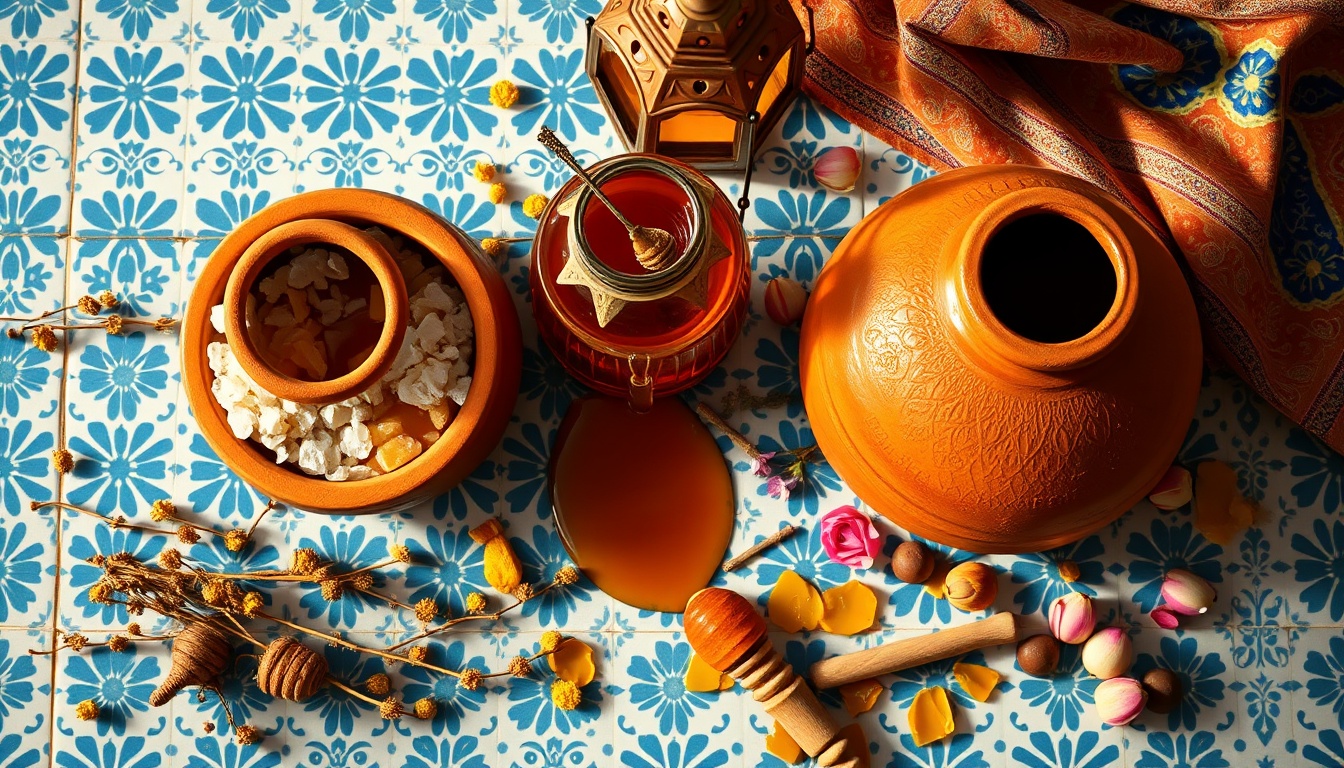
Euphorbia honey is produced nowhere else on Earth in documented commercial quantities. Euphorbia resinifera's natural range is restricted to the Anti-Atlas foothills; the plant exists in botanical collections in Europe and California, but no commercial honey production outside Morocco has been reported. The Taroudant souk — the main market town of Taroudant province about 80 kilometres east of Agadir — is the primary trading centre, where Amazigh beekeepers sell euphorbia honey in decorated ceramic jars or unlabelled containers at prices typically double or triple those of ordinary blossom honey. Authentic euphorbia honey can be identified by rapid crystallisation to brilliant white, by the characteristic mildness of flavour, and by melissopalynological pollen analysis. A developing geographic indication (IG Taroudant) is being pursued but as of 2026 has not yet achieved formal protection, meaning the Taroudant euphorbia name has no legal protection in export markets.
Pro Tip
Euphorbia honey crystallises to brilliant white within 2–4 weeks — one of the fastest crystallisation rates of any honey variety. Clear, liquid honey labelled as euphorbia has almost certainly been heat-treated. Authentic raw euphorbia honey from Taroudant should arrive already solid or semi-solid white. Ask for pollen-analysis documentation from specialty importers to confirm Euphorbia resinifera as the dominant pollen type.
Get the Honey Buyer's Cheat Sheet (free PDF)
16 varieties on one page — color, flavor, best use and what a fair price looks like — from the 304 honeys we track.
Atlas Thyme Honey: Morocco's Most Prized Everyday Honey
Moroccan thyme honey is produced primarily from Thymus broussonetii, a thyme species endemic to Morocco and the western Maghreb, named for the French naturalist Pierre Marie Auguste Broussonet (1761–1807). Unlike the Greek thyme honeys produced from Thymus capitatus (the dominant Aegean thyme species) or Spanish honeys from Thymus vulgaris, Moroccan Atlas thyme has a distinct botanical identity — the endemic Thymus broussonetii produces a honey with the fundamental thymol-carvacrol aromatic signature of premium thyme honeys worldwide, but with a flavour complexity shaped by the specific limestone geology and Atlantic-influenced climate of the Middle Atlas and High Atlas ranges. Thymus broussonetii blooms primarily in April through June at elevations of 1,200–2,500 metres, with the Middle Atlas provinces of Ifrane, Azrou, Khenifra, and Boulemane being the main production areas. High Atlas production concentrates in the valleys above Azilal and the Ourika valley south of Marrakech.
The flavour profile of Moroccan Atlas thyme honey reflects both its botanical source and its terroir. The Middle Atlas limestone geology — Jurassic carbonate formations similar to the Causses of southern France — imparts a mineral depth that experienced honey buyers associate with Moroccan thyme as distinct from Greek or Spanish counterparts. The mountain flora surrounding the thyme bloom — Cistus (rockrose) species, Origanum compactum (Moroccan oregano, one of the most thymol-rich Origanum species in the Mediterranean basin), various Lamiaceae shrubs, and high-altitude mountain wildflowers — contributes to a pollinatory context that gives premium Atlas thyme honey a complexity beyond pure monofloral thyme character. The honey is amber to dark amber, with powerful aromatic presence, natural bitterness, and a long persistent aftertaste common to high-quality thyme honeys anywhere in the Mediterranean.
Within Morocco, Atlas thyme honey occupies a position comparable to Manuka in New Zealand or Hymettus in Greece — it is the benchmark premium everyday honey that forms the reference point for quality judgments about all other Moroccan varieties. Domestic price premium over commercial orange blossom honey is typically 3–6x. International awareness is growing but lags behind Greek thyme honey by a wide margin — French specialty importers (particularly in Provence, Lyon, and Paris) are the primary external market, driven by Morocco's historic ties with France and the French public's familiarity with high-quality thyme honey as a concept. Moroccan Atlas thyme honey is significantly more affordable than Greek Hymettus at equivalent quality levels, making it a strong value proposition for buyers who prioritise thyme honey's culinary versatility and documented antimicrobial properties.
The Argan Paradox: Morocco's Most Famous Tree, Its Forgotten Honey
The argan tree (Argania spinosa) is one of the most economically significant endemic species in the world. Its natural forest range is restricted to the Sous-Massa region of southwestern Morocco — roughly 800,000 hectares between the High Atlas foothills, the Anti-Atlas, the Atlantic coast, and the Saharan transition zone — with a small outlier population in Algeria near Tindouf. This forest, designated a UNESCO Biosphere Reserve in 1998, is the only place on Earth where argan trees grow in natural forest density. The global argan oil industry — built on the oil pressed from argan kernels, used in cosmetics (as a skin and hair oil) and cooking (as a premium Moroccan culinary oil) — generates an estimated $70 million per year or more in export revenue, with argan oil commanding in European and North American specialty food and cosmetics retail. The argan tree's economic profile is as famous internationally as any tree on Earth.
Yet the same trees produce a honey that virtually no international consumer has heard of. Argan trees bloom in March and April with small yellowish-green flowers that produce nectar accessible to honeybee foragers in the Sous-Massa valley. The resulting argan blossom honey — miel d'arganier in French, asel n ukray in Tachelhit — is pale amber to golden, with a mild, slightly nutty and floral character that reflects the argan flower's delicate nectar chemistry. It does not carry the heavy aromatic intensity of thyme or the botanical uniqueness of euphorbia, but it has a clean, distinctive character associated with the argan ecosystem. Traditional Amazigh beekeeping communities in the Sous-Massa valley have produced argan honey for centuries alongside the oil-production activities; the honey is consumed locally and sold at Agadir and Taroudant markets, but has received essentially none of the international marketing that argan oil has built into one of the world's most recognised specialty food brands.
The argan honey paradox is structural rather than botanical. The argan oil industry invested in certification (Appellation d'Origine Protégée in Morocco since 2009), in women's cooperative networks (argan oil production employs an estimated 2.5 million people in the Sous-Massa region), and in international marketing through luxury cosmetics channels that gave argan a global lifestyle premium. Honey production from the same trees received no comparable institutional investment, no GI designation, and no marketing development. For specialty honey buyers, argan blossom honey offers direct provenance connection to the UNESCO-designated argan ecosystem at price points well below the argan oil luxury tier.
Pro Tip
Authentic argan blossom honey is genuinely hard to find outside Morocco. Most honey labelled 'argan honey' internationally is simply Moroccan wildflower honey from the Sous-Massa region without guaranteed argan-pollen dominance. Reliable sources are specialty importers who work directly with Taroudant-region cooperatives and can provide pollen analysis showing Argania spinosa pollen as a meaningful component.
Draa Valley Jujube Honey: Morocco's Sidr
The Draa Valley is one of Morocco's most dramatic landscapes — a ribbon of oases and ksour (fortified villages) stretching 1,200 kilometres from the High Atlas foothills through the pre-Saharan zone to the Sahara proper. Along the valley's pre-Saharan edges, and in the adjacent Tafilalet basin around Rissani and Erfoud, the North African jujube (Ziziphus lotus) grows as a native component of the pre-desert scrubland. Ziziphus lotus — called nabca, nabka, or nabq in Arabic and Berber languages — is a small thorny tree of the Rhamnaceae family endemic to North Africa's pre-Saharan transition zone. It blooms in September through November, producing a late-season nectar flow when most competing blooms have finished.
The honey produced from Ziziphus lotus is Morocco's counterpart to Yemeni Sidr and Pakistani Sidr — but it is a related, not identical, product. Yemeni Sidr honey uses Ziziphus spina-christi (Christ's thorn), and Pakistani KPK Sidr uses Ziziphus mauritiana (Indian jujube), while Moroccan jujube honey comes from Ziziphus lotus, a North African endemic species. All three share the Ziziphus genus and the Rhamnaceae family, producing nectar-rich flowers in the autumn dry season that yield thick, dark amber to reddish-brown honey with caramel-buttery character, high fructose-to-glucose ratios that resist crystallisation, and elevated phenolic content associated with Ziziphus nectars. The three are comparable in general profile — all trade on the Quranic and Hadith tradition of Sidr honey as divinely endorsed medicine — but they are botanically distinct, and pollen analysis can separate them cleanly. Moroccan jujube honey commands significantly lower international prices than Yemeni Sidr, not because of botanical inferiority but because the Yemeni Sidr brand built its premium through Gulf market investment that predated Moroccan marketing by decades.
The Rissani market in the Tafilalet basin and the Zagora souks along the Draa Valley are the primary trading centres for authentic Moroccan jujube honey. Local sellers often identify the honey by its nabca or ziziphus origin specifically, and experienced buyers know to look for the dark amber colour, thick body, and the distinctive long-chain floral-caramel aromatic that distinguishes genuine Ziziphus honey from ordinary wildflower honey. Adulteration is documented in the market — jujube honey commands a price premium that creates incentive to dilute it with cheaper cotton or sunflower honey — and pollen analysis remains the most reliable authentication tool. European importers, particularly in Spain and France, have begun to import verified Moroccan jujube honey as a more accessible alternative to Yemeni Sidr.
Cedar Forest Honeydew and Orange Blossom Honey
The Middle Atlas is home to the world's largest natural stands of Atlantic cedar (Cedrus atlantica), a conifer endemic to Morocco and Algeria that covers approximately 130,000 hectares of mountain forest around Ifrane National Park, Azrou, and the cedar forests of the Bou Iblane and Bou Naceur massifs. Cedrus atlantica hosts populations of scale insects and aphids that excrete honeydew — the sugar-rich excretion that bees collect and transform into honeydew honey in the same way that European fir and spruce forests produce Tannenhonig in Germany or miel de sapin in France. Moroccan cedar honeydew honey (miel de cèdre or asel n tikida in Tachelhit) is dark amber to near-black, with strong caramel-malt-mineral flavour, significant natural bitterness, and the characteristic non-crystallising or slowly crystallising behaviour typical of honeydew honeys. Cedar honeydew honey is the rarest of Morocco's major varieties by production volume and commands the highest domestic price per kilogram among connoisseur buyers.
The Souss plain around Agadir — the flat, intensively cultivated coastal valley south of the High Atlas — produces Morocco's largest-volume single-source honey: orange blossom (miel d'oranger, asel n itiyen). The citrus orchards that dominate the Souss plain bloom in March and April, producing pale golden honey with the characteristic delicate floral sweetness of Citrus blossom. Moroccan orange blossom honey is the commercial workhorse of the Moroccan honey market, widely available in supermarkets, souk stalls, and export packaging, and priced significantly below the specialty varieties. Beyond orange blossom and cedar, Moroccan beekeepers produce lavender honey from Lavandula stoechas populations in the Middle Atlas foothills; carob blossom honey from Ceratonia siliqua on Atlantic-influenced western slopes; and rosemary honey from Rosmarinus officinalis on lower-altitude Mediterranean-facing slopes in the Rif and pre-Rif regions.
Apis mellifera intermissa: The Saharan Bee
Apis mellifera intermissa — classified by Friedrich Ruttner in his landmark 1988 monograph on honeybee subspecies — is the native honeybee subspecies of Morocco, Algeria, Tunisia, and Libya. It occupies a unique position in the Apis mellifera evolutionary tree: classified in the African lineage (clade A), it is adapted to the semi-arid and arid conditions of the Maghreb, and is one of the most genetically distinct of the 26 recognised Apis mellifera subspecies. Physically, Apis mellifera intermissa is smaller and darker than the Italian bee (Apis mellifera ligustica) and the Carniolan bee (Apis mellifera carnica) that dominate commercial beekeeping globally. Workers have darkened abdominal sclerites with reduced yellow banding, shorter body length, and shorter tongue than the larger European subspecies — traits consistent with adaptation to the smaller flower sizes common in Moroccan semi-arid flora.
Behaviourally, Apis mellifera intermissa is markedly more defensive than European commercial subspecies. It responds to hive disturbance with rapid and persistent defensive flights, making it significantly more challenging to manage under standard commercial beekeeping protocols without appropriate protective equipment. This defensiveness is understood as an evolutionary response to the high predator pressure across the semi-arid range where survival under natural selection has favoured strongly defensive colonies. The same defensiveness that complicates management contributes to the subspecies' extraordinary climate resilience: Apis mellifera intermissa colonies can survive and maintain brood productivity through Moroccan summer conditions — sustained temperatures above 40°C in the Draa Valley and Tafilalet, humidity below 20%, and extended dearth periods between seasonal blooms — that would be difficult or impossible for Apis mellifera ligustica without intensive management interventions.
Conservation of Apis mellifera intermissa is an active concern in Moroccan beekeeping. The introduction of Italian and Carniolan queen bees by commercial apiaries seeking more manageable colonies creates hybridisation pressure that dilutes intermissa genetics. Moroccan beekeeping associations, particularly in the Sous-Massa and Draa Valley regions where traditional Amazigh beekeeping communities have maintained native bee populations most continuously, have advocated for protected native-bee zones and have developed selection programmes to maintain intermissa characteristics. Research published by Moroccan and Spanish university groups has confirmed that intermissa populations in the Anti-Atlas and pre-Saharan zones show the highest genetic integrity, while coastal and lowland populations closer to commercial apiculture centres show greater hybridisation.
Amazigh Beekeeping and the Taroudant Honey Tradition
Morocco's oldest beekeeping tradition belongs to the Amazigh (Berber) communities of the Anti-Atlas — particularly the Tachelhit-speaking communities of the Sous-Massa and the Taroudant region, who have maintained continuous honey-harvesting practice in the euphorbia and thyme zones for centuries. Traditional hives in this region are cylindrical containers made from two primary materials: hollowed cork oak bark (taout), split and sealed into tubes 60–80 centimetres long and 20–25 centimetres in diameter, stacked horizontally in stone-walled shelters to moderate temperature; and hand-formed fired clay cylinders used in areas where cork oak is less available. Both designs are horizontal top-bar hives, similar in principle to traditional hives found across Mediterranean and North African beekeeping from ancient times — the design appears in Egyptian tomb paintings and in Aristotle's Historia Animalium. Honey is harvested by opening the hive end and cutting honey combs directly from the top bars.
The Taroudant souk (market) is the historical centre of the Moroccan specialty honey trade and remains the best place in Morocco to encounter the full range of authentic regional varieties. Weekly market days draw beekeepers from the Anti-Atlas foothills and Sous-Massa valley, selling euphorbia honey, orange blossom honey, thyme honey transported from the Middle Atlas, and jujube honey from the Draa Valley borderlands of Taroudant province. The honey is sold in traditional ceramic jars, unlabelled wooden containers, and — increasingly — branded glass jars targeting the growing domestic premium market and French tourists. The Rissani market in Tafilalet, accessible via Errachidia or via the Draa Valley from Zagora, is the primary trading point for Ziziphus lotus jujube honey from the pre-Saharan zone.
Pro Tip
The best time to find fresh euphorbia honey from Taroudant is February–April, when the spring extraction season is current. For thyme honey, July–September following the summer Atlas bloom is optimal. Ask the vendor specifically whether the honey is 'asel n tafza' (euphorbia) or wild thyme — using the Tachelhit names is the single most reliable signal that you are buying from someone with genuine knowledge of the product they're selling.
ONSSA Standards, Adulteration Risk, and Buying Authentic Moroccan Honey
Morocco's honey regulatory framework is administered by ONSSA — the Office National de Sécurité Sanitaire des produits Alimentaires, the national food safety agency. The standard governing honey quality is NM 08.1.041 (Norme Marocaine 08.1.041), issued under the Institut Marocain de Normalisation (IMANOR). The standard broadly aligns with Codex Alimentarius and EU parameters: moisture ≤20%, HMF ≤40 mg/kg (matching the EU standard exactly), diastase activity ≥8 Schade Units, sucrose ≤5%, reducing sugars ≥60%. The HMF limit of 40 mg/kg is a meaningful quality signal — it requires cold-chain management and careful processing — and represents a higher bar than the limits typical of non-EU developing countries, many of which permit 80 mg/kg.
No Moroccan honey variety had achieved formal Protected Designation of Origin (PDO) or Protected Geographical Indication (PGI) status in EU export markets as of 2026. A Geographic Indication (IG) process for Taroudant euphorbia honey under Moroccan national standards was in progress but not yet concluded. This GI gap is the primary structural weakness in the Moroccan specialty honey export market: without formal geographic protection, 'Moroccan euphorbia honey' can be applied to any white-crystallising honey from anywhere in Morocco. For buyers outside Morocco, geographic specificity from the vendor — Taroudant province for euphorbia, Middle Atlas or High Atlas provenance for thyme, Ifrane or Bou Iblane for cedar honeydew, Draa Valley or Tafilalet for jujube — is the best available proxy for authenticity in the absence of formal GI protection.
European retail for Moroccan specialty honey is concentrated in France, Spain, and Germany. French specialty honey importers (particularly in the artisan honey trade networks around Paris, Lyon, and Bordeaux) were the first to develop authenticated Moroccan euphorbia and thyme honey lines. Spanish importers, drawing on geographic proximity and Andalusian-Moroccan trade ties, are the second significant market. Prices for authenticated Moroccan specialty honey in European retail range from for premium Atlas thyme to for authentic euphorbia, and higher still for certified cedar honeydew or argan blossom honey from verified sources. These prices are competitive with comparable Greek, Turkish, and New Zealand specialty honeys at equivalent quality levels.