Real vs. Fake Honey: What Tests Can and Can't Prove
No kitchen trick can prove a jar is authentic. Use labels and traceability for practical buying checks, and interpret official sampling and laboratory results within their limits.
Last updated:
No home or visual test can prove honey is real. Water, thumb, paper, flame, vinegar, and crystallization checks can misclassify both genuine and adulterated honey. Read the product name and ingredients, check traceability, and use appropriate laboratory evidence when proof matters.
FDA FY25 samples found violative for undeclared sweeteners
EU imported consignments flagged as suspicious, not confirmed adulteration
can definitively confirm honey authenticity
Can Home Tests Prove Honey Is Real?
No home or visual test can prove that honey is authentic. Water, thumb, paper, flame, and vinegar tests mostly react to moisture, viscosity, or other physical properties that naturally vary by floral source, temperature, age, and processing. Genuine honey can fail them, and adulterated honey can pass them. Crystallization is normal in many genuine honeys, but it is not proof of purity; some genuine varieties crystallize slowly.
Use appearance and texture only to notice an unexpected change or storage problem. They cannot identify added syrup or verify botanical or geographic origin.
How Common Is Honey Adulteration?
Current official sampling does not support a blanket claim about all honey sold in U.S. stores. In the FDA's fiscal-year 2025 assignment, 4 of 102 domestic and imported honey samples were violative for undeclared sweeteners. That result describes the tested samples, not the prevalence of fraud across the entire market.
The European Commission's coordinated action found 147 of 320 imported consignments suspected of non-compliance. “Suspicious” was a screening result, not confirmation that every flagged consignment was adulterated and not a U.S.-retail statistic.
What Should You Check on the Label?
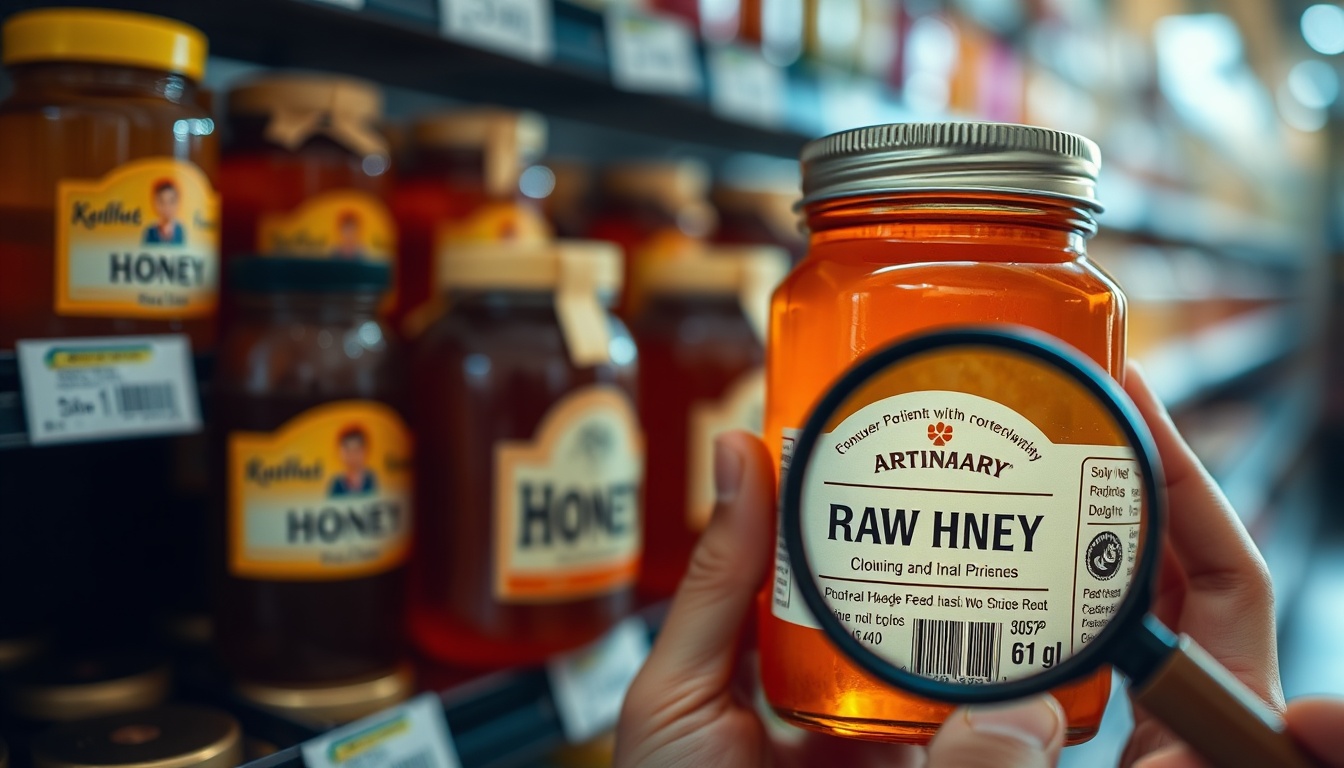
Start with the product name and ingredient list. FDA guidance says a product made only from honey may be named “honey.” When honey is mixed with another sweetener, the name should describe the blend and the added sweetener should appear in the ingredient statement. A clear producer or packer identity, country of origin, lot code, and reachable contact information improve traceability, but no label detail alone proves authenticity.
What Buying Checks Are Useful?
Prefer products that make the supply chain easier to check: a named producer or packer, specific origin, lot information, and a way to ask questions. Buying directly from a beekeeper may improve traceability, but the sales channel itself is not proof. Price, reviews, “raw,” “local,” cloudiness, and a named floral source can all inform a purchase without establishing purity.
How Do Laboratories Assess Authenticity?
Laboratories may combine stable-isotope analysis, sugar-profile methods, pollen analysis, spectroscopy, trace-element data, and supply-chain records. Each method has limits, and sophisticated adulteration may require several complementary methods. There is no single universally definitive test for every syrup, origin, and processing history.
Official UK Food Standards Agency overview of honey-authenticity methods
Check a honey label step by step
Use the label checker to review the product name, ingredients, origin, and traceability details. It does not certify authenticity.
Check a Honey LabelFrequently Asked Questions
How can you tell if honey is real or fake at home?
You cannot prove honey authenticity with a home or visual test. Water, thumb, paper, flame, and vinegar tests reflect properties such as moisture and viscosity, which vary naturally. Check labeling and traceability, and rely on fit-for-purpose laboratory testing when proof is required.
Does crystallization prove honey is pure?
No. Crystallization is a normal process affected by floral source, sugar balance, temperature, age, and particles in the honey. Genuine honey may crystallize quickly or remain liquid for a long time, so crystallization is not an authenticity test.
How common is adulterated honey?
No single official result establishes a universal prevalence. The FDA found 4 of 102 samples violative in its fiscal-year 2025 assignment. An EU coordinated action flagged 147 of 320 imported consignments as suspicious, which was not the same as confirmed adulteration or a U.S.-retail estimate.
What is the most practical check before buying honey?
Read the product name and ingredient list, then look for traceability details such as a named producer or packer, origin, lot code, and contact information. These checks reduce uncertainty but do not prove authenticity.
Edited by Sam French · Raw Honey Guide Editorial Team
Source reviewed against primary literature and official guidance where available. Health content is educational, not medical advice, and does not replace a licensed clinician.
Get the Honey Buyer's Cheat Sheet (free PDF)
16 varieties on one page — color, flavor, best use and what a fair price looks like — from the 268 honeys we track.
Related Guides
Quality & Grading
Identify quality honey and spot fakes.
Read GuideRaw Honey vs Regular
Processing, nutrition, and how to choose.
Read GuideBest Honey Brands
Compare labels, traceability, certification, testing evidence, and value without relying on a ranking.
Read GuideRelated Articles
How to Tell If Honey Is Real: 7 Tests You Can Do at Home
Learn 7 easy at-home tests to tell if your honey is real or fake. Water test, thumb test, flame test, and more. Spot adulterated honey before you buy.
Read ArticleHow to Read a Honey Label: What Every Buyer Should Know
Decode honey labels: raw, organic, unfiltered, UMF, MGO, True Source Certified. Spot marketing claims and buy smarter.
Read ArticleRaw Honey vs Organic Honey: Understanding the Key Differences
Raw vs organic honey — what's the real difference? Compare processing, certification, nutrition, and pick the right one.
Read Article