Japan: A Dual Honey Tradition in One of the World's Most Demanding Markets
Japan presents a paradox in global honey geography: it is simultaneously one of the world's most sophisticated honey-consuming nations and one of the smallest honey producers among developed economies. Japan's domestic honey production — estimated at approximately 2,500–3,500 metric tonnes annually by the Ministry of Agriculture, Forestry and Fisheries (MAFF) — meets only 5–10% of national consumption. The remaining 90%+ is imported, primarily from China, Canada, and Argentina, making Japan the world's third-largest honey importer. Yet this import dependence exists alongside a tradition of domestic honey production that is arguably the most technically refined and culturally embedded in Asia, producing varieties — tochi honey, renge honey, Nihon mitsubachi honey — that command prices far beyond any comparable imported product.
The reason lies in Japan's dual beekeeping tradition. Since the introduction of European honeybees (Apis mellifera) in the Meiji era (1868–1912), Japan has maintained two parallel beekeeping worlds. The modern commercial sector uses Western Apis mellifera colonies and produces honey from Japan's mountainous floral wealth — horse chestnut (tochi), milk vetch (renge), buckwheat (soba), Japanese basswood (shina), acacia/robinia — in volumes sufficient for specialty and premium retail. Alongside it, a growing tradition of Nihon mitsubachi beekeeping — keeping Japan's only native honeybee, Apis cerana japonica — produces tiny volumes of deeply complex honey. No dated retail price is cited for it. Understanding both traditions is essential for understanding Japanese honey.
Japan's geography — four main islands spanning from subtropical Okinawa to subarctic Hokkaido — creates extraordinary botanical diversity within a single nation. The dominant honey-producing regions are the temperate mountainous zones of Honshu (Nagano, Tochigi, Niigata, Akita, Iwate prefectures) and the northern island of Hokkaido. Mountain valleys and forest edges provide tochi (horse chestnut), shina (Japanese basswood), and diverse wildflower nectar flows. Hokkaido's vast agricultural plains produce soba (buckwheat) and wildflower varieties. The pacific coastal regions and lowland Honshu support renge (milk vetch) production, though this traditional variety has declined significantly over the past half-century as farming practices changed. For context with other Asian honey traditions, see our World Honey Guide.
Acacia/Robinia Honey (アカシア蜂蜜) — Japan's Most Produced Domestic Variety
Despite carrying the name "acacia," Japanese acacia honey (アカシア蜂蜜, akashia hachimitsu) is produced from Robinia pseudoacacia — false acacia or black locust — the same plant that produces the celebrated European acacia honey of Hungary, France, and Italy, and also dominant in Chinese acacia honey. Robinia pseudoacacia is not native to Japan; it was introduced from North America during the Meiji-era modernization programs and widely planted as a soil-stabilizing, fast-growing tree in reforestation efforts across Honshu and Hokkaido. Its extraordinary nectar productivity, combined with its successful naturalization across Japan's temperate mountain zones, made it the foundation of Japan's modern commercial beekeeping industry.
Japanese acacia honey shares the defining characteristics of all Robinia pseudoacacia honey worldwide: very pale colour (water-white to pale gold), exceptionally high fructose content (typically 38–42%), very slow or absent crystallization even after years of storage, and a mild, clean, lightly floral character without the assertive aromatics of stronger honey varieties. This mild profile makes it Japan's most commercially versatile honey — it dissolves cleanly in cold beverages without adding strong flavors, is used in Japanese patisserie (washoku and yōgashi alike) for its ability to add sweetness without dominating, and is the standard honey for sweetening yogurt, oatmeal, and mild herbal teas. Premium Japanese acacia honey from single-prefecture production in Nagano, Iwate, or Akita commands from specialty domestic honey retailers.
The main production regions for Japanese acacia honey are the mountainous prefectures of Nagano (Japan's largest domestic honey-producing prefecture), Iwate, Akita, Tochigi, and Niigata, where robinia trees colonize forest edges and river valleys at 300–900 metre elevation. Bloom timing varies by altitude and latitude: Kyushu lowland robinia blooms in late April–early May; Nagano mountain valleys bloom in late May–early June; northern Tohoku and Hokkaido robinia blooms in June. Beekeepers move hives to follow the bloom northward and upward — a transhumance pattern comparable to Spanish and Italian acacia honey production. A key authenticity marker for genuine Japanese domestic acacia honey: it should be completely liquid at room temperature even after years of storage. Any crystallization in labeled "Japanese acacia honey" suggests blending with other domestic varieties or imported honey.
Get the Honey Buyer's Cheat Sheet (free PDF)
16 varieties on one page — color, flavor, best use and what a fair price looks like — from the 304 honeys we track.
Tochi Honey (栃蜂蜜) — Japan's Most Prized Native Monofloral
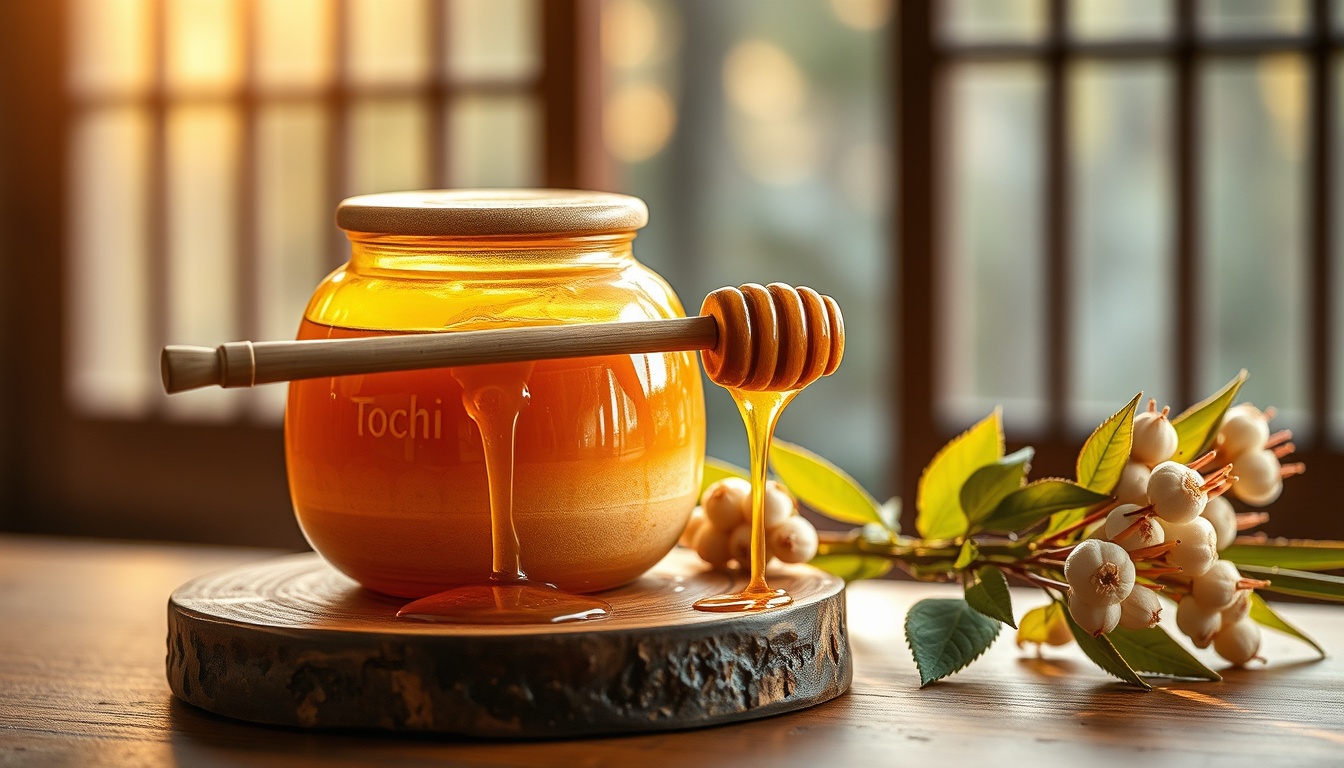
Among Japan's domestically produced monofloral honeys, tochi honey (栃蜂蜜, tochi hachimitsu) holds a place of special cultural and commercial distinction. It is produced from the flowers of Aesculus turbinata — the Japanese horse chestnut, or tochi-no-ki (栃の木) — a deciduous tree endemic to the cool-temperate mountain forests of Japan. Aesculus turbinata is closely related to the European horse chestnut (A. hippocastanum), which produces the strongly bitter chestnut honey of Corsica and Italy, but Japanese horse chestnut honey has a significantly different and more nuanced character: lighter in bitterness, more complex in floral aromatics, and occupying a flavor space between acacia honey's mildness and European chestnut honey's assertive bitterness.
Tochi honey is produced in the mountainous regions of Honshu where Aesculus turbinata grows abundantly in rich forest soils at 500–1,200 metres: Tochigi Prefecture (whose name is derived directly from the tochi tree — it was historically renowned as the region of tochi groves), Fukushima, Niigata, Nagano, Yamagata, and Iwate. The bloom occurs in late May–June, typically 2–4 weeks after acacia. Freshly harvested tochi honey is amber to golden-amber in colour, moderately viscous, with a distinctive aroma that blends floral depth, light caramel, and a subtle nutty-herbal note from the horse chestnut blossoms. The bitterness — present but restrained compared to European horse chestnut honey — provides complexity that makes it excellent with foods that can balance it: aged Japanese cheeses (rare but growing in Japan), natural yogurt, aged sake lees (sakekasu), and dark rye bread.
What makes tochi honey especially prized is its crystallization behavior: it forms a very slow, fine-grained semi-solid paste over 3–6+ months at room temperature, retaining its aromatic character beautifully in the crystallized state. Japanese honey connoisseurs often prefer aged, partially-crystallized tochi honey for its more complex, rounded flavor. Authentic premium tochi honey from named producers in Tochigi or Nagano is a domestic specialty. No dated retail price is cited. Tochi honey is also notable as one of the few Japanese domestic honeys with significant health research interest: its high flavonoid content from the Aesculus turbinata bloom has attracted attention from Japanese pharmaceutical research institutions studying phenolic bioavailability.
Renge Honey (蓮花蜂蜜) — Japan's Traditional Spring Honey
Before acacia honey came to dominate Japan's domestic market, renge honey (蓮花蜂蜜, renge hachimitsu) — produced from Astragalus sinicus, the Chinese milk vetch — was considered Japan's definitive domestic honey and the honey most Japanese people grew up with. Renge-so (蓮花草), as Astragalus sinicus is called in Japanese, was traditionally planted as a green manure cover crop in winter rice paddies across lowland Japan — primarily in Kyushu, Shikoku, the Kinki (Kansai) region, Chugoku, and coastal Honshu. Its April–May bloom, just before rice planting season, produced one of Japan's most reliable and abundant spring nectar flows, providing sustenance for enormous numbers of honeybee colonies and, for rural communities, the primary source of locally produced honey.
Renge honey is pale to water-white in colour — even paler than acacia honey — with an extraordinarily delicate, mild, lightly sweet character that carries a subtle, ephemeral floral note unlike any other honey. Japanese food writers have described it as "the taste of spring itself" — that lightness and transience are central to its appeal in a country where seasonal awareness (shun, 旬) is a cultural value of the highest order. It crystallizes moderately quickly into a smooth, very fine-grained white paste. Unlike European acacia honey, which is mild by virtue of its single dominant nectar source, renge honey's mildness comes from the Astragalus sinicus flower itself — a legume nectar with very low acidity and mineral content, producing some of the most delicate flavors in the honey world.
Authentic renge honey is now significantly rarer than it was in the mid-20th century. The widespread adoption of chemical fertilizers and pesticides in Japanese agriculture from the 1960s onward eliminated most renge-so from paddy fields — farmers no longer needed the natural nitrogen-fixing benefit of the milk vetch green manure when chemical fertilizers were available. As a result, many producers who once labeled their spring honey as "renge" shifted to acacia and other varieties, and genuine monofloral renge honey from traditional cultivation areas became a specialty product. Today, authentic single-origin renge honey from remaining cultivation areas in Kyushu and Shikoku commands and is considered a nostalgic luxury by older Japanese consumers and a genuine rarity by international honey enthusiasts. Flavor profile: water-white to very pale; fine-grained crystallized paste; extremely delicate, milky-floral-sweet, minimal bitterness. Best with: mild Japanese cheeses, fresh tofu, white mochi, plain yogurt, and as a table sweetener for delicate teas.
Soba Honey (そば蜂蜜) and Hokkaido Wildflower — The North's Bold Varieties
Hokkaido, Japan's northernmost main island and its largest and most agriculturally productive prefecture, produces Japan's most robust honey variety: soba honey (そば蜂蜜, soba hachimitsu), from buckwheat (Fagopyrum esculentum, called soba or 蕎麦 in Japanese). Hokkaido is the center of Japan's soba cultivation — buckwheat for noodles is deeply embedded in Japanese food culture, particularly in the cold-climate northern regions — and its summer bloom (July–August) provides a major nectar flow for Hokkaido's beekeeping operations. Japanese soba honey is directly comparable in character to American New York buckwheat honey or Eastern European buckwheat honey: very dark amber to near-black, intensely robust and complex, with flavors of dark molasses, roasted grain, dried fruit, and bitter chocolate, backed by a long mineral finish.
The cultural resonance of soba honey in Japan is enhanced by its connection to the national soba noodle tradition. In Nagano Prefecture — Japan's premier soba noodle-producing region as well as a significant buckwheat honey producer — pairing locally produced soba honey with Shinshu soba noodles has become a local specialty. Some Nagano soba restaurants offer soba honey-based desserts and dressings alongside the noodles, creating a direct botanical and culinary connection from field to table. Hokkaido soba honey, with its extreme northern terroir, tends toward even darker colour and more assertive flavor than Nagano soba honey due to the shorter, more intense Hokkaido growing season concentrating sugars and aromatics. Crystallization of soba honey is relatively rapid — within 1–3 months — producing a grainy, medium-textured dark amber paste.
Beyond soba, Hokkaido produces excellent polyfloral wildflower honey (百花蜜, hyakka mitsu, literally "hundred flower honey") from its diverse temperate flora: clover, sweet clover, goldenrod, fireweed, sunflower crop borders, and the forested mountain zones of the Hidaka and Daisetsuzan ranges. Hokkaido wildflower honey varies significantly by locality and season: coastal lowland varieties tend toward mild-moderate, golden amber; mountain-zone varieties can be darker, more complex, with linden/basswood (シナノキ, shina-no-ki — Tilia japonica and T. maximowicziana, Japan's native basswood species) notes prominent in July. Japanese basswood honey (シナノキ蜂蜜, shina-no-ki hachimitsu) is a monofloral specialty particularly prized in Niigata, Nagano, and Hokkaido, sharing the characteristic minted-herbal, cool floral depth of European linden honey. Flavor profile (soba): very dark, near-black; grainy crystallized paste; intensely robust, molasses-dark fruit, mineral. Price: premium domestic.
Nihon Mitsubachi (日本みつばち): The Native Japanese Honeybee
The most extraordinary chapter in Japanese honey is also the least known internationally: the honey of Apis cerana japonica — the Nihon mitsubachi (日本みつばち, Japanese honeybee), the only native honeybee species in Japan. Apis cerana japonica is a subspecies of the Asian honeybee Apis cerana and belongs to a lineage entirely distinct from the European Apis mellifera that produces virtually all commercially known honey worldwide. The Nihon mitsubachi has co-evolved with Japan's native flora, forests, and — most dramatically — Japan's native predators, over millions of years. The result is a bee with behavioral and physiological characteristics unlike any Apis mellifera variety, producing honey of extraordinary complexity at very low volumes.
The most famous documented behavior of Nihon mitsubachi is its thermal defense against the Japanese giant hornet (Vespa mandarinia japonica) — one of the most lethal insect predators in the world. When a Japanese giant hornet scout enters a Nihon mitsubachi colony to mark it for a raiding party, the colony responds with a remarkable mass defense: worker bees rapidly surround the hornet, forming a dense "bee ball" (熱殺蜂球, nessatsu hōkyū, or thermal bee ball), vibrating their flight muscles to generate heat. Ono et al. (Nature, 377:334–336, 1995) documented that the bee ball core reaches temperatures of 46–47°C — hot enough to kill the hornet (which dies at 44–46°C) while the bees themselves can tolerate up to 48–50°C. This remarkable precision in thermal tolerance — a gap of only 2–4°C between lethal-for-hornet and lethal-for-bee — represents one of the most extraordinary examples of co-evolutionary pressure documented in insect biology. Apis mellifera colonies in Japan have no such defense and are devastated by giant hornet raids, which is one reason keeping European bees in rural Honshu requires active human intervention to protect colonies during hornet season (August–November).
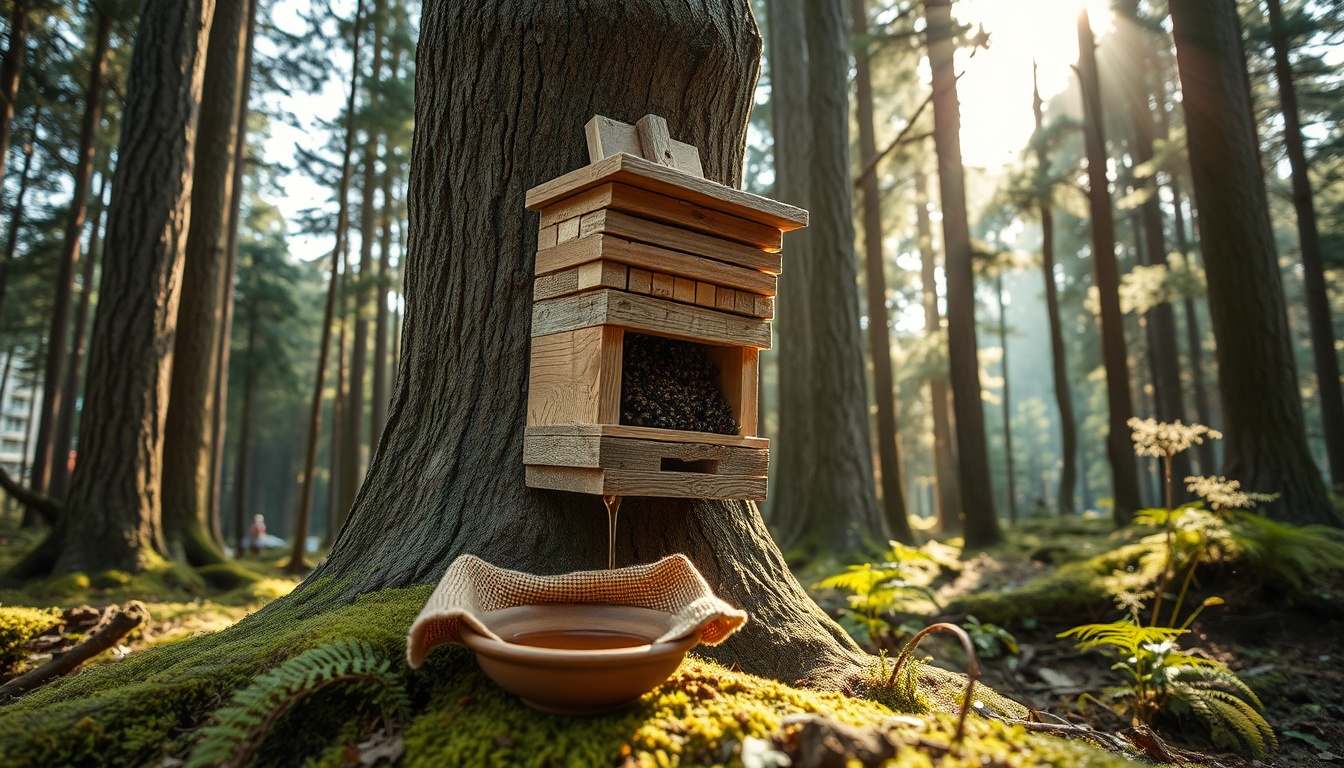
Nihon mitsubachi colonies produce significantly less honey than European colonies — typically 10–20 kilograms per year per colony, compared to 20–40 kilograms for a well-managed Apis mellifera colony. Traditional Nihon mitsubachi keeping uses wooden square-stacked box hives (called jū-bako hives, 重箱式巣箱), modeled on naturally colonized tree hollows. Honey is harvested once per year, typically in late autumn, by removing the uppermost boxes from which the bees have vacated, pressing the natural round comb through cloth to extract the honey without centrifuge. This cold-press extraction preserves all pollen, propolis, and enzymes in the honey — it is definitionally raw honey of the highest quality. The flavor profile of Nihon mitsubachi honey is unlike any Apis mellifera honey: extremely complex dark amber, with multiple overlapping floral notes from an entire year's foraging across Japan's wild forest flora, a subtle resinous depth from propolis contact during pressing, and a richness that experienced tasters describe as more wine-like than honey-like in its aromatic complexity.
Nihon mitsubachi honey is among the most expensive commercially available honey in the world. Small-batch production (typically 2–5 kilograms per hive per year from individual keepers) and labor-intensive keeping practices limit the crop. Unlike most commercial honey, Nihon mitsubachi honey is almost never available through standard retail channels — it is sold direct from individual keepers, at regional specialty markets, and increasingly through Japanese online producer platforms. The growing Nihon mitsubachi keeping movement in Japan has a strong community character: keeper associations (日本みつばちを守る会 and regional variants) promote traditional keeping methods, advocate against pesticide use in foraging areas, and document colony numbers across Japan's declining wild Nihon mitsubachi populations.
The Science: JAS Standards, Japanese Honey Research, and Quality
Japan's domestic honey quality is governed by the Japanese Agricultural Standards (JAS, 日本農林規格) for honey, administered by MAFF (Ministry of Agriculture, Forestry and Fisheries, 農林水産省). JAS standards for honey align closely with Codex Alimentarius international standards but include some Japan-specific provisions reflecting domestic industry needs. Key JAS honey quality parameters: water content (moisture) ≤20%; HMF (hydroxymethylfurfural) ≤40 mg/kg; diastase activity ≥8 (Schade scale); reducing sugars ≥65 g/100g; sucrose ≤5 g/100g. JAS standards explicitly prohibit the addition of sugars, glucose syrup, starch syrup, or any sweeteners — a category of adulteration that has affected Japanese honey imports significantly, particularly from Chinese suppliers.
Japanese honey imports are subject to Japan's Food Sanitation Act and residue testing under MAFF and the Ministry of Health, Labour and Welfare (MHLW). China, Japan's largest single source of imported honey, has faced recurring quality issues including antibiotic residues (particularly chloramphenicol and streptomycin) and C4 sugar adulteration. Japanese importers of premium honey have increasingly turned to Canadian, New Zealand, and European suppliers for documented quality, though Chinese honey remains dominant in the commodity price tier. For domestic honey, JAS certification with the JAS mark (JAS格付) on packaging is the primary quality signal for Japanese consumers. The Japan Honey Bee Association (日本養蜂協会) maintains additional quality designations and member producer standards.
Research on Japanese honey has grown significantly from Japanese universities. Tokai University, Meiji University, and various agricultural research institutions have published studies on the phenolic composition and antioxidant activity of Japanese monofloral varieties. Tochi honey has attracted particular research interest for its flavonoid profile — with elevated levels of quercetin, kaempferol, and catechin derivatives from Aesculus turbinata pollen and nectar — that appears to correlate with strong DPPH radical-scavenging activity in in vitro assays. Nihon mitsubachi honey has been studied for its exceptionally high propolis contact during cold-press extraction, which may contribute to elevated antimicrobial activity compared to centrifuge-extracted Apis mellifera honey. Research on Japanese soba honey has confirmed its high phenolic content consistent with buckwheat honey from other global production regions, citing similar results to Vit et al. studies on antioxidant activity of dark-colored honeys. All health-related benefits should be understood as preliminary in vitro research; honey is a food, not a medicine, and should be part of a balanced diet.
Buying Japanese Honey: How to Find and Authenticate Domestic Varieties
Navigating the Japanese honey market presents a challenge that mirrors Japan's honey trade imbalance: most honey sold at Japanese convenience stores, supermarkets, and discount retailers is imported, blended, or domestic-imported mixed product labeled in ways that require careful reading of the Japanese-language label. Here's how to identify and source authentic Japanese domestic honey:
**For genuine domestic Japanese honey:** The label (表示, hyōji) must state "国産" (kokusan) — meaning "domestically produced" — or name a specific Japanese prefecture of origin. "国産はちみつ" (kokusan hachimitsu) is the foundational qualifier. Single-variety labels should specify the floral source: アカシア (acacia/robinia), 栃 (tochi/horse chestnut), 蓮花/れんげ (renge/milk vetch), そば (soba/buckwheat), 百花 (hyakka/wildflower). JAS certification (JAS格付マーク) provides additional quality assurance. **For Nihon mitsubachi honey:** Look for "日本みつばちのはちみつ" (Nihon mitsubachi no hachimitsu) or "在来種みつばちのはちみつ" (zairai-shu mitsubachi no hachimitsu — indigenous bee honey). These products are almost never found in standard retail; search dedicated Japanese specialty honey sites, natural food stores, or regional producers' direct-sales platforms (直売, chokusei). Buy it from a named keeper.
**Outside Japan:** Japanese domestic honey is rarely exported in significant quantities, though specialty online platforms (Rakuten Global, some Japanese Amazon sellers, and specialty importers in the US, Germany, and UK) carry small volumes of premium tochi, acacia, and Nihon mitsubachi honey. When purchasing from outside Japan, verify: country of origin is Japan (not China, Canada, or Argentina), variety specification matches what you intend to buy, and the seller has verifiable producer relationships. No dated export price is cited for tochi, acacia, or Nihon mitsubachi. **Red flags:** Any Japanese honey priced comparably to imported commodity honey is almost certainly a domestic-imported blend or mislabeled. Genuine premium Japanese domestic single-variety honey is expensive by design — it reflects small-scale production, careful quality control, and genuine scarcity. For broader international honey buying context, see our World Honey Guide.