Lynghonung: Denmark's Thixotropic Heather Honey Completing the Nordic Cluster
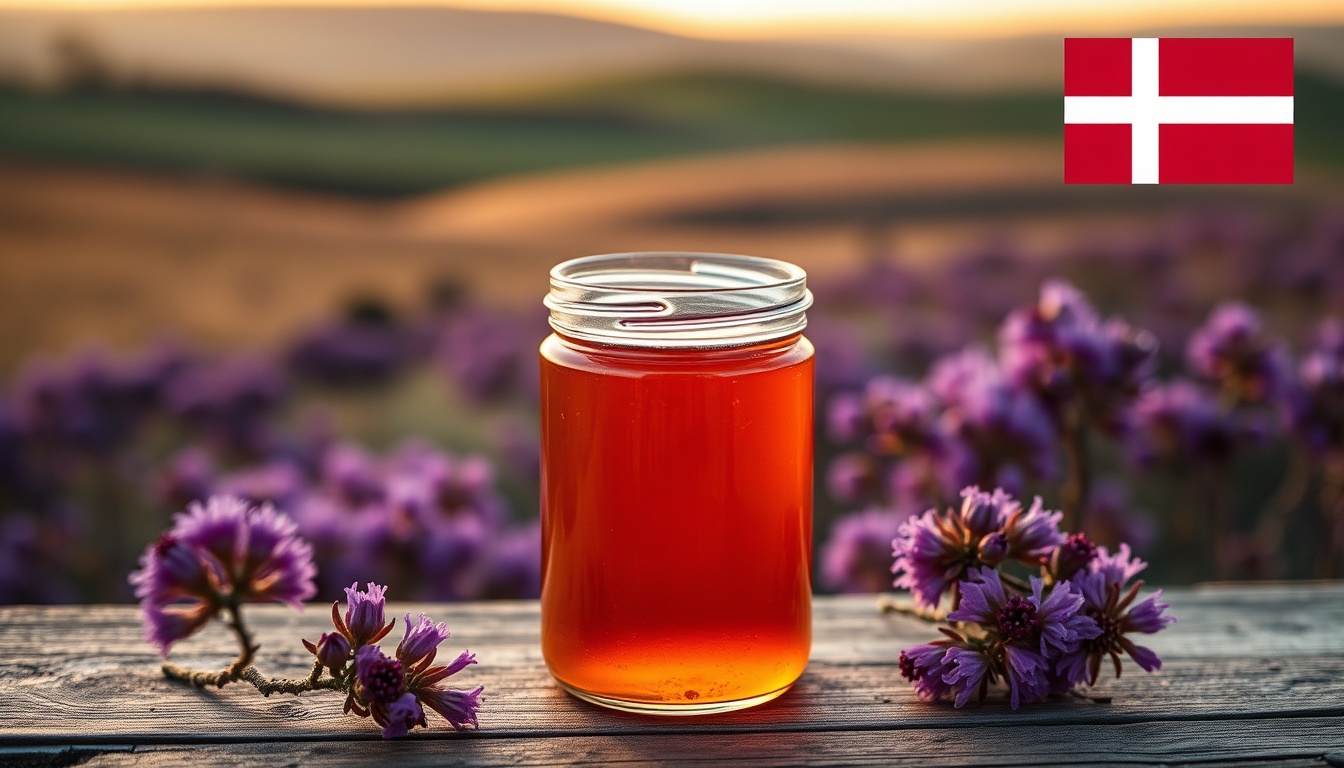
Denmark's most distinctive specialty honey is lynghonung — heather honey from Calluna vulgaris, the same low-growing moorland shrub that produces Sweden's ljunghonung and Norway's lynghonning. Like its Scandinavian neighbors, Danish lynghonung is thixotropic: it gels inside the jar at rest, forming a firm, semi-solid consistency that resists pouring, then flows freely when stirred or shaken before re-gelling within minutes. This property is caused by arabin protein — a diastase-related compound unique to Calluna honey matrix — and cannot be replicated by temperature crystallization or blending other varieties. Scottish heather honey shares identical thixotropic properties from the same Calluna vulgaris botanical source, though Scottish Highland granite-heath environments produce more pronounced amber color versus Denmark's lighter sandy-heath character. Denmark's contribution of lynghonung to the Nordic cluster completes a geographically contiguous heather-honey belt running from Denmark's Jutland peninsula through Norway's western fjord coast into Sweden's Norrland heathlands.
Denmark's Calluna heather moors are concentrated on Jutland's sandy glacial outwash plains, which cover the peninsula's central and western interior. The largest intact heathland complexes include Kongenshus Mindepark (Jutland's largest protected heathland, ~2,400 hectares in Viborg municipality), Mols Bjerge (Djursland peninsula, classified as National Park), Thy National Park (western Jutland coastal heathland), and the Rebild Bakker heathlands south of Aalborg. Historically the Jutland heath (the hede) covered nearly a third of the peninsula — deliberate afforestation with Sitka spruce and Scots pine in the 19th and 20th centuries reduced it dramatically, but conservation management since the 1980s has restored significant heathland extent. Calluna blooms August into mid-September in Jutland — a late-season flow that beekeepers transhumate to reach, moving hives from agricultural lowlands to heathland zones as summer clover and rapeseed flows end. This transhumance pattern contrasts sharply with German forest honey production, where beekeepers position hives in temperate coniferous zones for continuous honeydew collection throughout the summer season rather than Denmark's focused late-season Calluna campaign requiring seasonal hive movement to sandy heathland terroir.
Authentication of genuine lynghonung relies on the same thixotropy test used for Swedish and Norwegian heather honey: a properly sealed jar inverted at room temperature should show the honey gel clinging without flowing, then slowly moving after several seconds. Pollen analysis confirming Calluna pollen at ≥45% frequency (the EU minimum for monofloral classification) is the formal standard. The Dansk Biavlerforening (DBF, the Danish Beekeepers' Association, founded 1866 — one of Europe's oldest beekeeping organizations) administers the Danmarks Honning quality mark, which certifies Danish origin, minimum quality thresholds, and annual producer inspection. For lynghonung specifically, the DBF mark indicates certified domestic Calluna honey; producers in Jutland heathland zones use regional labeling to specify the heath source.
Pro Tip
The three Nordic thixotropic heather honeys — Danish lynghonung, Swedish ljunghonung, and Norwegian lynghonning — are all produced from Calluna vulgaris and all share the arabin-protein gel mechanism. The gel-in-jar test is reliable for all three: invert a sealed room-temperature jar. Genuine thixotropic heather honey clings for several seconds before slowly moving. A honey that flows immediately is diluted or blended. Danish lynghonung from Jutland moors and Norwegian lynghonning from western fjord heathlands represent the same floral source with terroir differences from their respective coastal or continental climates.
Læsø Sortebiet: Europe's Most Strictly Protected Dark Bee Conservation Program
Denmark's most remarkable contribution to European apiculture is the Læsø sortebiet (black bee) conservation program — the most strictly enforced Apis mellifera mellifera genetic reserve in continental Europe. Læsø is a small island (114 km²) in the Kattegat strait between Jutland and Sweden, with a population of approximately 1,800 permanent residents. Since 1993, Danish law has classified Læsø as a protected breeding zone for Apis mellifera mellifera under provisions of the Danish Nature Protection Act. All import of queen bees of non-mellifera subspecies onto the island is banned, all drone mating occurs naturally within the island's closed gene pool, and all resident colonies must be pure Apis mellifera mellifera. Violations are a criminal offense under Danish law — a level of legal enforcement that no other European dark bee conservation program matches.
The sortebiet — 'black bee' in Danish — is the same subspecies as Sweden's nordbi, Norway's svartbiet, and Finland's musta mehiläinen: the northern European native bee that was nearly eliminated across its historical range during the late 19th and 20th centuries by mass importation of Italian (Apis mellifera ligustica) and Carniolan (Apis mellifera carnica) bees. These imports were prized for honey production and manageable temperament, but they cross-mated readily with native dark bees, creating hybrid populations that lost the specific cold-climate adaptations the northern subspecies had developed over millennia. While Italian acacia honey produced by A. m. ligustica achieves water-white clarity and delicate vanilla undertones prized for commercial markets, the Læsø sortebiet produces honey with more pronounced terroir expression from Danish coastal botanical sources, creating amber varieties with mineral complexity from the island's maritime climate impossible to replicate in temperate Alpine foothills. On Læsø, the prohibition of non-native imports and natural island isolation from mainland Denmark (Læsø lies 18 km from the nearest Jutland coast — beyond the typical honeybee drone flight radius of 5–7 km) has allowed a genetically pure, locally selected population to persist and recover.
The Læsø Biavlerforening (Læsø Beekeepers' Association) coordinates conservation breeding in collaboration with the DBF and the Nordic Gene Bank. Queens are evaluated annually for winter survival (colonies that survive -15°C Kattegat winters intact), spring buildup rate in the short northern season, gentleness under inspection, and hygienic behavior — the capacity to detect and remove Varroa-infested brood that is the primary Varroa-resistance mechanism in managed bees. Læsø-bred queens are exported to breeders across Denmark and neighboring countries as foundation stock for mainland sortebiet breeding programs that lack geographic isolation. The program is the institutional model for the Nordic dark bee conservation network: Sweden's Öland and Gotska Sandön reserves, Norway's Osterøy program, and Finland's Åland Islands sanctuary all use analogous island-isolation + legal-protection + annual-evaluation frameworks, but the Læsø program is older, legally more stringent, and carries the strongest genetic documentation.
Pro Tip
Honey from Læsø's registered sortebiet apiaries is labeled with the Læsø sortebiet certification and commands a conservation premium at Danish specialty honey markets, the annual Dansk Biavlerforening fair, and select Copenhagen delicatessens. Purchasing documented Læsø honey directly supports the breeding program's operational costs — the island economy is small and the apiary network depends partly on specialty-product revenue. When buying online, look for explicit sortebiet certification and Læsø island origin labeling.
Get the Honey Buyer's Cheat Sheet (free PDF)
16 varieties on one page — color, flavor, best use and what a fair price looks like — from the 304 honeys we track.
Rapshonning: Denmark's Agricultural Honey and Why It Crystallizes in Days
Denmark's largest honey category by volume is rapshonning — rapeseed honey from Brassica napus, the dominant oilseed crop across Danish agricultural lowlands in Jutland, Funen, Zealand, and the smaller Danish islands. Rapeseed blooms bright yellow across the Danish landscape in May and June, providing a massive early-season nectar flow that most Danish colonies exploit regardless of beekeeper intervention. Rapshonning is pale cream to white in color — the palest honey commonly available in the Danish market — with a mild, slightly bitter-almond and floral flavor that becomes very soft and smooth after crystallization.
Rapshonning crystallizes unusually fast: within one to three weeks of extraction, the high glucose content (rapeseed nectar is strongly glucose-dominant) triggers nucleation and rapid crystal growth throughout the honey mass. If left to crystallize without management, rapshonning sets hard enough to require warming before it can be scooped from the jar. This is why most commercial rapshonning is either creamed (fine-grained, spreadable crystallization induced by stirring seed crystals in at controlled temperatures) or extracted and immediately processed to control crystal size. Creamed rapshonning is a Danish pantry staple — the default honey on breakfast bread and rye crackers — in the same role that pure clover honey USA plays in North American households, though rapeseed's glucose-dominant chemistry creates faster crystallization (1–3 weeks) versus clover's more balanced fructose-glucose ratio allowing 2–6 month liquid storage.
Denmark's rapeseed production is substantial: Denmark plants approximately 150,000–180,000 hectares of rapeseed annually, making it one of the crop's dominant zones in Northern Europe. This creates honey volumes that dominate domestic production statistics. Beekeepers who target specialty varieties must often manage around the rapeseed flow — extracting frames before rapeseed crystallizes in the comb — then move colonies to heathland, linden, or other specialty sources for summer and late-season flows. The tension between rapeseed volume and specialty variety management is one of the defining logistical realities of Danish commercial beekeeping.
Pro Tip
Creamed rapshonning is the most widely available Danish honey variety outside Denmark — it appears in Scandinavian specialty food shops across Germany, the Netherlands, and the UK. Its soft, spreadable texture and mild flavor make it the most accessible entry point into Danish honey. For something more distinctive, look for lynghonung from Jutland heathlands or specialty honey from Bornholm island producers.
Bornholm Island: Denmark's Limestone Terroir and the Southeastern Microclimate
Bornholm is Denmark's southernmost island (588 km², population ~40,000), located in the Baltic Sea closer to Sweden and Poland than to the Danish mainland. Its geology is unique within Denmark: Bornholm is underlain by Precambrian granite and sandstone rather than the chalky limestone that dominates the rest of Denmark, giving it a rocky, forested interior with a distinctive vegetation pattern. The Almindingen forest — Denmark's third-largest — covers the center of the island, with heath and sandy soils along the northeastern coast. Combined with a warmer and sunnier microclimate than the rest of Denmark (Bornholm averages significantly more sunshine hours annually than Copenhagen), Bornholm's flora and nectar profiles differ from mainland Danish honey.
Bornholm honey production includes several varieties rarely found elsewhere in Denmark. Heathland honey from northeastern Bornholm's Calluna moors — a modest but real thixotropic lynghonung — benefits from the island's extended warm season. Fruit blossom honey from Bornholm's apple and cherry orchards (the island is known for fruit farming) contributes a floral, fruity monofloral in May. Linden honey from scattered Tilia trees in the island's sheltered valleys provides the pale, mentholated variety familiar across the Nordic region. Bornholm polyflora — honey from the island's diverse coastal and forest flora — has a distinctive mineral character associated with the granite substrate, though this is more perceptible to experienced tasters than to casual consumers. This granite-influenced terroir character contrasts markedly with Texas wildflower honey, where limestone and clay soils across vast continental climate zones create botanical complexity through extended bloom succession, while Bornholm's compressed Baltic island geography produces mineral concentration from ancient Precambrian granite bedrock in a more focused seasonal window. Bornholm's small-scale producers sell primarily at the island's summer market circuit and via direct order; the island's tourism-driven economy makes local honey a premium product available at farm shops and the weekly Rønne market.
The cross-Baltic position gives Bornholm an interesting honey geography: the island is biologically within the range of some continental European flora absent from mainland Denmark, and its producers sometimes emphasize this botanical diversity in their labeling. Bornholm honey brands active in specialty Danish food retail include several small family apiaries that have sold through Danish farmers' markets and online since the 2010s, positioning Bornholm honey as the island-terroir alternative to Jutland heathland and mainland agricultural honey.
Danish Honey Regions: From the Jutland Heath to the Baltic Islands
**Northern Jutland (Nordjylland)**: The region with the densest heathland coverage in Denmark. Rebild Bakker hills, the Thy National Park coastal heathlands, and scattered protected heath reserves along Limfjord produce the bulk of Danish lynghonung. Agricultural lowlands around Aalborg and Hjørring produce rapeseed and clover. The distance from Malmö's urban-industrial corridor and the peninsula's geographic position at the North Sea–Kattegat junction gives northern Jutland a windswept, cool climate that influences late-season honey character.
**Central Jutland (Midtjylland)**: Kongenshus Mindepark, Denmark's largest intact heathland, is located here, making central Jutland the core of commercial lynghonung production. The Gudenå river valley produces mixed wildflower and water-meadow honey from the agricultural lowlands. Viborg is the traditional market center for Jutland interior honey.
**South Jutland and Funen (Syddanmark)**: Heavily agricultural — rapeseed and white clover dominate. The Wadden Sea tidal flats and salt marshes along the western coast produce sea-lavender and thrift honey in very small quantities from beehives placed along protected coastal zones. Funen ('the Garden of Denmark') has dense fruit orchard cultivation around Odense — apple blossom honey appears briefly in May.
**Zealand and Copenhagen (Sjælland)**: Denmark's most densely populated region. Urban beekeeping has grown substantially in Copenhagen since the early 2010s, with rooftop apiaries on major cultural institutions (the Royal Danish Theatre maintains a rooftop apiary) producing urban polyflora honey sold in the city's specialty food market circuit. Linden honey from the extensive Tilia street plantings in Copenhagen and provincial towns is available in late June through July. Rural Zealand produces rapeseed, clover, and phacelia honey from agricultural lowlands.
**Bornholm**: Specialty polyflora, fruit blossom, and small-volume lynghonung from northeastern coastal heathlands, under the island's distinctive Baltic microclimate. Small producer scale; primarily sold direct and through island tourism channels.
**Læsø**: Low-volume sortebiet honey with conservation certification. Available from Læsø producers at Danish specialty food fairs and direct order.
Danish Honey Standards, DBF Certification, and What to Look for When Buying
Danish honey regulation is governed by Bekendtgørelse nr. 476 af 27/04/2022 om honning (the Danish Honey Order) — Denmark's implementation of EU Honey Directive 2001/110/EC, updated to incorporate EU 2014/63/EU amendments. As an EU member state, Denmark applies the full suite of EU honey labeling requirements: water content ≤20% (≤18% for heather honey intended for industrial use), HMF ≤40 mg/kg (≤80 mg/kg for honey from regions with tropical climates), diastase activity ≥8 Schade units (≥3 for honeys with low natural diastase such as acacia), and country-of-origin labeling for single-origin honeys.
The primary voluntary quality certification for Danish-produced honey is the Danmarks Honning mark administered by the Dansk Biavlerforening (DBF). The mark certifies that honey: (1) is produced in Denmark by a registered DBF member, (2) meets DBF's additional quality thresholds (moisture ≤18.5%, HMF ≤30 mg/kg — stricter than EU minimums), and (3) has been subject to annual inspection. The DBF mark is a hexagonal honeycomb motif with the Danish flag colors and 'Danmarks Honning' text. It is the most reliable single purchase signal for genuine domestic Danish honey versus EU-blend imports. Denmark imports significant honey volumes from Eastern Europe and outside the EU for industrial use and retail blending; blended products are labeled 'blend of EU/non-EU honeys' or similar — any blend is excluded from DBF certification.
For specialty purchases, key labels to look for include: Lynghonung med DBF-mærket (heather honey with DBF certification), Læsø sortebiet honey (conservation program certification), and Bornholm Honning (island-specific origin). Danish specialty honey reaches international buyers primarily through Danish delicatessen chains and specialty food importers in Germany, the Netherlands, and the UK. The DBF's producer directory (publicly available via dbf.dk) lists registered Danish beekeepers with contact information and specialty varieties. Direct-order from Jutland heathland producers typically ships to EU countries; non-EU shipping is limited to a handful of larger specialty operations.
Pro Tip
The DBF Danmarks Honning mark is the most reliable authentication signal for Danish-produced honey. Look for the hexagonal logo with Danish flag colors. DBF-certified heather honey (lynghonung) additionally carries the thixotropic property — verify with the invert-jar test. Læsø sortebiet honey is labeled separately with island-origin and conservation certification. Avoid honey labeled only 'blend of EU honeys' or with mixed-origin labeling if you want authentic single-origin Danish product.