The Consumer's Paradox: Europe's Largest Honey Buyer Prizes a Honey Made Without Flowers
Germany consumes approximately 78,000–85,000 metric tonnes of honey per year, the highest total consumption in the EU and roughly 1.0–1.1 kg per person annually — the highest per-capita consumption rate in continental Europe. Its most celebrated domestic variety, Schwarzwälder Tannenhonig (Black Forest Fir Honey), is produced not from flower nectar but from the metabolic excretions of aphids feeding on Abies alba (silver fir = Weißtanne) in the Black Forest mountains. This double inversion — Europe's largest honey-consuming country producing its most distinctive honey through a mechanism entirely different from conventional honey-making — defines the German honey tradition and makes it one of the most underappreciated in the Western specialty food market.
Germany's domestic production covers only 25,000–30,000 metric tonnes of its 78,000–85,000 MT annual consumption — roughly 30–35% of demand. The remaining 50,000–60,000 MT is imported: Argentina is the largest single source (approximately 18,000–22,000 MT per year), followed by Mexico, Ukraine, Romania, Hungary, and China, blended under the EU's generic "mixture of EU and non-EU honeys" label. The structural paradox is identical to France's but sharper in Germany's case: Germany operates Europe's most rigorous voluntary honey quality certification system — the Deutsches Imkerbund (DIB) Gütesiegel — with stricter-than-EU specifications for moisture, origin, heat treatment, and sucrose content, while the majority of honey sold in German supermarkets is commodity-blend imported honey at carrying no such certification.
For the honey enthusiast, Germany's paradox opens a productive research question: what genuine domestic varieties justify the premium, and how does a buyer outside Germany find them? The answer divides into four categories, each with a distinctive character that no import blend can replicate: Waldhonig (forest honeydew honey, especially Schwarzwälder Tannenhonig from silver fir), Heideblüte (heather blossom honey from the Lüneburg Heath, gel-textured and botanically authenticated by its thixotropic behavior), Lindenblüte (linden blossom honey with its unmistakable cooling-aromatic signature), and specialty monoflorals including Rapshonig, Akazienhonig, and Buchweizenhonig. The guide that follows covers each in depth and explains the DIB certification that distinguishes authentic German honey from the import blend.
Waldhonig — Germany's Honeydew Tradition
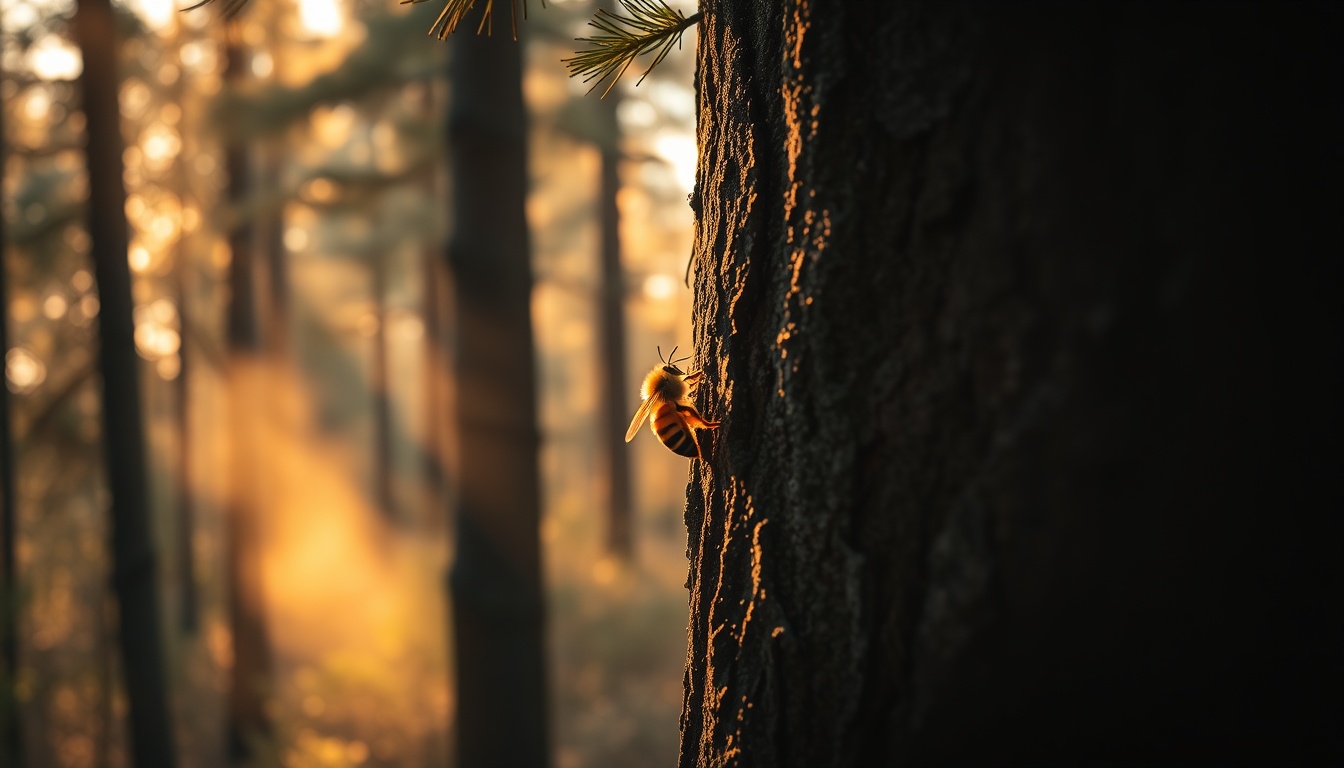
Waldhonig (forest honey) is the generic German category for honeydew honey — honey produced not from flower nectar but from the concentrated sugar-rich excretions of sap-feeding insects on conifers and deciduous trees. The mechanism mirrors that of French miel de sapin and Greek pine honeydew: bark lice (Psyllidae), scale insects (Coccidae), and aphids (Aphididae) feed on the phloem sap of trees, metabolise a portion of the proteins, minerals, and complex sugars, and excrete the remainder as a sticky solution called honeydew. Bees collect honeydew in warm, dry conditions between July and September, when aphid populations peak and excretion is most abundant. The resulting honey has fundamentally different chemistry from nectar-derived honey: lower simple sugars, higher oligosaccharides and polysaccharides (particularly melezitose, erlose, and raffinose), significantly higher mineral content, and higher electrical conductivity — the measurable proxy EU standards use to define honeydew honeys as distinct from flower honeys.
Germany's primary Waldhonig ecosystems are the Black Forest (Schwarzwald) in Baden-Württemberg and the Bavarian Alpine foothills, where Abies alba (silver fir) and Picea abies (Norway spruce) monocultures and mixed conifer forests support large aphid and scale insect populations through summer. The most important honeydew-producing insects on German conifers include: Physokermes piceae (the spruce soft scale), Cinara piceae and Cinara pectinatae (conifer aphids), and in recent decades Metcalfa pruinosa — an introduced North American planthopper established in Central Europe since the 1990s that produces abundant honeydew across a wide range of deciduous and conifer hosts. Honeydew availability is highly weather-dependent: a warm, dry August promotes peak aphid activity; a cool, wet summer suppresses them dramatically. Beekeepers in the Black Forest describe Waldhonig seasons as either exceptional (yielding 20–30 kg per colony) or near-absent, with little middle ground.
Generic Waldhonig not restricted to the specific Black Forest PGI zone covers a range from mixed conifer sources across Germany's forested regions. It is characterised by conductivity between 0.6 and 1.2 mS/cm (vs. 0.2–0.5 mS/cm for most flower honeys), dark amber to near-black color, complex malt-and-toffee primary notes with mild resinous and dried-fruit secondary notes, a relatively low perceived sweetness compared to flower honeys, and slow crystallisation due to high fructose and complex carbohydrate content. For comparison with German forest honey traditions, German forest honey represents the pinnacle of Central European honeydew production with its distinctive resinous complexity from Black Forest and Bavarian conifer sources. In German culinary tradition, Waldhonig is specified in sauerbraten marinades, Lebkuchen (German gingerbread) spice blends, game-meat glazes, and as an accompaniment to strong mountain cheeses. Its complexity rewards serious pairing in a way that most commodity flower honeys do not.
Get the Honey Buyer's Cheat Sheet (free PDF)
16 varieties on one page — color, flavor, best use and what a fair price looks like — from the 304 honeys we track.
Schwarzwälder Tannenhonig: The Black Forest's PGI-Protected Fir Honeydew
Schwarzwälder Tannenhonig (Black Forest Fir Honey) is Germany's most celebrated individual honey variety and the only German honey with EU Protected Geographical Indication (g.g.A. — geschützte geografische Angabe) status. The PGI designation restricts the name "Schwarzwälder Tannenhonig" to honeydew honey produced exclusively from Abies alba (silver fir = Weißtanne) honeydew within the Black Forest mountain region of Baden-Württemberg — the forested mountain massif between the Rhine Plain to the west and the Swabian Alps to the east, reaching elevations of 400–1,500 metres. The silver fir is the PGI's defining biological source: unlike Norway spruce honeydew (more widely available across German forests), Abies alba honeydew has a distinctive oligosaccharide and mineral composition that the PGI specifications capture through conductivity requirements. The designation distinguishes Schwarzwälder Tannenhonig from generic Waldhonig and from the adjacent French tradition: miel de sapin des Vosges AOP uses the same Abies alba source in the geologically continuous Vosges mountain range on the Rhine's opposite bank.
Schwarzwälder Tannenhonig must meet strict physicochemical thresholds: electrical conductivity ≥0.8 mS/cm (the international minimum for confirmed honeydew honey); HMF content ≤15 mg/kg (half the EU standard of 40 mg/kg, reflecting minimal heat processing); diastase number ≥8 Schade units; colour in the dark amber to near-black range; and sensory evaluation by certified tasting panels confirming the characteristic flavor profile. The honey must be harvested and first processed within the defined Black Forest geographic zone. Annual production volume is inherently variable and limited by natural aphid population cycles: authentic Schwarzwälder Tannenhonig from named Black Forest apiaries is never abundant. Retail prices reflect this: in German specialty shops, with premium pricing for named-beekeeper provenance.
The flavor of Schwarzwälder Tannenhonig is one of the most complex in the honey world: deep malt and toffee-caramel dominate, supported by mild silver-fir resin, a barely perceptible dried-fruit (plum, fig) middle note, and a long, clean mineral finish. There is essentially no floral sweetness — this is a fundamentally savory-sweet honey in a way that flower honeys are not. Consistency is noticeably thicker than most nectar honeys at room temperature, and colour ranges from dark amber-brown to near-black. Authentic Schwarzwälder Tannenhonig pairs comfortably with aged, pungent German mountain cheeses (Allgäuer Bergkäse, aged Emmental), game-meat glazes, dark rye breads, and bold black teas. The direct comparison with miel de sapin des Vosges AOP is instructive: both are Abies alba honeydew products from adjacent mountain ranges, both specify ≥0.8 mS/cm conductivity and ≤15 mg/kg HMF, and both exhibit the same dark-resinous-mineral character — the AOP framework on the French side requires stricter production controls, while the German PGI specifies geographic origin and key physicochemical parameters.
Heideblüte — The Gel Honey of the Lüneburg Heath
Heideblüte (heather blossom honey) from the Lüneburg Heath (Lüneburger Heide) in Lower Saxony is Germany's most texturally distinctive honey and the one with the longest continuous documented tradition of nomadic beekeeping in the German-speaking world. The Lüneburg Heath — a lowland heathland of approximately 7,400 km² — is one of the largest remaining heathland landscapes in Central Europe, managed since the Neolithic period by a combination of sheep-grazing (by the endemic Heidschnucken breed) and controlled burning to prevent forest succession. The resulting open Calluna vulgaris (common heather = Besenheide) monoculture produces some of Europe's most extensive and botanically pure late-summer heather nectar flows. Heather bloom runs from mid-August to late September — a 4–6 week window — making Heideblüte an inherently limited single-season product.
Heideblüte from Calluna vulgaris is a thixotropic honey: at rest it presents as a gel or semi-solid with a consistency closer to thick jam than liquid honey; under mechanical shearing — stirring, spreading, or the deformation caused by a tasting spoon — the gel breaks and the honey flows freely, then reforms over several hours at rest. This thixotropy arises from protein compounds specific to Calluna vulgaris nectar, suspected to involve arabinoxylans and other structural polysaccharides that form a three-dimensional gel network within the honey matrix. No equivalent gel-forming mechanism has been identified in any other European flower honey type (Calluna honey in Scotland, Ireland, and Wales shows the identical property; Scottish heather honey shares this distinctive thixotropic gel behavior from the same Calluna vulgaris source with comparable dark amber color and complex herbal character; manuka honey's thixotropy arises from a different mechanism involving protein fibrils). The thixotropic gel state of authentic Heideblüte is therefore both a quality marker and a botanical authentication tool: if the honey is fully liquid at room temperature without having been heat-treated, it is not pure Calluna vulgaris Heideblüte. Adulterated or mislabeled heather honey (e.g., Erica spp. heather honey, which is liquid) fails this test immediately.
The traditional production practice involves Wanderimkerei (nomadic beekeeping): beekeepers transport hives to the Heath in early August as bloom begins and collect them in September. This practice, documented in German beekeeping literature from the 16th century, is still followed by specialist Heidebauern and migratory beekeepers in Lower Saxony and is considered essential for authentic Lüneburg Heideblüte. Yield varies dramatically: a warm, dry August with full bloom can yield 15–25 kg per colony; a poor year may yield fewer than 5 kg. Heideblüte is dark amber-red in colour, with a warm, bittersweet-herbal aromatic complexity distinct from both flower honey sweetness and forest honeydew depth. It pairs exceptionally with strong cheeses (Harzerkäse, Tilsiter, aged Gouda), dark rye breads, and powerful black teas. Price for named-producer authentic Lüneburg Heideblüte.
Lindenblüte — Germany's Most Aromatic Flower Honey
Lindenblüte (linden blossom honey, from Tilia cordata — small-leaved lime / Winterlinde, and T. platyphyllos — large-leaved lime / Sommerlinde) is Germany's most distinctively aromatic flower honey and the one most immediately identifiable by its signature cooling-fresh sensory note. Its primary aroma is characterised by a clean, menthol-like cooling top note — not peppermint or camphor, but a fresh, open, almost aqueous coolness overlaid on mild hay-like and herbal middle notes with a clean, mellow sweetness. German linden honey represents the pinnacle of Central European linden production with this distinctive cooling aromatic signature from Germany's exceptional density of Tilia plantings impossible to replicate elsewhere. This cooling profile is generated by linalool oxide and other monoterpene derivatives in Tilia blossom nectar and is unique enough that experienced tasters can identify Lindenblüte blind among European honeys. No other European flower honey has a comparable fresh-cooling signature.
Germany's extraordinary density of Tilia plantings creates a uniquely rich Lindenblüte production environment. The German tradition of planting lime trees in village squares (Dorflindenbaum), along avenues (Alleen — Germany's tree-lined avenue tradition is among the densest in Europe), at church grounds, and in urban parks has created a dispersed forage network across every German region. Urban honey from German cities (Berlin, Hamburg, Munich, Frankfurt) is often Lindenblüte-dominant in July: the concentrated burst of lime-tree nectar during the brief bloom overwhelms urban-garden floral diversity for its duration. The Linden bloom is narrow — T. platyphyllos flowers mid-June to early July; T. cordata flowers approximately two weeks later in late June to mid-July — making the full Lindenblüte window typically 3–4 weeks. In warm, dry summers the nectar flow is intense and yields are high; in cool, wet years the linden nectar production falls dramatically.
Lindenblüte honey is pale gold to light amber when liquid, crystallising over 3–8 months to a medium-textured, smooth cream that retains some but not all of its signature aroma. Specialist German Lindenblüte producers sell fresh-extracted honey within months of the July harvest specifically to preserve the volatile cooling top note at its most pronounced — a parallel to the seasonal premium that applies to early-harvest olive oil or fresh-pressed apple juice. Price: from identified German linden-specialist producers.
Rapshonig, Phacelia, Buchweizen and Other German Varieties
Rapshonig (rapeseed honey, from Brassica napus) is Germany's dominant honey variety by production volume — the agricultural backbone of the domestic industry — and the most commercially misunderstood. Rapshonig crystallises with exceptional speed: within 2–4 weeks of extraction at room temperature it forms a dense, very fine crystal network that produces an almost white, opaque, solid honey with a smooth, creamy texture. Flavor-wise, it is among the mildest honeys produced anywhere: clean, slightly fatty-sweet, with essentially no floral character or bitterness. Germany cultivates approximately 1.4 million hectares of rapeseed annually, providing extraordinary nectar availability during the late-April-to-May bloom. For most commercial German beekeepers, the spring rapeseed flow accounts for 50–70% of annual honey yield. Authentic German Rapshonig under DIB certification is reliably white-cream with verified German origin; most Rapshonig sold in German supermarkets is similarly pale but may contain imported rapeseed or blended product. The varietal distinction matters: pure Rapshonig is the ideal creaming honey for German-style Cremehonig (creamed honey), where small crystal size and high glucose content create the smooth, spreadable texture that German consumers prefer over liquid honey.
Phacelia honey (Büschelschönhonig, from Phacelia tanacetifolia — blue tansy) is a second German volume variety that is almost unknown outside Germany. Phacelia tanacetifolia is intentionally planted across Germany as a bee forage crop and green manure — Germany has the largest intentional Phacelia acreage in Europe, with approximately 150,000 hectares sown annually. Phacelia honey is extremely pale (near-water-white to very pale gold), mild, with a slightly herbal-fresh character, and crystallises to a very smooth, fine texture comparable to rapeseed. It is valued by German beekeepers primarily as a spring and early-summer forage crop that bridges the gap between early willow and fruit bloom and the main rapeseed flow; commercially, it is often blended into German wildflower honey rather than sold as a monofloral. Buchweizenhonig (buckwheat honey, Fagopyrum esculentum) is produced in modest volumes by artisan beekeepers in Lower Saxony, Thuringia, and Bavaria — near-black, powerfully intense, malty-molasses character, high antioxidant polyphenol content, comparable in character to French miel de sarrasin or Canadian buckwheat honey but from German-cultivated buckwheat.
Akazienhonig (acacia honey, from Robinia pseudoacacia — the black locust, known in German as Robinie or Falsche Akazie) is produced in the sandy Brandenburg landscape east of Berlin, along Rhine and Main river valley zones, and in the Franconian wine country of northern Bavaria. German Akazienhonig is directly comparable to Hungarian or Romanian acacia in botanical character — pale gold to water-white, slow-crystallising (often remaining liquid for 2–3 years), mild and clean with barely perceptible floral notes, high fructose-dominant sugar profile — though produced in smaller volumes than Hungary's dominant acacia output. For comparison, Italian acacia honey shares the same Robinia pseudoacacia source with comparable pale color and liquid stability, representing the broader European acacia tradition with subtle terroir variations from Alpine foothills versus German river valleys. Robinia pseudoacacia is the same tree species introduced into Hungary in the 17th century (as noted in the global honey origin atlas: introduced from Virginia and the Carolinas as a soil-stabilizer, it became the foundation of Hungary's acacia honey industry). In Germany it remains a secondary variety, prized for its liquid stability and neutral flavour rather than its geographic distinctiveness.
DIB Standards — Germany's Voluntary Quality Framework
The Deutsches Imkerbund (DIB — German Beekeepers' Association) is the world's largest national beekeeping organization by membership, with approximately 107,000 registered members managing around 880,000–900,000 bee colonies as of 2022. The DIB operates primarily as a hobby and small-scale beekeeping organization: most German beekeepers maintain fewer than 25 colonies, and the image of German beekeeping is of a tradition-conscious, Slow Food-aligned craft rather than an industrial operation. This cultural positioning explains both the strictness of the DIB voluntary quality standards and the relative smallness of Germany's domestic production share relative to its consumption.
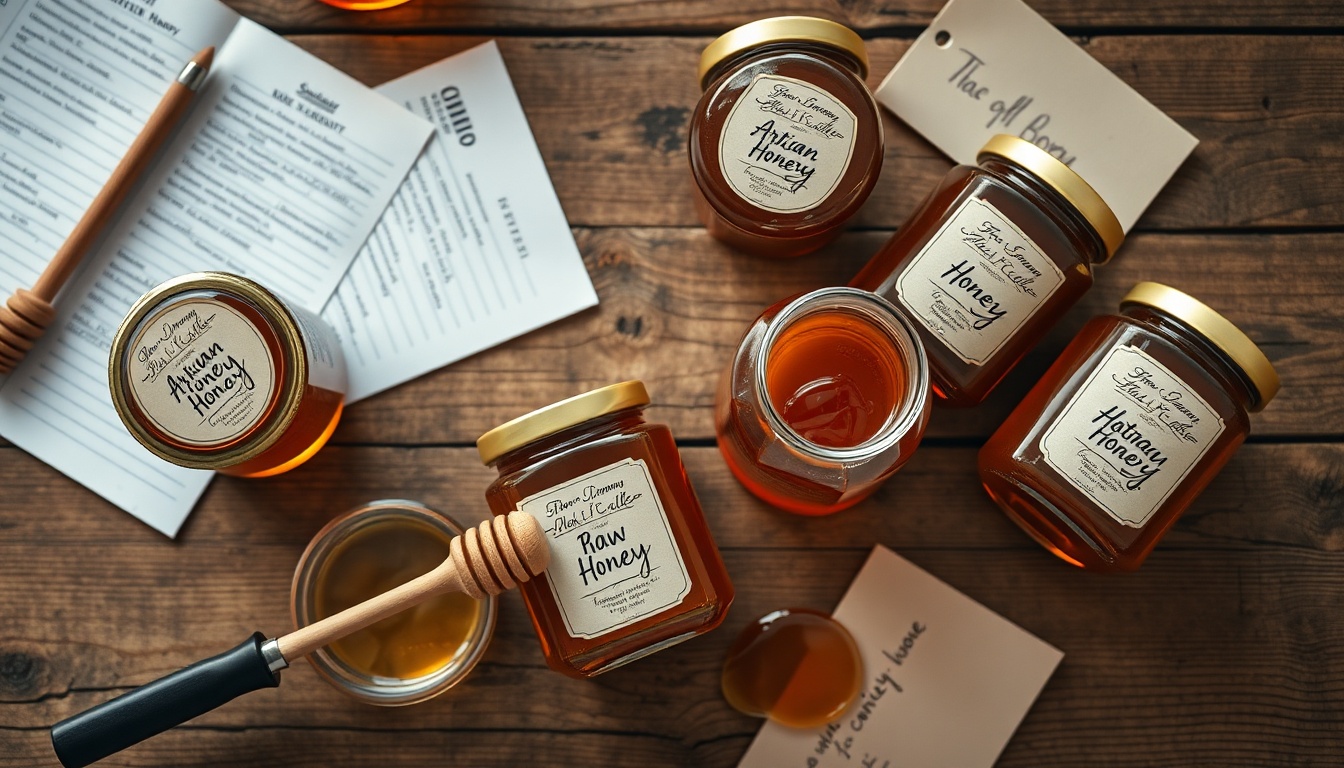
DIB certification under the "Echter Deutscher Honig" (Genuine German Honey) Gütesiegel imposes requirements significantly stricter than EU minimum honey standards (Directive 2001/110/EC). Maximum moisture content: 18% (vs. EU's 20%), reducing fermentation risk and ensuring denser body. Mandatory 100% German origin: no blending with imported honey. All processing within Germany. Heat treatment above 40°C prohibited, preserving enzyme activity and aroma compounds. Maximum sucrose: 5%. Required label information: harvest year, German federal state or regional origin, beekeeper or cooperative identity. Each production lot undergoes independent physicochemical testing before the Gütesiegel may be applied: moisture, HMF (≤40 mg/kg), diastase (≥8 Schade units), conductivity, specific gravity, sucrose, and sensory evaluation. The hexagonal Echter Deutscher Honig seal is the recognisable certification mark — six-sided gold honeycomb design — that consumers can verify on packaging.
The practical effect of the DIB system for the international buyer is straightforward: a honey carrying the Echter Deutscher Honig seal is reliably German-origin, below 18% moisture, unheated, from identified producers, and verified by independent testing. It is not a protected designation in the EU geographic sense (it is voluntary, not a PDO or PGI), but it is the strongest quality assurance available for German domestic honey. DIB-certified honey constitutes roughly 40–50% of domestically produced German honey by volume; the remainder is sold through farmer's markets, farm-direct channels, and specialty retailers without the seal. For buyers outside Germany, the seal combined with producer-level provenance (named apiary, named state, named variety, harvest year) represents the gold standard.
Buying German Honey: What to Look For
Within Germany, the best authentic honey purchase channels are: Imkermärkte (beekeepers' markets) and farm-direct Hofverkauf (farmgate sales), which offer the highest producer traceability and freshest seasonal product; specialty food shops (Feinkostläden) in major cities, which typically stock certified regional varieties including Schwarzwälder Tannenhonig, Lüneburg Heideblüte, and named Lindenblüte; and online direct-from-beekeeper platforms (Honig-im-Glas, MeinBauernhof.de, Slow Food Convivium-affiliated producer directories). Large supermarket chains (REWE, Edeka, Aldi) carry mostly blended or imported commodity honey in the €2–5 range; the REWE Bio and Edeka Naturkind ranges more reliably stock DIB-certified product.
Outside Germany — in the US, UK, Austria, and Swiss specialty food markets, and in German immigrant communities globally — authentic German specialty honey requires careful label reading. Reliable indicators: the hexagonal Echter Deutscher Honig seal; a named German federal state or specific region (Baden-Württemberg for Schwarzwälder Tannenhonig; Lower Saxony for Lüneburg Heideblüte; any state for Lindenblüte or Rapshonig); German varietal naming (Tannenhonig, Heideblüte, Lindenblüte, Rapshonig, Waldhonig, Akazienhonig — the German names are the authentic lexicon, not just their English translations); and a beekeeper or cooperative name with harvest year. Price provides a secondary signal: authentic German specialty honey in international retail typically exceeds $15–20 USD / for named-variety honeys with DIB certification, with Schwarzwälder Tannenhonig from authenticated Black Forest producers at in US specialty shops.
The emerging trend in premium German honey is regional terroir differentiation modelled on artisan wine and craft spirits: Black Forest, Lüneburg Heath, Bavarian Alps, Rhine Valley, and Sauerland producers are increasingly selling named-apiary honeys with GPS-identified forage zones, detailed tasting notes, and harvest-year specificity. For the international enthusiast new to German honey, the recommended entry point is Schwarzwälder Tannenhonig — dark, complex, and utterly unlike any flower honey — as a gateway to the Waldhonig category; then authentic Heideblüte from a Lüneburg producer who practices Wanderimkerei (confirm this on the label or directly with the producer) to experience the thixotropic gel-state that is Calluna honey's authentication signature; then Lindenblüte at peak freshness (within 3–4 months of July harvest) to experience the cooling-aromatic signature at full intensity. Compare with French honey (adjacent honeydew tradition, different appellation framework) and the Greek pine honeydew tradition (same honeydew category, entirely different ecological source — pine aphids rather than silver fir). See also the honey origin atlas for Germany's place in the global supply picture.