Estonia Among the Baltic States: Boreal-Hemiboreal Forest as the Defining Spine
Estonia (Eesti) is the northernmost of the three Baltic states, bordering the Gulf of Finland to the north (across which lies Helsinki, ~80 km from Tallinn), Lake Peipus and the Russian Federation to the east, Latvia to the south, and the Baltic Sea to the west across which lie Saaremaa, Hiiumaa, Muhu, and approximately 2,000 smaller islands. Land area is 45,339 km² (slightly larger than Denmark, smaller than Switzerland) and population approximately 1.37 million as of the 2024 Statistics Estonia estimate — the smallest of the three Baltic states by population (Latvia ~1.83 million, Lithuania ~2.86 million) but the largest by per-capita forest area. The country is a member of the European Union and NATO since 2004, of the Eurozone since 2011, and of the OECD since 2010. It is governed by the Riigikogu (the unicameral parliament of 101 directly elected members sitting at Toompea Castle in Tallinn) under the 1992 constitution that re-established Estonian independence after the 1991 dissolution of the Soviet Union — itself a re-establishment of the 1918 Republic of Estonia interrupted by the 1940 Soviet annexation, the 1941–1944 German occupation, and the 1944–1991 second Soviet occupation.
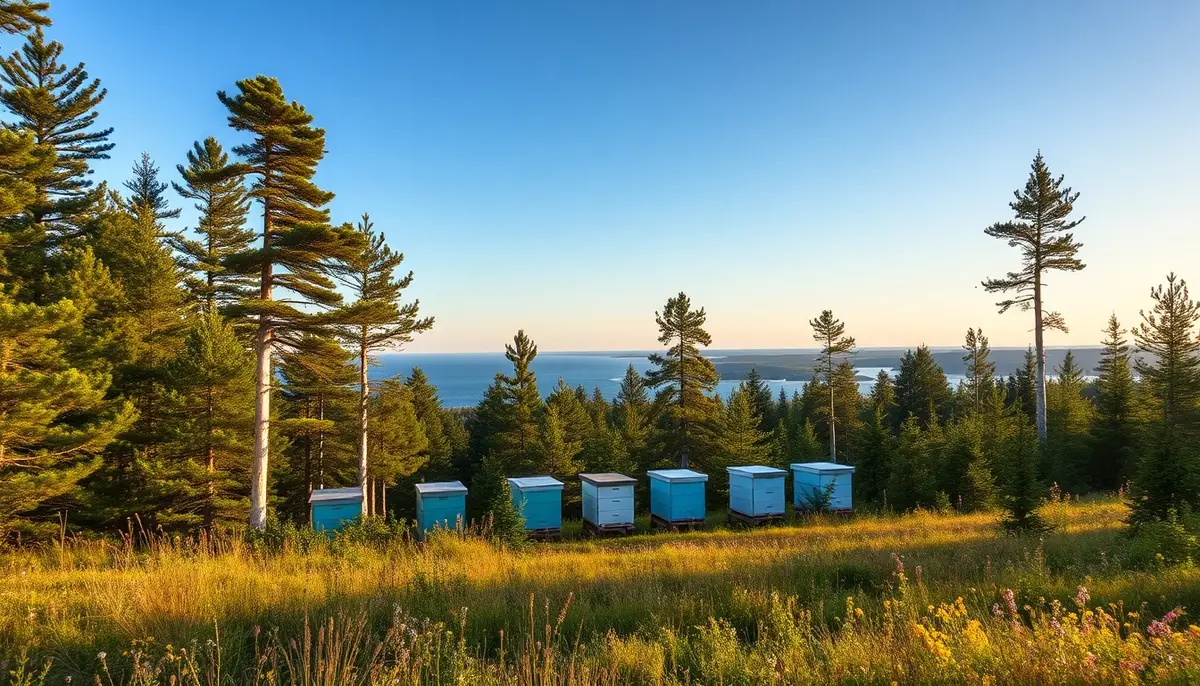
Estonia's defining structural feature for honey-production purposes is its forest cover. As of the 2023 Estonian Forest Statistics yearbook, forests cover approximately 51% of the land area (some reports cite 53–55% including transitional and clear-cut areas in active rotation), the highest forest-cover percentage among the three Baltic states (Latvia ~52%, Lithuania ~33%) and among the higher percentages in the European Union. The dominant forest types are boreal-hemiboreal mixed: Norway spruce (Picea abies) and Scots pine (Pinus sylvestris) coniferous communities account for approximately 60% of forested area, with European silver birch (Betula pendula) and downy birch (Betula pubescens) hardwood communities accounting for roughly 30%, and small-leaved lime / linden (Tilia cordata), grey alder (Alnus incana), aspen (Populus tremula), and oak (Quercus robur) communities accounting for the remainder. The boreal-hemiboreal vegetation zone — Estonia sits at the southern edge of the Eurasian boreal-coniferous belt that stretches from Scandinavia through European Russia to the Pacific — is the single most important forage zone for Estonian beekeeping and the structural axis that distinguishes the Estonian honey profile from any Western European or Mediterranean cluster covered in this corpus to date.
Estonia is also a notably maritime country despite its forest dominance. The mainland coastline runs ~3,794 km including the islands; the largest islands are Saaremaa (2,673 km², Estonia's largest island and the second-largest in the Baltic Sea after Sweden's Gotland), Hiiumaa (989 km², Estonia's second-largest), Muhu (198 km²), Vormsi (92 km²), and Kihnu (16 km²). The maritime west and the continental east produce a non-trivial bloom-calendar variation across the country: spring blooms approximately 10–14 days earlier on the south-western coast and on Saaremaa than in inland Tartu County or in north-eastern Ida-Viru County, and the late-summer honeydew-production window on the boreal-hemiboreal continental forest is substantially more reliable than the maritime-influenced western forest, which experiences more frequent rain interruptions. The two large lakes — Lake Peipus (3,555 km², the largest cross-border lake in Europe, shared with Russia) and Lake Võrtsjärv (270 km², the largest entirely-Estonian lake) — anchor riparian linden (Tilia cordata) and willow (Salix species) communities that contribute the country's principal supplementary blossom-honey crops alongside the dominant honeydew.
Estonian Honey Standards: Direct EU Application Under Põllumajandusministri Määrus 2014/16
Estonia adopts honey-composition law under a structurally distinct mechanism from the Crown-Dependency Order-in-Council reference pattern (Jersey, Guernsey, Isle of Man) and from the microstate treaty-and-customs-union pattern (Andorra, Liechtenstein, San Marino, Monaco, Vatican City). As a full European Union member since 1 May 2004, Estonia applies EU Council Directive 2001/110/EC (as amended by Directive 2014/63/EU) by direct national transposition rather than by reference to a third-party national instrument. The principal Estonian transposition is Põllumajandusministri määrus nr 16 / 11.04.2014 (Regulation of the Minister of Agriculture No. 16 of 11 April 2014, 'Honey Quality Requirements'), which transposes the EU Directive's Annex I composition limits and Annex II definitional taxonomy into Estonian national law under the authority of the 1999 Toiduseadus (Food Act, RT I 1999, 30, 415, as amended). The composition limits in force on Estonian-marketed honey are therefore identical to those in any other EU member state: moisture ≤20% (≤23% for heather honey from Calluna vulgaris and certain other listed exceptions), HMF ≤40 mg/kg (≤80 mg/kg for honey of declared tropical origin), diastase activity (Schade) ≥8 units (or ≥3 for naturally low-diastase varieties listed in Annex I), electrical conductivity ≤0.8 mS/cm for blossom honey and ≥0.8 mS/cm for honeydew (a load-bearing distinction for the Estonian metsamesi crop discussed below), free acidity ≤50 milliequivalents per kilogram, and the Annex II sugar profile.
Enforcement of honey composition runs through the Põllumajandus- ja Toiduamet (PTA, the Estonian Agriculture and Food Board, headquartered in Tallinn) under the Toiduseadus and the EU Official Controls Regulation (EU) 2017/625. Analytical testing for any Estonian sample requiring official confirmation routes principally to the PTA's Veterinaar- ja Toidulaboratoorium (Veterinary and Food Laboratory) at Väike-Paala 3, Tallinn — accredited under EVS-EN ISO/IEC 17025 for the standard EU honey-composition assay panel — or to the Eesti Maaülikooli (Estonian University of Life Sciences) laboratory at Tartu for research-grade or arbitrational testing. The 2014 Estonian regulation also incorporates the EU labelling requirements under Regulation (EU) No 1169/2011 (the Food Information to Consumers Regulation), including the country-of-origin declaration that since the 2024 amendment to Directive 2001/110/EC by Directive (EU) 2024/1438 must specify each blend constituent's country of origin in descending order rather than the previous 'EU / non-EU blend' formulation. Estonian-origin honey marketed within Estonia must bear the declaration 'Päritolumaa: Eesti' (Country of origin: Estonia); blends must list each constituent country in descending order by mass.
Estonia is also subject to the EU's national residue-monitoring plan under Council Directive 96/23/EC (now superseded by Regulation (EU) 2017/625) and submits annual residue results to the European Commission. Estonian honey-residue monitoring as reported to the EU between 2018 and 2024 has shown consistently low pesticide-residue levels by EU standards (no glyphosate exceedances in the 2022–2024 sample frames; sub-LOQ neonicotinoid results across the same period), which is consistent with Estonia's relatively low-intensity arable agricultural footprint (only ~22% of land area is agriculturally used, vs ~52% forest), the country's 2017 prohibition on outdoor neonicotinoid use under EU Implementing Regulation (EU) 2018/783, and the boreal-hemiboreal forest-honeydew crop's structural distance from arable spray-drift exposure. PTA also operates the standard EU notifiable-disease regime for European foulbrood (Melissococcus plutonius), American foulbrood (Paenibacillus larvae), and small hive beetle (Aethina tumida); Estonia has not had a confirmed small hive beetle detection as of 2026 and remains within the cluster of Northern-European jurisdictions classified as low-risk for that pest.
Get the Honey Buyer's Cheat Sheet (free PDF)
16 varieties on one page — color, flavor, best use and what a fair price looks like — from the 304 honeys we track.
Eesti Mesinike Liit (1908) and Estonian Beekeeping: The Baltic Region's Oldest Continuous Body
Eesti Mesinike Liit (EML, the Estonian Beekeepers' Union) is the country's principal apicultural body and the oldest continuously functioning beekeeping organisation in the Baltic region. Founding records place the original Eestimaa Mesinikkude Selts (Estonian Beekeepers' Society) at a 1908 founding meeting in Tartu under the umbrella of the broader Estonian agricultural-cooperative movement of the late Imperial Russian period — predating the Latvian Beekeepers' Association (founded 1922 as the Latvijas Biškopības Biedrība in independent Latvia) by 14 years and the Lithuanian Beekeepers' Association (founded 1926 as the Lietuvos Bitininkų Sąjunga in independent Lithuania) by 18 years. The 1908 body operated continuously through the 1918 Estonian War of Independence and the 1920–1940 first Republic of Estonia, was reorganised under Soviet-era cooperative structures during the 1944–1991 second Soviet occupation, and re-emerged in its modern form as Eesti Mesinike Liit in 1991 after Estonian independence. EML is headquartered at Tartu (the country's second city and the historic intellectual centre, home to the University of Tartu, founded 1632 as Academia Gustaviana) and operates a network of approximately 30 county-and-regional societies (maakondade ja regionaalsed seltsid) covering all 15 Estonian counties.
Active membership runs in the 800–1,200 range as of the 2024 EML annual report; the broader Estonian beekeeping population is substantially larger — Statistics Estonia and PTA registry data place the total number of registered beekeepers (every Estonian beekeeper must register with PTA under the Toiduseadus) at approximately 5,000–6,000, with an estimated active hive count of approximately 35,000–45,000 colonies producing 600–1,000 tonnes of honey per year (year-to-year variation depending on honeydew-flow availability, weather, and Varroa pressure). The structural ratio — approximately 7 colonies per beekeeper across the country — is among the lowest in Europe, reflecting the dominance of small-scale hobbyist and side-line operations over commercial-scale apiaries; only approximately 80–120 Estonian beekeepers operate at a commercial scale (≥150 colonies), with the largest single operation running approximately 1,500 colonies in Pärnu County. The EML operates the country's principal apicultural training programme (a multi-year course recognised under the 1998 Kutseseadus / Professions Act with three certification levels — algajale mesinikule / beginner, edasijõudnud mesinikule / advanced, and meistermesinikule / master beekeeper) and the principal honey-quality-show circuit (the annual Eesti Mee Konkurss / Estonian Honey Competition held each autumn at the Põltsamaa or Tartu agricultural-fair grounds).
Estonia's bee-subspecies position is distinct from the BCD sub-cluster's mellifera-conservation-axis position. Soviet-era introductions in the 1944–1991 period brought substantial Apis mellifera carnica (Carniolan bee) and A. m. ligustica (Italian bee) populations to Estonia, complementing and progressively displacing the historic A. m. mellifera (the European Dark Bee, M-lineage) population that had occupied Estonia at the northern edge of its native European range. Modern Estonian apicultural genetics are dominated by A. m. carnica (the most widely kept subspecies in the country as of 2026, favoured for its winter-hardiness in the continental Estonian climate and its compatibility with the boreal-hemiboreal honeydew flow's compressed late-summer collection window), with approximately 10–25% A. m. mellifera mitotype prevalence retained in scattered apiaries across the country — particularly on Saaremaa and Hiiumaa, where the islands' partial geographic isolation and the lower Soviet-era importation pressure preserved more of the original M-lineage genetics. EML maintains a small-scale collaborative interest in A. m. mellifera conservation through informal contacts with the SICAMM (Société Internationale pour la Conservation de l'Abeille Noire) network and the Norwegian, Danish, and Swedish Nordic-mellifera programmes, but Estonia does not operate a formal SICAMM-aligned breeding programme comparable to the Manx Bee Improvement Group on the Isle of Man or the Læsø programme in Denmark. Saaremaa's structural potential as a future A. m. mellifera mating-station candidate site (analogous to Læsø) has been identified in EML strategic-planning documents but has not progressed to a funded programme as of 2026.
The Estonian Forage Calendar: Boreal Honeydew, Lake Riparian Linden, and the Saaremaa Island Crop
The Estonian forage calendar is structurally bipartite: a spring-and-summer blossom-honey window (May through July, dominated by lowland and lake-riparian flowers) followed by a late-summer honeydew window (mid-July through early September, dominated by boreal-hemiboreal mixed-forest honeydew). The bipartite structure is what most distinguishes the Estonian honey profile from the Western European hedge-bank-and-multifloral pattern (Jersey, Guernsey, France, England, Belgium) and the Nordic heather-and-cloudberry pattern (Norway, Finland, Sweden's Gotland and Småland) on the one hand, and from the Mediterranean thyme-and-citrus-and-eucalyptus pattern (Malta, Greece, Italy) on the other. The honeydew dominance — approximately 40–60% of total annual Estonian honey production by mass in a typical honeydew year, rising to 70%+ in exceptional years and falling to under 25% in years when summer drought or anti-cyclonic weather suppresses the spruce-aphid and pine-aphid populations whose excretions drive the flow — is the single most important commercial-and-editorial fact about Estonian honey.
The blossom calendar runs as follows. Late April through early May: willow (Salix caprea, S. fragilis, S. cinerea) along Lake Peipus, Lake Võrtsjärv, and the Pärnu, Emajõgi, and Pirita river systems — pale, mild, primarily a colony build-up flow rather than a marketed honey. Mid-May through early June: dandelion (Taraxacum officinale agg.) on agricultural margins and abandoned Soviet-era kolkhoz field-edges — bright golden, fast-crystallising, occasionally extracted as a small-batch monofloral. Late May through mid-June: rapeseed (Brassica napus) on commercial-arable Lääne and Pärnu County land — pale, mild, fast-crystallising fine-grain crystals, the country's principal early-summer commercial crop. Late May through mid-June: Estonian hawthorn (Crataegus monogyna) and bird-cherry (Prunus padus) on hedge margins and forest edges — small-volume contribution to spring multifloral. Mid-June through mid-July: the principal Estonian linden (Tilia cordata) flow from lake-riparian and urban-edge plantings in Tallinn, Tartu, Pärnu, Narva, Viljandi, Rakvere, and from the natural lime woodlands on the limestone cliffs of the North Estonian glint — pale gold to greenish-pale, mentholated, the country's signature blossom-honey monofloral and the only Estonian variety with a routinely-marketed regional naming convention (Tartumaa pärnamesi, Saaremaa pärnamesi). Late June through July: white clover (Trifolium repens) on agricultural pasture and on Soviet-era kolkhoz field margins — pale, mild, the year-round mainstay of Estonian multifloral honey.
The honeydew calendar runs from approximately mid-July through early September on the boreal-hemiboreal mixed-forest belt across the country — most reliably in Ida-Viru County, Lääne-Viru County, Jõgeva County, Tartu County, Põlva County, and Võru County in the continental east-and-south, and less reliably in Pärnu and Lääne County on the maritime west. The Estonian metsamesi (forest honey) crop is produced from honeydew secreted by aphids feeding on Norway spruce (Picea abies) — principally Cinara pilicornis, C. piceae, and Lachnus piceae — and on Scots pine (Pinus sylvestris) — principally Cinara pinea and C. pini — supplemented in some years by honeydew from European silver fir (Abies alba) in the small Estonian fir plantations and from European larch (Larix decidua) in the small larch plantations. The collected honeydew honey is dark amber to almost black, viscous, mineral-and-malt complex, and structurally distinguishable from blossom honey by its high electrical conductivity (typically 0.9–1.4 mS/cm against the EU's ≥0.8 mS/cm honeydew threshold), its low pollen content (honeydew honey is low-pollen by definition because the bees collect aphid excretions rather than nectar with co-collected pollen), and its high mineral and oligosaccharide content — characteristics shared with German Tannenhonig, Greek pine honey, and Czech medovice. Estonian metsamesi commands a domestic premium of approximately 30–60% over equivalent-grade Estonian linden or multifloral honey in the EML competition circuit and in Tallinn / Tartu specialty-food retail, and is the principal Estonian honey export when shipped to Germany, the Netherlands, Finland, and Sweden. There is no PDO, PGI, or EU GI registration for Estonian metsamesi as of 2026, despite the structural distinguishability of the variety; EML strategic-planning documents have identified a potential 'Eesti Metsamesi' or regional 'Lõuna-Eesti Metsamesi' (Southern Estonian Forest Honey) GI as a future commercial-marketing target.
Where Estonia Sits in the Cluster-of-Clusters: The Baltic Forest Honeydew Sub-Cluster's Opening Member
Estonia is the opening member of a structurally distinct sub-cluster within the corpus's broader European-honey-jurisdiction taxonomy: the Baltic Forest Honeydew sub-cluster, anchored on the boreal-hemiboreal mixed-forest honeydew flow as the defining production-axis spine and on direct-EU-application as the defining regulatory mechanism. With Latvia and Lithuania as the planned closing members, the sub-cluster will reach three-member completion on the same structural template the British Crown Dependencies sub-cluster (Jersey, Guernsey, Isle of Man) and the European microstate cluster (Andorra, Liechtenstein, San Marino, Monaco, Vatican City) have established — three jurisdictions sharing one defining structural mechanism while exhibiting cluster-internal differentiation along independent editorial axes. The Baltic Forest Honeydew sub-cluster's regulatory mechanism — direct EU application via national transposition under each country's domestic Food Act (Estonia's Toiduseadus, Latvia's Pārtikas aprites uzraudzības likums, Lithuania's Maisto įstatymas) — is structurally distinct from the BCD sub-cluster's Order-in-Council reference mechanism and from the microstate cluster's treaty-and-customs-union mechanism, establishing a third regulatory-mechanism category in the corpus's taxonomy.
Estonia opens three internal differentiation axes that Latvia and Lithuania will extend and close. First, beekeeping-association founding date: EML 1908 + LBB 1922 + LBS 1926, a longest-continuity axis with Estonia at the apex (predating the Latvian and Lithuanian equivalents by 14–18 years and predating the Channel Islands' GBKA 1928 by 20 years — making EML the oldest continuously functioning beekeeping body covered in the corpus to date). Second, forest-cover percentage: Estonia ~51% + Latvia ~52% + Lithuania ~33%, a forest-cover-and-honeydew-reliability axis with Estonia and Latvia at the apex (the two countries with the most reliable annual metsamesi / meža medus crop) and Lithuania at the lower end (where the smaller forest area and the higher arable-agricultural intensity reduce the honeydew flow's reliability and shift the production balance toward blossom-honey monoflorals — buckwheat, linden, rapeseed, white clover). Third, A. m. mellifera retention: Estonia approximately 10–25% mellifera mitotype prevalence, with similar but as-yet-unpublished retention estimates expected for Latvia and Lithuania — likely structurally similar to Estonia's position given the broadly comparable Soviet-era importation history across the three countries, but a sub-cluster axis that the Latvia and Lithuania ships will need to close.
The cluster-of-clusters now spans twelve jurisdictions across three sub-clusters: five European microstates under the treaty-and-customs-union Adopted-by-Reference variant (Andorra, Liechtenstein, San Marino, Monaco, Vatican City) + three British Crown Dependencies under the Order-in-Council Adopted-by-Reference variant (Jersey, Guernsey, Isle of Man) + Estonia as the Baltic Forest Honeydew sub-cluster's opening direct-EU-application member, with Latvia and Lithuania the planned closing members. The three regulatory-mechanism categories — treaty-and-customs-union, Order-in-Council reference, and direct-EU-application — establish a comprehensive structural taxonomy of European-honey-jurisdiction-by-regulatory-mechanism that the corpus can use as the editorial spine for a future top-level taxonomic synthesis page once the Baltic sub-cluster reaches three-member completion. The framework is now load-bearing on four independent editorial axes — regulatory mechanism, beekeeping-association founding date, native-bee subspecies-conservation status, and characteristic forage zone — across twelve jurisdictions, sufficient evidence to count as a robust cross-jurisdictional pattern in the corpus and as the editorial spine for the future synthesis page.