Lithuania Among the Baltic States: Largest by Population, Pine-Dominant Forest Belt
Lithuania (Lietuva) is the southernmost of the three Baltic states, bordering Latvia to the north, Belarus to the east and southeast, Poland to the south, the Russian Kaliningrad Oblast exclave to the southwest, and the Baltic Sea to the west. Land area is 65,300 km² — slightly larger than Latvia (64,589 km²) but within ~1% of equivalence, the two larger members of the Baltic trio against Estonia's 45,339 km². Population is approximately 2.86 million as of the 2024 Statistics Lithuania (Lietuvos statistikos departamentas) estimate — the largest of the three Baltic states by population (Estonia ~1.37 million, Latvia ~1.83 million). Lithuania is a member of the European Union and NATO since 2004, of the Eurozone since 2015 (the latest of the three Baltic states to adopt the euro — Estonia 2011, Latvia 2014, Lithuania 2015), of the OECD since 2018, and of the Schengen Area since 2007. It is governed by the Seimas (the unicameral 141-member parliament sitting at the Seimas Palace on Gedimino prospektas in Vilnius) under the 1992 Constitution that re-established Lithuanian independence after the 1990 declaration and the 1991 international recognition. The 1992 Constitution succeeds three earlier Lithuanian constitutional periods — the medieval Grand Duchy of Lithuania (1253–1795, in personal union with Poland from 1386), the first independent Republic (1918–1940 under the 1922 Steigiamojo Seimo and the 1928 / 1938 successor constitutions), and the Soviet-era Lithuanian SSR (1940–1990) — and re-establishes Vilnius as the capital after the historical interim Kaunas capital (1920–1939, during the period when Vilnius and the Vilnius Region were under Polish control following the 1920 Żeligowski's Mutiny).
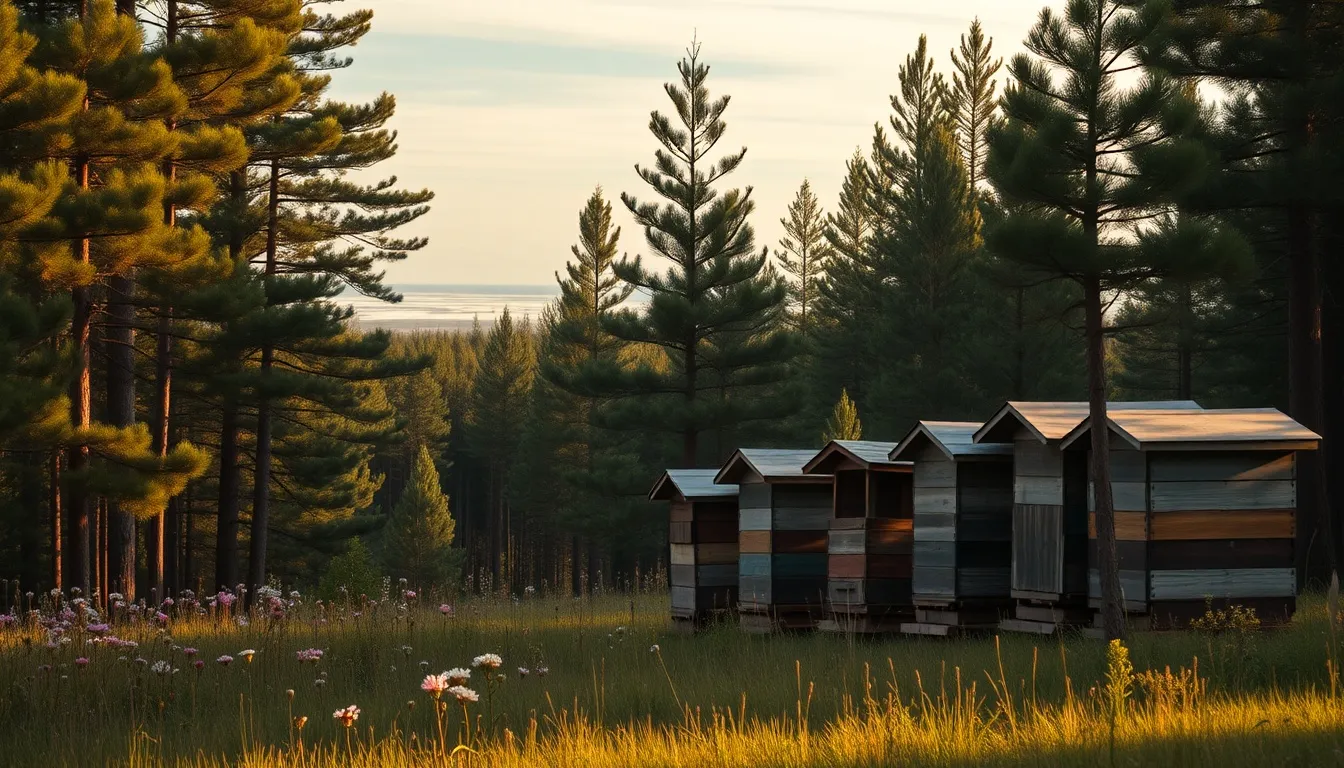
Lithuania's defining structural feature for honey-production purposes — like Estonia and Latvia — is its forest cover, but here the Lithuanian profile diverges meaningfully from its northern Baltic neighbours. According to the 2023 State Forest Service of Lithuania (Valstybinė miškų tarnyba) yearbook, forests cover approximately 33% of Lithuania's land area — substantially lower than Estonia's ~51% or Latvia's ~52%, and the lowest forest-cover percentage among the three Baltic states despite Lithuania being the largest by both area and population. The lower forest share reflects the country's larger agricultural footprint (approximately 47% of land area is agriculturally used, the highest agricultural share of the three Baltic states) — particularly the Suvalkija and Žemaitija arable plains where the country's principal commercial rapeseed, white-clover, and buckwheat crops are grown. The dominant forest types are structurally Scots pine (Pinus sylvestris) dominant, broadly paralleling Latvia's pine-leading composition rather than Estonia's spruce-leading balance: Scots pine accounts for approximately 35% of forested area, European silver birch (Betula pendula) and downy birch (Betula pubescens) for ~22%, Norway spruce (Picea abies) for ~21%, grey alder (Alnus incana) and black alder (Alnus glutinosa) for ~13%, with aspen (Populus tremula), oak (Quercus robur), small-leaved lime (Tilia cordata), and ash (Fraxinus excelsior) communities accounting for the remainder. The pine-dominant share is concentrated in the Dzūkija region (southern Lithuania, the country's largest contiguous forest tract centred on the Dainava Forest and Dzūkija National Park) where Pinus sylvestris reaches ~70–80% of local forest cover on the post-glacial sandy-plain substrate — the highest single-species pine concentration of any forest landscape in the Baltic Forest Honeydew sub-cluster.
Lithuania's geography divides into five traditional ethnographic regions, each with a distinct forage-and-landscape profile. Aukštaitija (the Highlands, northeastern Lithuania, ~22,000 km², centred on Panevėžys, Utena, and Visaginas) is the country's lake-rich upland — the Aukštaitija National Park alone holds 126 lakes within ~406 km², and the broader region is the densest lake country in Lithuania with linden-and-mixed-forest forage and the country's principal liepų medus (linden honey) production. Žemaitija (Samogitia, western Lithuania, ~21,000 km², centred on Telšiai, Šiauliai, and Plungė) is the country's western upland — the Žemaitija National Park, the Samogitian Highland (Žemaičių aukštumas, max elevation 234 m at Medvėgalis hill), and a more maritime-influenced bloom calendar 5–8 days earlier than the continental east. Suvalkija (Sudovia, southwestern Lithuania, ~7,000 km², centred on Marijampolė and Vilkaviškis) is Lithuania's principal arable-agricultural zone, the historical territory of the Sudovian Yotvingian Baltic tribe, and produces the country's principal early-summer rapeseed and white-clover commercial crops. Dzūkija (southern Lithuania, ~12,000 km², centred on Alytus, Druskininkai, and Varėna) is the country's pine-forest heartland — the Dainava Forest, the Dzūkija National Park (581 km², Lithuania's largest national park, ~85% pine forest cover), and the Čepkeliai Strict Nature Reserve form Lithuania's largest contiguous Pinus sylvestris tract and the country's principal pine-honeydew forage zone. Mažoji Lietuva (Lithuania Minor, the western coastal strip and Curonian Spit, ~3,000 km², centred on Klaipėda) is the country's only Baltic Sea coastline (~99 km, the shortest of the three Baltic states), holds the Curonian Spit (Kuršių nerija, UNESCO World Heritage Site since 2000) with its Pinus mugo (mountain pine) dunes, and the Nemunas Delta Regional Park.
Lithuanian Honey Standards: Direct EU Application Under Žemės Ūkio Ministro Įsakymas 3D-333 (2003)
Lithuania adopts honey-composition law under direct EU application via national transposition under ministerial order, structurally identical to the Estonian and Latvian mechanisms — Estonia's Põllumajandusministri määrus 2014/16, Latvia's Ministru kabineta noteikumi Nr. 558, Lithuania's Žemės ūkio ministro įsakymas Nr. 3D-333 — and structurally distinct from the Crown-Dependency Order-in-Council reference pattern (Jersey, Guernsey, Isle of Man) and from the microstate treaty-and-customs-union pattern (Andorra, Liechtenstein, San Marino, Monaco, Vatican City). As a full European Union member since 1 May 2004, Lithuania applies EU Council Directive 2001/110/EC (as amended by Directive 2014/63/EU and most recently by Directive (EU) 2024/1438) via direct national transposition: the principal Lithuanian instrument is Lietuvos Respublikos žemės ūkio ministro 2003 m. rugpjūčio 12 d. įsakymas Nr. 3D-333 'Dėl Medaus techninio reglamento patvirtinimo' (Order of the Minister of Agriculture of 12 August 2003, 'On Approval of the Honey Technical Regulation'), made under the authority of the Lietuvos Respublikos maisto įstatymas (Food Law, 2000, with subsequent amendments). Subsequent amendments to the principal order have been made periodically to align with EU directive updates, most recently to incorporate the 2024/1438 country-of-origin descending-order labelling rule.
The composition limits in force on Lithuanian-marketed honey are therefore identical to those in any other EU member state: moisture ≤20% (≤23% for heather honey from Calluna vulgaris and certain other listed exceptions), HMF ≤40 mg/kg (≤80 mg/kg for honey of declared tropical origin), diastase activity (Schade) ≥8 units (or ≥3 for naturally low-diastase varieties listed in Annex I), electrical conductivity ≤0.8 mS/cm for blossom honey and ≥0.8 mS/cm for honeydew (a load-bearing distinction for the Lithuanian miškinis medus / forest-honey crop), free acidity ≤50 milliequivalents per kilogram, and the Annex II sugar profile. Enforcement runs through the Valstybinė maisto ir veterinarijos tarnyba (VMVT, the Lithuanian State Food and Veterinary Service, headquartered in Vilnius) under the Maisto įstatymas and the EU Official Controls Regulation (EU) 2017/625. Analytical testing for any Lithuanian sample requiring official confirmation routes principally to the Nacionalinis maisto ir veterinarijos rizikos vertinimo institutas (NMVRVI — the National Food and Veterinary Risk Assessment Institute, the country's principal food-safety reference laboratory in Vilnius), accredited under LST EN ISO/IEC 17025 for the standard EU honey-composition assay panel, or to the Lietuvos sveikatos mokslų universiteto Veterinarijos akademija (LSMU — the Lithuanian University of Health Sciences Veterinary Academy, Kaunas) for research-grade testing.
Lithuania is also subject to the EU's national residue-monitoring plan and submits annual residue results to the European Commission. Lithuanian honey-residue monitoring as reported to the EU between 2018 and 2024 has shown low pesticide-residue levels by EU standards, consistent with Lithuania's compliance with EU Implementing Regulation (EU) 2018/783 prohibiting outdoor neonicotinoid use and the structural distance of the Dzūkija pine-forest honeydew crop from arable spray-drift exposure (the Suvalkija arable belt is geographically separated from the Dzūkija forest belt by the Nemunas River corridor and the southeastern lake country). VMVT operates the standard EU notifiable-disease regime for European foulbrood, American foulbrood, and small hive beetle (Aethina tumida); Lithuania has not had a confirmed small hive beetle detection as of 2026 and remains within the cluster of Northern-European jurisdictions classified as low-risk for that pest. Lithuania is one of the EU member states without a national PDO, PGI, or GI registration for any honey variety as of 2026 — paralleling Estonia and Latvia in this respect — despite the structural distinguishability of Dzūkija pine-forest miškinis medus from Western European multifloral honey and from German Tannenhonig and Greek pine honey; LBS strategic-planning documents have identified a potential 'Dzūkijos miško medus' (Dzūkija Forest Honey) or regional 'Dainavos medus' (Dainava Forest Honey) GI as a future commercial-marketing target.
Get the Honey Buyer's Cheat Sheet (free PDF)
16 varieties on one page — color, flavor, best use and what a fair price looks like — from the 304 honeys we track.
Lietuvos Bitininkų Sąjunga (1926) and Lithuanian Beekeeping: The Closing Member on the Continuity Axis
Lietuvos bitininkų sąjunga (LBS, the Lithuanian Beekeepers' Association) is the country's principal apicultural body and the closing member of the Baltic Forest Honeydew sub-cluster's beekeeping-association founding-date axis. Founded in 1926 in independent Lithuania under the umbrella of the broader Lithuanian agricultural-cooperative movement that emerged after the 1918 Lithuanian Declaration of Independence and the 1920 Soviet–Lithuanian Peace Treaty, LBS post-dates the Latvijas Biškopības Biedrība (LBB, founded 1922 in independent Latvia) by 4 years and post-dates the Estonian Mesinike Liit (EML, founded 1908 in Tartu under late-imperial-Russian agricultural-cooperative auspices) by 18 years. The 1926 founding date places LBS at the closing position of the independent-Baltic-period agricultural-civic institutional founding axis spanning 1908–1926 — a structural ordering that maps directly onto the relative timing of each country's formal independence (Estonia February 1918, Latvia November 1918, Lithuania February 1918 with the 1920 Soviet treaty providing later-than-Estonia institutional consolidation). The original 1926 LBS operated through the 1918–1940 first Republic of Lithuania, was dissolved during the 1940 Soviet annexation and the 1941–1944 German occupation, was reorganised under Soviet-era cooperative structures during the 1944–1990 second Soviet occupation, and was re-established in its modern form in 1990 at independence restoration with reference to the 1926 founding date. LBS is headquartered at Kaunas (Lithuania's second-largest city, ~290,000 residents, the country's interim capital 1920–1939 and the seat of the Vytautas Magnus University and the Lithuanian University of Health Sciences) and operates a network of approximately 30 county-and-regional societies (sąjungos) covering all ten Lithuanian counties (Alytaus, Kauno, Klaipėdos, Marijampolės, Panevėžio, Šiaulių, Tauragės, Telšių, Utenos, Vilniaus).
Active LBS membership runs in the 1,500–2,500 range as of the 2024 LBS annual report; the broader Lithuanian beekeeping population is substantially larger — Statistics Lithuania and VMVT registry data place the total number of registered beekeepers (every Lithuanian beekeeper is required to register with VMVT under the Maisto įstatymas and the Veterinarijos įstatymas / Veterinary Law) at approximately 3,500–5,500, with an estimated active hive count of approximately 100,000–140,000 colonies producing 1,500–2,500 tonnes of honey per year (year-to-year variation depending on honeydew-flow availability, weather, Varroa pressure, and rapeseed bloom timing). Lithuanian honey production is therefore approximately 1.2–1.5× the Latvian production by mass and approximately 2–3× the Estonian production by mass — consistent with the larger beekeeper population, the larger arable-pollination-demand base, and the larger commercial-scale operation share. The structural ratio — approximately 25 colonies per beekeeper across the country — is the highest of the three Baltic states (Latvia ~18, Estonia ~7), indicating the most commercial-scale-leaning beekeeping population of the three: approximately 250–400 Lithuanian beekeepers operate at a commercial scale (≥150 colonies), with the largest single operations running 2,500–5,000 colonies in Suvalkija, Dzūkija, and Aukštaitija. LBS operates the country's principal apicultural training programme (a multi-year course recognised under the Lietuvos Respublikos švietimo įstatymas / Education Law) and the principal honey-quality-show circuit (the annual Lietuvos medaus konkursas / Lithuanian Honey Competition held each autumn at the Kaunas Tado Ivanausko zoologijos muziejus / Tadas Ivanauskas Zoological Museum grounds during the broader Žemės ūkio ir maisto pramonės paroda / Agriculture-and-Food-Industry Exhibition) and edits the bimonthly Lietuvos bitininkas (Lithuanian Beekeeper) journal, the longest-running continuously-published Baltic apicultural periodical.
Lithuania's bee-subspecies position is broadly similar to Estonia's and Latvia's — and structurally distinct from the British Crown Dependencies' mellifera-conservation position. Soviet-era introductions in the 1944–1990 period brought substantial Apis mellifera carnica (Carniolan bee, native to Slovenia / Austria / the western Balkans) and A. m. ligustica (Italian bee) populations to Lithuania, complementing and progressively displacing the historic A. m. mellifera (the European Dark Bee, M-lineage) population that had occupied Lithuania at the southern edge of the same northern-European range that includes Estonia, Latvia, Belarus, and parts of European Russia. Modern Lithuanian apicultural genetics are dominated by A. m. carnica — the most widely kept subspecies in the country as of 2026, favoured for winter-hardiness in the continental Lithuanian climate (winters routinely fall to −10 to −20 °C inland, with extremes below −30 °C) and for compatibility with the boreal-mixed-forest honeydew flow's compressed late-summer collection window — with an estimated 5–20% A. m. mellifera mitotype prevalence retained in scattered apiaries across the country, particularly in the Aukštaitija lakeland, the Žemaitija upland, and the Dzūkija pine-forest interior where the lower Soviet-era importation pressure preserved more of the original M-lineage genetics (the residual A. m. mellifera share is estimated lower in Lithuania than in Latvia or Estonia, reflecting the higher Soviet-era apicultural-import volume associated with the larger Lithuanian colony count and commercial-scale share). As with Estonia and Latvia, Lithuania does not operate a formal SICAMM-aligned (Société Internationale pour la Conservation de l'Abeille Noire) breeding programme comparable to the Manx Bee Improvement Group on the Isle of Man or the Læsø programme in Denmark; the Aukštaitija National Park area and Žemaitija upland have been identified in LBS strategic-planning documents as potential future A. m. mellifera mating-station candidate sites but no funded programme has progressed as of 2026.
The Lithuanian Forage Calendar: Pine-Dominant Honeydew, Linden, Buckwheat, Rapeseed, and the Curonian Spit Constraint
The Lithuanian forage calendar is structurally bipartite in the same pattern as the Estonian and Latvian calendars — a spring-and-summer blossom-honey window (May through July) followed by a late-summer honeydew window (mid-July through early September) — but with a distinct internal composition. The two principal compositional differences against the northern Baltic neighbours are (a) the pine-dominant honeydew flow concentrated in the Dzūkija pine-forest belt (Pinus sylvestris carrying an even larger share of the late-summer flow than in Latvia, paralleling Latvia's pine-leaning composition rather than Estonia's spruce-leaning balance) and (b) the comparatively larger commercial buckwheat (Fagopyrum esculentum) and rapeseed (Brassica napus) flows on the Suvalkija and Aukštaitija arable plains, which give Lithuania the largest combined arable-honey commercial base of the three Baltic states. The Lithuanian honeydew share — approximately 20–35% of total annual Lithuanian honey production by mass in a typical year, lower than the Latvian ~30–50% share or the Estonian ~40–60% share — reflects the lower forest-cover percentage and the larger arable-pollination-driven share of the Lithuanian crop, but miškinis medus (forest honey) remains a structurally important and the second-largest single component of the Lithuanian crop after the combined rapeseed-and-multifloral arable share.
The blossom calendar runs as follows. Late April through early May: willow (Salix caprea, S. fragilis, S. cinerea) along the Nemunas, Neris, Šventoji, Nevėžis, and Mūša river systems and the Aukštaitija lake-margins — pale, mild, primarily a colony build-up flow. Mid-May through early June: dandelion (Taraxacum officinale agg.) on agricultural margins and abandoned Soviet-era kolūkis field-edges — bright golden, fast-crystallising, occasionally extracted as a small-batch monofloral. Late May through mid-June: rapeseed (Brassica napus) on commercial-arable Suvalkija and Aukštaitija land — pale, mild, fast-crystallising fine-grain crystals, the country's principal early-summer commercial crop and the largest single arable-honey component of the Lithuanian production base, structurally larger than the Latvian or Estonian rapeseed components and comparable to the Polish rapeseed flow on the same Eastern European arable belt. Mid-June through mid-July: the principal Lithuanian liepų medus (linden honey) flow from Tilia cordata — Aukštaitija lakeland-riparian and urban-edge plantings in Vilnius, Kaunas, Klaipėda, Šiauliai, Panevėžys, Alytus, Marijampolė, plus the natural lime woodlands on the Aukštaitija upland — pale gold to greenish-pale, mentholated, the country's signature blossom-honey monofloral and the variety with the most established cross-Baltic identity (the Lithuanian, Latvian, and Estonian linden flows are structurally similar in chemistry and timing). Late June through July: white clover (Trifolium repens) on agricultural pasture and on Soviet-era kolūkis field margins — pale, mild, the year-round mainstay of Lithuanian multifloral honey.
Late July through August: the principal Lithuanian grikių medus (buckwheat honey) flow from Fagopyrum esculentum on the Suvalkija and Aukštaitija commercial-arable plains and on smaller Žemaitija plots — dark amber to almost black, malty-molasses-pungent, high in iron and polyphenols, fast-crystallising, the country's principal dark-amber blossom monofloral and a structurally meaningful Lithuanian export crop to Germany, Poland, and the Baltic-diaspora markets in the United Kingdom and the United States. The Lithuanian buckwheat flow is structurally similar to the Polish, Latvian, and Western Russian buckwheat flows on the same Eastern European arable belt, and is one of the editorial axes on which Lithuania is more closely aligned with Latvia and Poland than with Estonia. The honeydew calendar runs from approximately mid-July through early September on the boreal-mixed-forest belt across the country — most reliably in the Dzūkija pine-forest belt (the Dainava Forest, the Dzūkija National Park, the Čepkeliai Strict Nature Reserve, and the Aukštadvaris Regional Park area in Alytus and Varėna districts) where the largest contiguous Pinus sylvestris tracts in the Baltic Forest Honeydew sub-cluster preserve the Cinara pinea and C. pini pine-aphid populations whose excretions drive the principal Lithuanian honeydew flow. The Aukštaitija lakeland and the Žemaitija upland produce smaller mixed pine-and-spruce honeydew shares from the same Cinara genus on the lower-density forest mosaic. The collected miškinis medus is dark amber to almost black, viscous, mineral-and-malt complex, and structurally similar to Latvian meža medus, Estonian metsamesi, German Tannenhonig, Greek pine honey, Czech medovice, Slovenian gozdni med, and Sweden's skogshonung. The pine-honeydew dominance of the Dzūkija crop produces a miškinis medus profile that sits at the most pine-leaning position of the Baltic Forest Honeydew sub-cluster — closer to Greek elatihelio (Halkidiki / Evia pine-honey) on the aphid-host axis than the Estonian metsamesi, while remaining within the latitude-and-climate band of the broader Baltic boreal-mixed-forest crop. Lithuanian miškinis medus commands a domestic premium of approximately 20–45% over equivalent-grade Lithuanian linden, buckwheat, or multifloral honey in the LBS competition circuit and in Vilnius / Kaunas / Klaipėda specialty-food retail. The Curonian Spit (Kuršių nerija) deserves a separate note: although the Spit's Pinus mugo (mountain pine) and Pinus sylvestris dunes would in principle support a distinctive coastal pine-honeydew flow, the Spit's UNESCO-protected ecological-reserve status and the Kuršių nerijos nacionalinis parkas (Curonian Spit National Park) management plan limit commercial apiculture on the Spit to a small number of historically-licensed sites, so commercial Curonian-Spit honey is effectively absent from the Lithuanian market — a structural-protection-driven absence rather than a botanical-flow absence.
Where Lithuania Sits in the Cluster-of-Clusters: The Baltic Forest Honeydew Sub-Cluster Reaches Three-of-Three
Lithuania is the closing member of the Baltic Forest Honeydew sub-cluster within the corpus's broader European-honey-jurisdiction taxonomy, opened by Estonia 2026-04-29 and extended by Latvia 2026-04-29. With Lithuania shipped, the sub-cluster reaches three-of-three completion — the threshold at which a sub-cluster full-pack distribution artifact becomes drafting-eligible (succeeding the §230 Estonia solo pack drafted at one-of-three and the §231 Estonia + Latvia preview pack drafted at two-of-three) and at which the corresponding synthesis page (`/learn/baltic-forest-honeydew-cluster`) becomes ship-eligible under the corpus's three-member-completion synthesis-page rule applied to the prior /learn/european-microstate-honey-cluster (5-of-5 microstates) and /learn/british-crown-dependencies-honey-cluster (3-of-3 BCDs) ships. The sub-cluster's defining structural mechanism — direct EU application of EU Council Directive 2001/110/EC via national transposition under each country's domestic Food Act and ministerial / cabinet regulation (Estonia's Toiduseadus + Põllumajandusministri määrus 2014/16, Latvia's Pārtikas aprites uzraudzības likums + Ministru kabineta noteikumi Nr. 558, Lithuania's Maisto įstatymas + Žemės ūkio ministro įsakymas Nr. 3D-333) — is now load-bearing across all three completed members and remains structurally distinct from the BCD Order-in-Council reference mechanism and from the microstate treaty-and-customs-union mechanism, establishing the third regulatory-mechanism category in the corpus's taxonomy as a complete three-member jurisdictional set.
Lithuania closes the three internal differentiation axes that Estonia opened and Latvia extended. First, beekeeping-association founding date: EML 1908 + LBB 1922 + LBS 1926 (the longest-continuity axis fully closed at three members spanning 18 years, with the founding-date ordering mapping directly onto the relative timing of each country's formal independence and post-independence institutional consolidation). Second, forest-cover percentage: Estonia ~51% + Latvia ~52% + Lithuania ~33% (a forest-cover-and-honeydew-share axis with Estonia and Latvia at the apex essentially tied and Lithuania at the lower end, the inverse-monotonic ordering against the population-and-area ordering — Lithuania is largest by population and second-largest by area but holds the lowest forest cover percentage). Third, honeydew-host botanical composition: Estonia spruce-dominant (~60% Picea-Pinus coniferous, majority Picea) + Latvia pine-dominant (~36% Pinus, ~24% Picea) + Lithuania pine-dominant with Dzūkija pine concentration (~35% Pinus, ~21% Picea, with ~70–80% Pinus in the Dzūkija pine-forest interior) — the closing member confirms the spruce-pine compositional axis as a North-South gradient across the cluster, with Estonia at the northern spruce-dominant end and Lithuania at the southern pine-dominant end and Latvia at the inverted-pair middle position. The spruce-pine composition axis remains the cluster's first internally-inverted axis at two-of-three (Estonia spruce vs Latvia pine) and resolves at three-of-three into a North-South monotonic gradient (Estonia spruce-leaning + Latvia pine-leaning + Lithuania pine-dominant-with-Dzūkija-concentration). Fourth axis newly visible at three-of-three completion: arable-share-and-buckwheat-prevalence — Estonia (small commercial buckwheat), Latvia (meaningful commercial buckwheat on Zemgale + Latgale), Lithuania (largest commercial buckwheat on Suvalkija + Aukštaitija) — a monotonic gradient that maps onto the inverse forest-cover ordering and gives Lithuania the largest combined arable-honey commercial base of the three.
The cluster-of-clusters now spans fourteen jurisdictions across three completed sub-clusters: five European microstates under the treaty-and-customs-union Adopted-by-Reference variant (Andorra, Liechtenstein, San Marino, Monaco, Vatican City) + three British Crown Dependencies under the Order-in-Council Adopted-by-Reference variant (Jersey, Guernsey, Isle of Man) + Estonia, Latvia, and Lithuania as the Baltic Forest Honeydew sub-cluster's three completed direct-EU-application members. With three completed sub-clusters, the regulatory-mechanism taxonomy is now fully closed at three categories — treaty-and-customs-union, Order-in-Council reference, and direct-EU-application — establishing a comprehensive structural taxonomy of European-honey-jurisdiction-by-regulatory-mechanism that the corpus can now use as the editorial spine for a future top-level taxonomic synthesis page. The framework is now load-bearing on five independent editorial axes — regulatory mechanism, beekeeping-association founding date, native-bee subspecies-conservation status, characteristic forage zone, and arable-share-and-buckwheat-prevalence — across fourteen jurisdictions and three sub-clusters, sufficient evidence to count as a robust cross-jurisdictional pattern in the corpus and as the editorial spine for the future synthesis pages anchored on each three-member completed sub-cluster (european-microstate-honey-cluster, british-crown-dependencies-honey-cluster, baltic-forest-honeydew-cluster) and for the future top-level regulatory-mechanism synthesis page anchored on the three completed sub-clusters.