The Western Third of Hispaniola
Haiti occupies the western third of Hispaniola — the same island, the same geology, the same original tropical forest that Christopher Columbus described in 1492 as 'the most beautiful thing my eyes have ever seen.' The Spanish crown named it La Española; the Taino people who inhabited it called it Ayiti, 'land of high mountains.' Today satellite imagery of the island shows the sharpest political ecology contrast in the Western Hemisphere: the Dominican Republic's eastern two-thirds remain roughly 40% forested, while Haiti's western third has less than 3% forest cover remaining — a stark division so visible from orbit that it is frequently cited in ecology textbooks.
The loss is centuries deep. French colonial Saint-Domingue — by the late 18th century supplying approximately half of Europe's coffee and a third of its sugar — required immense forest clearance for plantation agriculture and charcoal-fueled sugar processing. The Haitian Revolution (1791–1804) ended slavery but left an economy built on smallholder charcoal production as the primary household energy source, continuing deforestation across independent Haiti at a rate that accelerated through the 19th and 20th centuries. By 2010, when the earthquake struck, forest cover was already below 4%. Disaster relief camps burned wood for fuel; subsequent agricultural pressures deepened the loss further. Today Haiti has one of the lowest forest cover rates of any country in the Americas.
For honey bees, this transformation has been profound. Where Apis mellifera colonies in the Dominican Republic forage from cloud forests, coffee agroforests, and endemic wildflower belts, the same species on the Haitian side navigates largely degraded pasture, secondary growth, and introduced weedy species. The island shares the same bee population — Africanized Apis mellifera moved through the Caribbean island chain in the 1980s and reached Haiti as it did the DR. The paradox that defines Haitian honey is this: a country with almost no forest left still produces honey, because bees are extraordinarily adaptive foragers — but the botanical profile of that honey has been fundamentally transformed by the landscape.
Massif de la Hotte and the Last Cloud Forests
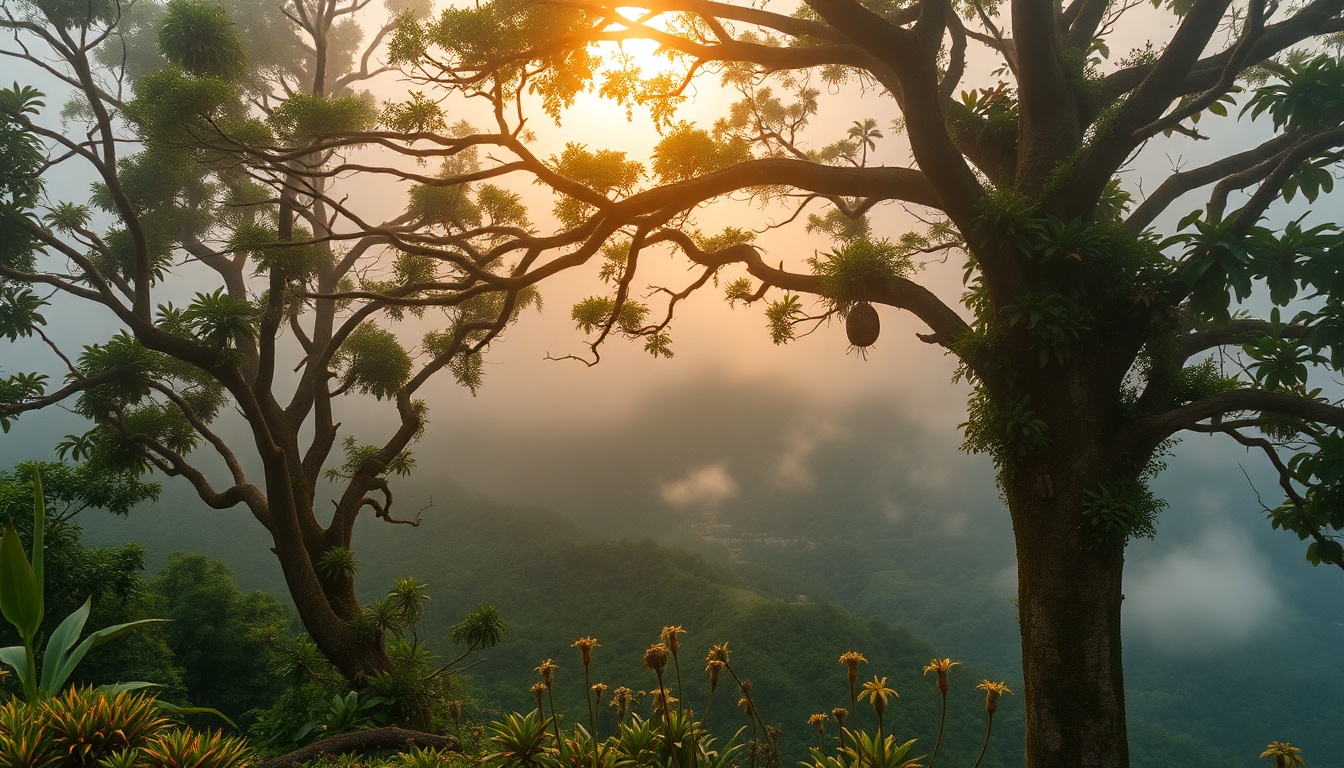
Haiti's most extraordinary surviving ecosystem is the Massif de la Hotte — the mountain range that forms the spine of the Tiburon Peninsula in the country's southwest. Pic Macaya, at 2,347 meters, anchors a cloud forest biosphere reserve (Parc National Pic Macaya, established 1983) that holds one of the highest plant endemism rates in the entire Caribbean basin. Botanists have recorded plant endemism levels above 50% for certain plant families in this restricted fragment — meaning more than half the plant species found here exist nowhere else on Earth.
The forest persists because the Massif de la Hotte's steep terrain, high altitude, and difficult access have slowed charcoal harvesting compared to accessible lowlands. Cloud forest at 1,500–2,347 meters receives mist-fed moisture year-round, sustaining dense canopy dominated by endemic tree species — Podocarpus (the Caribbean's only native conifer), Magnolia pallescens (a rare endemic magnolia found only in Haiti and the DR), bromeliads, orchids, and a complex understory of flowering shrubs. Apis mellifera colonies foraging in the Pic Macaya buffer zone produce honey from a botanical palette that is genuinely unlike anything else in the Caribbean — endemic wildflower honey from one of the Western Hemisphere's most botanically unique fragments.
The Massif du Nord in the country's northeast — where Dondon, La Victoire, and Milot districts sit — contains the country's other significant remaining highland forest fragment. Coffea arabica is still cultivated here at 600–1,200 meters alongside mango, avocado, and highland wildflower vegetation. Honey from the Massif du Nord reflects this agroforestry landscape: multifloral, medium amber, with coffee blossom floral notes during the January–March bloom window that neither producer nor market has yet identified as a distinct varietal.
Get the Honey Buyer's Cheat Sheet (free PDF)
16 varieties on one page — color, flavor, best use and what a fair price looks like — from the 304 honeys we track.
Haitian Bleu and the Kenscoff Coffee Highlands
Before the Haitian Revolution, colonial Saint-Domingue was one of the world's most significant coffee-producing territories. The colony's heirloom Arabica variety — grown continuously from the early 18th-century introduction of Typica coffee through French Martinique — is today called 'Haitian Bleu' or 'Marchell' by specialty buyers who have rediscovered it. The Typica lineage that spread through the Caribbean in the 1720s and 1730s from the original French botanical gardens source is the same genetic line that underpins Jamaica Blue Mountain coffee, introduced to Jamaica in 1728. Haiti and Jamaica have been growing near-identical heirloom Arabica varieties for nearly three centuries; one became the world's most expensive coffee designation, the other has been largely forgotten internationally.
Kenscoff, the highland municipality immediately south of Port-au-Prince at 1,200–1,800 meters elevation, is Haiti's best-positioned surviving coffee-growing zone. The Kenscoff plateau — accessible by the mountain road that climbs from the capital — has cooler temperatures, sufficient rainfall, and volcanic-influenced soils suited to highland Arabica cultivation. Small-scale producers in Kenscoff and neighboring Fermathe grow Haitian Bleu Typica coffee for domestic consumption and for the small specialty export sector that NGO programs (Lutheran World Relief, USAID WINNER program, and cooperatives such as Café Selecto) have developed since the mid-2000s. Coffee blooms January through March in the Kenscoff highlands, producing fragrant white flowers with a jasmine-like fragrance. Apis mellifera colonies in the Kenscoff zone forage coffee blossoms abundantly — and the honey harvested during this window is pale, delicate, and floral. No internationally marketed 'Kenscoff coffee blossom honey' or 'Haitian Bleu coffee blossom honey' product exists as of 2026.
The structural gap mirrors the patterns documented across the Caribbean and Central America in this guide series: Guatemala's Alta Verapaz cardamom and coffee, Honduras's Marcala denomination of origin, Costa Rica's Tarrazú, El Salvador's Santa Ana coffee DO, Jamaica's Blue Mountains CIB designation, the Dominican Republic's Barahona CODOCAFE designation — all have created geographic identity for coffee without extending that logic to the honey produced on the same farms during the same bloom window. In Haiti's case the gap is more stark because the specialty coffee revival itself is fragile and under-resourced. A 'Kenscoff coffee blossom honey' product would require both the coffee revival infrastructure and a parallel honey value chain to develop simultaneously — a higher coordination barrier than any other country in the Caribbean cluster.
The Vetiver Paradox
Haiti produces approximately 60–70% of the world's vetiver oil — an essential raw material in high-end perfumery derived from the roots of Chrysopogon zizanioides, a tropical grass introduced during the French colonial period. Vetiver roots yield a complex, earthy-woody essential oil used as a base note in hundreds of luxury fragrances from Chanel to Guerlain. Haiti's vetiver is particularly prized: the southern department (Aquin, Saint-Louis-du-Sud, Cavaillon) produces a distinctively complex variety from the same alkaline, drought-prone soils that make the perfume market's demand for Haitian vetiver essentially inelastic.
Chrysopogon zizanioides does not produce honey. Vetiver is a grass, and grasses are wind-pollinated — they produce no nectar, no pollen attractive to bees, and no floral structure accessible to Apis mellifera. The vast plains of southern Haiti where vetiver cultivation has displaced whatever forest or wildflower habitat once existed are, from a honey perspective, biological deserts. In regions where vetiver is the dominant cash crop, beekeepers have no viable honey-producing landscape. The same climatic and soil conditions that make Haitian vetiver world-class — shallow, alkaline, drought-stressed limestone — are not suitable for wildflower or arboreal honey-producing vegetation either.
The vetiver paradox is this: Haiti's most globally significant agricultural export, the one product for which the country commands a genuine international quality premium and near-monopoly market position, has no relationship to or benefit for honey production. The perfume industry's demand for Haitian vetiver is structurally separate from any possible honey value chain. For comparison, the Dominican Republic's most significant export crop parallel — organic cocoa — does produce honey opportunities (Theobroma cacao blossom honey) that remain unexplored. Haiti's vetiver does not.
Logwood, Artibonite, and Historical Honey Heritage
Long before vetiver became Haiti's signature aromatic export, the country and neighboring Hispaniola were the world's primary source of logwood — Haematoxylum campechianum, the hardwood whose heartwood yields the blue-purple dye that colored European textiles before synthetic aniline dyes were discovered in 1856. Colonial Saint-Domingue exported logwood alongside sugar and indigo. The tree itself is a honey plant: Haematoxylum campechianum produces abundant small yellow flowers during its dry-season bloom (November–March), and Apis mellifera forage it extensively where it persists in degraded secondary growth and live-fence hedgerows across the Caribbean lowlands.
Logwood honey — pale amber to water-white, mild, slightly floral with a faint herbal-woody note — is produced across Haiti's lowlands wherever H. campechianum persists in hedgerows and secondary vegetation. It is consumed domestically as generic multifloral honey without varietal identity, despite being arguably Haiti's most historically connected honey type. In Jamaica, where the same species persists in St. Elizabeth and Manchester parishes, logwood honey has at least the theoretical identity of a named historical type. In Haiti its connection to the colonial dye-trade heritage has never been developed as a marketing story.
The Artibonite Valley — Haiti's agricultural heartland, stretching from the central plateau to the Gulf of Gonâve — is the country's rice bowl, producing the bulk of domestic staple food alongside sugarcane and banana plantations along the valley floor. Artibonite honey reflects this agricultural landscape: predominantly tropical wildflower multifloral from the secondary vegetation, mango and avocado orchards, and river-corridor trees that persist around field margins. It is the commercial backbone of Haitian honey production — abundant, affordable, and domestically consumed, with essentially no export infrastructure.
Ti Gèp — Haitian Stingless Bee Traditions
In Haitian Creole, the stingless bee is ti gèp — 'little bee.' Before 1492, Hispaniola was inhabited by Taino people who maintained meliponicultura — the keeping of Melipona beecheii, the same stingless bee that Maya people called Xunan Kab across Mesoamerica. The Taino harvested stingless bee honey from clay-pot and hollow-log hives, used it in fermented beverages and as a traditional medicine, and had developed honey-keeping traditions over centuries before European contact. Spanish colonization devastated Taino society by the 1540s through disease, forced labor in gold mines, and violence, disrupting most indigenous meliponicultura traditions on Hispaniola.
In rural communities across southern and southwestern Haiti — particularly in the remaining forested zones around the Massif de la Hotte, the Presqu'île du Sud, and isolated highland villages — informal stingless bee traditions have persisted in fragmented form. Rural families maintain ti gèp colonies in carved log hives (gouès) and clay vessels, harvesting small quantities of stingless bee honey (myèl ti gèp) for household use and local markets. The honey — high in moisture (25–35%), acidic, complex in flavor from organic acid fermentation and botanical diversity — has never been commercially developed or internationally marketed. The same cultural and botanical revival that has driven Xunan Kab meliponicultura recovery in Mexico's Yucatan, Guatemala's Maya communities, and Cuba has not reached Haiti's ti gèp tradition in any organized way.
Melipona beecheii populations on the Haitian side of Hispaniola have not been systematically surveyed. The absence of research is itself a data point: in a country with almost no remaining forest and severe poverty constraining scientific fieldwork, even basic melissopalynological surveys of surviving stingless bee populations have not been conducted. The possibility of Haitian stingless bee honey with distinctive endemic-flora pollen profiles from Pic Macaya's cloud forest represents an entirely uncharacterized research and commercial opportunity.
MARNDR Regulation and Resilience Beekeeping
Haitian honey is regulated under the Ministère de l'Agriculture, des Ressources Naturelles et du Développement Rural (MARNDR), which references Codex Alimentarius standards for basic honey quality parameters. Practical regulatory enforcement is limited by institutional capacity, and most Haitian honey reaches domestic markets through informal channels without formal phytosanitary certification. The Département de l'Agriculture in each of Haiti's ten departments administers extension services, but dedicated apiculture extension infrastructure is thin compared to the Dominican Republic's more developed SENASA and DIGENOR system.
International development programs have invested in Haitian beekeeping as a resilience livelihood strategy — specifically because bees can generate income from degraded landscapes where more input-intensive agriculture is not viable. USAID WINNER (Watershed Initiative for National Natural Environmental Resources) and successor programs have supported apiculture training and hive distribution across multiple departments. Catholic Relief Services / Caritas Haiti, Lutheran World Relief, and Partners in Health (which has occasionally included honey production in community food security programs) have all contributed to the sector at different points. The result is a fragmented but persistent network of trained beekeepers across rural Haiti who produce honey primarily for domestic markets, with limited but growing interest in specialty export development.
The structural path forward for Haitian honey — if any — runs through the same specialty food value chain logic as the Kenscoff coffee revival: small-scale, high-quality, story-driven production from the surviving forest refugia (Pic Macaya, Massif du Nord, Kenscoff highlands) certified to EU or USDA organic standards through the same NGO-linked certification pathways already in use for Haitian coffee and cocoa. A 'Massif de la Hotte endemic wildflower honey' or 'Kenscoff coffee blossom honey' — produced in tiny quantities, certified, traceable — would follow the same trajectory as the Kenscoff coffee revival or the revival of pre-colonial logwood honey identity. The botanical quality is there in the refugia. The institutions and value chain infrastructure are not yet connected.