The Question Wild-Fermenters Eventually Ask
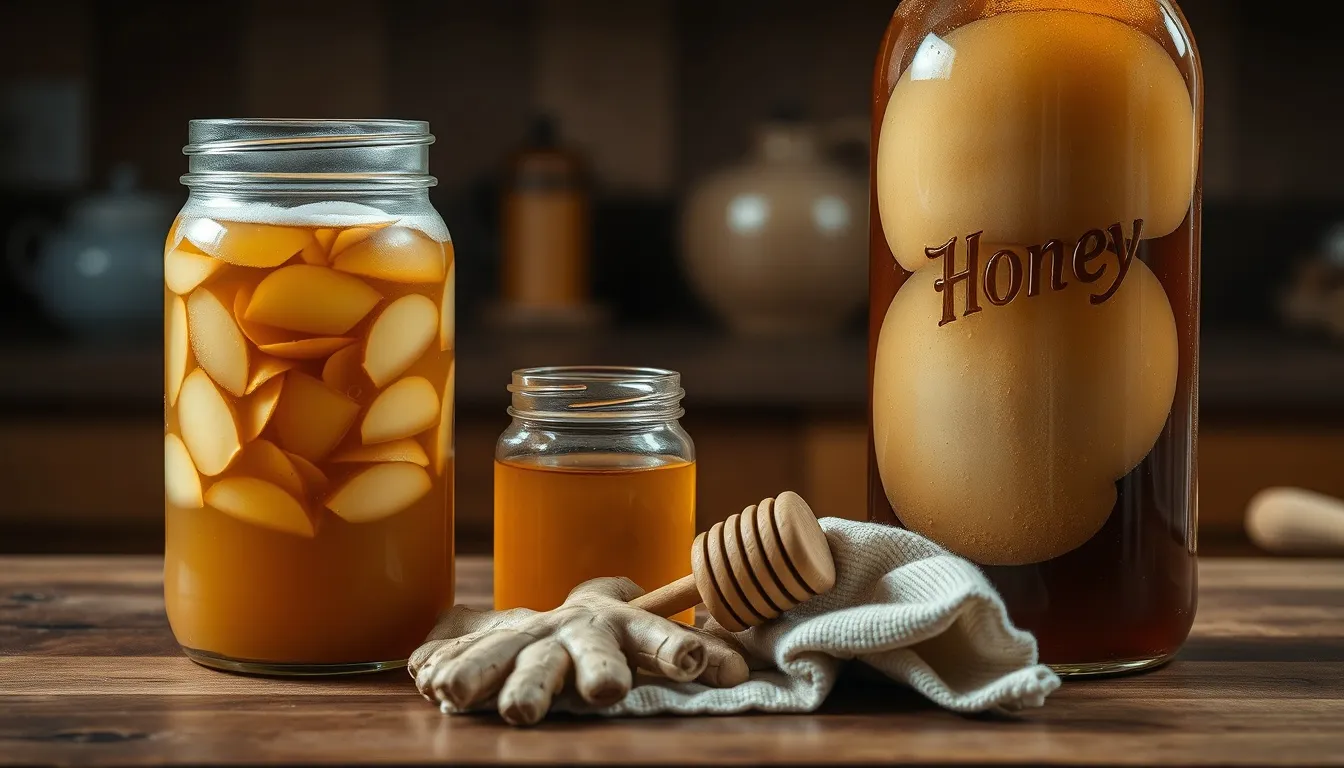
You have brewed kombucha at home and have a stable SCOBY on your counter. A friend hands you a jar of cloudy, fizzing liquid with a knob of grated ginger sitting on the bottom and tells you it is a "ginger bug" — a wild-fermentation starter for making honey-sweetened sparkling sodas. You taste it: tart, peppery, lightly effervescent, nothing like kombucha. The natural next question is whether you can swap inputs between the two systems. Can you use the kombucha SCOBY to start a ginger soda? Can you use the ginger bug to brew a kombucha-style long ferment?
The short answer is no in both directions, and the reasons are structural rather than recipe-level. A ginger bug and a kombucha SCOBY are two different fermentation systems entirely. They are sustained by different microbial consortia, run on different kinetics, finish at different pH ranges, and produce different final beverages. Understanding the differences makes both brews easier, and explains why brewers avoid high-MGO Manuka in a primary ferment.
Two Different Fermentation Architectures
A kombucha SCOBY is a structured biofilm. The "S" in SCOBY stands for symbiotic culture of bacteria and yeast, and the visible disc that floats on the surface is a cellulose pellicle produced by the bacterial fraction (Marsh and colleagues, 2014, *Food Microbiology*, sequenced 5 kombucha pellicles and found the acetic-acid genus *Gluconacetobacter*, since partly renamed *Komagataeibacter*, at more than 85% of bacteria in most samples, with *Zygosaccharomyces* the dominant yeast). The pellicle is how the culture self-organizes: aerobic acetic acid bacteria sit at the top in contact with oxygen, anaerobic yeasts hang below in the broth, and the geometry holds across many fermentation cycles.
A ginger bug has no pellicle and no comparable structure. It is a liquid wild-fermentation starter, sustained as a slurry of grated ginger root, sweetener, and water that the brewer feeds daily until it is reliably bubbly, then maintains by feeding once or twice a week. In a 2024 study of ginger bug and ginger beer (de Oliveira and colleagues, *Food Chemistry*), a longer ginger bug activation (96 hours) produced more organic acids and alcohols and more lactic acid bacteria and yeasts. There is no surface biofilm. The fermentation lives entirely in solution.
Pro Tip
A useful mental shorthand: kombucha is a tended garden with a fixed structure that you maintain across years; a ginger bug is a wild yeast-and-bacteria starter you cultivate from scratch in roughly a week, top up with grated ginger and honey, and replace as needed. Both are "fermented sparkling beverages." Neither is a substitute for the other.
Get the Honey Buyer's Cheat Sheet (free PDF)
16 varieties on one page — color, flavor, best use and what a fair price looks like — from the 304 honeys we track.
Why the Honey Choice Matters More Here
The microbial community in a ginger bug is more sensitive to honey chemistry than the community in a mature kombucha SCOBY, for a simple structural reason: there is no biofilm to buffer the bug. In a kombucha pellicle, the dense bacterial mat acts as a physical and biochemical reservoir, scavenging hydrogen peroxide via catalase, producing protective acetic acid that buffers the broth, and maintaining an aerobic-anaerobic gradient that keeps the yeasts alive while the bacteria do their work. A ginger bug has none of that protection — every yeast cell sits directly in the must, exposed to whatever antimicrobials the honey carries.
Honey carries three antimicrobial mechanisms simultaneously. First, glucose oxidase (a bee-secreted enzyme stored in the honey at low water activity) activates as soon as honey is diluted and starts producing hydrogen peroxide at a slow trickle. Second, gluconic acid (the dominant honey acid) drops the diluted-honey solution to roughly pH 3.8 within hours. Third, every honey carries a residual cocktail of plant phenolics from whatever nectar source the bees foraged, with antimicrobial activity that varies by floral source. A wild-fermentation starter with no protective biofilm has to tolerate all three at once.
The calculator uses 60 grams of honey per liter of total volume as its standard setting and 80 g/L as its strongest. Those are cooking conventions, not measured stall points; we found no study that sets the honey level at which a ginger bug stops fermenting.
The Manuka Trap — Same Conclusion, Different Severity
Most floral honeys ferment cleanly with a healthy ginger bug. The exception, as with jun, is high-grade Manuka. Manuka contains methylglyoxal (MGO), a non-peroxide antimicrobial compound that does not break down with dilution, oxygen exposure, or the catalase enzymes that wild-fermentation yeasts produce. The UMF or MGO grade on the label measures how much methylglyoxal the honey contains.
Methylglyoxal was identified as Manuka's main non-peroxide antibacterial compound in lab tests against bacteria (Mavric and colleagues, 2008). No study we found has tested Manuka in a ginger bug or a kombucha, so how much it slows either ferment is unmeasured. If a bug fed Manuka goes quiet, switch back to a floral honey at the next feed.
The practical rule for any wild-fermentation honey-sweetened ferment: brew with clover, orange blossom, wildflower, acacia, buckwheat, or any non-Manuka raw honey. If you want Manuka flavor, stir a teaspoon into the bottle at F2, after the bug has done the primary work.
Pro Tip
This is about brewing, not health. Lab antibacterial activity says nothing about what a honey-ginger soda does in the body.
Kinetics: 24 to 72 Hours vs 7 to 14 Days
The single most surprising difference for a kombucha brewer trying ginger bug for the first time is the speed. A ginger bug primary ferment (called F1, by analogy with the kombucha and beer convention) completes in 24 to 72 hours at room temperature. A kombucha primary takes 7 to 14 days. Both produce a tart, lightly fizzy liquid; the ginger-bug version arrives an order of magnitude faster.
The kinetic gap reflects the underlying microbiology. Kombucha is structured around the slow conversion of sugar through ethanol to acetic acid, with the yeasts producing ethanol and the Komagataeibacter then oxidizing it. The acetic acid step is rate-limiting — Komagataeibacter is a relatively slow grower, and the cellulose pellicle compounds the slowness. A ginger bug skips the acetic-acid pathway almost entirely. Its dominant acid is lactic acid produced by the LAB fraction, plus modest CO₂ from the yeast fermentation, with very little ethanol-to-acetate conversion. Lactic acid fermentation runs much faster than acetic acid fermentation, and without a biofilm bottleneck.
The pH end-point also differs. Kombucha finishes at roughly pH 2.8 to 3.2 (acetic acid is the dominant flavor anchor). Ginger bug finishes at roughly pH 3.5 to 4.0 (lactic acid plus the ginger-specific phenolics). The higher final pH is why ginger-bug sodas taste lightly tart rather than vinegary, and why they need the F2 (sealed bottle) phase to develop the sparkling-soda mouthfeel — there is not enough acetic-acid backbone to give the brew the kombucha-style pucker.
- Ginger bug F1 (open jar, room temp): 24–48 h at 22–25°C, 60 g/L honey, mild fizz at end
- Ginger bug F2 (sealed swing-top): 24–72 h at 18–24°C — burp daily, refrigerate when firm
- Kombucha F1 (open jar, room temp): 7–14 d at 24–29°C, 70 g/L sweetener, tart end-pH 2.8–3.2
- Kombucha F2 (sealed): 1–3 d at room temp, similar burp protocol
Pro Tip
We built a free Honey Ginger-Bug Calculator that runs the F1 / F2 timeline and the activation-jar shopping list live as you adjust batch size, sweetness, and starter share. No account, no email, no tracking — and a separate Honey Kombucha (Jun) Calculator covers the SCOBY-based brews.
How to Activate a Honey Ginger Bug from Scratch
You do not need a starter from somebody else. The ginger rhizome itself carries the microbes you need — what the brewer is doing is simply giving those microbes water, sweetener, and time to wake up. Buy ginger fresh and unpeeled from a market that sells organic or unwashed root; the wax coating that ships on supermarket commercial ginger can suppress the surface microbes the bug needs.
Combine 480 mL filtered (non-chlorinated) water with 1 tablespoon (about 14 g) freshly-grated ginger and 1 tablespoon (about 21 g) raw floral honey in a wide-mouth pint jar. Cover with cloth and a rubber band — you want gas exchange but not fruit flies. Stir vigorously twice a day, and add another tablespoon of grated ginger plus another tablespoon of honey daily. Within 3 to 5 days at 22 to 25°C, the jar will start producing visible CO₂ when stirred (a stream of fine bubbles trailing up to the surface), and the smell will shift from "raw ginger plus honey" to a tart, slightly winey, distinctly fermenty bouquet. That is your active bug.
Once the bug is active, you have two routes. Route A: feed it daily and use it within a week. Route B: feed it a tablespoon of ginger + tablespoon of honey twice a week and refrigerate between feeds — slows the metabolism without killing the culture. Both work. Route A produces a more vigorous bug; Route B is lower maintenance. Most home wild-fermenters run Route B and pull the bug onto the counter for a 24-hour wake-up feed before brewing a full batch.
Recipe Math: How a 1-Quart Soda Translates
For a 1-quart (about 0.95 L) sparkling soda at the calculator’s standard 60 g/L setting, you need about 57 grams of honey (about 2.7 tablespoons by volume). The starter share is 12 percent of total volume — so about 114 mL of mature ginger bug, leaving room for the flavor base (juice, herbal tea, or plain water plus a fresh-ginger steep). Total: 57 g honey + 114 mL active bug + 793 mL flavor base, mixed in a swing-top bottle, capped, and held at 18 to 24°C for 24 to 72 hours of F2.
For honey volume, the calculator uses 1.4204 g/mL: a cooking estimate interpolated from FAO Table 2.4 at 20°C and assumed 17.5% moisture. The table gives specific gravity, which this estimate approximates numerically as g/mL. At those settings, 57 g of honey occupies about 40 mL and 227 g about 160 mL. Divide honey grams by 1.4204 to estimate its volume in mL when accounting for the liquid ingredients. Actual honey varies; the Honey Weight and Volume Converter lets you explore temperature and moisture assumptions, and a scale gives the weight of your actual portion.
- 1-quart soda: 57 g honey + 114 mL active bug + 793 mL flavor base (rounded estimates)
- 1/2-gallon soda: 114 g honey + 227 mL active bug + 1,586 mL flavor base (rounded estimates)
- 1-gallon soda: 227 g honey + 454 mL active bug + 3,171 mL flavor base (rounded estimates)
- Sweetness presets: Mild = 40 g/L (lighter, faster, lower carbonation); Standard = 60 g/L (textbook); Strong = 80 g/L (richer, longer F2, residual sweetness)
- Starter share: 10–15 % of total volume from a mature active bug, a cooking convention; discard any jar with fuzzy mould
Bottle Conditioning Safety: The Same Rule as Kombucha
Sparkling-soda fermentation in a sealed bottle builds genuine pressure. Glass beer bottles with crown caps are rated for 4 to 6 atmospheres of internal pressure and are the standard for kombucha, jun, and ginger-bug F2 conditioning. PET (the plastic used in store-bought soda bottles) is also acceptable and offers the additional benefit that you can squeeze the bottle to gauge internal pressure — when a PET bottle squeezes hard or feels rock-solid, refrigerate it immediately to halt the ferment.
Avoid repurposed glass jars without explicit pressure ratings, particularly screw-top mason jars. Exploding-jar incidents are well documented in kombucha and home-soda forums and are entirely preventable with the right hardware. Swing-top "Grolsch-style" bottles are the gold standard for home soda — they cost a few dollars apiece, last for decades, and the rubber gasket reseals reliably across many ferments. Any well-stocked homebrew shop or general kitchen-supply retailer carries them.
Refrigeration completes the ferment. Cold slows yeast sharply, but it does not stop it: a refrigerated bottle keeps building some pressure, so check it and open it carefully. Drink within 2 to 3 weeks of refrigeration for best flavor.
Health Framing: What a Honey Ginger Soda Is and Is Not
A homebrewed honey ginger bug soda is a fermented drink with lactic acid, some alcohol and live microbes; the 2024 ginger bug study above measured more acids and alcohols the longer the bug was activated. The live-microbe count and alcohol in a home batch are unmeasured. Be skeptical of any source that describes ginger bug soda as a treatment or prevention for any specific condition.
What is reasonable to say is that ginger ferments contribute live microbes, modest acidity, and a small amount of dietary phytochemicals (gingerol from the ginger, floral phenolics from the honey, lactic-acid metabolites from the LAB). Whether any of that translates to a measurable health difference for the drinker is not currently settled by clinical evidence. Treat homebrewed honey ginger soda as an interesting flavor-and-beverage project — it is delicious, it is much cheaper than store-bought naturally fermented sodas, and it is a genuinely useful gateway into the broader world of wild fermentation. Anything beyond that is speculative.
The Take-Away for First-Time Brewers
A ginger bug is not a kombucha SCOBY, and a kombucha SCOBY is not a ginger bug. Both are wonderful home-fermentation projects; they just live in structurally different worlds. If you are starting from scratch, the ginger bug is the easier first project — no sourcing, no biofilm, no multi-week wait. Activate the bug from fresh ginger and floral honey in 3 to 5 days, brew your first 1-quart soda 24 to 48 hours after that, and bottle a sparkling honey-ginger drink within a week of starting.
Use clover, orange blossom, wildflower, or acacia honey for the activation and primary ferment. Skip the high-grade Manuka for now — save it for finishing. Hold temperatures in the 22 to 25°C range during F1, drop to 18 to 22°C for F2 to slow carbonation, and refrigerate as soon as the bottle squeezes firm. After four or five batches, most home brewers settle into a routine: a maintained bug in the fridge, a weekend brew day, and a constant supply of one or two flavors of homemade honey soda for the household.