The Difference Starts With Honey and Tea
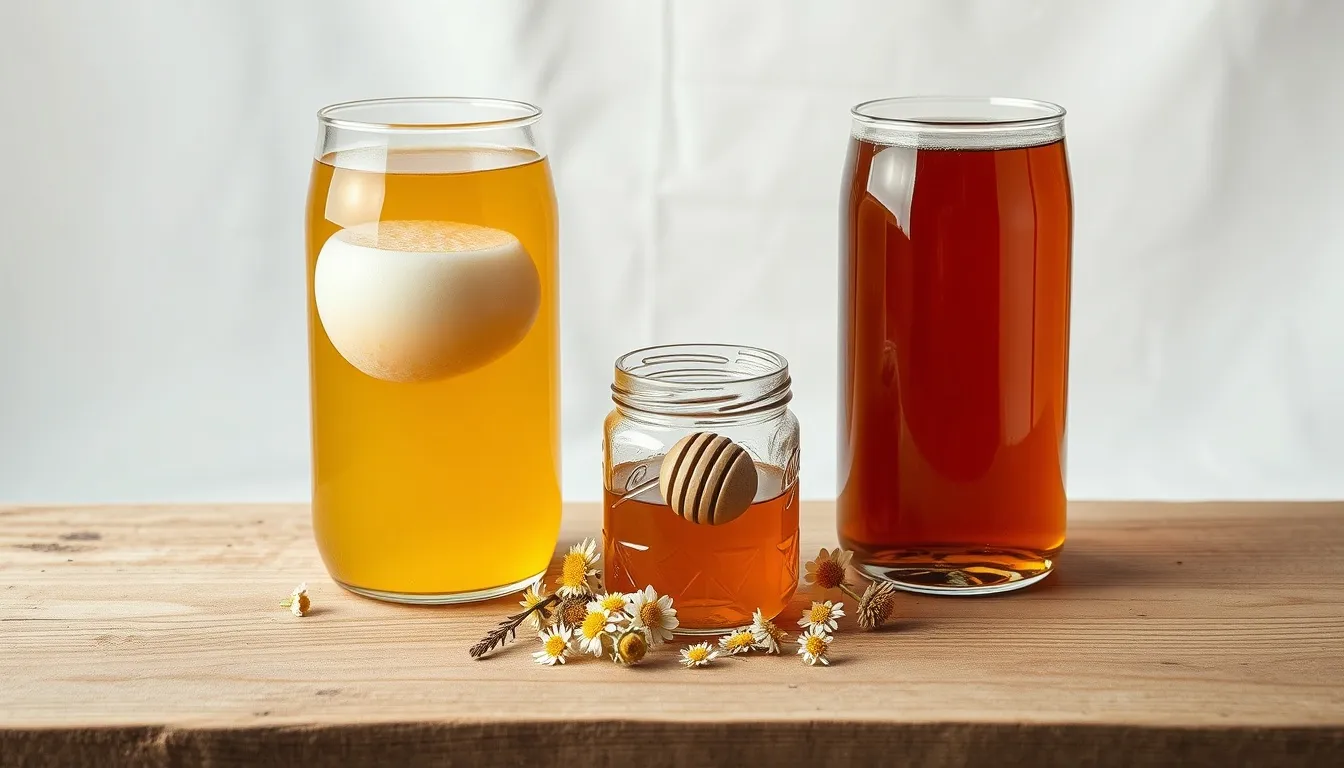
Jun is generally made with honey and green tea; kombucha commonly uses sugar with black or green tea. Those ingredients are a useful starting point for comparing the drinks. They do not establish that every culture sold as Jun has a distinct set of microbes, or that a kombucha culture cannot ferment honey. The BC Centre for Disease Control guidance on kombucha and Jun describes the question of a unique Jun culture as debated.
For a first batch, use a Jun culture and mature starter supplied with instructions for honey and tea. That is a practical way to follow a known recipe, rather than a claim that the culture has a proven, exclusive microbial identity. Changing the sweetener, tea and culture at once makes it harder to compare the result with the recipe you started from.
What the Microbial Studies Actually Show
Marsh et al. (2014) analyzed bacteria and fungi in five kombucha cultures and their corresponding fermented liquids. The study found differences among cultures and between the liquid and pellicle. It studied kombucha; it was not a direct comparison of Jun and kombucha.
Coton et al. (2017) studied industrial kombucha made with black and green tea. Both used the same starter biofilm, and lactic-acid bacteria were found in the green-tea fermentation as well as acetic-acid bacteria and yeasts. Green tea and the presence of lactic-acid bacteria therefore cannot, by themselves, identify a culture as Jun.
These studies support a narrower conclusion: kombucha cultures vary, and the ingredients and fermentation conditions can affect the community. They do not establish a universal Jun species list, a different Jun genome, or a genetic explanation for why a particular home batch stalls.
Pro Tip
SCOBY means symbiotic culture of bacteria and yeast. The visible cellulose layer is the pellicle; the liquid also contains microbes. Keep the mature starter specified by your recipe rather than assuming the visible mat is the entire culture.
Get the Honey Buyer's Cheat Sheet (free PDF)
16 varieties on one page — color, flavor, best use and what a fair price looks like — from the 304 honeys we track.
Can a Kombucha Culture Ferment Honey?
Yes, that has been demonstrated for a particular laboratory culture. Reva et al. (2015) maintained a kombucha culture in black tea sweetened with honey under controlled laboratory conditions. This is evidence against the blanket claim that kombucha cannot ferment honey. It is not a home-brewing recipe or proof that every sugar-fed culture will perform the same way.
A recipe that works with one culture is not a guarantee for another. If you want to brew the Jun recipe below, obtain the culture and mature Jun starter it calls for and follow the original instructions. Do not diagnose a sweet batch, a thin pellicle or slow fermentation as proof of missing peroxide-scavenging genes; none of the studies linked here supports that diagnosis.
Honey Choice: Separate Flavor From Fermentation Claims
The published recipe below calls for raw honey. Mild clover honey, acacia honey or orange blossom honey are flavor options to consider with green tea; buckwheat honey brings a more assertive flavor. These are taste suggestions, not rankings of fermentation reliability.
Mavric et al. (2008) identified methylglyoxal as a major antimicrobial constituent of the Manuka honeys they tested. Their laboratory assays used E. coli and S. aureus, not Jun cultures or brewing yeasts. That paper does not establish a Manuka grade that will stall Jun, or show that adding Manuka at bottling bypasses an antimicrobial effect. Follow the honey guidance supplied with your culture instead of using a honey grade as a fermentation test.
Recipe Quantities: Scaling One Published Jun Recipe
This example follows the original Kombucha Kamp Jun recipe, page 6. For a nominal 1-US-gallon vessel, it lists 12 US cups water (4 hot plus 8 cold), 1 US cup raw honey, 4–5 teaspoons loose green tea, and 1–2 US cups mature Jun starter, plus a Jun culture. The source also gives 4–5 tea bags for the full recipe. Tea-bag sizes vary; use the loose-tea measures below when scaling.
The gallon label describes the nominal vessel, not an exact finished yield. The separately measured water, honey and starter add to 14–15 US cups, rather than 16. Tea absorption, mixing and the culture can affect the actual fill, so this sum is neither a measured mixed yield nor a headspace measurement. The source does not instruct you to top up to a gallon. Follow the linked original recipe for brewing instructions.
Honey volume and honey weight are different measures. A quarter US cup is 4 US tablespoons or 2 US fluid ounces. That honey is estimated to weigh about 84 g, or 3.0 oz by weight, using the FAO Table 2.4 cooking estimate of 1.4204 g/mL at 20°C and assumed 17.5% moisture. The specific-gravity table is approximated numerically as g/mL; actual honey varies. The recipe specifies honey by volume, and these weights are estimates.
- Nominal 1-US-quart vessel: 3 cups water (1 hot + 2 cold), 1/4 cup honey (about 84 g), 1/4–1/2 cup mature starter, 1–1.25 teaspoons loose green tea, plus a Jun culture. Separate liquid measures: 3.5–3.75 US cups.
- Nominal 2-US-quart (half-gallon) vessel: 6 cups water (2 hot + 4 cold), 1/2 cup honey (about 168 g), 1/2–1 cup mature starter, 2–2.5 teaspoons loose green tea, plus a Jun culture. Separate liquid measures: 7–7.5 US cups.
- Nominal 4-US-quart (gallon) vessel: 12 cups water (4 hot + 8 cold), 1 cup honey (about 336 g), 1–2 cups mature starter, 4–5 teaspoons loose green tea, plus a Jun culture. Separate liquid measures: 14–15 US cups.
Pro Tip
The free Honey Kombucha (Jun) Calculator scales this same recipe from 0.5 to 8 nominal US quarts. Choose 1, 1.5 or 2 cups of mature starter per nominal gallon; 1 cup is the lower end of the source range and 1.5 cups is simply its midpoint. The tool scales quantities and does not predict fermentation time, acidity or alcohol content.
Follow the Recipe, Not a Universal Fermentation Clock
The linked Kombucha Kamp recipe gives 65–75°F (about 18–24°C) and 3–7 days, depending on taste and temperature. Those are the author's instructions for that recipe. They are not universal biological cutoffs: they do not establish that all Jun ferments faster or cooler than all kombucha, or that a batch must stall outside that range.
Use the original recipe and the instructions for your starter together. The calculator scales only ingredients; it does not predict readiness, acidity, alcohol or bottle pressure. Recording the culture, ingredients, temperature and elapsed time helps you compare batches without turning a calendar estimate into a measured result.
Acidity, Alcohol and Bottle Pressure Are Separate Checks
BCCDC guidance handles acidity, alcohol and pressure as separate concerns for kombucha and Jun. A pH reading or tart taste does not measure alcohol content or bottle pressure. This guide does not supply a universal bottling pH or a shelf-stability claim.
Use food-grade containers suitable for acidic drinks and, for carbonation, intended to withstand pressure. Follow the container maker's specifications. Refrigerate live drinks with residual sugar; refrigeration is not a substitute for controlling fermentation and pressure. The linked guidance provides the fuller process controls.
Choose Jun for the Drink, Not a Promised Upgrade
The research cited here does not demonstrate better outcomes from choosing Jun over kombucha. A count of live microbes, the presence of honey compounds or an antimicrobial laboratory result would not, by itself, establish a benefit from drinking Jun. We do not assign this untested recipe a live-microbe count, vitamin content or probiotic effect.
Choose the tea and honey flavors you enjoy, follow a documented recipe and think of the result as a fermented beverage. For a first batch, keep the ingredient quantities, starter instructions and source-specific process guidance together. Use the calculator for scaling and the original sources for what the research and recipe actually establish.