Minerals Are Real but Still Modest
Honey contains minerals, especially potassium, but it is not a major mineral food at normal serving sizes. The commodity reference entry from USDA FoodData Central is a useful baseline for ordinary honey: https://fdc.nal.usda.gov/fdc-app.html#/food-details/169640/nutrients.
This content was not professionally fact checked. It is for conservative consumer education only. NEVER use it as dietary advice. Use official dietetic sources for decisions about mineral intake.
The useful consumer point is variety. Darker honeys often carry more ash, potassium, iron, magnesium, and trace elements than pale honeys. The deeper honey mineral content index ranks varieties by mineral content; this article translates that idea into buying and label-reading decisions.
Why Dark Honey Usually Leads
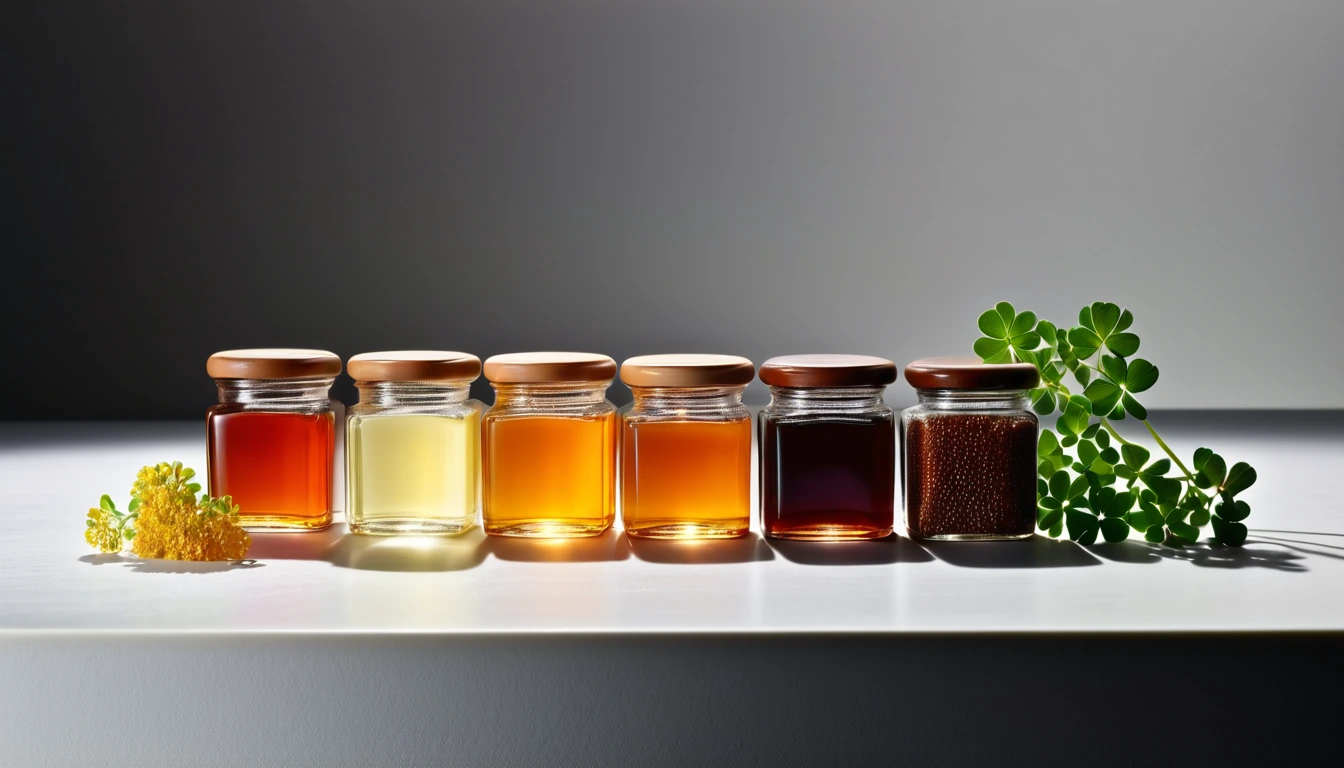
Mineral content is often summarized as ash content, meaning the inorganic residue left after controlled burning in a lab. Dark honeys such as buckwheat, chestnut, and heather usually sit higher because their source plants and soils contribute a richer mineral and phenolic matrix.
Reviews of honey chemistry describe minerals as part of a wider set of minor compounds that vary by botanical and geographic origin: https://pmc.ncbi.nlm.nih.gov/articles/PMC6225430/. Other reviews connect color and phenolics, which often travel with mineral-rich botanical sources: https://pubmed.ncbi.nlm.nih.gov/34829570/.
Color is a clue, not a certificate. A dark wildflower honey from diverse bloom can be mineral-richer than a pale clover honey, but a lab report is the only way to know the exact value.
Get the Honey Buyer's Cheat Sheet (free PDF)
16 varieties on one page — color, flavor, best use and what a fair price looks like — from the 304 honeys we track.
Practical Variety Tiers
High-mineral candidates: buckwheat, chestnut, heather, and some dark wildflower honeys. These are the jars to compare if you want a sweetener with more measurable non-sugar material.
Moderate candidates: manuka, avocado, blueberry, eucalyptus, and medium amber wildflower. They may carry a stronger mineral signal than pale table honey, but they are still not substitutes for mineral-rich foods.
Low-mineral candidates: acacia, tupelo, light clover, sage, and many very pale honeys. They can still be excellent for flavor, low crystallization tendency, or tea use. Mineral density is only one axis. The honey micronutrients by color guide explains how to use color without overreading it.
Serving Size Keeps the Claim Honest
A tablespoon of honey is roughly 21 g. Even when a dark honey has several times the minerals of a pale honey, that tablespoon is still a small serving compared with beans, greens, dairy, nuts, or mineral-fortified foods. The comparison where honey looks best is against refined sugar, which contributes essentially no minerals.
This is why the strongest claim is modest: replacing some refined sugar with a darker raw honey can add minor minerals while changing flavor. It does not make honey a mineral supplement.
If you want to compare mineral claims with amino acid and enzyme markers, use the honey microcompound mapper, then read the sibling guides on honey organic acids and enzymes and honey amino acids profile.
Source Notes
Useful starting points include the USDA nutrient page above, the USDA API record at https://api.nal.usda.gov/fdc/v1/food/169640?api_key=DEMO_KEY, and broad review literature on honey composition such as https://pmc.ncbi.nlm.nih.gov/articles/PMC9900486/.
Read any marketing claim against those baselines. A batch-specific mineral panel is meaningful. A vague front-label phrase such as 'packed with minerals' is not.
Pro Tip
Best consumer heuristic: dark honey usually means more minerals than pale honey, but exact values require a lab certificate.