The Land of Milk and Honey: What Biblical dvash Actually Was
The phrase 'land of milk and honey' appears more than twenty times in the Hebrew Bible — in Exodus, Leviticus, Numbers, Deuteronomy, and the Prophets — always as a description of Canaan, the land promised to the Israelites. The Hebrew word translated as 'honey' throughout these passages is dvash (דְּבַשׁ). Biblical scholars, food historians, and archaeologists have debated for decades whether dvash refers to bee honey or to the thick, dark syrup produced from pressed dates — silan in modern Arabic and Hebrew. The consensus today is that most uses of dvash in the Bible refer to date syrup rather than bee honey: Canaan was not known for extensive beekeeping in the period of the Exodus narrative, the word dvash is used in contexts where sweetness and abundance are metaphorical rather than apicultural, and date cultivation was far more established in the Jordan Valley and Jericho region than managed beekeeping.
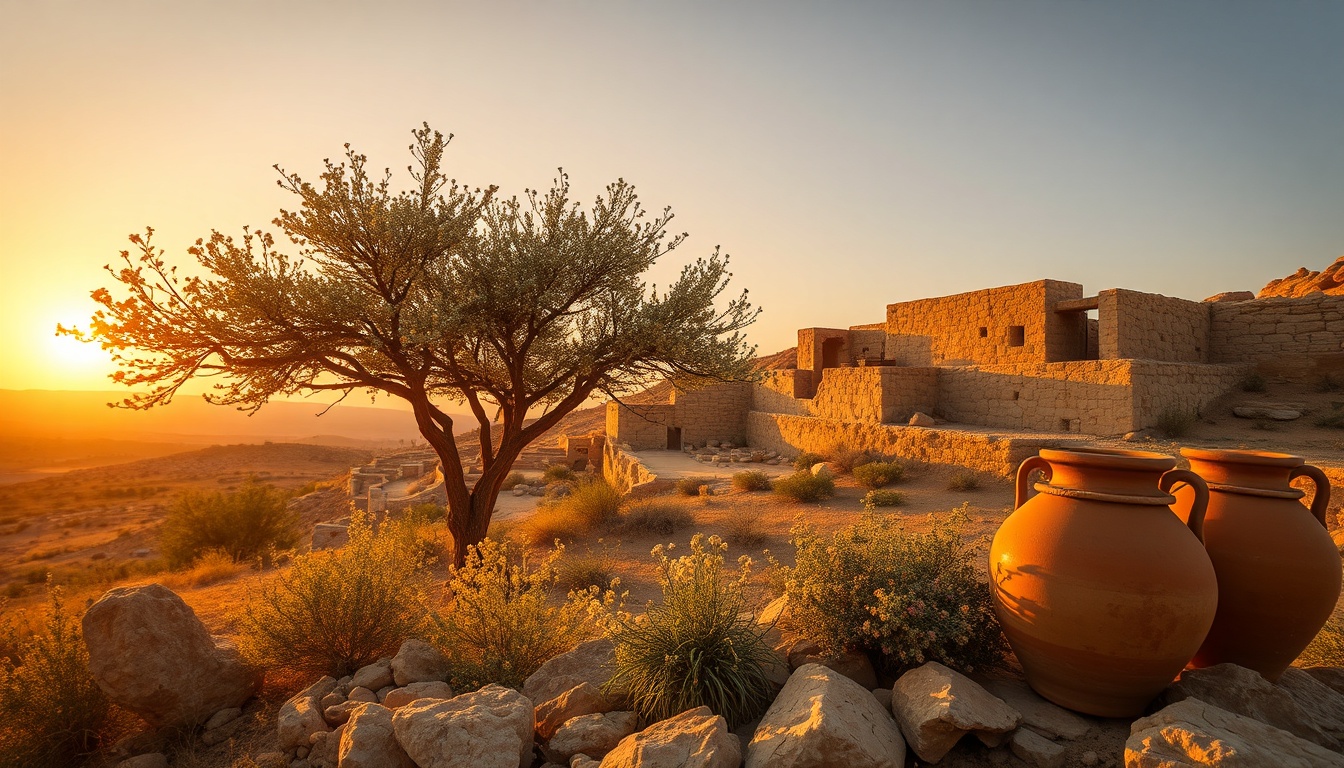
The irony is significant: the phrase that gave honey its most powerful cultural endorsement in Western civilisation — the phrase that appears in over a hundred honey brand names and thousands of marketing contexts — was probably not about bee honey at all. Yet this commercial irony sits alongside a genuine archaeological discovery that makes Israel's actual beekeeping history even more remarkable than the biblical framing suggests. In 2007, archaeologists excavating Tel Rehov in the Beth Shean Valley in northern Israel uncovered the world's oldest documented large-scale apiary: approximately 30 intact clay cylindrical hives arranged in rows, dated to approximately 900 BCE — the early Israelite monarchy period, the time of the kings. The Tel Rehov apiary represents organised beekeeping at a scale — potentially 100–200 hives based on the spatial evidence — that was not documented anywhere in the ancient world until this discovery.
The bee associated with the Tel Rehov hives was identified through archaeobotanical and genetic analysis as Apis mellifera jemenitica or a close relative — a subspecies adapted to the hot, dry climate of the southern Levant. Pollen analysis from the honey residue found in the Tel Rehov hives identified thyme (Thymus species), Syrian oregano (Origanum syriacum — za'atar), and other Levantine aromatic plants. The hives themselves were ceramic cylinders approximately 80 cm long and 40 cm in diameter, stacked in three rows in a dedicated building — the structure of a professional, planned beekeeping facility, not a casual household arrangement. Tel Rehov is not a biblical story about honey. It is the oldest hard evidence of organized commercial-scale beekeeping in human history.
Pro Tip
The Tel Rehov hives were excavated by a Hebrew University team led by Amihai Mazar. In a 2010 PNAS study, Guy Bloch and colleagues reported bee workers, drones, pupae and larvae preserved inside the hives, the first unequivocal proof that the clay cylinders were beehives. The bees did not match the local Apis mellifera syriaca; their measurements matched A. m. anatoliaca, a subspecies now found in Turkey, so the beekeepers may have imported gentler, more productive bees, or the subspecies ranges have shifted in 3,000 years.
Apis mellifera syriaca: The Original Levantine Bee
The native honeybee of Israel, Jordan, Lebanon, Syria, and the Palestinian territories is Apis mellifera syriaca, named by the entomologist Skorikov in 1929. Apis mellifera syriaca belongs to the O-lineage (Oriental lineage) of the Apis mellifera species complex — the same lineage as Apis mellifera jemenitica (Yemeni bee), Apis mellifera nubica (Nubian bee), and other subspecies found across the Middle East and northeast Africa. This genetic lineage is distinct from the European M-lineage (Apis mellifera mellifera, Apis mellifera carnica, Apis mellifera caucasica) that dominates global commercial beekeeping and from the C-lineage (Apis mellifera ligustica, Apis mellifera cerana-adjacent populations).
Apis mellifera syriaca is the native honey bee of the southern Levant. We could not find a published measurement supporting the tongue-length figures that earlier versions of this page gave for A. m. syriaca, so we removed them. What is well established is that it is the local bee of the hot, dry Levant, where herbs such as za'atar (Origanum syriacum), sage and thyme dominate the highland honey flora.
Genetic studies of Apis mellifera populations in Israel have documented significant introgression — mixing — of European subspecies genetics into Israeli bee populations, primarily A. m. ligustica (Italian bee) from imported queens and colonies used by Israeli commercial beekeepers since the early state period. The native A. m. syriaca genetic signature is clearest in isolated or low-management-intensity populations: wild colonies in Judean Desert cliff crevices, colonies maintained by Bedouin beekeepers in the Negev, and some populations in the Palestinian Authority territories where imported queen availability was more restricted. The Volcani Center (Agricultural Research Organization) in Rehovot has conducted ongoing research into A. m. syriaca genetics and performance, with interest in breeding programs that exploit its native climate adaptation — heat tolerance, foraging efficiency in high temperatures, and Varroa hygenic behavior compared to European subspecies.
Get the Honey Buyer's Cheat Sheet (free PDF)
16 varieties on one page — color, flavor, best use and what a fair price looks like — from the 304 honeys we track.
Negev Sidr: Desert Honey from the Quranic Lote Tree
Israel's Negev desert — the arid and hyper-arid zone covering approximately 60% of Israel's total territory, running from the Beer Sheva depression south to the Red Sea at Eilat — contains significant populations of Ziziphus spina-christi, the spiny lote tree known in Arabic as sidr and in Hebrew as sheizaf. This is the same tree species that produces the legendary Yemeni Sidr honey, the same species referenced in Quran Surah 56 (Al-Waqi'ah verse 28) as the sidr trees of Paradise, and the same species whose thorny branches provide the traditional identification of the 'crown of thorns' placed on Jesus at the crucifixion — an identification supported by the tree's prevalence in the Judean landscape and its sharp, curved thorns.
Negev Sidr honey is produced in small volumes by Israeli beekeepers who maintain apiaries in the northern Negev and the Judean foothills where Ziziphus spina-christi populations are dense. The flow occurs in October–November — the same autumn timing as Yemeni and Saudi Sidr — and produces a honey with amber to dark amber color, a characteristic caramel-herbal sweetness, and the slow crystallization typical of Sidr honey across its range (the high fructose content of Ziziphus nectar slows glucose crystallization).
The market paradox of Negev Sidr is almost exactly the inverse of the Yemen Sidr situation. Yemeni Sidr commands internationally based on a powerful brand built over decades, Quranic endorsement, and the perceived premium of an isolated and difficult-to-access production zone. Israeli Sidr — from the same species, with comparable analytical profiles documented in published literature — is essentially absent from international premium markets. No Israeli Sidr honey brand operates at international retail level. Domestic Israeli pricing for Negev Sidr is — a premium over Israeli wildflower honey but a fraction of the Yemeni equivalent. The branding gap is significant: 'Negev Sidr' carries none of the cultural weight of 'Yemeni Sidr' in Gulf, European, or North American premium honey markets, and Israeli political context limits Gulf-market access. Yet analytically, Negev Sidr honey is a premium variety whose market position is determined by story, not chemistry.
Pro Tip
A lab pollen analysis (melissopalynology) is how a Sidr honey's source is confirmed: Ziziphus spina-christi pollen should dominate. Ask an Israeli or Yemeni Sidr seller for one before paying premium prices.
Carob Blossom Honey: The Most Overlooked Israeli Specialty
The carob tree — Ceratonia siliqua — is among the oldest cultivated plants in the Mediterranean basin, with archaeological evidence of carob consumption in the Levant going back at least 5,000 years. In modern food consciousness, carob is known primarily as a chocolate substitute: the dried, ground carob pod (the 'locust bean' of food labelling) is used in confectionery and health food as a caffeine-free alternative to cocoa. But the carob tree's bloom — occurring in late August through October across Israeli and Palestinian orchards and wild stands — produces a major nectar flow that Israeli beekeepers have long recognized as one of the country's most distinctive honey plants.
Carob blossom honey has a colour and appearance unlike any common honey variety: dark amber to near-black when fresh, darker still on crystallization, with a flavour profile that experienced tasters describe as rich, complex, and reminiscent of the carob pod's characteristic caramel-chocolate character — though without the literal cocoa flavour. Carob honey crystallizes slowly to a smooth, spreadable consistency because the carob nectar's sugar profile — like Sidr nectar — has a higher fructose fraction than most temperate flower honeys.
No international carob blossom honey brand from Israel has achieved significant market presence. The variety is sold in Israeli specialty shops, at direct-from-producer markets, and through health food distributors within Israel — but Israeli carob honey is essentially unknown outside the country and is only rarely encountered even in European specialty honey markets that import Greek, Cypriot, or Lebanese varieties. This is an exact parallel to the Negev Sidr situation: a genuinely distinctive honey variety with unique botanical identity, documented quality, and no international brand claiming it. Israeli carob honey is arguably the most underexploited premium honey origin story in the entire Mediterranean basin — a honey that is darker, richer, and more complex than the lavender and citrus varieties that dominate Mediterranean honey marketing.
Eucalyptus and Citrus: The Modern Israeli Apiary Landscape
Modern Israel's agricultural and land-use landscape was substantially shaped by Zionist settlement decisions in the late nineteenth and early twentieth centuries, when the Jewish National Fund and associated organizations planted over 30 million trees across the landscape for erosion control, land reclamation, and shelter. Eucalyptus — particularly Eucalyptus camaldulensis (river red gum) — was the primary species chosen for swamp drainage, windbreak establishment, and dune stabilisation across the coastal plain, the Galilee, and the northern Negev margin. The result is a landscape where Eucalyptus is one of the dominant flowering trees across large parts of Israel, particularly in the coastal lowlands and the agricultural areas of the Galilee.
Israeli eucalyptus honey — produced from E. camaldulensis and E. globulus bloom in winter through early spring — is a significant component of Israel's commercial honey output. It is a medium-amber honey with the eucalyptol-dominant aromatic character typical of eucalyptus honey across its global range: slightly medicinal, herbal, with a distinctive cooling undertone that makes it recognisable among trained tasters, though Israeli eucalyptus develops more concentrated minerality from Mediterranean limestone soils compared to Australian eucalyptus varieties from different geological terroir. Israeli eucalyptus honey is used medicinally in folk tradition and is commercially significant in domestic food markets, but it does not carry the premium or the botanical distinctiveness of Negev Sidr or carob blossom as a marketing proposition. The eucalyptus landscape of Israel is literally a human-made arboricultural decision from the early twentieth century — an inadvertent honey source created by land reclamation, not botanical heritage.
Citrus blossom honey — from the Jaffa orange and Shamouti orange groves of the coastal plain and the Beit She'an Valley — represents another historically significant Israeli honey variety. The Jaffa orange was one of Israel's most famous agricultural export products through the mid-twentieth century; at its peak, Israeli citrus dominated European markets from Britain to Germany. The citrus blossom flow in March–April produces a pale golden, delicately floral honey with the characteristic orange-blossom sweetness similar to Florida orange blossom honey, though Israeli varieties develop distinctive Mediterranean limestone minerality and more concentrated floral intensity from the drier climate and volcanic-limestone terroir compared to Florida's subtropical sandy soils. Israeli citrus acreage has declined significantly since the 1970s as urban expansion, water costs, and competition from Spanish, Egyptian, and Moroccan citrus have reduced commercial cultivation — but Jaffa Valley and Beit She'an Valley apiaries still produce citrus honey in meaningful volumes. Like eucalyptus, Israeli citrus honey does not carry a distinguished international brand, and most production enters domestic consumption or undifferentiated export.
Za'atar, Wildflower, and the Highland Bee Pasture
The most complex and botanically diverse Israeli honey comes from the wildflower polyflora of the highland landscape: the Galilee mountains, the Golan Heights, the Judean Hills and the Judean Desert margin, and the Samarian highlands. This landscape — at 300–1,200 metres altitude — is dominated by the Mediterranean garrigue: a mosaic of low shrubs, aromatic herbs, and annual wildflowers characteristic of the entire eastern Mediterranean basin. The dominant honey plants are Origanum syriacum (Syrian oregano, za'atar — the most important regional aromatic herb, used throughout Levantine cuisine as the primary component of za'atar spice blend), Thymus species, Salvia species, Cistus (rockrose), Echium species, Asphodelus (asphodel), and Hyoscyamus (henbane, toxic to humans but not to bees).
Israeli highland wildflower honey varies enormously by season and site. Spring flow (February–May) captures the annual wildflower diversity at its maximum — anemones, cyclamens, iris, lupins, mustard, and the Mediterranean geophyte community that blooms briefly and intensely before the summer drought. Summer flow (May–July) shifts to the aromatic shrub community — za'atar, thyme, sage — that produces concentrated nectar in the hot, dry Levantine summer. Autumn flow (September–November) incorporates carob and the beginning of the Sidr season. Israeli beekeepers who run small-scale artisanal operations in the Galilee and Jerusalem hills describe the wildflower polyflora as the most complex and characterful Israeli honey variety — but also the hardest to market because complexity is difficult to communicate to consumers accustomed to monofloral honey identity.
Za'atar honey — produced from predominantly Origanum syriacum sources in the Galilee, Golan, and Palestinian highlands — is the closest Israeli equivalent to Greek thyme honey in terms of aromatic character, sharing similar carvacrol and thymol volatile compounds though Israeli za'atar honey develops more intense herbal complexity from the higher elevation Levantine terroir and limestone-volcanic soil minerality compared to Greek coastal thyme varieties. The same carvacrol and thymol compounds that give za'atar its characteristic herbal intensity (and make it the dominant flavour note in the za'atar spice blend) contribute to the honey's aromatic profile: a medium-amber honey with herbal, resinous, faintly medicinal notes that experienced Mediterranean honey tasters recognise as distinctly Levantine. Za'atar honey is sold domestically in Israel and in the Palestinian Authority territories as a premium variety, but it has no international brand presence comparable to Greek Hymettus thyme honey or Turkish Anzer.
The Volcani Center and Israeli Honey Research
Israel's Agricultural Research Organization — the Volcani Center, founded in 1921 in Rehovot — has been the institutional backbone of Israeli beekeeping science since before the state's establishment. The Volcani Center's bee research unit has conducted sustained work on Apis mellifera syriaca genetics and performance, Varroa destructor resistance mechanisms in Levantine bee populations, honey plant phenology and mapping across Israeli ecosystems, and honey quality analytics.
The Tel Rehov excavation gave Israel the oldest beehives found anywhere as of 2010, a large apiary inside an Iron Age town of the 10th to early 9th centuries BCE, documented in peer-reviewed work such as the 2010 PNAS study on the bees inside them. That history is in the scientific literature, not just folk tradition.
The beekeeping record Israel has built, from the Tel Rehov hives to modern bee research, is one of the best documented anywhere.
Pro Tip
To find the published morphometric and genetic studies of Apis mellifera syriaca, search PubMed or Europe PMC for 'Apis mellifera syriaca'.
The International Market Gap: Israel's Most Powerful Untold Honey Story
Despite operating in the world's most honey-storied cultural landscape — the 'land of milk and honey' of the Hebrew Bible and Christian Old Testament, home to the oldest documented large-scale apiary in human history, and the source of the native bee subspecies that pollinates the Levantine aromatic herb flora — no Israeli honey brand operates at significant international retail scale in 2026. Israeli honey is not absent from international markets entirely: some Israeli wildflower and eucalyptus honey reaches Jewish community specialty food shops in the US, UK, and Europe, particularly through kosher food distribution channels that carry Israeli agricultural products. But compared to the cultural equity of 'Israeli honey' as a phrase in English — an equity that encompasses biblical narratives, archaeological discoveries, and the oldest recorded beekeeping tradition in the Levant — the commercial footprint is almost invisible.
The reasons for this gap are structural rather than quality-related. Israeli honey production at approximately 5,000 tonnes per year is modest relative to major exporting countries; Israel's honey sector is oriented toward domestic consumption rather than export; the political context of Israeli food products in certain international markets (particularly in the Gulf states that are the natural premium honey import market for Sidr varieties) creates distribution barriers; and the Israeli government has not invested in honey origin branding comparable to New Zealand's Manuka program or France's AOP designation infrastructure. The Negev Sidr is analytically comparable to Yemeni Sidr but has none of its brand recognition. Israeli carob honey is analytically comparable to Sicilian carob honey but has none of its Italian-food-culture marketing infrastructure. Israeli za'atar honey is analytically comparable to Greek Hymettus thyme honey but has essentially none of its international recognition.
For buyers who can access authentic Israeli honey — through specialty importers, kosher food distributors, or direct from Israeli producers who ship internationally — the value proposition is significant: documented honey varieties with 3,000 years of beekeeping archaeology behind them, from native bee genetics adapted to Levantine flora over millennia, at prices well below comparable Mediterranean premium varieties from better-branded origins. The 'land of milk and honey' story remains the most powerful unclaimed premium honey origin story in the English-speaking world.