Syria's Honey Geography: Mediterranean Floristics, Mountain Ranges, and the Eastern Steppe
Syria occupies 185,180 km² at the eastern end of the Mediterranean basin — a geography that compresses one of the world's most floristically diverse landscapes into a country slightly smaller than Iraq. The western fifth of Syria is structurally Mediterranean: the Coastal Plain (10–30km wide, Tartus to Latakia), the Jebel Ansariyya (Alawi/Nusayriyah Mountains, 900–1,562m), the Orontes River valley (Al-Ghab plain, 200m), and the western Anti-Lebanon range. These zones receive 600–1,400mm of rainfall annually and support dense maquis and garrigue communities — Pistacia lentiscus (mastic), Arbutus andrachne (strawberry tree), Quercus calliprinos (kermes oak), Olea europaea (wild olive), Pinus brutia (Brutia pine), Cedrus libani remnants, and the wild herb communities — Origanum syriacum (Syrian za'atar), Salvia officinalis and Salvia fruticosa, Thymus vulgaris — that define the Levantine honey flora. East of the Anti-Lebanon, rainfall drops below 200mm, the landscape transitions through the Syrian Steppe (badia) to desert, and the Euphrates valley corridor sustains irrigated agriculture and the last intact riverine vegetation complex in the Middle East.
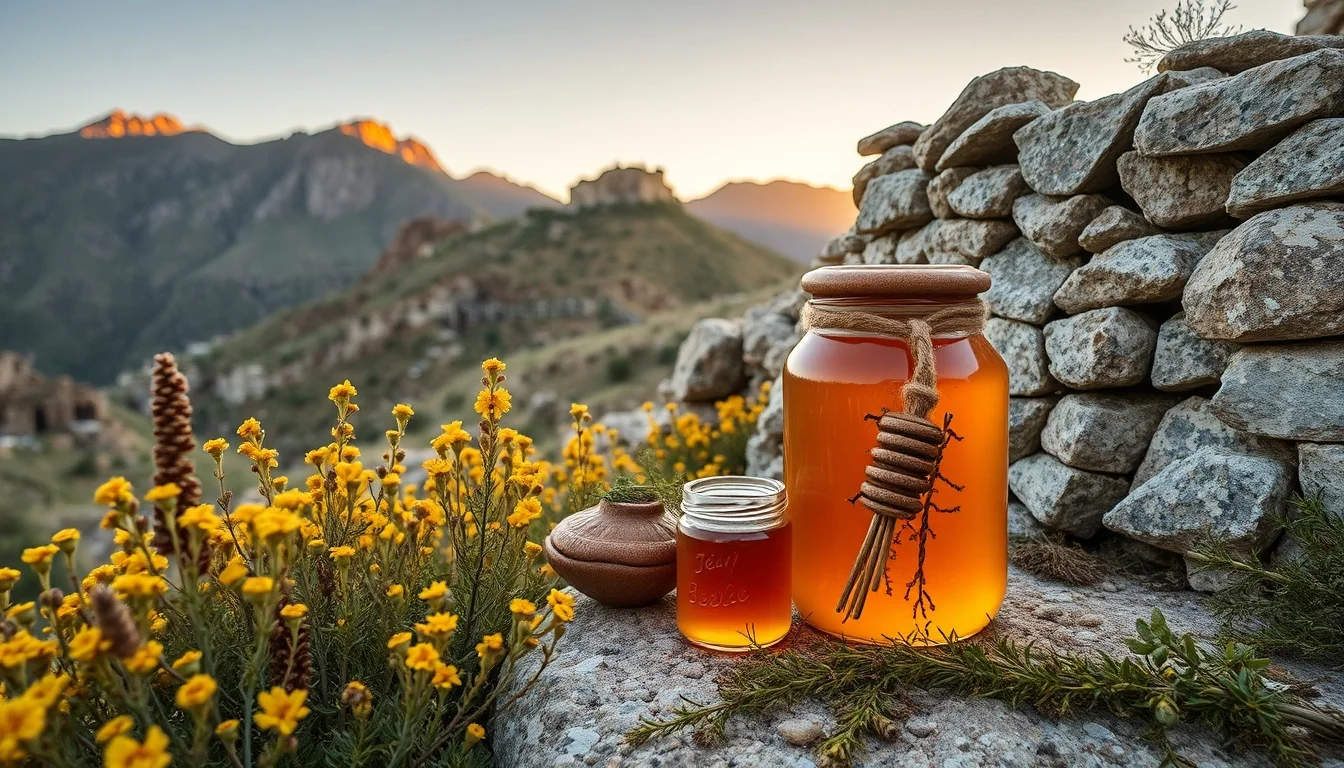
Syria's honey-producing zones map onto this east-west rainfall gradient with remarkable precision. The Coastal Mountain zone (Jebel Ansariyya and Alawi Mountains, 400–1,562m) produces the country's most distinctive wild za'atar honey from dense Origanum syriacum communities on the limestone-karst slopes — the same herb that defines Levantine za'tar spice blends and gives the endemic Levantine honey its characteristic herbal-camphor profile. The Qalamoun Mountains north and northeast of Damascus (1,200–2,400m) are the country's primary thyme-honey belt, supporting significant managed A. mellifera syriaca beekeeping in the orchards and mountain wildflower communities. Syrian mountain wildflower honey achieves botanical complexity comparable to mountain wildflower honey California, though Syrian Levantine highlands create distinctive herbal-resinous character from Mediterranean maquis communities (wild sage, mastic, strawberry tree) versus California's Sierra Nevada conifers and chaparral, demonstrating how limestone karst versus granite bedrock geology shapes mountain honey terroir expression. The Jabal al-Arab (Hauran volcanic plateau, 1,000–1,803m) in southern Syria supports a distinct honey flow from the basalt-soil botanical communities — medicinal herbs, wild mustard, and the remnant Atlantic pistachio woodland that covers the plateau's upper zones. The Syrian Badia (steppe and semi-arid zone, ~55% of total land area) contributes spring desert-bloom honey from Astragalus species, desert thyme (Za'tar barri, Thymbra spicata), and Ziziphus lotus in the wadi systems.
Pre-war annual honey production in Syria was estimated at 10,000–15,000 tonnes from approximately 600,000–750,000 managed colonies (FAO FAOSTAT, 2009–2011 average; Syrian Ministry of Agriculture data), making Syria one of the larger honey-producing countries in the Arab world after Yemen and Saudi Arabia. The primary beekeeping provinces were Hama, Homs, Idlib, Aleppo, and the coastal Latakia-Tartus belt — zones where the combination of Mediterranean flora, water availability, and centuries of beekeeping tradition had established dense concentrations of household and commercial apiaries. Syrian honey was exported primarily to Gulf Cooperation Council (GCC) states — Saudi Arabia, United Arab Emirates, Kuwait — where za'atar mountain honey and premium A. m. syriaca honey from highland apiaries commanded price premiums over imported European and Central Asian honeys. The 2011 civil war catastrophically disrupted this system, with estimated colony losses exceeding 80% in the most-affected governorates by 2015–2018.
Apis mellifera syriaca: The Syrian Bee's Global Genetic Importance
Apis mellifera syriaca — the Syrian honeybee, also called the Levantine bee — was formally described by French entomologist Amédée Louis Michel le Peletier de Saint-Fargeau in 1836, making it one of the earliest named A. mellifera subspecies in the scientific record and one of the longest-studied in apiology. Morphologically, A. m. syriaca occupies a transitional position between the dark European subspecies (A. m. mellifera, A. m. carnica) and the hot-climate African/Oriental subspecies (A. m. jemenitica, A. m. intermissa): medium-sized and variably pigmented from pale yellow to darker brown banding depending on population. Its tongue is not longer than European bees': workers measured around Damascus averaged 6.23 mm, slightly shorter than published averages for Carniolan (6.6 mm) or Italian (6.5 mm) bees (Alburaki and Alburaki (2008, Emirates Journal of Food and Agriculture)). Earlier versions of this page said 6.3–6.6 mm and a foraging advantage on tubular flowers; we found no source for either. The geographic range of A. m. syriaca extends through the entire Fertile Crescent arc: Israel, Lebanon, Syria, Jordan, Turkey (southeastern Anatolia), Iraq, and historically across the northern Arabian Peninsula.
The global genetic significance of A. m. syriaca is substantial. The subspecies carries alleles in both the nuclear genome and mitochondrial haplotype that are intermediate between the European M-lineage and the African/Oriental O-lineage, making it scientifically invaluable for understanding A. mellifera population genetics and domestication history. Multiple studies from the Institut National de la Recherche Agronomique (INRA) and the University of Vienna have identified A. m. syriaca as a key bridge subspecies in the phylogeographic reconstruction of the Apis mellifera species complex — its position at the Fertile Crescent, where plant and animal domestication began approximately 10,000 years ago, makes it a candidate ancestral population for the early managed beekeeping records from Mesopotamia (earliest cuneiform references to beekeeping, c. 2,400 BCE in the temple records of the city of Nippur). Several European breeding programs have used A. m. syriaca alleles to improve heat tolerance in Italian acacia honey production lines — where Italian A. m. ligustica creates exceptional water-white clarity and delicate vanilla character under optimal Alpine foothills conditions, the Syrian subspecies contributes genetic resilience for extreme heat management while maintaining the docile temperament essential for commercial beekeeping.
In commercial Syrian beekeeping, A. m. syriaca is valued for specific productive traits: high propolis production (the propolis from Syrian mountain colonies is strongly aromatic, with a resin profile reflecting the mastic, cedar, and Mediterranean herb communities of the Jebel Ansariyya), strong spring build-up aligned with the early mountain wildflower flows (March–April), excellent foraging efficiency on the composite and labiate wildflowers of the Syrian mountain flora, and high honey storage behavior. The defensive behavior of A. m. syriaca — more reactive than Italian bees, requiring consistent smoke management — is well-documented and is the primary reason the subspecies has been partially replaced by introduced Italian and Carniolan genetics in commercial Syrian apiaries since the 1970s. Traditional Syrian beekeepers in Idlib, Hama, and the coastal mountains have maintained pure A. m. syriaca populations in traditional log hives and clay-cylinder hives — the historic beehive forms of the Levant — for generations, creating a genetic reserve of significant value given the devastation of Syrian managed-bee populations by the civil war.
Pro Tip
The za'atar and sage notes of Levantine highland honey come from the plants the bees forage on. A. m. syriaca is the local bee of that landscape, but its tongue is not unusually long: workers measured around Damascus averaged 6.23 mm (Alburaki and Alburaki 2008).
Get the Honey Buyer's Cheat Sheet (free PDF)
16 varieties on one page — color, flavor, best use and what a fair price looks like — from the 304 honeys we track.
Za'atar Honey: Origanum syriacum and the Levantine Mountain Flow
Origanum syriacum — Syrian oregano, Lebanese oregano, Bible hyssop (the 'ezov' of Exodus), the core botanical component of the Levantine za'tar spice blend — is the defining honey plant of Syria's coastal mountains and one of the most botanically significant honey sources in the entire Middle East. The species name syriaca directly references Syria as its recognized center of distribution and likely origin: O. syriacum grows wild across the limestone-karst slopes of the Jebel Ansariyya, Anti-Lebanon, Qalamoun, and Jabal al-Arab in dense, aromatic stands that flower from June through September, providing a sustained late-summer nectar flow of exceptional quality. The plant is distributed across the wider Levant (Lebanon, Israel, Jordan, Turkey, Cyprus, Greece) but reaches its highest wild density in western Syria's montane zones, where the Mediterranean climate and well-drained karst soils create optimal conditions for the dense sub-shrub communities that Origanum syriacum forms in undisturbed habitats.
Syrian za'atar honey is characteristically light amber to medium amber with a pronounced herbal-camphor aromatic profile — the same volatile compound (carvacrol, thymol) that defines the smell of the fresh herb, present in the nectar at concentrations sufficient to give the honey a distinctively sharp, herbal warmth different from the milder herbal notes of Greek thyme honey (from Thymus capitatus or T. vulgaris). While Greek thyme honey achieves exceptional purity from single-species Thymus stands creating delicate medicinal character, Syrian za'atar honey's Origanum syriacum botanical source produces higher carvacrol content relative to thymol, creating more pronounced oregano-adjacent intensity impossible to replicate outside the Levantine limestone karst terroir. The distinction between Syrian za'atar honey and its close Levantine relatives — Lebanese za'tar honey, Jordanian za'tar honey — is subtle and terroir-dependent: the Jebel Ansariyya population of O. syriacum grows at 400–1,200m on west-facing coastal slopes with summer Mediterranean humidity; the Lebanese coastal mountain population grows at 800–1,800m; the Jordanian Ajloun population at 800–1,200m on the more continental eastern slope of the Levant range. Each produces a za'atar honey with a slightly different carvacrol-to-thymol ratio and a different surrounding wildflower polyfloral character. No systematic comparative analysis of these three national za'atar honeys exists in published literature — the data gap is structurally similar to the gap in comparative Sidr honey chemistry noted in the Yemen and Jordan guides in this series.
Za'atar honey from Syrian highland apiaries was the country's premium export honey before 2011 — sold at Aleppo's covered souk (the Souq al-Madina, now UNESCO-listed and partially destroyed) alongside the famous Aleppo soap (olive oil + laurel berry oil), Aleppo pepper (Capsicum annuum × Capsicum frutescens dried), and the processed wool and silk of the medieval textile trade. Syrian za'atar honey from mountain apiaries in Idlib and Hama governorates reached Gulf retail markets at prices of wholesale (2008–2010 Syrian Ministry of Agriculture export data), well above the prices commanded by undifferentiated Syrian wildflower honey. The war eliminated most of this export infrastructure: the Aleppo souk's honey traders were displaced or killed, the mountain apiaries of Idlib were damaged or abandoned during the 2012–2020 offensive cycles, and the export logistics chains through Turkey and Lebanon were severed.
Aleppo's Honey Heritage: Medieval Silk Road Commerce and the Destroyed Souk
Aleppo (Halab in Arabic) is one of the oldest continuously inhabited cities on Earth — archaeological evidence places settlement at Tell as-Saudaa adjacent to the modern city at approximately 8,000 BCE, with continuous habitation through the Akkadian, Hittite, Aramaean, Assyrian, Persian, Hellenistic, Roman, Byzantine, Umayyad, Abbasid, Hamdanid, Zengid, Ayyubid, Mamluk, and Ottoman periods. As a commercial city, Aleppo sat at the western terminus of the overland Silk Road for much of its history: goods from China, Central Asia, India, and Mesopotamia reached Aleppo before being transshipped west to the Mediterranean ports of Antioch, Latakia, and Tripoli. Honey was a consistent commodity in this trade, both as an Aleppan local product (mountain honey from the Jebel al-A'la and the Idlib highlands north of the city) and as a transit good (Anatolian honey from southern Turkey, Iraqi date honey from the Euphrates valley, Arabian honey from the Hejaz).
The medieval Islamic geography of Aleppo's honey trade is documented in the geographic encyclopedias of Yaqut al-Hamawi (1179–1229 CE, born in Aleppo) and Ibn Hawqal (943–988 CE), who specifically identify the honey from the highland orchards north and west of Aleppo as a prized commercial commodity distinguishable by its aromatic profile — the za'atar and mountain wildflower character that matched the premium requirements of urban Abbasid and Fatimid consumers. This aromatic intensity parallels New York buckwheat honey in its distinctive flavor concentration, though Syrian highland honey achieves herbal-resinous complexity from Mediterranean aromatic shrubs while buckwheat honey creates molasses-dark intensity from Fagopyrum esculentum agricultural blooms, demonstrating how different botanical sources produce equally memorable honey character through entirely different chemical pathways. The Ottoman-era Souq al-Madina of Aleppo, enclosed by stone arcades and organized by trade guild, contained a dedicated honey section (Souq al-'Asel) adjacent to the spice market and the soap workshop district. Ibn Battuta, passing through Aleppo in 1355 CE, noted the quality and variety of Aleppan honey as among the finest encountered in his 29-year journey across the Islamic world. The Souq al-Madina was inscribed as a UNESCO World Heritage Site in 1986 as part of the Ancient City of Aleppo; heavy fighting in 2012–2016 destroyed or severely damaged approximately 35% of the covered market area, including sections of the honey and spice trade zones.
The Aleppo brand in honey exists implicitly rather than in labeled commercial form — unlike Aleppo soap (widely sold internationally under the 'Aleppo' label) and Aleppo pepper (increasingly available in Western specialty food stores), 'Aleppo honey' has not developed as an international commodity category despite the city's documented honey trade heritage. The structural reasons are identical to those observed in other conflict-origin honeys in this guide series (Yemen's Sidr paradox is the extreme version): origin labeling requires supply chain stability, consistent quality control infrastructure, and a producer community able to maintain continuous export operations — all of which are incompatible with the operational conditions of the Aleppo region from 2012 to the present. The honey trade infrastructure of Aleppo's souk has been partially restored in the post-2016 period as Assad government control of the city solidified, but at a fraction of pre-war volume and without the export logistics networks that made Syrian za'atar honey a viable Gulf export commodity before 2011.
Idlib Province: Beekeeping Through Active Conflict — Production Under Bombardment
Idlib governorate — Syria's last large opposition-held territory, bordered by Turkey to the north, Aleppo governorate to the east, Hama to the south, and Latakia to the west — presents the most extreme case of conflict-zone beekeeping in the 122-country corpus of this guide series. The 2015–2022 offensive cycles against Idlib (Russian-Syrian air campaign beginning September 2015, the 2019–2020 Idlib offensive that displaced 900,000 civilians in three months, the ongoing ceasefire negotiations under the 2020 Moscow Agreement) did not eliminate beekeeping in the province — they restructured it. FAO emergency beekeeping programs distributed approximately 6,000 hives in Idlib between 2016 and 2022 as part of rural livelihood restoration, specifically because beekeeping requires low capital inputs, produces a high-value, low-volume product that can be transported through checkpoints, and provides income independent of land tenure — critical in a displacement context where farmers may have fled their agricultural land but can keep bees near displacement camps.
The Idlib highlands — specifically the Jebel al-Zawiya (a limestone plateau at 500–900m south and west of Idlib city) and the Jebel al-A'la ('High Mountain,' the ancient 'Dead Cities' plateau at 600–900m northwest of Aleppo) — were major beekeeping zones before the war and have maintained partial beekeeping activity throughout the conflict. The Dead Cities plateau (a UNESCO tentative World Heritage Site comprising over 700 archaeological sites of Byzantine-era settlement abandoned in the 7th–8th centuries CE) is heavily wooded with planted and wild Pistacia, Quercus, and fruit-orchard remnants from the Byzantine and early Islamic periods — a honey landscape that has been agriculturally active for 1,500 years. Beekeepers in the Jebel al-A'la zone harvested honey from these woodland wildflower flows before the war; displaced beekeepers returning to partially-cleared areas after local ceasefire agreements have documented the survival of multiple traditional apiaries, including clay-cylinder hive installations built into the walls of Byzantine ruin-sites that have been continuously used for generations.
The honey produced in Idlib during active conflict has been documented by Syrian humanitarian organizations including the Syrian Civil Defense (White Helmets), which has photographed beekeeping operations in several Idlib villages as evidence of agricultural continuity — used in advocacy materials to demonstrate civilian resilience and counter the narrative that conflict has eliminated rural livelihoods. Mercy Corps, which maintained programming in northwest Syria including Idlib through 2022, included honey production in livelihood assessments. The cross-line commodity function of honey — its portability, high value-to-weight ratio, and demand on both sides of conflict lines — is identical to the pattern documented in South Sudan, Yemen, and the nine-country conflict-zones synthesis published at `/learn/honey-conflict-zones`. Syrian conflict honey has not been systematically analyzed for quality characteristics (HMF, moisture, pollen profile) in published literature, but field reports from FAO-supported programs suggest that honey from Idlib's mountain apiaries maintains quality standards consistent with pre-war production — the botanical resources and the bee populations have not been eliminated, even if production volume has collapsed.
The Euphrates Valley and Syrian Steppe: Cotton Honey, Desert Bloom, and the East-West Gradient
Eastern Syria — Deir ez-Zor governorate along the Euphrates, the Al-Hasakah triangle (wheat and cotton zone), and the Syrian Badia (steppe) extending south to the Jordanian and Iraqi borders — represents a honey landscape structurally different from the Mediterranean mountain zones of western Syria. The Euphrates valley between Deir ez-Zor and the Iraqi border historically supported significant irrigated agriculture: cotton (Gossypium hirsutum), wheat, sesame, and fruit orchards created managed floral landscapes that supported commercial beekeeping on a scale impossible in the more biodiverse but lower-production mountain zones. Cotton honey — from Gossypium hirsutum monofloral sources in the Euphrates irrigation districts — was a significant commercial variety in Syrian pre-war production: light in color, mild in flavor, high in fructose content (crystallizes slowly), produced in volume from the large-scale cotton plantations of the Raqqa and Deir ez-Zor irrigation districts. This variety shared botanical characteristics with Texas cotton honey, though Syrian cotton honey from Euphrates alluvial soils developed distinctive mineral complexity from ancient river sediments versus Texas High Plains cotton honey from alkaline clay soils, creating subtle terroir differences between these two major cotton honey regions.
The Syrian steppe (badia) supports a spring desert-bloom honey distinct from both the mountain za'atar honey of the west and the valley monofloral honeys of the east. The badia bloom — triggered by winter rainfall of 100–200mm in January–March — produces a brief but intense wildflower flow from Astragalus species (the dominant steppe legume, covering vast areas after wet winters), desert thyme (Thymbra spicata, called za'tar barri in Arabic — 'wild thyme of the field'), Echium italicum (viper's bugloss), Centaurea species, and in the wadi systems, Ziziphus lotus (Christ's thorn jujube, a Ziziphus species different from the sidr Z. spina-christi of the highlands). The steppe honey season is brief — approximately four to six weeks from late February to early April in good rainfall years, following the winter rains — and requires migratory beekeeping to exploit: Syrian traditional beekeepers loaded hives onto trucks or transported them by donkey to follow the bloom front from south to north across the badia, then retreated to the mountain zones as the steppe desiccated. This migratory beekeeping pattern is one of the oldest documented beekeeping practices in the archaeological record — clay-cylinder hive fragments consistent with steppe-zone honey harvest have been found at multiple Bronze Age sites in the Syrian and Jordanian badia.
Eastern Syria's beekeeping infrastructure was particularly severely disrupted by the Islamic State occupation of Raqqa, Deir ez-Zor, and the Euphrates valley corridor from 2014 to 2017 and the subsequent US-backed coalition military campaign (Operation Inherent Resolve) to retake the region. The agricultural cooperatives, veterinary services, and honey-packing facilities that processed and sold cotton and steppe honey from the Euphrates zone were entirely shut down during the IS period and have been only partially rebuilt under the Autonomous Administration of North and East Syria (AANES/Rojava) that governs much of the northeast as of 2026. FAO assessments from 2019–2022 documented the survival of local beekeeping knowledge in Al-Hasakah and Deir ez-Zor governorates — traditional beekeepers have returned to apiaries in areas with cleared unexploded ordnance, but production volumes remain well below pre-2011 levels.
Syria's Post-War Honey Economy: FAO Programs, Reconstruction, and Market Prospects
Syria's honey sector recovery faces a structural challenge different from the post-conflict beekeeping reconstruction cases elsewhere in this guide series. The Yemen case involves intact traditional beekeeping communities in geographically protected zones (Hadramaut, Marib) producing a globally recognized premium product (Sidr) that commands at the premium tier — demand-pull reconstruction is theoretically possible. The South Sudan case involves a peace-dividend economy where honey functioned as a cross-line livelihood precisely because it required no fixed infrastructure. Syria's challenge is that its most valuable honey — za'atar mountain honey from the Jebel Ansariyya and Idlib highlands — requires rebuilt mountain apiaries, functional A. m. syriaca breeding stock, quality control infrastructure, and export logistics through Turkish border crossings or via the Syrian government-controlled Latakia port — all of which require political and security conditions that remain unresolved as of 2026.
FAO's Syria program has been one of the most sustained emergency beekeeping interventions in the agency's recent history: hive distribution programs in Hama, Homs, and Tartus governorates (government-controlled areas) began in 2015–2016; northwest Syria programs through Turkish border crossings (Bab al-Hawa crossing) reached Idlib from 2017 onward; northeastern Syria programs through AANES-controlled crossings started in 2019. The FAO Syria 2023 agricultural assessment estimates that managed bee colony counts have recovered to approximately 35–45% of pre-war levels nationally, with significant geographic variation: coastal Latakia-Tartus (the most stable zone throughout the war) has recovered to approximately 60–70% of pre-war counts; Idlib remains at 20–30%; the northeast (Hasakah, Deir ez-Zor) at 15–25%. No current national honey production figure is reliable — the segmented governance of Syria (Assad government, AANES, Turkish-backed opposition) produces separate and incompatible agricultural statistics.
The international market prospects for Syrian honey are currently minimal — no Syrian honey brand operates at international retail level, no certification or origin-documentation infrastructure exists to verify a 'Syria origin' label for Western markets, and the reputational challenges of the Assad government mean that Syria-branded food exports face political barriers in US and EU markets beyond pure logistics. The most likely path to market recovery is through Turkish intermediary channels: Syrian beekeepers in Idlib and northern Aleppo export informally through Turkish border markets to honey traders in Gaziantep and Hatay (Turkish provinces with significant Syrian refugee populations and Syrian-Turkish food trade networks), where Syrian za'atar honey enters the Turkish domestic market under Turkish labeling without Syria-origin identification. This origin-laundering is economically rational from the Syrian producer's perspective — it captures value — but prevents Syria's honey from building the brand identity that would eventually allow direct market access at premium price points. The long-term honey recovery scenario for Syria depends on political normalization that is not foreseeable on the horizon as of 2026.