The Cedar of Lebanon: Honeydew from a National Symbol
Lebanon's national flag carries a single image: the Cedar of Lebanon (Cedrus libani). The tree is as central to Lebanese identity as the maple leaf is to Canada. What the flag does not show is that this same tree — when infected by scale insects (Marchalina hellenica and related Coccidae species) — produces a honeydew that bees convert into one of the Levant's most distinctive dark honeys.
Cedar honeydew honey is collected when scale insects feed on cedar tree sap and excrete honeydew — a sugar-rich liquid that bees harvest in the absence of sufficient nectar flows. The chemistry differs sharply from blossom honey: it contains higher concentrations of oligosaccharides, amino acids, and minerals, producing a darker color (dark amber to near-black), more complex flavor profile (resinous, slightly piney, with herbal and caramel undertones), and very low tendency to crystallize. Conductivity is high — typically 0.8–1.5 mS/cm — analogous to Greek pefkomelo (pine honeydew) and German Tannenhonig (silver fir honeydew).
The challenge is scarcity. Lebanon's cedar forests have been reduced to approximately 1,500–2,000 hectares of mature woodland — less than 3% of their historical extent. The four main surviving ancient cedar forests — Bsharri (the Cedars of God / Arz ar-Rab, a UNESCO World Heritage Site since 1998), Tannourine, Barouk, and Shouf Cedar Reserve — are protected national reserves. Beekeeping within or immediately adjacent to these forests is strictly controlled. The result is that authentic Cedrus libani honeydew honey may be the world's most geographically concentrated premium honey: the source forest fits within an area smaller than some single apiaries in industrial honey-producing countries.
Producers in the Bsharri district and Tannourine region (northern Lebanon) have maintained traditional apiaries for generations, positioning hives in alpine meadows adjacent to cedar groves during the August–October period when scale insect populations peak and honeydew production is highest. The honey is sold exclusively at local markets and a handful of Beirut specialty food shops — international availability is essentially zero.
Wild Za'atar: Lebanon's Mountain Thyme and Its Honey
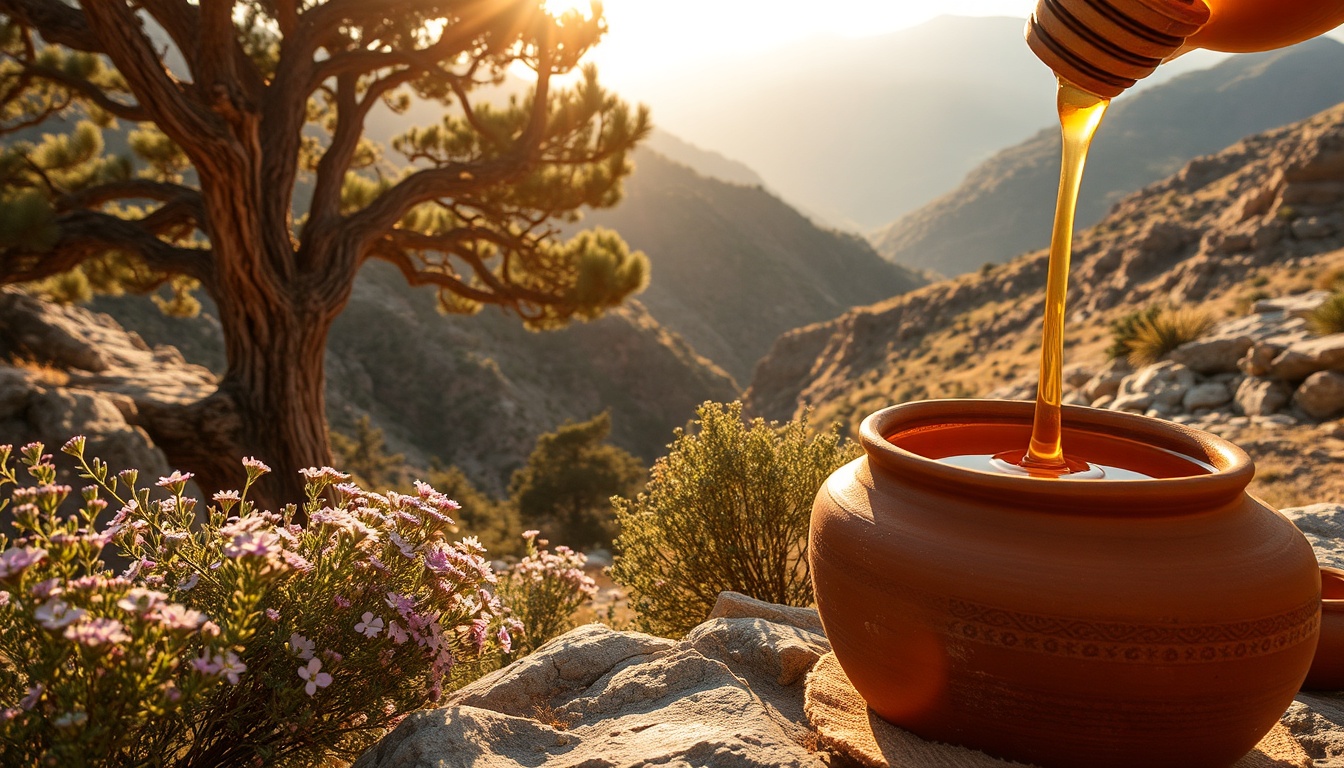
Za'atar (زعتر) is both a plant and a spice blend that defines Levantine cuisine. The plant at its botanical core is Origanum syriacum — Lebanese oregano, also called Syrian oregano or Biblical hyssop. This is distinct from European oregano (Origanum vulgare), distinct from Turkish oregano (Origanum onites), and distinct from the Cypriot thyme (Thymus capitatus) used in Greek and Cypriot thyme honeys. Origanum syriacum is endemic to the Levant — Lebanon, Syria, Israel, Jordan, and parts of Turkey — and carries a distinctively herbal, camphor-edged aromatic profile that is more intense and resinous than its Mediterranean relatives.
Wild za'atar honey is produced when bees work the flowering stages of Origanum syriacum growing on Lebanon's mountain slopes between approximately 800 and 1,800 meters elevation. The bloom period runs June through August, coinciding with the main nectar season in the Chouf, Metn, Kesrwan, Jbeil, and Akkar mountain ranges. The honey carries the plant's characteristic oils — carvacrol and thymol, the same phenolic compounds that give thyme and oregano their antimicrobial properties — in detectable concentrations that transfer into the honey's aroma profile.
Za'atar honey ranges from light amber to warm amber, with a sharp herbal opening, camphor middle note, and slightly resinous finish. It crystallizes moderately — typically within 3–6 months at room temperature — to a fine-grained cream. Among those familiar with Levantine food culture, it is the honey that most directly evokes the za'atar spice blend, the breakfast dip, the street-food flatbread: it is a regional identity in a jar.
Lebanon has no formal protected-designation system for honey. Wild za'atar honey exists as a category recognized informally among producers and consumers but without the EU DOP/PGI framework that protects Greek thyme honey (Thymus capitatus) or Turkish Anzer honey (plateau wildflower). This means authentic Lebanese za'atar honey can be labeled — or mislabeled — without legal consequence, and that any institutional quality infrastructure for premium Lebanese honey remains undeveloped.
Pro Tip
Za'atar honey pairs exceptionally well with labneh (strained yogurt) and olive oil — a combination that mirrors the za'atar spice blend's traditional use. The camphor and thymol notes complement the acidity of labneh in the same way that Greek thyme honey complements fresh cheese.
Get the Honey Buyer's Cheat Sheet (free PDF)
16 varieties on one page — color, flavor, best use and what a fair price looks like — from the 304 honeys we track.
The Phoenician Honey Trade and the Alphabet Connection
The Phoenicians — the seafaring civilization centered in the coastal city-states of modern Lebanon (Byblos / Jbeil, Tyre / Sour, Sidon / Saida) from approximately 1200 to 300 BCE — conducted one of antiquity's most extensive long-distance commodity trades across the Mediterranean. Their exports included purple dye from Murex snails (giving their civilization its Greek name: phoiníkios, 'purple people'), cedar timber for Egyptian and Mesopotamian shipbuilding, blown glass, metalwork, and — documented in trade records from their colonies across the Mediterranean — honey and beeswax.
Phoenician beeswax served multiple critical functions in ancient commerce: it waterproofed papyrus scrolls (essential for record-keeping and correspondence in humid Mediterranean climates), sealed wooden ship hulls, was used in lost-wax casting for metalwork, and formed writing tablets. Phoenician honey was traded to Egypt (which maintained its own beekeeping tradition dating to 2,450 BCE but imported Levantine mountain honey as a specialty commodity), to Greece (Phoenician and Greek trade routes overlapped closely in the Aegean from 900 BCE onward), and eventually to Carthage — the Phoenician colony founded near modern Tunis circa 814 BCE — where apiculture became a major North African industry.
The most significant and underappreciated connection: the Phoenician alphabet — from which the Greek alphabet derives, and from which Latin derives, and from which all Western alphabets ultimately derive — was a commercial tool. Its 22 consonantal letters were invented, refined, and disseminated by Phoenician merchants conducting trade across Cyprus, Crete, Rhodes, Sicily, Sardinia, and Spain. The trade ledgers recording honey and beeswax shipments from Lebanese mountain producers to Mediterranean ports were written in the same writing system that, through Greek transmission, became the foundation of all Western literacy. The honey trade was, in a real sense, part of the commercial context that spread writing across the ancient world.
Byblos — modern Jbeil, 37 km north of Beirut — was the primary Phoenician port for cedar timber and papyrus trade with Egypt, and gives its name to the Greek word for book (βιβλίον / biblion) and, by extension, to 'Bible.' Egyptian papyrus was traded through Byblos in such volume that the Greeks named the material after the city. The same port exported mountain honey and cedar resin to Egyptian and Greek markets. Archaeological excavations at Byblos have recovered storage vessels containing organic residues consistent with honey and beeswax dating to the Middle Bronze Age (~2100–1550 BCE).

Qadisha Valley: UNESCO Beekeeping Heritage
The Qadisha Valley (Wadi Qadisha, 'the Holy Valley') in northern Lebanon — inscribed as a UNESCO World Heritage Site in 1998 alongside the adjacent cedar forest of Bsharri — is one of the most dramatic gorges in the eastern Mediterranean. Its near-vertical limestone walls reach 1,500 meters, its microclimates shift from Mediterranean shrubland at the valley floor to sub-alpine meadow at the plateau rim, and its isolation preserved religious communities from at least the 5th century CE through the medieval period.
Maronite Christian monasteries built directly into the cliff faces of the Qadisha Valley — Qannubin, Saydet Hawqa, Mar Elisha, Deir Qozhaya — maintained their own apiaries as part of traditional subsistence economy. Honey was produced for monastic consumption, for beeswax candles used in liturgy, and as a traded commodity at markets in the valley towns of Bsharri and Ehden. The high elevation (900–1,400 m at the plateau rim), intact cedar and fir forest cover, and the absence of industrial agriculture throughout the valley created conditions for honey of exceptional botanical diversity: wild thyme, sage, rosemary, Cistus (rock rose), Satureja (savory), Astragalus, and the mountain wildflowers endemic to Lebanon's calcareous highlands.
Contemporary beekeeping in the Qadisha region continues this monastic tradition. Several small producers near Bsharri and Hadchit position hives at the plateau edge above the valley during the summer honey season, moving them between cedar forest edges and wildflower meadows in a form of micro-transhumance covering altitudinal shifts of 300–400 meters. The honey produced — a complex mountain wildflower blend anchored by za'atar, cedar honeydew contributions, and endemic limestone-plateau flora — is sold as 'Qadisha honey' (عسل القاديشا) at the Bsharri municipal market and at monastery gift shops. No formal PDO or quality certification exists.
Lebanese Honey Varieties
Lebanon's vertical geography — from sea-level coastal strip to 3,088-meter mountain summits within 50 kilometers — and its position at the intersection of Mediterranean, continental, and semi-arid climates produce a range of honey types far greater than the country's size would suggest.
- Cedar Honeydew (عسل ندوة الأرز / Asal nadwat al-arz) — Produced adjacent to the Cedrus libani forests of Bsharri, Tannourine, and Barouk. Dark amber to near-black, resinous and piney, low tendency to crystallize, high mineral content, conductivity 0.8–1.5 mS/cm. August–October harvest. Extremely limited production — authentic cedar honeydew honey rarely leaves the producing village.
- Wild Za'atar Thyme Honey (عسل الزعتر البري / Asal al-za'atar al-barri) — From Origanum syriacum growing on mountain slopes 800–1,800m throughout the Lebanese ranges. Light to warm amber, distinctively herbal and camphor-edged, crystallizes to fine-grained cream within 3–6 months. June–August bloom. The most readily identifiable Lebanese monofloral outside the country.
- Mountain Wildflower (عسل الجبل / Asal al-jabal) — Complex blend from the diverse limestone-plateau flora at 1,000–2,000m: wild thyme, sage (Salvia judaica and S. triloba), rosemary, Cistus, lavender (Lavandula stoechas), Astragalus, Verbascum, and dozens of endemic mountain plants. Amber to dark amber, intensely aromatic, complex and regionally specific. The dominant variety by volume in Lebanese mountain apiaries.
- Carob Blossom Honey (عسل الخروب / Asal al-kharrub) — From Ceratonia siliqua (carob), the same tree whose seeds gave the world the 'carat' weight standard (shared botanical history with Cypriot carob honey). Lebanon's coastal and foothill carob groves bloom October–November, producing a dark honey with distinctive fig, molasses, and slightly bitter notes. More available in south Lebanon (Nabatieh, Tyre district) than in the mountains.
- Orange Blossom Honey (عسل زهر الليمون / Asal zahr al-laymun) — From citrus orchards in the coastal Chouf foothills and the Bekaa Valley citrus belt. April–May bloom. Water-white to pale yellow, delicate citrus-blossom fragrance, low acidity, slow crystallization. Available in Sidon and Tyre markets. The most internationally familiar style but produced in small quantities compared to mountain varieties.
- Bekaa Valley Wildflower — Lebanon's Bekaa Valley, a high-altitude plateau (800–1,200m) running the length of the country between the Lebanon and Anti-Lebanon mountain ranges, produces a distinct wildflower honey from clover, sainfoin (Onobrychis viciifolia), phacelia, and agricultural blossom. More agricultural in character than mountain honey, less botanically complex, higher production volume. The Bekaa is Lebanon's primary agricultural zone and the region most disrupted by the post-2019 economic crisis.
Pro Tip
Cedar honeydew and wild za'atar mountain honey are Lebanon's most distinctive varieties — if you find labeled Lebanese mountain honey at a Middle Eastern specialty food shop, ask specifically about the region (Bsharri, Tannourine, Barouk, or Qadisha) and harvest month (July–September for za'atar, August–October for cedar honeydew). Unlabeled origin is a signal of commodity blending.
Modern Lebanon: Economic Crisis and the Honey Industry
Lebanon's honey industry entered a severe crisis beginning with the October 2019 popular uprising and deepening through the catastrophic economic collapse of 2020–2023. The Lebanese pound lost approximately 98% of its value against the US dollar between 2019 and 2023 — from 1,500 LBP/USD to over 100,000 LBP/USD at crisis peaks. For beekeepers, this translated directly into the inability to afford imported equipment: hive frames, Varroa treatments (oxalic acid, amitraz), extraction machinery, and winter feed supplements all became inaccessible at any reasonable cost.
The Beirut port explosion of August 4, 2020 — 2,750 tonnes of ammonium nitrate detonating in one of the largest non-nuclear explosions in history — destroyed approximately one-third of Beirut and killed over 200 people. The explosion damaged storage warehouses holding agricultural equipment imports for the 2020 season, including beekeeping supplies destined for distribution to rural producers. The Bekaa Valley beekeeping community, while geographically distant from Beirut, depends on the capital's import infrastructure for equipment and inputs.
Varroa destructor mite pressure — which requires active chemical and mechanical management in any modern apiary — became unmanageable for many Lebanese producers as treatment costs exceeded household income. Colony collapse rates increased sharply in 2021–2022. An estimated 40–60% of registered Lebanese beekeeping operations reduced hive counts or ceased production entirely during the 2020–2022 period, according to estimates from the Lebanese Agricultural Research Institute (LARI).
Paradoxically, the crisis also produced a small counter-current. Lebanese diaspora communities in Brazil, Canada, Australia, Germany, and France — among the most globally distributed diaspora of any Middle Eastern country — created demand channels for authentic Lebanese mountain honey shipped privately by family members. Small-batch Lebanese cedar honeydew and za'atar honey began appearing in Lebanese diaspora grocery networks in São Paulo's Vila Mariana neighborhood, Dearborn, Michigan, and Paris's 20th arrondissement. This informal export circuit predates any formal international honey trade Lebanon has managed to establish.
Lebanon's Ministry of Agriculture and LARI have proposed quality standards for labeled mountain honey, and the Association of Lebanese Honey Producers (Itihad Nahl Lubnan) has lobbied for a PDO-equivalent framework aligned with EU standards to enable formal export access. As of 2026, no formal protected designation exists. Lebanon's cedar and za'atar honeys remain the most geographically distinctive and least-recognized premium honeys in the broader Middle Eastern region.