Yemen: The Most Prestigious — and Most Counterfeited — Honey Origin in the World
In the honey world, few origins carry the mythic weight of Yemen. Sidr honey from the narrow river valleys of Hadhramaut — Wadi Doan above all — is among the highest-priced honeys in Gulf wholesale and retail markets, which places it well above every other honey in commercial trade except the rarest Nihon mitsubachi. In the United Arab Emirates, Saudi Arabia, Qatar, and Kuwait, a jar of authenticated Wadi Doan Sidr is a culturally significant gift, a traditional postpartum food, and a status object in ways no Western honey market has an equivalent. At the same time — and precisely because of this prestige — Yemeni Sidr honey is widely recognized as one of the most adulterated food categories on Earth. Industry estimates commonly cited in the Gulf food press, and supported by independent Saudi and Emirati food safety studies (King Saud University, UAE Ministry of Climate Change and Environment surveys of labeled Sidr products), place the share of counterfeit or adulterated product sold under the "Yemeni Sidr" label at 70–80%, with some surveys of Gulf market samples finding even higher rates.
Yemeni honey is therefore a paradox: a genuinely extraordinary product, produced in tiny real volumes by traditional beekeepers using methods largely unchanged for centuries, selling at prices that correctly reflect that scarcity — and simultaneously a category flooded with cheaper honey dyed dark, labeled with aspirational Yemeni geography, and exported through supply chains that never pass near Yemen. Any serious honey guide has to cover both. This guide covers the real Yemeni honey traditions — Sidr from Wadi Doan, Sumra from the Tihama foothills, Salam from the arid central plateau — the native Apis mellifera jemenitica bee that produces them, the physicochemical signatures that distinguish authentic Yemeni honey from counterfeit, the traditional Hadrami beekeeping practices, and how to buy Yemeni honey with actual provenance rather than just a label. For broader context on how Yemeni Sidr compares to other jujube-genus honeys, see our Moroccan honey guide (which covers Ziziphus lotus as the North African relative) and the World Honey Guide.
One note on current context: Yemen has experienced prolonged armed conflict since 2015, and its honey industry — especially smallholder beekeeping and export logistics — has been severely affected. Many traditional Hadhramaut beekeepers have faced displacement, reduced hive counts, and damage to the Ziziphus forests themselves (reports from the Food and Agriculture Organization of the United Nations have documented impacts on Yemeni agriculture broadly). Real Yemeni honey production today is a fraction of pre-conflict volumes. This guide treats the subject factually and commercially, focusing on the honey itself; readers interested in the humanitarian dimension should consult FAO and OCHA Yemen reporting directly.
Wadi Doan Sidr Honey (عسل دوعني) — The Apex of Yemeni Beekeeping
Wadi Doan is a dramatic steep-walled tributary valley of the greater Wadi Hadhramaut river system in eastern Yemen's Hadhramaut Governorate — a narrow green ribbon of date palms, Ziziphus spina-christi (the Christ-thorn jujube, known locally as سدر or sidr), and mud-brick villages snaking between sheer sandstone cliffs that rise 200–400 metres on either side. The valley is the historical homeland of the Hadrami Sayyid merchant families whose diaspora across the Indian Ocean world (Indonesia, Singapore, East Africa) built the commercial trading networks through which Yemeni honey first reached global prominence. Wadi Doan Sidr honey (عسل السدر الدوعني, asal as-sidr al-duwani) is the product of the very specific combination of Ziziphus spina-christi groves concentrated in this valley and its side-wadis, the traditional beekeeping community that has maintained colonies in the same villages for generations, and the late-autumn Sidr bloom (typically October–December) that produces a single annual honey flow.
Authentic Wadi Doan Sidr is distinguished from other jujube-genus honeys by several converging factors. Botanically, Ziziphus spina-christi — Christ's thorn jujube — produces nectar with a distinctive aromatic profile dominated by terpenoid and phenolic compounds unlike those in Ziziphus lotus (Moroccan jujube), Ziziphus mauritiana (Indian ber), or Ziziphus jujuba (Chinese commercial jujube). Geographically, Wadi Doan's combination of extreme dry desert climate, calcium-rich sandstone-derived soils, and the terraced Sidr groves along the valley floor concentrates these nectar compounds in ways the same species cannot replicate in wetter climates. Culturally, the Hadrami beekeeping tradition maintains bees in hollow palm-log hives (كوار, kuwar) or clay cylindrical hives positioned in stone niches in house walls and cliff faces — a management style that produces honey of significantly different character from Langstroth-hive Sidr honey produced by commercial operations elsewhere.
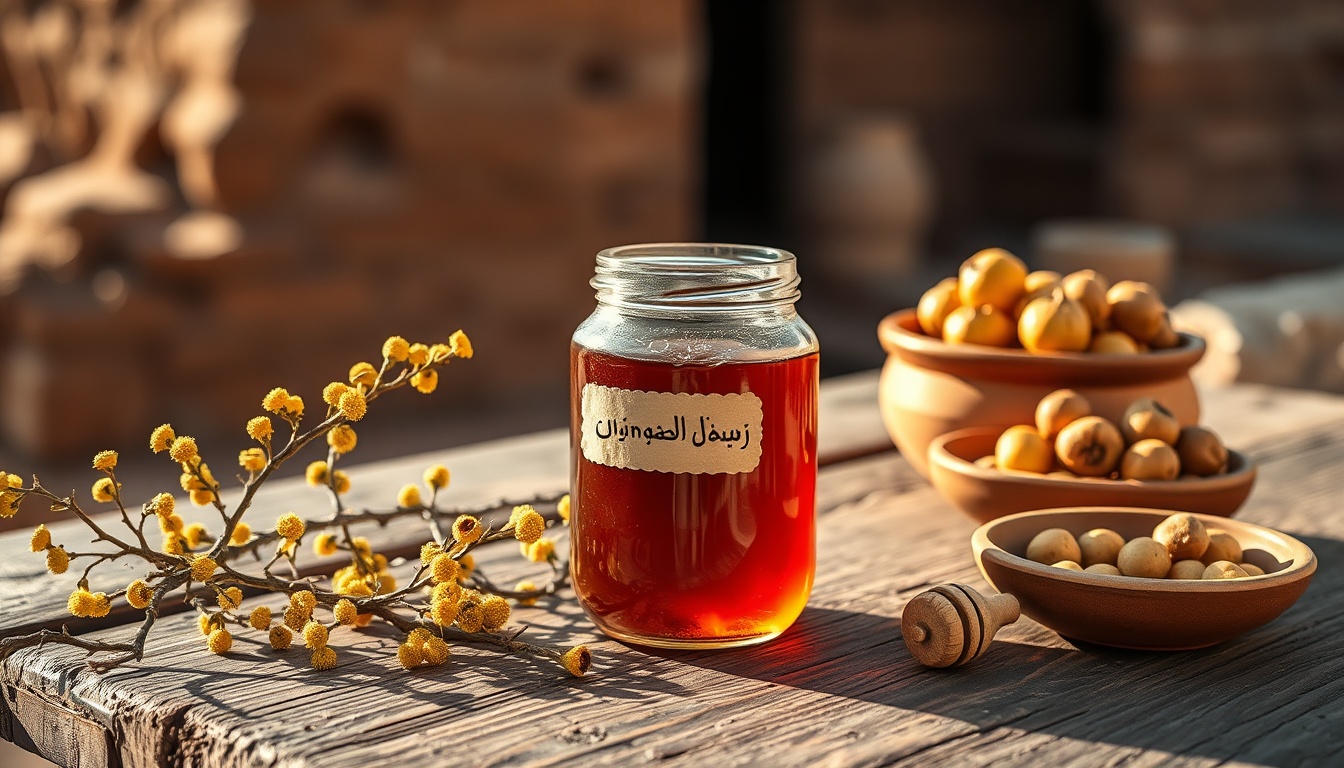
The sensory profile of authentic Wadi Doan Sidr is distinctive and not reproducible by dyeing, blending, or flavoring cheaper honey: deep mahogany-amber to dark reddish-brown in color (not black — genuine Sidr is never opaque); a remarkably thick, almost taffy-like viscosity that holds its shape when spooned; a complex aroma combining dried fig, date molasses, warm caramel, subtle resin, and a faint smoky-herbal note from the arid terroir; a round, full, warming sweetness without the cloying quality of high-fructose commodity honey; and a long mineral-herbal finish that lingers for minutes. Wadi Doan Sidr typically does not crystallize for years due to its particular fructose-to-glucose ratio (F/G typically ~1.5–1.8) and its high trisaccharide and oligosaccharide content, which are among the physicochemical authenticity markers Saudi and Yemeni food science labs use to verify provenance. No dated retail price is cited for authenticated Wadi Doan Sidr in Gulf markets, or for named-producer single-harvest jars exported to Europe or North America. The gap versus ordinary commercial honey is wide enough that counterfeit product is common.

Get the Honey Buyer's Cheat Sheet (free PDF)
16 varieties on one page — color, flavor, best use and what a fair price looks like — from the 304 honeys we track.
Sumra Honey (عسل السمرة) — Yemen's Great Acacia Tradition
Beyond the celebrity of Sidr, Yemen's second great honey tradition is Sumra honey (عسل السمرة, asal as-sumra) — produced from Acacia tortilis (the umbrella thorn acacia), called sumra in Yemeni Arabic. Acacia tortilis is the iconic flat-crowned tree of the semi-arid African and Arabian savannah, ranging from sub-Saharan Africa across the Arabian Peninsula. In Yemen it grows abundantly across the Tihama coastal plain, the foothills of the western mountains, and the transitional zones between the highlands and the eastern desert. Its bloom, typically during the winter-to-early-spring period in lower elevations, produces a major nectar flow for both Yemeni and Saudi beekeepers.
Yemeni Sumra honey is entirely distinct from the European "acacia honey" — Robinia pseudoacacia — that dominates international acacia honey commerce (see our Italian, Spanish, and Japanese honey guides for that tradition). Acacia tortilis is a genuinely different species in a different genus from Robinia, and its nectar produces honey with correspondingly different character: medium to deep amber in color (not water-white like Robinia); moderate viscosity; an aromatic profile combining warm woody-floral notes, faint brown sugar, and a distinctive mineral-earthy depth from the arid acacia savannah terroir; a moderate to assertive sweetness with notable body; and a clean medium-length finish. It crystallizes more readily than Sidr — typically within 4–8 months at room temperature — into a medium-grained amber paste that some Yemeni and Saudi consumers actively prefer to the liquid state.
Sumra honey holds a specific cultural place in Yemen and the Gulf as a more accessible everyday premium honey than Sidr — still clearly superior to imported commodity honey, still locally produced, still bearing the Yemeni terroir signature, but priced a fraction of Sidr. Typical Gulf retail prices for authenticated Yemeni Sumra, roughly a quarter to a third of Sidr prices. It is the honey a middle-class Yemeni or Gulf family is more likely to keep for everyday use, reserving Sidr for postpartum care, gifts, and significant occasions. In terms of production volume, Sumra is meaningfully larger than Sidr — Acacia tortilis forests are much more extensive than Ziziphus spina-christi groves, and the Sumra bloom is geographically distributed across much of rural Yemen, not concentrated in narrow valleys. This relative abundance is also why authentic Sumra is less adulterated than Sidr: the incentive to counterfeit is much lower when the genuine product itself is more affordable.
Salam, Dhahi, and Yemen's Other Regional Honeys
Beyond Sidr and Sumra, Yemen produces a constellation of less-exported regional honeys that together represent the depth of the country's beekeeping tradition. Salam honey (عسل السلم, asal as-salam) is produced from Acacia ehrenbergiana — a smaller, shrubby acacia species closely related to Acacia tortilis and dominant in the drier central and eastern Yemeni landscape. Salam honey shares Sumra's acacia-family character but typically shows a slightly darker color, a more concentrated and sometimes bitter-edged aromatic profile reflecting the harsher terroir where Acacia ehrenbergiana predominates, and higher mineral content. It is particularly prized in Yemen's interior and the Marib and Shabwa governorates.
Dhahi honey (عسل الضهي, asal ad-dhahi) refers to honey produced from Euphorbia species in Yemen's escarpment and mountain zones — comparable in conceptual category to the Moroccan euphorbia honey tradition but from different Euphorbia species (primarily Euphorbia cactus and Euphorbia triaculeata, both native to the Arabian Peninsula and not the Moroccan Euphorbia resinifera). Dhahi honey is lighter in color, with a distinctive resinous-floral aromatic note from the euphorbia nectar; it is regionally significant in Yemen's western escarpment communities around Ibb, Taiz, and the Jabal Bura' protected area but rarely exported. Marae'i honey (عسل المرعى) refers broadly to polyfloral pasture honey from wildflower blooms in Yemen's brief green seasons — the category most Yemeni rural households actually consume day-to-day, produced from whatever is blooming: indigenous herbs, wild legumes, occasional sunflower and sesame crops in cultivated zones. Its character varies widely by region, season, and year.
The Socotra archipelago — the biologically extraordinary UNESCO World Heritage Site island off Yemen's southern coast — also has its own distinct honey tradition, produced by Socotri beekeepers from the island's famously endemic flora including Dracaena cinnabari (the dragon's blood tree) and Boswellia species (the frankincense trees). Socotri honey is produced in tiny volumes, consumed almost entirely locally, and virtually never exported; it is mentioned here as a matter of completeness rather than practical buying advice. For Hadhramaut specifically, additional named regional honeys include Jirdani (from Wadi Jirdan), Mariyi (from Wadi Mariyah), and Hajari (from Wadi Hajar) — all Sidr-tradition honeys but with subtle terroir differences that serious Gulf consumers distinguish, analogous to single-vineyard distinctions in wine. These are almost never sold outside the immediate region or named Hadrami producer networks.
Apis mellifera jemenitica (نحل يمني): The Native Yemeni Honeybee
All authentic Yemeni honey is produced by Apis mellifera jemenitica — the Yemeni honeybee, a distinct subspecies of Apis mellifera native to the southern Arabian Peninsula and parts of the Horn of Africa. Ruttner's foundational work on Apis mellifera subspecies classification (Ruttner, 1988, "Biogeography and Taxonomy of Honeybees," Springer) places jemenitica in the African lineage (A-group) rather than the European lineages, and subsequent molecular studies (Franck et al., Molecular Ecology, 2001; Alattal et al., various) have confirmed that Yemeni honeybees are genetically distinct from both Apis mellifera ligustica (Italian), the commercial standard, and Apis mellifera scutellata (African), the aggressive tropical African subspecies.
Apis mellifera jemenitica is notably smaller than European bee subspecies, with workers typically 15–20% shorter body length than A. m. ligustica. It produces smaller colonies (10,000–20,000 workers at peak, versus 40,000–60,000 for ligustica), stores correspondingly less honey per colony (5–15 kg per season is typical for well-managed jemenitica, versus 30–50 kg for ligustica in temperate climates), and is specifically adapted to the extreme heat and aridity of the Arabian Peninsula. It tolerates hive temperatures up to ~45°C during the day, continues foraging in conditions that would shut down a European colony, and has evolved to make efficient use of the sparse, discontinuous nectar flows typical of desert and semi-arid ecosystems. It is also notably defensive — Yemeni and Saudi beekeepers approach their colonies with full veiling and calm smoke discipline that European beekeepers would not typically need for Italian stock.
The genetic distinctiveness of A. m. jemenitica matters for understanding Yemeni honey: the honey is not simply a function of which plants are in bloom — it reflects the specific way jemenitica foragers collect, process, and concentrate nectar in Yemeni climatic conditions, including their famously short foraging cycles in the hottest midday hours and their intense colony-level temperature regulation. Commercial Saudi and Emirati beekeepers attempting to produce "Sidr honey" using imported European bees in Ziziphus spina-christi groves consistently produce honey that differs in sensory and physicochemical profile from traditional Hadrami product, even when the botanical nectar source is identical. Conservation of Yemeni jemenitica populations is increasingly recognized as important for preserving the country's honey heritage; King Saud University (Riyadh) and the University of Sana'a have maintained jemenitica conservation research programs, and the FAO Yemen office has supported small-producer beekeeping recovery projects in Hadhramaut specifically to preserve the local jemenitica populations alongside the Sidr groves.
The Adulteration Problem: Why 70–80% of "Yemeni Sidr" Is Not Yemeni, Not Sidr, or Neither
The single most important practical fact about buying Yemeni honey is that the global retail market in "Yemeni Sidr honey" is overwhelmingly adulterated. This is not a niche concern or a conspiracy theory — it is documented in Saudi and Emirati government food safety surveys, in academic studies of Gulf-market Sidr samples, and in repeated investigations by Gulf food-press outlets. Common estimates cited in the regional press and industry sources place the adulterated share at 70–80% of retail-labeled product; some market-sample surveys have found even higher rates in certain tiers. The adulteration takes several distinct forms, and understanding them is the foundation of buying real Yemeni honey.
**Type 1 — Dyed and flavored imposter honey.** Cheaper honey (often Chinese commodity honey, sometimes date syrup-blended product) is colored with caramel coloring and/or small additions of blackstrap molasses to approximate Sidr's dark mahogany hue, then labeled as Sidr and sold at a fraction of authentic Sidr prices (but still a significant markup over the underlying commodity honey). This is the most common form and is detectable by careful sensory evaluation: the aromatic complexity of real Sidr cannot be replicated by dye and molasses, and the viscosity of commodity honey is wrong. Type 2 — Sugar syrup adulteration. Honey mixed with high-fructose corn syrup, rice syrup, or inverted sugar syrup to dilute it, sometimes in ratios of 30–70%. Detection requires laboratory isotope ratio analysis (δ¹³C testing, per AOAC Official Method 998.12) or NMR profiling. Type 3 — Non-Yemeni Sidr. Honey genuinely produced from Ziziphus species, but from Saudi Arabia, Pakistan (where Ziziphus mauritiana dominates), Sudan, or other non-Yemeni origins, labeled and priced as Yemeni. Some of this is honest "Sidr-type honey" sold as a more affordable alternative; some is deliberately passed off as Yemeni. Type 4 — Yemeni origin but not Sidr. Genuine Yemeni Sumra, Salam, or polyfloral honey labeled as Sidr. Type 5 — Yemeni Sidr from outside Hadhramaut. Genuine Yemeni-origin Sidr from other Ziziphus regions, labeled specifically as Wadi Doan. Each of these represents progressively subtler deception, harder for consumers to detect without laboratory support.
Authentication strategies that work for consumers: (1) Source from importers who name specific Hadrami producer cooperatives or family names — not just "Yemeni Sidr" but "Al-Amoudi family Wadi Doan 2023 harvest" or equivalent. This provenance is standard in serious Gulf honey retail; if your Western importer cannot provide it, that is a significant red flag. (2) Expect the price: authentic Wadi Doan Sidr at retail outside Yemen is. Product priced labeled as Yemeni Sidr is almost certainly not what it claims. (3) Require physicochemical documentation: reputable Sidr importers in Europe and North America will provide a certificate of analysis showing moisture (16–19% typical), HMF (low, consistent with fresh-harvested raw honey, typically <15 mg/kg), sucrose (<5%), diastase activity (≥8), electrical conductivity, and pollen analysis (melissopalynology) confirming ≥45% Ziziphus pollen. (4) Sensory check when you receive the honey: genuine Wadi Doan Sidr has the distinctive combination of deep mahogany color, taffy-like viscosity, complex dried-fig-and-caramel aroma, and long mineral-herbal finish described above. If the sensory profile is wrong, the provenance claim is wrong regardless of packaging.

The Science: Physicochemical Markers, Research, and Quality Standards
Yemeni honey has been the subject of considerable scientific investigation, both from Yemeni institutions and — during the post-2015 period of reduced in-country research — from Saudi, Emirati, and international collaborators. Al-Waili and colleagues (a prolific Yemeni-originated research group based across the US, Dubai, and elsewhere) have published extensively on the physicochemical and biological properties of Yemeni Sidr, Sumra, and polyfloral honeys, with work appearing in journals including Journal of Medicinal Food, Journal of Dietary Supplements, and European Journal of Medical Research. Alqarni et al. (Saudi Journal of Biological Sciences and related outlets) have characterized the phenolic and antioxidant profiles of Ziziphus spina-christi honey from both Yemeni and Saudi origins. Al-Mamary et al. (Food Chemistry, 2002) provided one of the earliest comprehensive physicochemical characterizations of Yemeni honey varieties including Sidr, Sumra, Salam, and Marae'i, establishing baseline compositional parameters still referenced today.
Key physicochemical markers for authentic Wadi Doan Sidr honey from the published literature: moisture content typically 15.5–18.5%; fructose 33–38%; glucose 22–27%; F/G ratio typically 1.5–1.8 (higher than most honeys, contributing to slow crystallization); sucrose ≤3%; HMF typically <10 mg/kg in fresh product (rising with age and any heating); diastase activity ≥10 Schade (typically higher in fresh unheated Sidr); electrical conductivity typically 0.4–0.7 mS/cm; free acidity 15–35 meq/kg; total phenolic content typically 60–120 mg gallic acid equivalents per 100 g (notably high compared to light honeys); melissopalynology showing ≥45% Ziziphus spina-christi pollen for monofloral designation. Sumra honey shows a different profile: higher moisture (17–20%), lower F/G ratio (~1.2), characteristic Acacia tortilis pollen dominance, lower phenolic content than Sidr but still elevated compared to commodity honey.
Regulatory standards applicable to Yemeni honey include Codex Alimentarius (CXS 12-1981, revised 2019), the Gulf Standards Organization (GSO) 147/2008 standard on honey, and — for products exported to the European Union — the EU Honey Directive (2001/110/EC, amended by 2014/63/EU). All set broadly similar quality parameters (moisture, HMF, diastase, sucrose, reducing sugars) that authentic Yemeni honey easily meets. The more challenging authentication layer — proving specifically that a given sample is genuinely from Ziziphus spina-christi in Hadhramaut and not from another origin — requires the combination of melissopalynology (pollen analysis, ISHF and IHC methods), stable isotope analysis (δ¹³C testing for sugar adulteration, δ¹⁵N for geographic origin to a limited extent), and increasingly ¹H-NMR honey profiling, which can match sample profiles against reference databases. No single test is perfect; the combination is the current practical gold standard. Health-related research on Yemeni honey is preliminary and should be understood as such — honey is a food, not a medicine, and no honey (Sidr, Sumra, or otherwise) substitutes for medical care. For information on honey's general nutritional properties, see our raw honey benefits guide.
Buying Yemeni Honey: A Practical Authentication Checklist
For the consumer serious about obtaining genuine Yemeni honey outside Yemen, there are reliable approaches — but they require more diligence than buying any other honey category. The following is a consolidated practical checklist based on Gulf-market conventions, expert importer practice, and the authentication science above.
**Step 1 — Source through specialist importers, not generalist retailers.** In the United States, United Kingdom, Germany, Netherlands, and France, there are a handful of specialty honey importers that maintain direct relationships with named Hadrami producer families or Yemeni exporter cooperatives. These importers are typically small, sell online rather than through mass retail, and publicly document their supply chain. Amazon listings, generic Arab grocery chains, and non-specialist gourmet retailers are significantly higher-risk sourcing channels. **Step 2 — Demand provenance specificity.** A legitimate Wadi Doan Sidr will carry: a named wadi or village of origin (Doan, Amd, Aissar, Hajarain are the iconic Wadi Doan villages); a harvest year and ideally month (Sidr bloom is October–December; honey harvest is November–January); a named producer or cooperative; and ideally a lot number tying a specific jar to a specific harvest batch. Generic "Yemeni Sidr" without these details is either commodity-grade at best or counterfeit at worst. **Step 3 — Match the price to reality.** Authenticated Wadi Doan Sidr at specialist retail outside Yemen ranges from approximately for an entry-tier single-origin product to for named-producer premium harvest. Pricing significantly below for labeled Wadi Doan Sidr is a warning signal. (Yemeni Sumra is legitimately much cheaper — typically at specialist retail — and offers the best value-for-authenticity ratio in the Yemeni honey category.)
**Step 4 — Sensory verification on receipt.** Wadi Doan Sidr should be deep mahogany-amber (not black, not medium amber), should pour as a thick slow ribbon that holds its shape briefly on a spoon, should have a complex aroma dominated by dried fig, date, warm caramel, and faint resinous-herbal notes, should taste warmly sweet but never cloying, and should finish long with a mineral-herbal persistence. A jar labeled Wadi Doan Sidr that tastes like standard dark honey, molasses-adulterated commodity honey, or overtly artificial honey is not Wadi Doan Sidr regardless of what the label claims. **Step 5 — Request a certificate of analysis for premium purchases.** Any importer pricing Sidr at should be willing to share (or link to) a physicochemical analysis showing the parameters described in the science section above, including pollen analysis confirming Ziziphus spina-christi dominance. Resistance to providing documentation at this price point is itself diagnostic. **Step 6 — Consider the alternative.** For readers who cannot confidently source authenticated Wadi Doan Sidr, Yemeni Sumra honey is dramatically less adulterated (the economic incentive is much lower), genuinely representative of Yemeni terroir and Apis mellifera jemenitica production, and available at price points that do not demand extensive authentication procedures. It is the everyday honey of Yemeni and Gulf households for a reason. Moroccan Ziziphus lotus jujube honey from Draa Valley producers is also a legitimately excellent alternative at a reasonable price (see our Moroccan honey guide). For comparable jujube-genus honey character from a different-origin: Pakistani Ber honey (Ziziphus mauritiana) from Punjab and Sindh is honestly labeled, significantly cheaper, and genuine Sidr-family honey.