The change that began applying on 14 June 2026
For honey blends sold in the European Union, the current framework makes the origin statement more specific: identify the countries where the honey was harvested, put them in descending order by their share of the blend’s weight, and normally show a percentage for each. The application date was 14 June 2026. Two qualifications matter when you compare jars: there are defined exceptions, and qualifying older stock can continue to be sold.
The revision was adopted in 2024, which is why an article or package may refer to the “2024 honey rules.” That is the legislation’s year, rather than the date when the new national measures began applying. Article 5 of Directive (EU) 2024/1438 sets the 14 June 2026 application date; the country-share provisions appear in Article 2(4) of the current Honey Directive.
This guide explains what an EU shopper can learn from those details. It does not establish which optional provisions a particular Member State has adopted, or apply the EU framework to honey labels in other markets. For the broader vocabulary of honey packaging, start with our general label decoder.
Origin means the country of harvest
The origin line answers where the honey was harvested. A brand’s address, a distributor’s location or a statement that a jar was packed somewhere answers a different question. Look for the harvest-country information even when the front design prominently names a local company. A European packer can handle honey harvested in several countries; the company name does not tell you their shares.
For a single-country honey, the country of harvest still has to be named. The new blend provisions become relevant when honey originates in more than one country. Their percentages describe country contributions by weight, rather than the proportion of pollen from a flower, the number of beekeepers involved or a share of the supplier’s overall business.
For blends, the country statement belongs in the principal field of vision. The EU food-information regulation, Article 2(2)(l) defines that as the part of a package most likely to be seen at first glance when buying and identifying the product. In practical terms, look at the main display area as well as the smaller details elsewhere on the jar.
Get the Honey Buyer's Cheat Sheet (free PDF)
16 varieties on one page — color, flavor, best use and what a fair price looks like — from the 268 honeys we track.
A fictional label, read one line at a time
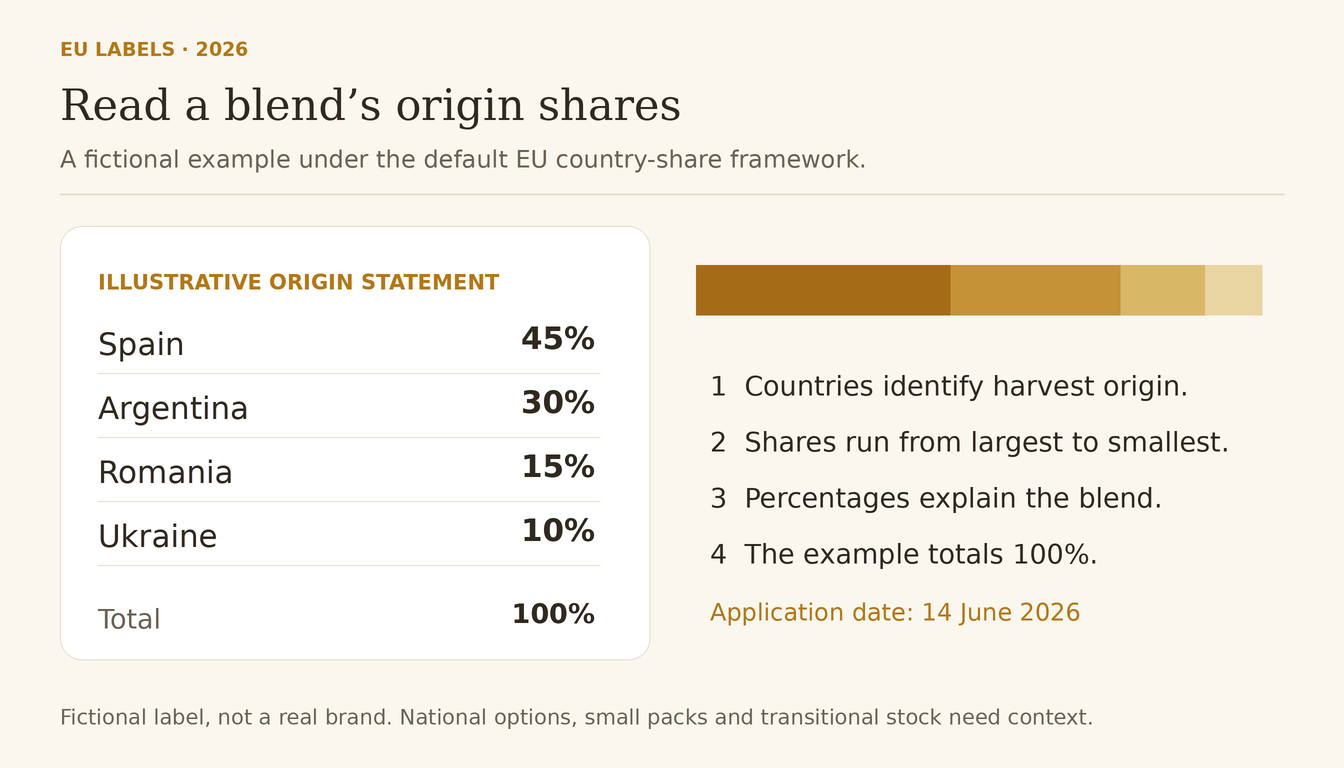
The illustration below is a fictional teaching example, not a real brand, a tested jar or a model of every required packaging detail. Its origin statement reads: Spain 45%, Argentina 30%, Romania 15%, Ukraine 10%. The four shares total 100% and run from largest to smallest.
Spain is the largest contribution, but 45% is less than half. Calling this simply “mostly Spanish honey” could give a reader the wrong impression. Argentina is the second-largest contribution; together those first two countries account for 75% of this invented blend. Romania and Ukraine make up the remaining 25%. These are conclusions from the example’s arithmetic, without assumptions about taste or quality.
To picture the weight basis, imagine exactly 100 g of this illustrative mixture: 45 g would be assigned to Spain, 30 g to Argentina, 15 g to Romania and 10 g to Ukraine. That is an explanation of the declared proportions, not a laboratory separation you could perform on a spoonful. Once honey has been blended, the label is the operator’s origin declaration.
- Spain — 45% of the fictional blend by weight.
- Argentina — 30% of the fictional blend by weight.
- Romania — 15% of the fictional blend by weight.
- Ukraine — 10% of the fictional blend by weight.
- Total — 100%; this example has four countries of harvest.
How to understand the 5% tolerance
Article 2(4)(a) allows a 5% tolerance for each individual share within a blend, calculated using the operator’s traceability documentation. The documentation matters: this is a sourcing declaration connected to records, rather than a claim that someone measured the geographic contribution of every retail jar independently.
The provision does not supply a worked numerical formula. We therefore do not turn Spain’s illustrative 45% into a permitted interval here, or substitute “five percentage points” for the directive’s “5%.” Those expressions are mathematically different, and the wording alone should not be stretched into a consumer calculator.
Read a displayed percentage as useful information about the declared blend, with a tolerance built into the framework. It helps distinguish a small contribution from a dominant one. It cannot tell you the exact origin of the honey in one particular spoonful, and it gives no answer about floral identity, processing or authenticity. A jar’s country percentages and any testing evidence should be assessed separately.
The optional top-four rule has three conditions
The default is a percentage for every country in the blend. The directive also permits a Member State to allow a narrower percentage display for honey placed on its own market. Article 2(4)(a) attaches specific conditions to that option; it is not a general permission for every packer to shorten a label.
The blend must contain honey from more than four countries. Its four largest shares must together represent more than 50% of the blend. And the relevant Member State must have provided for the option. Where that treatment is allowed, the four largest shares still carry percentages; all the remaining countries still appear, in descending order, without percentages.
The threshold concerns the combined top four. It does not mean that only a country contributing more than 50% needs a percentage. Our four-country illustration does not meet the “more than four countries” condition, so this exception would not justify removing any of its percentages.
If you see four quantified countries followed by additional country names, you may be looking at this permitted format. The unquantified names still represent declared origins, rather than optional marketing information. You can add the four displayed shares to understand their combined contribution, but you cannot allocate the remainder between the other countries from their names alone. Whether the option is available in the place of sale needs current national evidence; we do not infer adoption from the EU text.
Packs under 30 g can use two-letter country codes
Small honey portions have a separate space-saving provision. For packages containing a net quantity of less than 30 g, country names may be replaced by two-letter codes from the current ISO 3166-1 alpha-2 standard. A 20 g portion is below that threshold; a package containing exactly 30 g is not.
The code stands for a country of harvest. It is not a quality grade, an organic mark or a producer’s own abbreviation. If a code is unfamiliar, match it to the ISO country-code standard rather than guessing from the brand’s address or the language on the wrapper.
This provision changes how country names can be written. It does not itself say to remove the blend percentages or to stop putting origins in descending order. You should still distinguish the small-pack format from the separate, conditional top-four percentage option. A short label may be using a permitted abbreviation while conveying the same kind of origin information.
Why an older label can still be on the shelf
The earlier EU framework allowed blend-origin statements such as “blend of EU honeys,” “blend of non-EU honeys” and “blend of EU and non-EU honeys,” as appropriate. The earlier version of Article 2(4) records those alternatives. They grouped origins broadly, rather than telling you which countries contributed how much.
The change did not require every qualifying older jar to disappear on 14 June 2026. Article 6 of Directive (EU) 2024/1438 permits products placed on the market or labelled before that date, in accordance with the relevant earlier directives, to continue to be marketed until stocks are exhausted.
Both parts of that explanation matter. The qualifying event can be placement on the market or labelling before the date, and the products must have complied with the relevant earlier rules. A harvest date alone does not establish that a jar qualifies. Nor does a best-before date tell you when the product was labelled.
For a simple old-versus-new comparison, our imaginary four-country mixture could previously have carried the broad EU-and-non-EU origin wording under the earlier framework; the current default supplies the four countries and their percentages. Finding the older wording in a shop in October 2026 does not, by itself, show that the honey is fake or unlawfully labelled. A specific judgment needs the product’s history and the applicable rules, not just a photograph of one phrase.
Country percentages are not an authenticity certificate
An origin statement gives you a more informative declaration to compare. It does not publish the underlying traceability records or demonstrate an independent test of the jar. Even a detailed, tidy label is not proof that added syrup is absent. Our honey adulteration guide explains that separate question and why a consumer should distinguish a declared claim from evidence supporting it.
Country and floral origin also describe different things. “Spain 45%” says nothing about what proportion of the entire blend came from orange blossom, rosemary or another plant. The Honey Directive addresses floral-origin claims separately in Article 2(2)(b), including the source and the honey’s relevant characteristics. Do not reinterpret geographic shares as floral shares.
The numbers also do not describe heating, filtration, organic certification or the quality of each contribution. If those properties matter to you, read the corresponding claims and ask what supports them. Choosing a country you want to support is a valid buying preference; assigning every honey from that country the same flavor or quality is a further assumption the label cannot resolve.
A short routine for comparing two jars
Start with the origin statement before drawing conclusions from flags, a local-looking brand name or pictures of a landscape. Compare the information the labels actually provide. One jar may tell you a single harvest country; another may name several countries with their respective shares. Neither arrangement alone tells you which honey you will prefer.
For terms beyond country of harvest, our introductory honey-label guide covers the broader packaging vocabulary. Keep that wider assessment separate from this particular EU change. The useful improvement here is knowing more about the declared sourcing of a blend, while recognizing exactly where the statement stops answering your questions.
- Find the harvest-country statement and distinguish it from the packer or distributor’s address.
- For a blend, read the descending shares and decide whether that declared mix meets your sourcing preferences.
- If percentages stop after four countries, check the conditions and the national option before treating the format as a defect.
- On a portion pack, check the net quantity before interpreting abbreviated country names.
- If you see older generic wording, ask the seller or brand about the product’s labelling history before deciding whether the transition applies.
- Evaluate floral, processing, certification and authenticity claims using their own supporting evidence.