White Honey Has Three Different Meanings
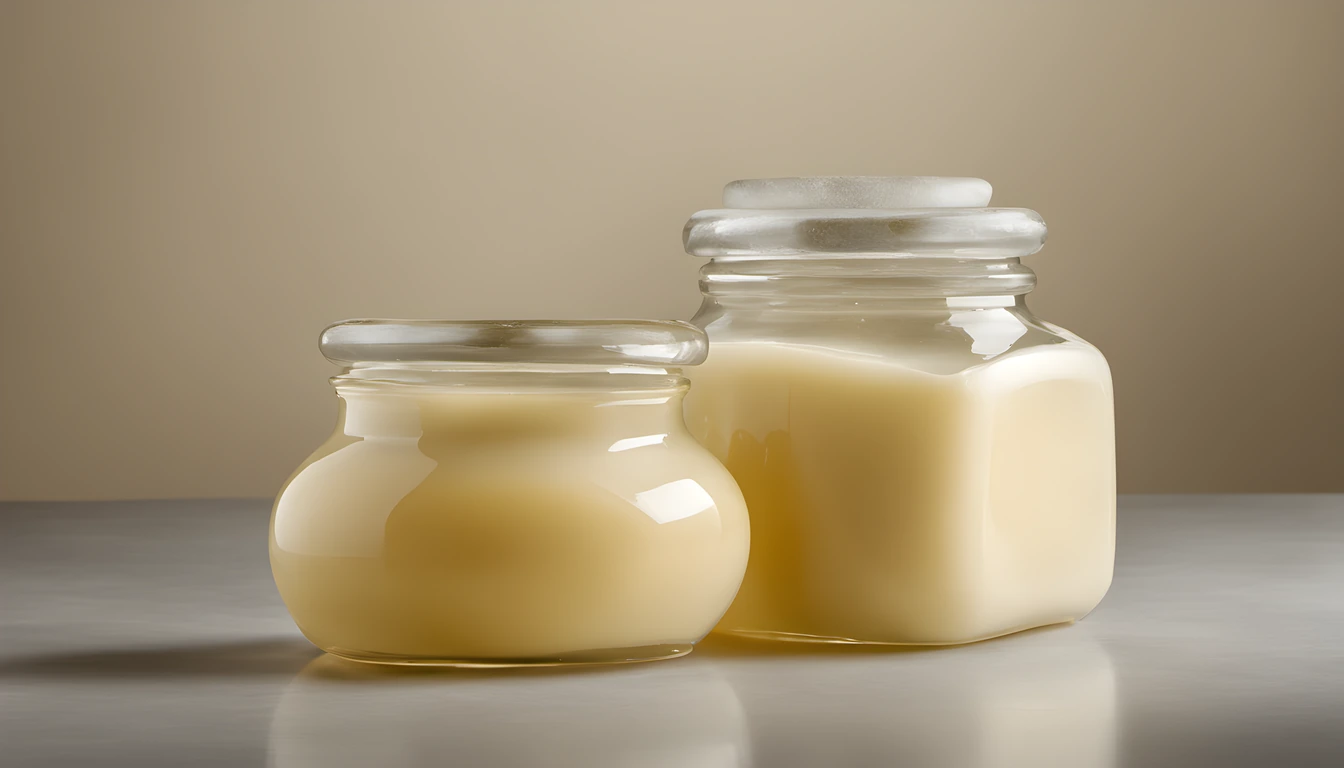
White honey can mean a pale liquid color, a light-looking crystallized texture, or a description used by a producer for honey from a particular place. Those meanings can overlap, but they answer different questions. A transparent pale-gold honey and an opaque ivory spread might both be advertised as white honey without being the same floral variety or having the same texture.
Start with what you want from the jar. If you want a honey that pours, look for its liquid form. If you want a spread for toast, ask about its crystal texture. If you want honey from a named region, check the harvest origin. The word white cannot answer all three questions for you.
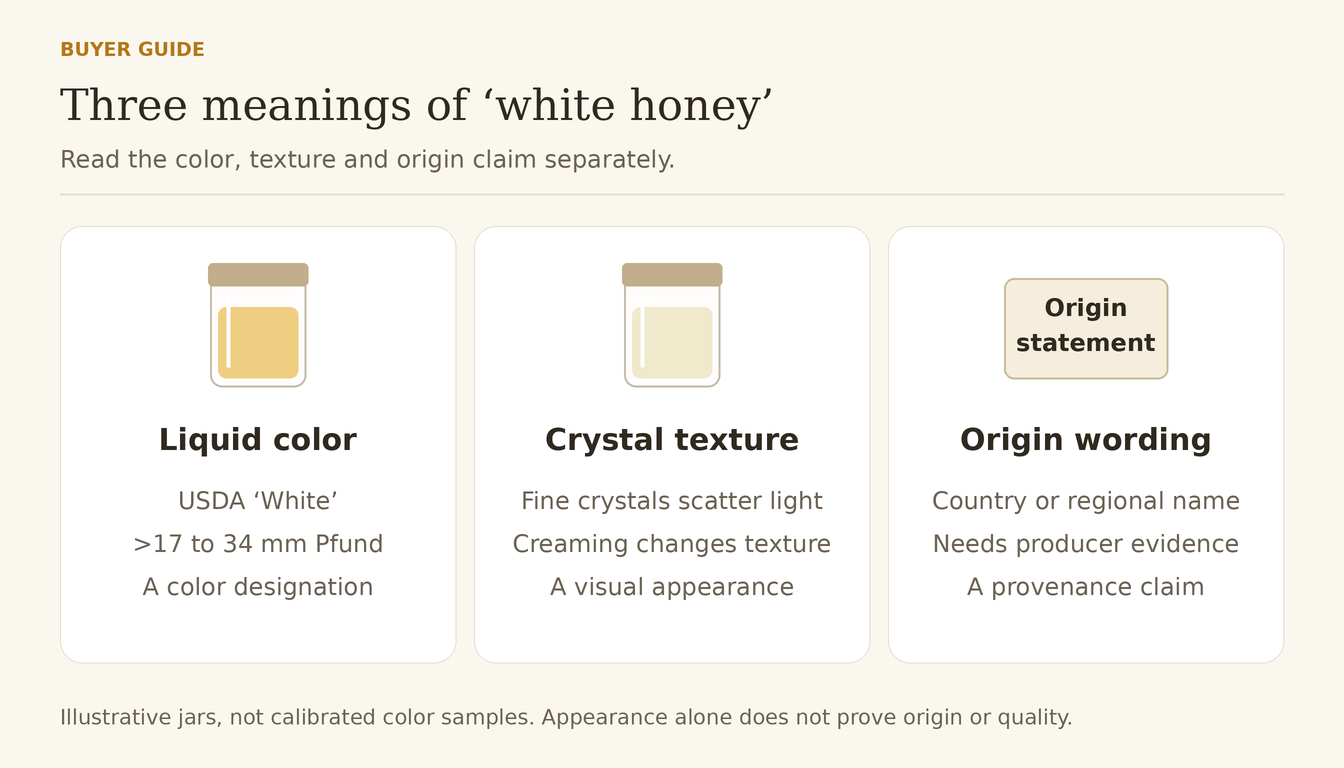
The illustration separates these ideas into three panels. It shows explanatory examples, not tested honey samples or a calibrated color chart. Read it as a guide to the questions below, rather than a shade card for identifying your jar.
- Liquid color: how pale or dark the honey is when assessed for color.
- Crystal texture: whether the honey is transparent and flowing or opaque and crystallized.
- Origin label: what the seller says about the place or plants the honey came from.
The USDA White Designation Describes Color
In the USDA extracted-honey standard, White is a specific designation: over 17 through 34 millimeters on the Pfund scale. It sits between Extra White and Extra Light Amber. White here describes a pale part of the honey color range; it does not mean an opaque, milk-white product.
The same standard separates color from quality grading. Section 52.1397 excludes color as a quality factor for those grades, and section 52.1398 calls for adjustment for cloudiness when determining the designation. A photo of a cloudy jar therefore cannot substitute for a measured color assessment.
Ask whether the seller means a measured color designation or simply a pale appearance. A batch color result can answer that narrow question. It still does not identify the flowers, establish a country of harvest, or tell you whether you will enjoy the flavor. Our honey color guide covers the wider spectrum; the exact White boundary used here comes from USDA Table I.
Pro Tip
For USDA White, the lower boundary is exclusive and the upper boundary is inclusive: more than 17 mm and no more than 34 mm Pfund.
Get the Honey Buyer's Cheat Sheet (free PDF)
16 varieties on one page — color, flavor, best use and what a fair price looks like — from the 268 honeys we track.
Why Liquid Honey Can Become a Pale, Opaque Spread
Crystallization changes how light interacts with honey. Glucose crystals form within the liquid, and a crystallized jar can look lighter and less transparent than its liquid starting material. The light-looking texture and the liquid color designation are therefore different observations.
A 2025 study of monofloral honey creaming followed Greek cotton, thyme and heather honey samples during a controlled creaming process. The researchers measured increased lightness during crystallization and suggested that reflection from glucose crystals helps explain it. The researchers also note that crystal size and shape may affect the measured color. This supports an appearance explanation, rather than a rule that every honey becomes equally white.
The samples behaved differently, including differences among honeys with the same botanical name. The study does not let a shopper identify cotton, thyme or heather honey by matching a photograph. Nor does its lightness measurement describe the USDA Pfund color range: these are different measurements.
This distinction is useful when shopping online. A photograph showing a pale spread may be a perfectly reasonable illustration of a crystallized product, yet leave you unable to judge its liquid shade. Ask the seller for the form supplied in the jar and a description of the texture. Do not order a pourable honey on the strength of color alone.
Creamed, Crystallized and Raw Describe Different Things
Creamed honey is deliberately made into a fine-crystal spread. Ordinary crystallized honey may have a different texture, so an opaque photograph cannot tell you whether the spoonful will be smooth or noticeably grainy. The creamed honey guide explains the production method; the buying question here is whether the seller is offering a controlled texture or honey that has set during storage.
Creaming does not require dairy. In the study above, the starter added to the honey was itself creamed honey. Plain creamed honey can therefore be made with honey alone. A honey-and-butter spread or a flavored blend is a different ingredient choice, even if it looks similar in a jar. Read the product name and any ingredient statement, and ask about additions when the description is unclear.
Raw is a separate claim about handling and processing. Neither whiteness nor a smooth spread demonstrates how a batch was heated, strained or otherwise prepared. If that distinction matters to your purchase, ask the producer what they did to the honey. A useful reply describes the process rather than pointing back to its color.
These terms can appear together on a label without replacing one another. A buyer could want honey-only ingredients, a creamed texture and a particular handling method. Confirm each feature separately. There is no need to choose the whitest photograph to get the spread you prefer.
A Regional Name Needs Its Own Explanation
A description such as Ethiopian white honey adds an origin claim to an appearance term. Treat the words separately: where was it harvested, and what does white mean for this product? The country name does not give the jar a universal recipe, crystal texture or floral identity. A producer may describe a local product more precisely than a retailer using a broad category name.
The Codex Standard for Honey treats regional and floral descriptions separately. Its regional designation refers to honey produced exclusively in the named area. A floral designation concerns honey coming wholly or mainly from that plant source, with corresponding sensory, physicochemical and microscopic characteristics. This is an international standard, not a claim that every retail label has been independently verified.
For an origin-focused purchase, ask for the country and region of harvest, the producer or cooperative, and information tied to the batch being sold. Distinguish that from the address of the importer or packer. If a flower is named, ask what supports that additional claim; a place name and a plant name are not interchangeable.
Our Ethiopian honey guide, Russian honey guide and Kazakhstan honey guide have the country-focused role. Use this page to decode white, then follow the relevant regional guide for broader context. Do not transfer a botanical description from one country or producer to an unrelated pale jar.
What You Can Observe—and What Needs Evidence
Separate the visible product from claims about its history. That keeps a useful observation, such as a smooth texture, from becoming an unsupported conclusion about where the bees foraged. Use this checklist when comparing listings or speaking with a seller.
- It looks pale and transparent: you can describe the appearance. A USDA White designation needs an appropriate color assessment, rather than a screen comparison.
- It looks opaque: you can see reduced transparency. Ask whether it is creamed, naturally crystallized or partially crystallized; the picture alone does not establish the method.
- A spoonful feels smooth: you have information about that sample’s texture. It does not establish the floral source or the texture of another batch.
- The label names a region: you have a seller’s origin claim. Ask for harvest and supply-chain information associated with the jar or lot.
- The label names a flower: you have a botanical claim. Producer records and appropriate sensory or laboratory evidence can address it; white color is insufficient.
- The product looks like other white honey: resemblance is not an authenticity test. Use the honey label guide to organize the claims before seeking stronger evidence.
Three Example Listings, Three Different Questions
Consider three fictional listings. The first says “White liquid honey” and supplies a batch result of 28 mm Pfund. That result falls within the USDA White interval. If your goal is a pale liquid ingredient, this is relevant information. You would still need separate details about its floral source and origin if those matter to you.
The second says “Creamed honey, honey only” and shows an ivory spread. Here the useful question is whether the texture is fine and spreadable at the temperature where you will use it. There is no reason to infer a Pfund number from the photograph. For toast, the texture description may answer your needs more directly than a color measurement.
The third says “Mountain white honey” with an attractive landscape on the label. Ask which mountain region, which country, and who produced the batch. Also ask whether white describes the liquid shade or the supplied crystallized form. A landscape image supplies atmosphere; it is not a harvest record.
These examples are invented to explain label reading, not recommendations for real brands. The most useful listing is the one that answers the question behind your purchase. More adjectives do not resolve a missing texture description or an unclear origin.
A Short Checklist Before You Buy
Write down your intended use before comparing jars. Then ask a few specific questions. A concise exchange can be more useful than searching for the palest product photo, especially when you care about a particular region or a spreadable texture.
For flavor, ask for a description of the actual batch or try a small jar before buying a large one. White is not a complete tasting note. For value, compare net weight and total cost alongside the information provided about the product; a premium price by itself does not verify a premium origin.
- Which form will arrive: liquid, creamed or another crystallized texture?
- Is it plain honey, or does the product contain other ingredients?
- What does white mean here: a measured color designation, a texture description or the producer’s product name?
- Where was this batch harvested, and who produced it?
- If a floral source or special handling method is claimed, what information supports it?
- What storage instructions should you follow to retain the supplied texture?
Using and Handling the Jar You Chose
For spreading, a creamed product gives you a texture to work with directly: try it on toast or use a spoonful with yogurt. For pouring or measuring into a dressing, a liquid product may be more convenient. These are practical choices about handling, not a ranking of white honey above amber or dark honey.
Keep the jar tightly closed and use clean, dry utensils. Penn State Extension’s honey storage guidance recommends an airtight container in a dry place and explains that honey can absorb moisture and odors when exposed to air. Follow any product-specific instructions, especially if you bought a spread with added ingredients.
You do not need to liquefy creamed honey before eating it. If you prefer a liquid texture, the same Extension guidance describes warming crystallized honey in hot, non-boiling water until crystals disappear. Keep water out of the honey and use a container suitable for warming. This changes the texture you selected; it is not an authentication test.
For more detail, see the decrystallization guide and storage guide. Keep the original label or a photo of its batch information if you expect to reorder. That gives you something specific to discuss with the seller beyond “the white one.”