Correction, October 2026: we removed or corrected claims and figures on this page that our sources did not support. How we handle corrections
Honey Color Science: Pfund Scale & the Antioxidant Link
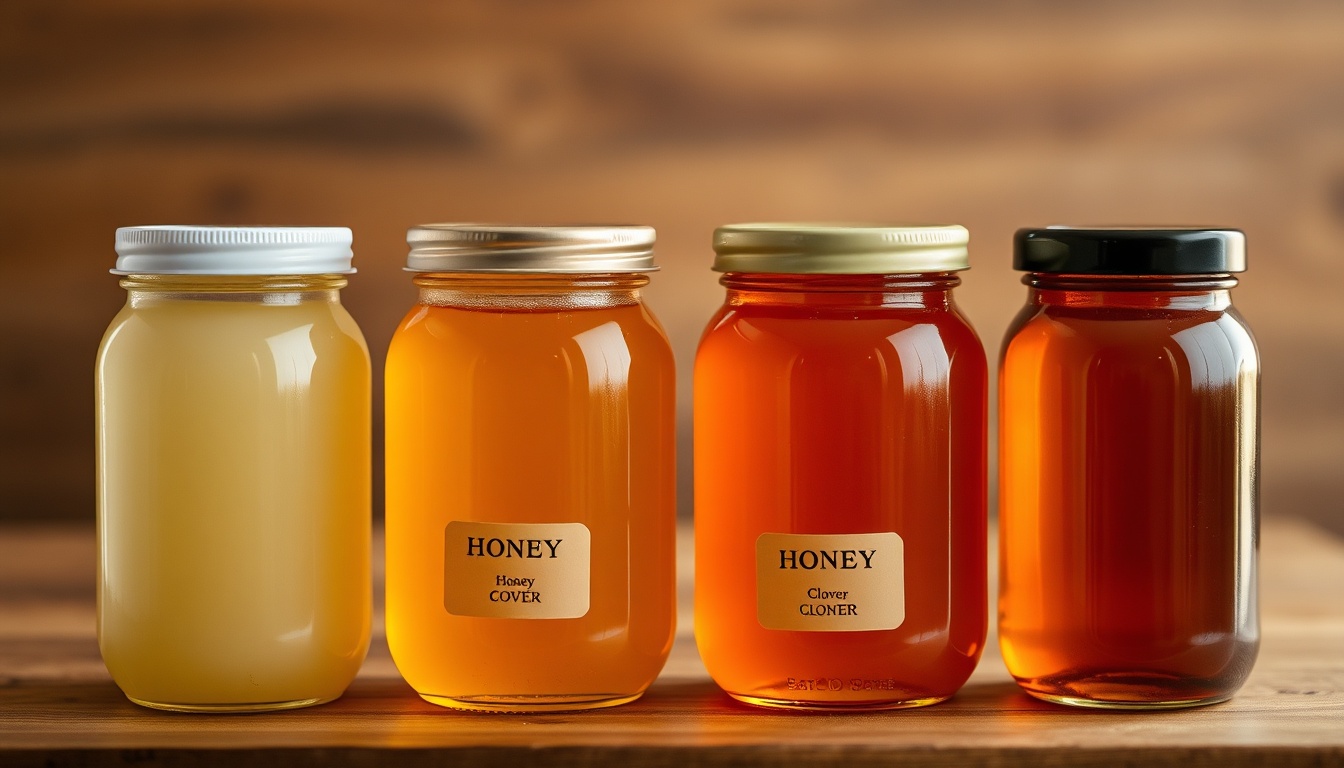
Honey runs from nearly clear to almost black. The colour is measured in millimetres on the Pfund scale, and the USDA sorts it into seven colour designations. In a Polish study of 49 honeys, darker honey carried more phenolics on average (Spearman r = 0.77), with clear exceptions.
The colours below are measured means: 15 European honey types from the International Honey Commission’s descriptive sheets (Persano Oddo & Piro 2004) and Polish buckwheat (Puścion-Jakubik et al. 2022). We found no comparable measured means for US varieties such as clover, tupelo or orange blossom, so they are not shown.
The colour rule, measured
Across 49 Polish honeys, colour tracked total phenolics (r = 0.77) and the FRAP antioxidant test (r = 0.68). It did not track the DPPH test. Heather and dark multifloral honey were the same colour and differed twofold in phenolics. Colour is the best clue you can see on a shelf; it is not a measurement.
Measured Pfund Colour of 16 Honey Types
Mean colour in mm Pfund, lightest to darkest, with the USDA designation each mean falls in. IHC = International Honey Commission descriptive sheets; Poland = 2022 Polish study. Single jars vary around these means. Swatches approximate the jar colour.
Sources: Persano Oddo & Piro 2004; Puścion-Jakubik et al. 2022. Grade limits: USDA Table I.
The Pfund Scale: USDA’s 7 Colour Designations
A Pfund grader reads honey colour in millimetres along a wedge of amber glass: the higher the number, the darker the honey. The USDA’s U.S. Standards for Grades of Extracted Honey (effective May 23, 1985) list seven colour designations by their Pfund range. Two details from the standard: colour is not a factor of quality for its grades, and the Pfund grader is not the officially approved device for setting a USDA designation; official designations use USDA-approved colour standards.
| USDA designation | Pfund range | Measured means in this range (mm) |
|---|---|---|
| Water White | 8 mm or less | none of the 15 IHC means |
| Extra White | over 8 to 17 mm | Rosemary 15, Rhododendron 12.4, Acacia (black locust) 12.9, Citrus 15 |
| White | over 17 to 34 mm | Lime (linden) 33.3, Rape (canola) 26.2, Lavender 33.3 |
| Extra Light Amber | over 34 to 50 mm | none of the 15 IHC means |
| Light Amber | over 50 to 85 mm | Thyme 53.1, Heather 76.9, Sunflower 52.4, Eucalyptus 54.2, Dandelion 56.6 |
| Amber | over 85 to 114 mm | Chestnut 87.9, Metcalfa honeydew 100.8, Honeydew 86 |
| Dark Amber | over 114 mm | Buckwheat (Poland) 166.4 |
Ranges from USDA Table I: each runs from “over” the previous limit “to and including” its own.
Color as an Antioxidant Proxy (r = 0.77)
Two studies tested colour and antioxidants on the same honeys. In 2002, honeys from 7 floral sources scored 3.1–16.3 µmol Trolox equivalents per gram on ORAC, and the darkest, such as buckwheat, scored highest. In 2022, a Polish team measured colour, total phenolics and two antioxidant tests on 49 honeys, each from a different beekeeper.
Each dot is the mean of one honey type in a Polish study of 49 honeys. Across all 49 samples, colour tracked total phenolics (Spearman r = 0.77) and the FRAP antioxidant test (r = 0.68); the DPPH test did not track colour. Source: Puścion-Jakubik et al. 2022.
Buckwheat was the darkest group (166.4 mm) with 182.6 mg of phenolics per 100 g; linden (43.5 mm) had 29.23. The exceptions matter as much as the trend: heather and dark multifloral honey sat at the same colour with 91.78 and 187.6 mg, and honeydew honey (109.9 mm) scored higher on FRAP (0.323) than the darker heather (0.141).
What the correlation means practically
Between two jars of the same kind of honey, the darker one is the better bet for more phenolics. Across different kinds, colour is a rough guide only. And these are Polish honeys; a US jar of the same name can differ.
Three Things That Change Honey’s Color
1. Floral source
The main driver. In the IHC sheets, mean colour runs from 12.4 mm for rhododendron and 12.9 mm for acacia to 87.9 mm for chestnut and 100.8 mm for Metcalfa honeydew.
2. Heat and age (darkens)
Honey heated at 50–70 °C for up to 12 days formed more brown pigment the hotter and longer it was heated, and its DPPH antioxidant activity rose with the browning (Turkmen et al. 2006). A heat-darkened jar can look and test "richer" without more of its original phenolics. HMF, the standard marker of heating and age, is capped in the EU at 40 mg/kg (80 mg/kg for declared tropical honey).
Sources: Turkmen et al. 2006, Food Chem 95:653–657; Directive 2001/110/EC.
3. Crystallization (lightens)
Glucose crystals scatter light, so crystallized honey looks paler and opaque. The composition is unchanged; warm the jar gently and the original colour returns. Compare colours in liquid honey only.
For the difference between pale liquid color and a white, spreadable texture, read our white honey guide.
Manuka: Graded by Lab Test, Not Colour
Manuka is sold on a lab number. Its UMF and MGO grades come from tests for methylglyoxal (MGO) and other manuka markers, not from colour or antioxidant tests. The colour of a manuka jar tells you nothing about its grade; the number on the label does. See our manuka guide for what the grades mean.
Practical Buyer Guide: Match Color to Purpose
For more phenolics
Buy dark. In the Polish study the highest group means were dark multifloral (187.6) and buckwheat (182.6 mg per 100 g), both Dark Amber. Within one kind of honey, pick the darker jar.
For manuka
Ignore colour and read the MGO or UMF number on the label.
For neutral sweetening and baking
Buy pale: acacia (12.9 mm) and citrus honeys average Extra White in the IHC sheets. Pale honey will not darken batters or cover delicate fruit flavours.
For bold flavor (cooking, cheeseboards)
Buy darker honeys: chestnut, honeydew, heather or buckwheat. Pair with strong cheeses, game and dark bread.
Frequently Asked Questions
What is the Pfund scale for honey?
Does honey color indicate flavor?
Does darker honey always have more antioxidants?
Why does honey get lighter when it crystallizes?
Can heating change honey's color?
What color is the healthiest honey?
Why is manuka honey not dark if it has so many benefits?
What does "water white" honey mean?
Sources and Updates
Updated : An earlier version showed 12 varieties with estimated Pfund values and per-variety ORAC (acacia 65 to buckwheat 796 µmol TE/100 g) and credited a 2002 study with a colour–ORAC correlation of r ≈ 0.76. Those numbers are not in the cited studies, so we replaced them with measured colour means and the Polish colour–phenolics data.
- USDA, United States Standards for Grades of Extracted Honey (effective May 23, 1985), Table I
- Persano Oddo L, Piro R. Main European unifloral honeys: descriptive sheets. Apidologie 2004;35(Suppl 1):S38–S81 (International Honey Commission working group, 6,719 samples)
- Puścion-Jakubik A, Karpińska E, Moskwa J, Socha K. Content of phenolic acids as a marker of Polish honey varieties and relationship with selected honey-quality-influencing variables. Antioxidants (Basel) 2022;11(7):1312
- Gheldof N, Engeseth NJ. Antioxidant capacity of honeys from various floral sources based on the determination of oxygen radical absorbance capacity and inhibition of in vitro lipoprotein oxidation in human serum samples. J Agric Food Chem 2002;50:3050–3055
- Turkmen N, Sari F, Poyrazoglu ES, Velioglu YS. Effects of prolonged heating on antioxidant activity and colour of honey. Food Chem 2006;95:653–657
- Council Directive 2001/110/EC relating to honey
Get the Honey Buyer's Cheat Sheet (free PDF)
16 varieties on one page — color, flavor, best use and what a fair price looks like — from the 304 honeys we track.
Related Guides
Edited by Sam French · Raw Honey Guide Editorial Team
Source reviewed against primary literature and official guidance where available. Health content is educational, not medical advice, and does not replace a licensed clinician.