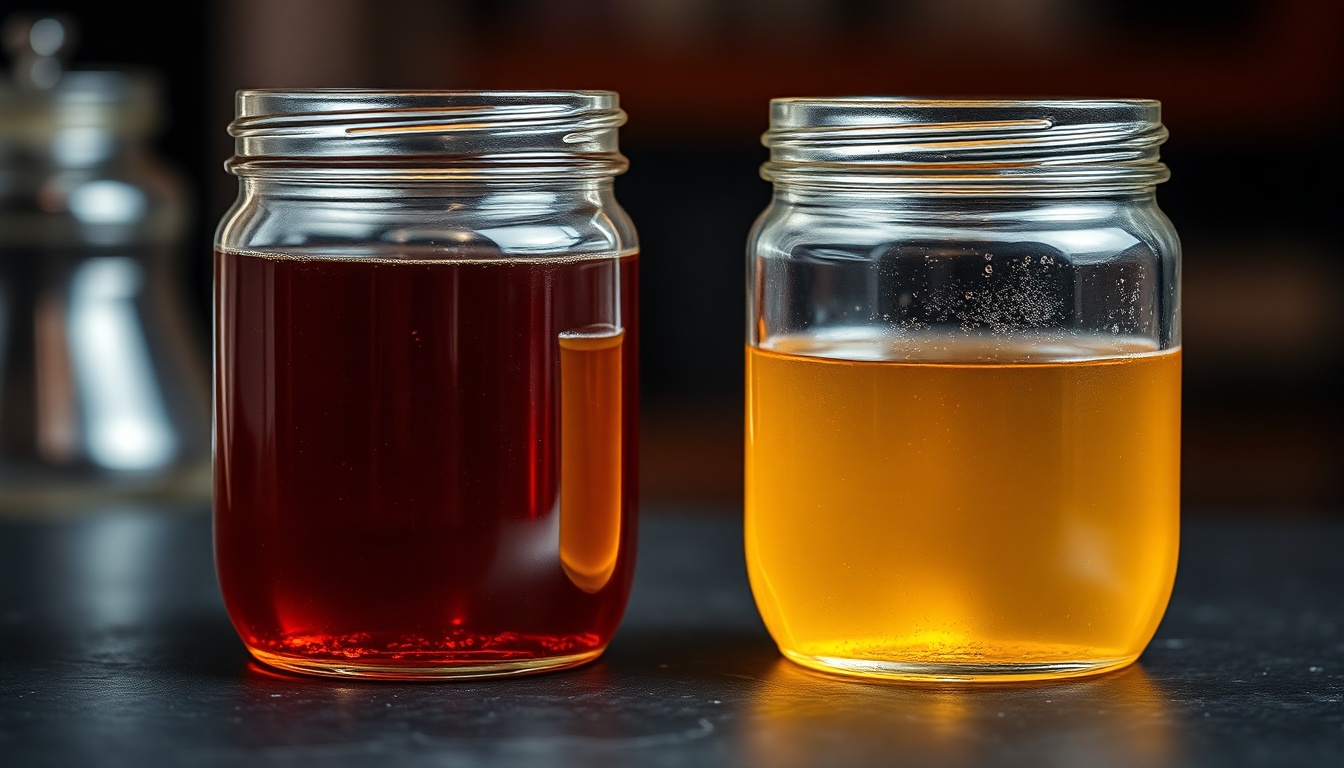
Honey Polyphenol Profile: Phenolic Acids vs. Flavonoids
The antioxidant gap between buckwheat and acacia honey is roughly 15-to-1 on ORAC measurements. But why — and what does that mean for the specific health effects associated with each? The answer lies in honey's phenolic fingerprint: two compound families with different origins, different structures, and different implications.
Data below are mid-range estimates from peer-reviewed HPLC surveys (Ferreres 1994, Bertoncelj 2007, Truchado 2009, Gheldof & Engeseth 2002). Individual jars vary; these represent central tendencies across documented surveys.
The raw-vs-filtered revelation
Raw honey consistently tests higher in flavonoids than the same honey filtered — not primarily because the nectar changes, but because pollen grains and trace propolis residues are the main carriers of honey's flavonoid fraction. Remove them by ultra-filtration and the flavonoid reading drops sharply. This is why "raw" matters for antioxidant retention, and specifically which antioxidant fraction it preserves.
Phenolic Acids vs. Flavonoids by Variety
Total polyphenols (mg/kg honey). Amber = phenolic acids (from nectar). Gold = flavonoids (from pollen & propolis). Sorted highest to lowest. Raw, unfiltered honey assumed.
Two Families, One Color Rule
Honey polyphenols fall into two families. Phenolic acids — hydroxycinnamic acids (caffeic, p-coumaric, ferulic) and hydroxybenzoic acids (gallic, protocatechuic, syringic, chlorogenic) — are primarily nectar-derived. They originate in the plant's own defense chemistry: UV screening, pathogen resistance, and antifeedant compounds that the plant builds into its tissues and secretions. When a plant produces phenolic-rich nectar, that chemistry transfers directly into honey.
Flavonoids — a diverse subclass including flavones (luteolin, apigenin), flavonols (quercetin, kaempferol), flavanones (pinocembrin, naringenin, hesperidin), and flavanols (catechins) — reach honey by a different route. Although some floral sources do place flavonoids in nectar, the dominant pathway in honey is via pollen grains and propolis residues. Bees introduce microscopic pollen into the honey during processing; wax and propolis fragments, also rich in pinocembrin and chrysin, contribute further (Ferreres et al. 1994, Pietta et al. 1996).
Both families produce the ORAC signal. But they arrive by different routes, they respond differently to filtration, and they have different bodies of clinical research behind them. The color rule holds for both: darker honey = more of both families. But the ratio matters — heather's flavonoid fraction is unusually high relative to its phenolic-acid fraction, while buckwheat's is almost entirely phenolic-acid driven.
Phenolic Acids: The Nectar Signature
Phenolic acids are the workhorses of honey's antioxidant chemistry. They correlate strongly with color (r = 0.82 per Gheldof & Engeseth 2002) because darker nectars come from plants with more active phenolic defense systems. Buckwheat — the darkest major commercial monofloral — is exceptional: chlorogenic acid alone accounts for roughly 100–200 mg/kg of its total, making buckwheat honey among the most phenolic-acid-dense sweeteners in any form.
The major compounds, by family:
- Hydroxycinnamic acids — caffeic, p-coumaric, ferulic, chlorogenic (the most bioavailable and extensively studied). Caffeic and p-coumaric cross cell membranes more readily than the heavier flavonoids.
- Hydroxybenzoic acids — gallic, protocatechuic, syringic. Gallic acid is present in most dark honeys; syringic acid is the direct methyl-ester of manuka's unique leptosperin marker (methylsyringate).
Phenolic acids survive filtration reasonably well (they're small molecules, not particle-associated) but degrade at elevated temperatures. Pasteurization at 63°C/30 min reduces caffeic and p-coumaric acid concentrations by approximately 10–20% (Khalil et al. 2010).
Why chlorogenic acid matters
Chlorogenic acid (CGA) — buckwheat honey's dominant phenolic — is the same compound credited for much of coffee's antioxidant activity. In isolation, CGA has been studied for glucose metabolism, LDL oxidation inhibition, and anti-inflammatory signaling. Buckwheat honey's 15–20× higher CGA vs. clover or acacia is not a marketing claim — it's a direct consequence of the plant's own defensive biochemistry, measurable by HPLC in any analytical food laboratory.
Flavonoids: The Pollen and Propolis Story
The most widely cited honey flavonoids — pinocembrin, chrysin, galangin, quercetin, kaempferol — are often attributed to flower nectar in popular writing. The research picture is more nuanced. Pinocembrin and chrysin in particular are known propolis compounds; the flavonoid profile of honey from the same floral source can differ substantially between apiaries based on propolis composition, which varies regionally and between colonies (Ferreres et al. 1994).
The practical implication: raw, unfiltered honey consistently tests higher for total flavonoids than fine-filtered commercial honey — not primarily because nectar composition changes, but because filtration removes the pollen grains and propolis microparticles that carry the bulk of the flavonoid fraction. Ultra-filtration — used to produce clear honey and to obscure geographic origin — removes essentially all pollen, and with it a significant portion of the flavonoid payload.
This has practical implications for buying raw honey: "raw" specifically matters for the flavonoid fraction. If you prefer a filtered or creamed honey and antioxidants are a priority, opt for a dark variety (buckwheat, forest honeydew) where phenolic-acid content is high regardless of filtration. If you prefer pale honey and want both fractions, raw and unfiltered acacia will retain more flavonoids than filtered acacia — though the absolute values remain low.
| Flavonoid | Type | Primary carrier in honey | Found highest in |
|---|---|---|---|
| Pinocembrin | Flavanone | Propolis / wax | Heather, chestnut, buckwheat |
| Chrysin | Flavone | Propolis / wax | Heather, wildflower, buckwheat |
| Galangin | Flavonol | Propolis / wax | Heather, manuka, honeydew |
| Quercetin | Flavonol | Pollen grains | Wildflower, buckwheat, chestnut |
| Kaempferol | Flavonol | Pollen grains | Wildflower, orange blossom |
| Luteolin | Flavone | Pollen grains | Orange blossom, wildflower |
| Hesperidin | Flavanone | Citrus nectar | Orange blossom (unique marker) |
| Catechins | Flavanol | Chestnut pollen + nectar | Chestnut (bitter astringency) |
Unique Botanical Markers
Beyond the general phenolic families, several varieties contain compounds so characteristic that they serve as chemical authentication markers in food fraud detection.
Chlorogenic acid is the dominant marker — among the most studied phenolic acids for cardiovascular research. Dark molasses color correlates directly with total phenolic load.
Conifer resin contact enriches phenolic-acid fraction. Abscisic acid (plant stress hormone) is unusually high in Abies-source honeydew (Yao et al. 2003).
Catechins and condensed tannins from Castanea sativa nectar and pollen produce the distinctive bitter astringency. These are flavanols — a flavonoid subclass technically distinct from flavones/flavonols.
Highest flavonoid fraction among common varieties. Pinocembrin and galangin (from propolis/wax) dominate. The thixotropic protein network (not phenolic) is separately responsible for the gel texture.
Leptosperin (methyl syringate) is unique to Leptospermum-source honey and is used as the primary chemical authentication marker. The MGO antibacterial activity is distinct from — and additive to — the phenolic fraction.
Eucalyptol (1,8-cineole) is not phenolic, but phenolic-acid precursors from Eucalyptus exudate contribute to the distinctive antiseptic, mentholaceous aroma.
Hesperidin (a flavanone characteristic of Citrus species) is found in orange blossom honey but not in honeys from non-Citrus sources — useful as a botanical origin marker.
Quercetin-3-glucoside (isoquercitrin) is a characteristic flavonol glycoside for Tilia-source honeys. The dominant aroma driver (linalool) is a terpene, not phenolic.
Practical Buyer Guide
For maximum phenolic acids
Choose buckwheat, forest honeydew, or chestnut. These are the nectar-derived compounds that remain partially present even in filtered honey. Color is your proxy: amber-to-black = phenolic-acid-rich.
For maximum flavonoids
Choose raw, unfiltered honey from heather, chestnut, or buckwheat. "Raw" matters specifically for flavonoids because pollen and propolis particles carry this fraction. Ultra-filtered honey loses most of it regardless of source.
For unique bioactive markers
Choose authentic mānuka (leptosperin + MGO) for documented antibacterial activity. Choose orange blossom if you specifically want hesperidin (a citrus flavanone). These are not ORAC-driven — they are variety-specific pharmacological profiles.
For neutral sweetening
Acacia or clover: both have minimal phenolic content, neutral flavor, and the lowest antioxidant values. If you want the mildest, most heat-stable sweetener, the low phenolic count is a feature, not a flaw — they contribute to baked goods without competing flavors.
Frequently Asked Questions
What are honey polyphenols?
Does raw honey have more antioxidants than filtered honey?
Which honey has the most polyphenols?
Why does buckwheat honey have so many antioxidants?
Where do honey flavonoids come from?
Is manuka honey high in polyphenols?
What phenolic compound makes chestnut honey bitter?
Does heating honey destroy polyphenols?
Related Guides
Edited by Sam French · Raw Honey Guide Editorial Team
Source reviewed against primary literature and official guidance where available. Health content is educational, not medical advice, and does not replace a licensed clinician.