Chestnut Honey Benefits: Europe's Boldest Variety
Italian chestnut honey is one of the most distinctive foods in the world — dark, intensely bitter-tannic, and packed with antioxidants. With 8-20× more polyphenols than clover honey and a flavor that complements aged cheese, game meats, and dark chocolate, it rewards curious palates and adventurous cooks.
Last updated:
Chestnut honey (miele di castagno) is a dark, bitter-tannic monofloral honey from Castanea sativa trees, produced primarily in Italy, Corsica, and France. It has the highest antioxidant content of common European honeys (150-320 mg GAE/100g polyphenols — 8-20× clover), broad-spectrum antibacterial activity, and a bold caramel-woody bitter flavor profile unlike any other honey. Best pairings: aged Pecorino, blue cheese, game meats, dark chocolate, and espresso. In our catalogue, the middle half of 9 verified chestnut jars cost $15 to $24 (Oct 7, 2026). Crystallizes slowly (12-24 months). Never give to infants under 12 months.

Chestnut Honey at a Glance
mg GAE/100g — 8-20× clover
High-GI; glucose-dominant
Slow; coarse dark crystals
middle half of 9 verified chestnut jars, Oct 7, 2026
What Makes Chestnut Honey Unique Among Honey Varieties?
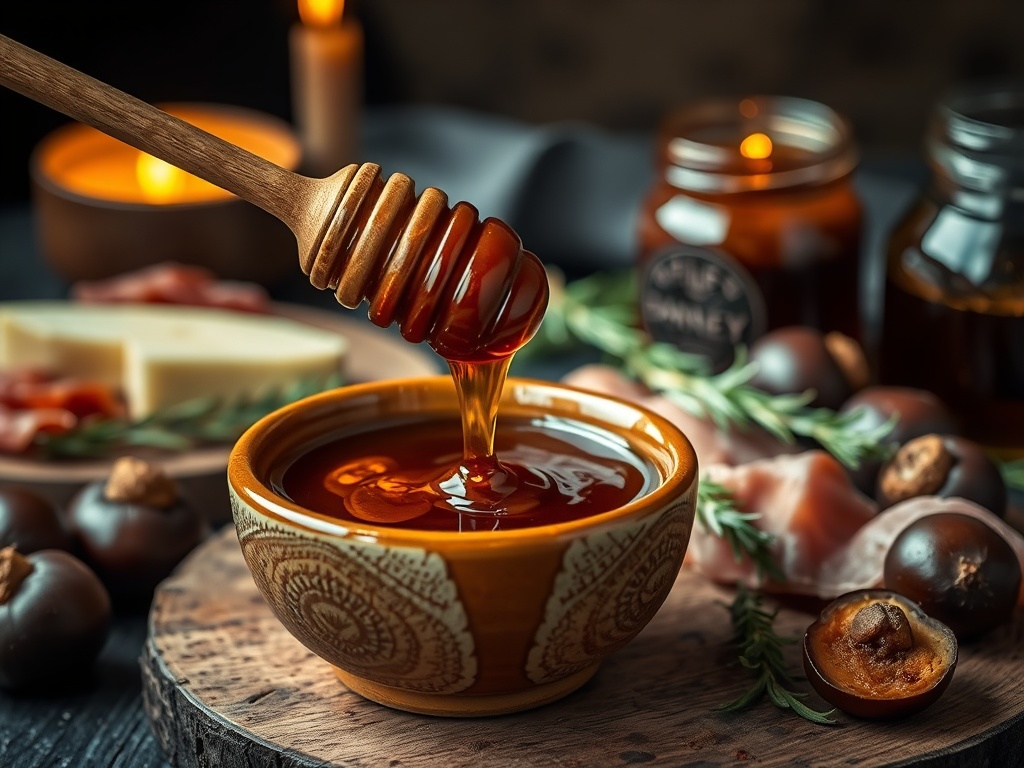
Chestnut honey is one of the most distinctive and polarizing honey varieties in the world — unmistakably dark, bold, and complex in ways that set it entirely apart from the mild sweetness most consumers associate with honey. Produced primarily from the nectar and honeydew of sweet chestnut trees (Castanea sativa), it is the signature honey of the Italian Apennines, French Corsica, the Ardèche region, and the Iberian Peninsula, where ancient chestnut forests have sustained beekeeping traditions for thousands of years. Roman and medieval texts document chestnut honey as a prized food and medicine; Pliny the Elder described it in Naturalis Historia as among Italy's finest honeys, and it appears in Benedictine monastic records from Corsica dating to the 12th century. The honey's color ranges from dark amber to dark brown — nearly opaque in some examples — with reddish mahogany tones that deepen with time. The flavor is its most defining characteristic: intensely aromatic, distinctly bitter with tannin-like astringency, woody and earthy, with notes of roasted caramel, dark molasses, and forest undergrowth. There is a lingering pleasant bitterness that many tasters describe as almost savory — a complete contrast to sweeter varieties. This bitterness comes from catechins, tannins, and saponins transferred from chestnut catkin flowers, which bloom in June and July and produce an unusually strong, intensely scented nectar. Crystallization is notably slow — most chestnut honeys remain liquid for 12 to 24 months at room temperature before forming coarse, dark crystals. The fructose-to-glucose ratio in chestnut honey is relatively low (unlike acacia), contributing to faster crystallization than acacia but slower than clover. Italian chestnut honey (miele di castagno) from Tuscany, Calabria, and Campania is protected by Italian agricultural tradition; Corsican AOP-certified honey (Miel de Corse) is among the most prestigious. Chestnut honeydew — collected from aphid secretions on chestnut bark rather than from nectar — is even darker and more mineral-rich, frequently sold alongside or blended with pure nectar honey in Central European markets.
Key Takeaways
- Produced from Castanea sativa nectar — Italian Apennines, Corsica, Ardèche, Iberian Peninsula are primary origins
- Documented by Pliny the Elder (1st century AD) and Benedictine monastic records — one of Europe's oldest cultivated honey varieties
- Dark amber to mahogany-brown, nearly opaque; intensely aromatic, distinctly bitter-tannic with woody caramel-forest notes
- Bitterness from catechins, tannins, and saponins in chestnut catkin nectar — almost savory, not sweet-forward
- Crystallizes slowly (12-24 months) into coarse dark crystals — low glucose ratio; often sold liquid for extended shelf life
- Top grades: Italian IGP/DOP miele di castagno; Corsican AOP Miel de Corse among world's most prestigious
What Are the Evidence-Based Health Benefits of Chestnut Honey?
Chestnut honey has one of the most impressive evidence bases of any widely available honey variety, driven by its exceptionally high polyphenol content and the unique pharmacological profile of chestnut flower compounds. A landmark 2013 study published in the Journal of Agricultural and Food Chemistry (Bertoncelj et al.) measured chestnut honey's total phenolic content at 150-320 mg GAE/100g — among the highest values recorded for any European honey and comparable to the most potent antioxidant foods. For context, this is 8 to 20 times the antioxidant density of commercial clover honey (15-35 mg GAE/100g) and exceeds buckwheat honey in many samples. The dominant polyphenols identified are caffeic acid, ferulic acid, catechin, epicatechin, ellagic acid, and quercetin — compounds with documented anti-inflammatory, antimicrobial, and cardioprotective activities in peer-reviewed literature. Antibacterial strength is a consistent finding: a 2017 systematic review in Molecules (Islam et al.) found chestnut honey among the most potent European honeys against Staphylococcus aureus, E. coli, Helicobacter pylori, and Pseudomonas aeruginosa in in vitro assays. The antimicrobial mechanism combines hydrogen peroxide (from glucose oxidase), polyphenol-mediated membrane disruption, low pH (3.5-4.5), and low water activity — multiple independent mechanisms that resist bacterial adaptation. For wound healing, a 2016 study in Phytotherapy Research demonstrated that chestnut honey extract accelerated keratinocyte migration (a key step in wound closure) at concentrations as low as 0.1% — suggesting topical applications have genuine mechanistic support. Iron absorption support is a particularly distinctive benefit: chestnut honey's unusually high iron content (0.72-1.2 mg/100g, compared to 0.01-0.06 mg/100g for most honeys) combined with its significant vitamin C precursors and organic acids may modestly support iron bioavailability when consumed alongside iron-rich foods — though this mechanism has been proposed but not yet confirmed in clinical trials. Prebiotic activity is well-supported: a 2019 study in Nutrients demonstrated that chestnut honey significantly promoted the growth of Lactobacillus and Bifidobacterium species in vitro while inhibiting pathogenic strains, outperforming other honey varieties in selective prebiotic effect. As with all honeys, none of these are approved medical treatments; chestnut honey should be viewed as a nutrient-dense food with complementary wellness properties, not a drug.
Key Takeaways
- Total phenolics 150-320 mg GAE/100g — 8-20× clover, exceeding most buckwheat samples; one of highest for European honeys
- Dominant polyphenols: caffeic acid, ferulic acid, catechin, epicatechin, ellagic acid, quercetin (JAgrFoodChem 2013)
- Broad-spectrum antibacterial: effective against S. aureus, E. coli, H. pylori, P. aeruginosa — multiple independent mechanisms (Molecules 2017)
- Wound healing: chestnut honey extract accelerates keratinocyte migration at 0.1% concentration (Phytotherapy Research 2016)
- Highest iron content of common honeys (0.72-1.2 mg/100g vs. 0.01-0.06 for clover) — modest mineral nutrition contribution
- Strong prebiotic effect: selectively promotes Lactobacillus and Bifidobacterium vs. pathogens (Nutrients 2019)
Quick Antioxidant Comparison
| Variety | Phenolics (mg GAE/100g) | Color |
|---|---|---|
| Chestnut | 150–320 | Dark amber–mahogany |
| Buckwheat | 100–200 | Very dark brown |
| Wildflower | 60–120 | Amber |
| Clover | 40–80 | Light amber |
| Acacia | 15–35 | Pale yellow |
Source: Bertoncelj et al., Journal of Agricultural and Food Chemistry, 2013.
What Are the Best Culinary Uses for Chestnut Honey?
Chestnut honey's bold, bitter-tannic intensity makes it one of the most exciting culinary honeys — but it requires thoughtful pairing. The golden rule: use chestnut honey where you want the honey to be a co-star, not a neutral sweetener. It will not quietly fade into the background, and that is its greatest asset in cooking. Cheese pairings are chestnut honey's most celebrated application, and for good reason. The bitter-woody notes cut brilliantly through fat and match in intensity with aged, pungent, and salty cheeses. The definitive Italian pairing is chestnut honey with Pecorino Romano or Pecorino Sardo — the saltiness and sharpness of aged sheep's milk cheese elevated magnificently by bitter honey. Blue cheeses (Gorgonzola Piccante, Roquefort, Stilton) are equally spectacular — the bitterness of the honey balances the pungent bacterial notes. Aged Parmigiano-Reggiano, Comté, and Manchego Curado also pair beautifully. Fresh mild cheeses like mozzarella or ricotta work better with lighter honeys — chestnut honey will overpower them. In savory cooking, chestnut honey is exceptional for glazing game meats (venison, wild boar, duck), pork ribs, and lamb chops where its intensity complements rather than sweetens. A classic Italian preparation: wild boar tagliata with chestnut honey, balsamic reduction, and rosemary. It is also magnificent in marinades for beef — combine 2 tablespoons chestnut honey, 3 tablespoons soy sauce, crushed garlic, and black pepper for a savory-sweet glaze that caramelizes beautifully at high heat. For desserts, chestnut honey pairs best with dark chocolate (minimum 70% cacao — the complementary bitterness is remarkable), nuts (especially walnuts, hazelnuts, and roasted chestnuts), and spiced preparations. A classic Corsican dessert: chestnut honey poured over brocciu (fresh sheep's milk cheese) with a scattering of roasted chestnuts. In baking, chestnut honey adds remarkable depth to gingerbread, spiced cakes, pain d'épices (French honey spice bread), and dark fruit cakes. For beverages, chestnut honey is outstanding in whiskey-honey cocktails, dark beer cocktails (try it with a stout), espresso-based drinks, and digestif pairings with Amaro or Grappa. Dissolve 1 teaspoon in a warm espresso and you have one of the most complex sweetened coffees imaginable. It also makes an excellent honey-vinegar shrub for cocktails with its bold flavor holding up to acidic components.
Key Takeaways
- Cheese pairings: Pecorino Romano, Gorgonzola, Roquefort, Stilton, Parmigiano-Reggiano — bitter notes cut fat and match intensity
- Game and red meats: venison, wild boar, duck, pork ribs, lamb — only honey strong enough for game flavor
- Classic Italian preparation: wild boar tagliata with chestnut honey, balsamic, and rosemary
- Baking: gingerbread, pain d'épices, spiced dark cakes — adds caramel-forest depth no lighter honey can match
- Beverages: espresso (extraordinary), whiskey cocktails, stout beer, Amaro pairings — bitter intensity is a feature
- Dark chocolate (70%+ cacao) + chestnut honey: complementary bitterness creates complex pairing; use as a dessert finish
Classic Italian Cheese Board Pairing
The definitive Italian antipasto: slice aged Pecorino Sardo or Pecorino Romano into thin wedges. Arrange alongside sliced prosciutto crudo and roasted whole chestnuts. Drizzle generously with chestnut honey just before serving. Add a few walnut halves and grind fresh black pepper over the cheese. Serve with dark sourdough or carta di musica (Sardinian flatbread) and a glass of Cannonau di Sardegna or full-bodied Barbera d'Asti.
The bitter-tannic chestnut honey bridges the salty sharpness of aged sheep's milk cheese, the sweetness of prosciutto, and the earthy depth of chestnuts — a combination that has been made in Sardinian and Tuscan farmhouses for centuries.
Chestnut Honey for Skin, Wound Healing, and Wellness
Chestnut honey's exceptionally high polyphenol content and strong antibacterial activity make it one of the most scientifically supported honeys for topical applications, though its dark color and intensely sticky consistency require some practical adaptation. For wound care, the peer-reviewed evidence for chestnut honey specifically is meaningful: a 2016 Phytotherapy Research study demonstrated keratinocyte migration acceleration — the cellular mechanism behind wound re-epithelialization — at dilutions as low as 0.1%. The combination of polyphenol-mediated inflammation reduction, broad-spectrum antibacterial activity, low pH (creating an inhospitable environment for pathogens), and osmotic dehydration (pulling fluid from wound beds, inhibiting bacterial growth) makes chestnut honey mechanistically justified for minor wound support. In practice: for minor cuts, scrapes, or irritated skin, apply a thin layer of raw chestnut honey and cover with a clean bandage. The dark color will stain bandages but has no clinical significance. For serious wounds, burns, or infections, medical-grade honey products (Medihoney, L-Mesitran) have regulatory approval — chestnut honey from a food jar is not sterile and is not a medical device. For skin care, chestnut honey's high antioxidant content offers UV-protective and anti-aging properties when applied topically. A simple Tuscan beauty tradition: apply a thin layer of raw chestnut honey to clean, damp skin, massage gently for 2 minutes (the slight acidity provides very mild exfoliation), then rinse after 15 minutes. The polyphenols absorb into the skin's surface layers during contact time. Catechin and epicatechin in particular have demonstrated UV-induced DNA damage reduction in cultured human keratinocytes (Brun et al., Journal of Photochemistry and Photobiology, 2013). For hair, chestnut honey's high mineral content (iron, manganese, zinc) makes it a nutritive hair mask component: mix 2 tablespoons chestnut honey with 1 tablespoon argan oil, 1 tablespoon apple cider vinegar, apply to damp hair, cover and leave for 30-45 minutes, then rinse thoroughly. The vinegar opens the hair cuticle, allowing minerals and conditioning compounds to penetrate. For internal wellness, the strongest evidence supports chestnut honey as a prebiotic food and immune-supporting antioxidant source. Daily consumption of 1-2 tablespoons as part of a balanced diet — in tea, on yogurt, or with cheese — provides a measurable polyphenol boost. Note: chestnut honey is intensely caloric (approximately 64 calories/tablespoon, same as other honeys); use in moderation. Never give to infants under 12 months.
Key Takeaways
- Wound healing: accelerates keratinocyte migration at 0.1% dilution (Phytotherapy Research 2016) — use on minor wounds only
- Broad antibacterial mechanism: polyphenols + H₂O₂ + low pH (3.5-4.5) + low water activity — multiple redundant pathways
- Skin mask: apply to damp skin for 15 minutes — catechin and epicatechin reduce UV-induced DNA damage (JPP 2013)
- Hair mask: chestnut honey + argan oil + apple cider vinegar — mineral-rich conditioning treatment for damaged hair
- Dark color will stain bandages/fabric — no clinical significance but plan for laundry and draping
- Never give to infants under 12 months; 64 cal/tablespoon — same calorific density as all other honeys
How to Buy Authentic Chestnut Honey and Spot Counterfeits
Chestnut honey's reputation makes it a target for adulteration, blending, and mislabeling — particularly in export markets where consumers are less familiar with its correct characteristics. The most common fraud is blending cheaper dark honeys (honeydew, or generic forest honey) with genuine chestnut nectar honey and selling the blend as pure monofloral chestnut. Sensory authentication starts with aroma: authentic chestnut honey has a very distinctive, intensely aromatic bitterness that is immediately evident when opening a jar — a complex scent combining tannin, wood, caramel, and floral catkin notes. Any jar lacking this intense and somewhat challenging aroma is almost certainly blended. Color is a secondary indicator: genuine chestnut honey ranges from dark amber to dark mahogany-brown, often with reddish tones. Bottles labeled "chestnut honey" that are light golden or pale amber are incorrectly labeled. In pollen analysis (melissopalynology), authentic monofloral chestnut honey should contain ≥20% Castanea pollen — unusually, chestnut is "underrepresented" in pollen analysis relative to its actual nectar contribution because bees deliberately remove it; so ≥20% pollen is sufficient for monofloral certification under EU Regulation 2001/110/EC. Certifications to look for: Italian IGP (Protected Geographic Indication) for Toscana, Calabria, or Campania chestnut honey; AOP/AOC (Appellation d'Origine Protégée) for Miel de Corse — these carry the strictest pollen analysis requirements and origin verification. For North American consumers, reputable importers include Gustiamo (Italian food specialist), Zingerman's Mail Order, and specialty cheese shops that maintain direct producer relationships. Be wary of large supermarket private-label "chestnut honey" priced like bulk clover. In our catalogue, the middle half of 9 verified chestnut jars cost $15 to $24 (Oct 7, 2026); price alone does not prove a blend, so check aroma, color and origin labeling too. Safety notes: never give to infants under 12 months. People with tree nut allergies should note that chestnut honey contains chestnut pollen, which in rare cases may trigger reactions — introduce cautiously if you have known chestnut or tree nut sensitivity, though most pollen-allergic individuals tolerate monofloral honeys of that same species, reactions are possible. Caloric density: 64 calories per tablespoon, identical to other honeys.
Key Takeaways
- Aroma authentication: unmistakable bitter-tannin-caramel-wood scent immediately evident on opening — absent = blended
- Color: dark amber to mahogany-brown with reddish tones; pale or golden "chestnut honey" is incorrectly labeled
- Pollen certification: ≥20% Castanea pollen sufficient for monofloral under EU 2001/110/EC (intentionally underrepresented)
- Certifications: Italian IGP, Corsican AOP/AOC — gold standard. US sources: Gustiamo, Zingerman's, specialty cheese importers
- Price guide: $15–24 (middle half of 9 verified chestnut jars, Oct 7, 2026); a jar far below that deserves a closer look
- Tree nut allergy caution: chestnut pollen present — introduce carefully if known chestnut sensitivity; consult physician
Related Honey Variety Guides
Frequently Asked Questions
What does chestnut honey taste like?
Chestnut honey has a bold, intensely aromatic flavor that is uniquely bitter and tannic — unlike the mild sweetness of most honeys. The flavor profile combines caramel-woody bitterness, earthy tannins (similar to dark coffee or black tea), notes of roasted chestnuts and forest undergrowth, and a lingering pleasant astringency. Some describe it as almost savory. The color is dark amber to mahogany-brown. It is one of the most distinctive and polarizing honey varieties — honey lovers who enjoy bitter chocolate, espresso, and aged cheese typically find it exceptional.
What are the health benefits of chestnut honey?
Chestnut honey has the highest antioxidant content of widely available European honeys: 150-320 mg GAE/100g total phenolics — 8-20 times more than clover honey and often exceeding buckwheat. Key polyphenols include caffeic acid, catechin, epicatechin, ellagic acid, and quercetin. Documented benefits include: broad-spectrum antibacterial activity (effective against S. aureus, E. coli, H. pylori), wound healing acceleration (keratinocyte migration, Phytotherapy Research 2016), prebiotic effect promoting beneficial gut bacteria (Nutrients 2019), and the highest iron and mineral content of common honey varieties. These are complementary wellness properties, not medical treatments.
What foods pair best with chestnut honey?
Chestnut honey pairs best with bold, pungent, or savory foods where its bitter-tannic intensity is a feature rather than an obstacle. The classic Italian pairing is aged Pecorino Romano or Pecorino Sardo cheese. Blue cheeses (Gorgonzola, Roquefort, Stilton), aged Parmigiano-Reggiano, and Manchego Curado are equally excellent. For meats, it glazes game (venison, wild boar, duck) and pork magnificently. Dark chocolate (70%+ cacao) is a celebrated pairing. In beverages, it is extraordinary dissolved in espresso or used in whiskey cocktails. It should not be used where neutral sweetness is desired — use acacia or clover for that.
Where does chestnut honey come from?
Chestnut honey is produced primarily from the nectar of Castanea sativa (sweet chestnut) trees, which bloom in June and July. The most prestigious production regions are: Tuscany, Calabria, and Campania in Italy (sold as miele di castagno, often with IGP geographic protection); Corsica, France (Miel de Corse, with AOP/AOC designation); the Ardèche region of France; and Portugal and Spain. Chestnut forests across the Apennine and Pyrenean mountain ranges are the primary European source. Some chestnut honey from Slovenia, Croatia, and Turkey is also exported.
How do you know if chestnut honey is authentic?
Authentic chestnut honey has a very distinctive, immediately recognizable aroma: intensely bitter-tannic-caramel-woody, evident as soon as you open the jar. Any "chestnut honey" lacking this challenging but complex scent is almost certainly blended. The color should be dark amber to mahogany-brown — pale golden product is mislabeled. Certified authentic products carry Italian IGP designation or Corsican AOP/AOC certification. Price is only a rough signal: in our catalogue, the middle half of 9 verified chestnut jars cost $15 to $24 (Oct 7, 2026), so a jar far below that deserves a closer look.
Is chestnut honey good for wounds?
Chestnut honey has meaningful peer-reviewed support for minor wound care: a 2016 Phytotherapy Research study found chestnut honey extract accelerates keratinocyte migration (wound re-epithelialization) at dilutions as low as 0.1%. Its broad-spectrum antibacterial activity, low pH (3.5-4.5), and high polyphenol content provide a sound mechanistic basis for topical application on minor cuts and scrapes. However, for serious wounds, burns, or clinical infections, medical-grade honey products (Medihoney, L-Mesitran) have regulatory approval and sterility guarantees that food-jar honey cannot provide. Always consult a physician for serious injuries.
Edited by Sam French · Raw Honey Guide Editorial Team
Source reviewed against primary literature and official guidance where available. Health content is educational, not medical advice, and does not replace a licensed clinician.
Get the Honey Buyer's Cheat Sheet (free PDF)
16 varieties on one page — color, flavor, best use and what a fair price looks like — from the 304 honeys we track.
Related Guides
Buckwheat Honey Guide
Antioxidants, cough relief, dark honey benefits, athletic performance, and ORAC rating.
Read GuideManuka Honey Benefits
UMF/MGO ratings and proven benefits.
Read GuideHoney & Cheese Pairings
Pair honeys with cheeses like wine.
Read GuideRelated Articles
Chestnut Honey: Taste, Colour, Origins and Price
Chestnut honey is dark, tannic and slow to set. Compare Italian, French, Greek, Spanish and Turkish jars, typical catalog prices, and how to spot a blend.
Read ArticleBuckwheat Honey Benefits: Why This Dark Honey Is Worth Trying
Buckwheat honey has 3-9x more antioxidants than lighter honeys. Learn its benefits for coughs, heart health, and more.
Read ArticleHoney for Inflammation: What the Science Actually Shows
Can honey reduce inflammation? Clinical evidence on polyphenols, NF-kB inhibition, and which honey types work best.
Read ArticleReady to explore chestnut honey and other specialty varieties?