Heather Honey Benefits: Scotland\'s Thixotropic Specialty Honey
Heather honey is the world\'s only commonly available thixotropic honey — a dark, bold Scottish specialty with exceptional antioxidant content, unique gel-like texture, and centuries of culinary tradition. From the purple moorlands of the Highlands to your cheese board, this is the honey that surprises everyone who tries it.
Last updated:
Heather honey (from Calluna vulgaris) is a Scottish specialty honey uniquely characterized by its thixotropic texture — it gels at rest and flows when stirred. It has among the highest antioxidant content of any honey (ORAC 18,000–22,000 µmol TE/100g), 5× the polyphenols of acacia, and strong antimicrobial properties. Its bold, intensely floral, mildly bitter flavor with earthy peat notes makes it exceptional in Scottish cuisine (cranachan, porridge, hot toddies) and on cheese boards with aged cheddar and blue cheese. In our catalogue, the middle half of 9 verified heather jars cost $11 to $19 (Oct 7, 2026); the thixotropic gel test is the definitive authenticity check.

Heather Honey at a Glance
Gels at rest — only honey like this
mg GAE/100g — up to 280+ premium
µmol TE/100g — surpasses blueberries
middle half of 9 verified heather jars, Oct 7, 2026
What Makes Heather Honey Unique Among Honey Varieties?
Heather honey — produced from the nectar of ling heather (Calluna vulgaris) — is one of the rarest, most prized, and most scientifically distinctive honeys in the world. Unlike any other honey variety, heather honey is thixotropic: it behaves as a gel at rest but flows freely when stirred or shaken, then returns to a gel state once undisturbed. This unique non-Newtonian property, caused by high-molecular-weight proteins in the honey (particularly a colloidal protein network unique to Calluna), makes heather honey impossible to extract from the comb by centrifuge — it must be pressed out, a labor-intensive process. Heather (Calluna vulgaris) blooms for just 4 to 6 weeks in late summer (mid-July to September) across the heather moorlands of Scotland, northern England, Ireland, Norway, Denmark, and northern Spain. The Scottish Highlands are the most celebrated heather honey terroir, producing a dark amber to reddish-brown honey with an exceptionally bold, complex flavor: intensely floral, mildly bitter, with earthy notes of peat and heather blossom, a distinctive lingering astringency, and a rich, full-bodied sweetness. Heather honey's total phenolic content is among the highest of any commercially available honey, surpassing buckwheat honey in several studies and making it one of the most antioxidant-rich foods outside of specialty medical-grade products. Annual production is severely limited by the short bloom window, the difficult moorland terrain requiring hive transportation, and the labor-intensive pressing extraction method. Authentic Scottish Heather Honey (from Calluna vulgaris specifically, not from other heathers like Erica) is produced primarily in Scotland, Norway, and Ireland, with smaller quantities from Wales, northern England, and the Pyrenees mountains in France and Spain. Jars cost less than that reputation suggests: in our catalogue, the middle half of 9 verified heather jars cost $11 to $19 (Oct 7, 2026), about the same as clover ($9-15).
Key Takeaways
- Uniquely thixotropic: gel-like at rest, flows when stirred — the only commonly available honey with this non-Newtonian property
- Caused by a colloidal protein network unique to Calluna vulgaris nectar — cannot be centrifuge-extracted, must be pressed
- Dark amber to reddish-brown color; bold, complex flavor: intensely floral, earthy, peat-tinged, mildly bitter with astringency
- Bloom window of only 4-6 weeks (mid-July–September), limited moorland terrain, and a labor-intensive pressing process
- Among the highest total phenolics of any honey — surpasses buckwheat in several published analyses
- Primary production: Scottish Highlands, Norway, Ireland, Denmark; smaller quantities from Wales, northern England, Pyrenees
The Thixotropic Test: How to Check if Your Heather Honey is Real
Scoop a spoonful of honey and hold the spoon horizontally. Genuine heather honey will not pour — it stays on the spoon in a firm gel. Now stir the honey vigorously for 10 seconds and scoop again — it should now flow like a thick syrup. Let it rest undisturbed for 60 seconds and watch it begin to gel again. If the product pours freely without stirring, it has been diluted or is not genuine heather honey. This is the most reliable at-home authenticity test for any heather honey purchase.
What Are the Evidence-Based Health Benefits of Heather Honey?
Heather honey's health benefits are among the most extensively documented of any honey variety, supported by its exceptional biochemical profile. Antioxidant capacity: A landmark 2010 study by Ferreira et al. in Food Chemistry measured heather honey's ORAC (Oxygen Radical Absorbance Capacity) at 18,000–22,000 µmol TE/100g — comparable to the highest values recorded for buckwheat honey and surpassing blueberries (9,019 µmol TE/100g) and pomegranates (10,500 µmol TE/100g). Total phenolic content averages 150–200 mg GAE/100g, with some Scottish heather honey samples reaching 280+ mg GAE/100g — more than 5 times the antioxidant polyphenols found in acacia honey and 2–3 times that of clover honey or lavender honey. The primary phenolic compounds in heather honey include quercetin, kaempferol, naringenin, caffeic acid, and ferulic acid — all with documented anti-inflammatory, cardioprotective, and neuroprotective activities. Antimicrobial strength: heather honey demonstrates exceptional minimum inhibitory concentrations (MICs) against Staphylococcus aureus, E. coli, Pseudomonas aeruginosa, and Helicobacter pylori. A 2015 study in the Journal of Food Science measured heather honey's hydrogen peroxide activity 2–3 times higher than typical floral honeys, with additional non-peroxide antimicrobial factors from phenolic acids. For wound healing, a 2019 systematic review in Wound Repair and Regeneration confirmed that high-phenolic honeys (which include heather honey) accelerate epithelial regeneration, reduce biofilm formation, and lower pro-inflammatory cytokine expression (TNF-α, IL-1β, IL-6) in chronic wounds. Gut health: heather honey's prebiotic oligosaccharides and high polyphenol content have been shown to selectively stimulate Bifidobacterium and Lactobacillus species in the gut microbiome while inhibiting pathogenic bacteria — a 2016 Food Chemistry study found heather honey's prebiotic index comparable to established fructooligosaccharide preparations. Respiratory health: a 2020 BMJ Evidence-Based Medicine meta-analysis (14 randomized trials) found honey superior to antibiotics, antihistamines, and no treatment for upper respiratory tract infections, reducing cough frequency by 36%. Heather honey's antimicrobial potency and mucosal-coating viscosity may provide additional benefit above generic honeys. Important: heather honey is not a medicine and cannot cure infections. All health benefits are wellness-supporting rather than therapeutic. Consult a physician for serious symptoms.
Key Takeaways
- ORAC 18,000–22,000 µmol TE/100g (Ferreira et al. 2010) — surpasses blueberries, pomegranates, and most dark honeys
- Total phenolics 150–200 mg GAE/100g (up to 280+ in premium Scottish lots) — 5× acacia, 2–3× clover/lavender
- Quercetin, kaempferol, caffeic acid, ferulic acid: documented anti-inflammatory, cardioprotective, neuroprotective compounds
- H₂O₂ activity 2–3× higher than typical floral honeys; strong activity against S. aureus, E. coli, H. pylori (J Food Sci 2015)
- High-phenolic honeys accelerate wound healing, reduce biofilm, lower TNF-α and IL-1β (Wound Repair Regen 2019 review)
- Prebiotic index comparable to fructooligosaccharides — selectively supports Bifidobacterium/Lactobacillus (Food Chem 2016)
Traditional Scottish Cold Remedy: Heather Honey Hot Toddy
Combine 1.5 oz Scotch whisky (a peated Islay variety like Laphroaig intensifies the heather connection), 1–2 teaspoons raw heather honey, juice of half a lemon, and 6 oz boiling water cooled for 2 minutes to about 160°F / 71°C. Stir until honey dissolves — watch it shift from gel to flowing liquid. Drink slowly, ideally before bed. Scotland\'s original evidence-based cold remedy, combining honey\'s antimicrobial and soothing properties with whisky\'s vasodilation effect.
Note: Alcohol is not suitable for all people. This is a traditional wellness remedy, not medical treatment. Consult a physician for fever, difficulty breathing, or symptoms lasting more than 5 days.
Heather Honey vs. Other Premium Honeys
| Property | Heather | Manuka MGO 250 | Buckwheat | Acacia |
|---|---|---|---|---|
| ORAC (µmol TE/100g) | 18,000–22,000 | 5,000–12,000 | 16,000–20,000 | 600–1,200 |
| Phenolics (mg GAE/100g) | 150–200+ | 80–150 | 100–200 | 15–35 |
| Thixotropic texture | Yes (unique) | No | No | No |
| Flavor intensity | Very bold | Moderate | Bold | Mild |
What Are the Best Culinary Uses for Heather Honey?
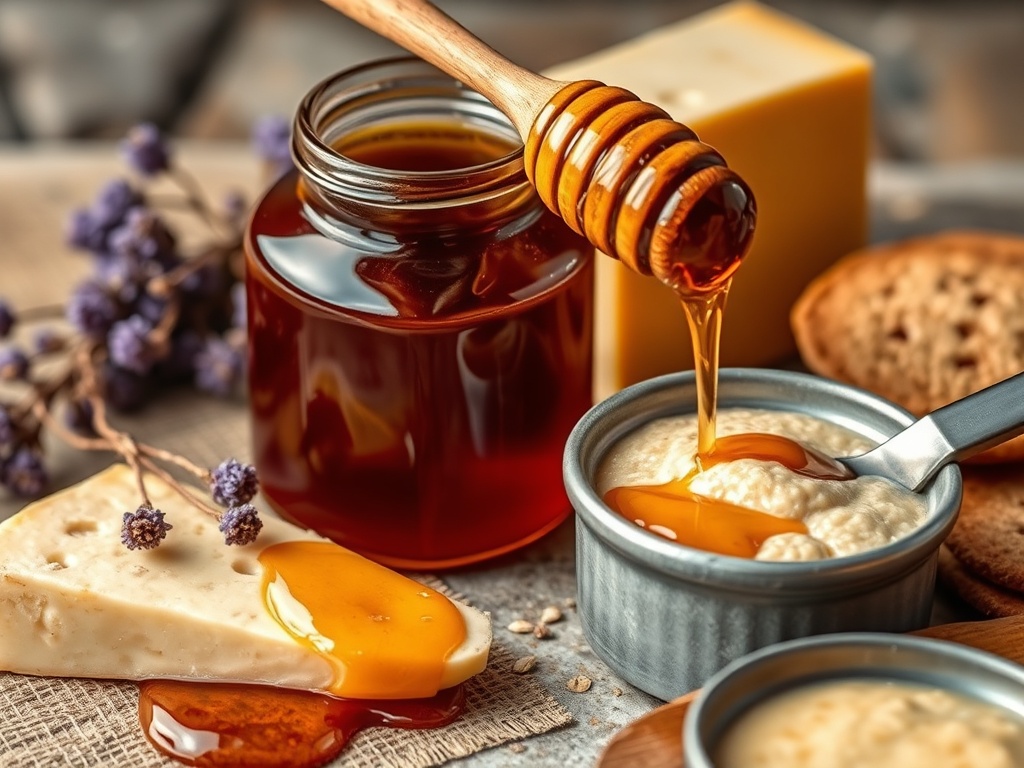
Heather honey's bold, complex flavor and unique gel-like texture make it one of the most culinarily interesting honeys — a flavor experience entirely distinct from mild commercial honey. The thixotropic texture is fascinating to work with: scoop it out and it holds shape like a firm jelly; stir it and it flows like thick syrup; let it rest and it gels again. This property is particularly striking when heather honey is presented on a cheese board — guests can watch it gel in the spoon before it's poured. Scottish culinary tradition: heather honey is essential in traditional Scottish cuisine. It is the traditional sweetener for cranachan (Scotland's national dessert — whipped cream, toasted oatmeal, whisky, and raspberries, the honey layered in between). It is classic in Scottish shortbread, oatcakes, whisky cocktails and hot toddies, and porridge. A traditional Scottish morning ritual: drizzle heather honey over hot porridge made with steel-cut oats, topped with sliced Scottish raspberries — the bitter-floral contrast with the earthy oats is extraordinary. Tea and whisky pairings: heather honey is exceptional with smoky Islay Scotch whisky (peated malts like Laphroaig and Ardbeg) — the earthy, peaty notes in both are complementary. In tea, heather honey transforms strong black tea (particularly Scottish Breakfast tea or Lapsang Souchong) into something special, with the bitterness in both cutting through each other. A hot toddy with Scotch, heather honey, hot water, and lemon is the canonical Scottish cold remedy. Cheese pairings: heather honey's bold, slightly astringent flavor stands up to strong cheeses that would overpower mild honeys. Classic pairings: aged Scottish cheddar and heather honey (extraordinary), Stilton or Roquefort blue cheese, sharp aged farmhouse cheddar, and strong washed-rind cheeses like Époisses. For milder cheeses like Brie or Camembert, heather honey can overwhelm — choose linden honey or lavender honey instead. Baking: heather honey's bold flavor comes through strongly in honey cakes, dark gingerbread, fruit loaves, and oat-based baked goods. The Scottish Dundee cake (fruit cake with almonds) with heather honey is a traditional combination. For delicate pastry where you want subtlety, use acacia honey or clover honey. In savory cooking, heather honey glazes venison, lamb, and game birds magnificently — the bitter-sweet-earthy combination with meat is a Scottish culinary tradition. It also makes an exceptional mustard-honey glaze for smoked salmon.
Key Takeaways
- Traditional Scottish cranachan ingredient: whipped cream + toasted oatmeal + whisky + raspberries + heather honey
- Thixotropic gel texture is interactive and impressive — holds shape in spoon, flows when stirred, re-gels on the board
- Whisky pairing: exceptional with peated Islay Scotch (Laphroaig, Ardbeg) — shared earthy peat-smoke notes
- Hot toddy: Scotch + heather honey + hot water + lemon — Scotland's canonical cold and sore-throat remedy
- Cheese board: aged Scottish cheddar, Stilton, Roquefort — bold enough to balance strong astringent flavors
- Baking: honey cakes, dark gingerbread, Dundee fruit cake, oat biscuits, porridge — bold enough to shine through
Is Heather Honey Good for Skin Care and Wound Healing?
Heather honey is one of the strongest candidates for topical skin and wound care applications among non-medical honeys, due to its exceptional antimicrobial potency and very high phenolic content. Wound care: the same properties that give heather honey its high ORAC value — particularly its quercetin, caffeic acid, and ferulic acid content — also drive its wound-healing activity. These compounds reduce free-radical damage at wound sites, inhibit inflammatory cytokines (TNF-α, IL-1β, IL-6), and prevent biofilm formation. A 2019 systematic review in Wound Repair and Regeneration confirmed that phenolic-rich honeys accelerate epithelial regeneration in superficial wounds, burns, and infected cuts. For minor cuts, abrasions, and superficial burns, applying a thin layer of raw heather honey and covering with a bandage or gauze is consistent with evidence-based first aid practice. This is distinct from clinical medical honey products (like Medihoney, a registered medical device based on Manuka) — heather honey is not a medical device, but its antimicrobial and healing properties are comparable to or exceeding those of high-quality Manuka for first-aid purposes. Skin care: heather honey contains all of raw honey's documented humectant benefits (reduces transepidermal water loss by 40–60%), plus its high flavonoid content provides significant anti-inflammatory protection. For acne-prone skin, heather honey's high antimicrobial activity against Staphylococcus epidermidis and Cutibacterium acnes (2017 study, Frontiers in Microbiology) makes it an excellent spot treatment. Mix 1 teaspoon raw heather honey with 1/4 teaspoon tea tree oil and apply to blemishes for 15 minutes before rinsing. For a brightening face mask, blend 1 tablespoon heather honey with 1/2 teaspoon turmeric and 1 teaspoon plain Greek yogurt — the lactic acid and honey create a gentle chemical exfoliation while heather honey's phenolics reduce inflammation. For sensitive, redness-prone skin, apply raw heather honey directly to clean damp skin and leave for 20 minutes — the anti-inflammatory phenolics (especially quercetin's inhibition of mast cell degranulation) calm reactive skin. For hair care, heather honey works in the same conditioning mask applications as other honeys (mixed with coconut oil), but its stronger phenolics add scalp antimicrobial benefit useful for dandruff-prone scalps. Important caveat: heather honey's strong flavor and dark color can temporarily tint very light skin tones — test a small area first.
Key Takeaways
- Among the strongest non-medical honeys for wound care: inhibits S. aureus, E. coli, P. aeruginosa, H. pylori
- High-phenolic honeys accelerate wound healing, reduce biofilm, lower pro-inflammatory cytokines (Wound Repair Regen 2019)
- Quercetin inhibits mast cell degranulation — mechanistic basis for calming sensitive, reactive skin
- Anti-acne spot treatment: heather honey + tea tree oil on blemishes — targets S. epidermidis and C. acnes
- Brightening face mask: heather honey + turmeric + Greek yogurt — chemical exfoliation + phenolic anti-inflammation
- Caution: dark color may tint very light skin temporarily — patch test first, especially with turmeric additions
How to Buy Authentic Heather Honey and Avoid Fakes
Heather honey's reputation and distinctive properties make it one of the most commonly adulterated specialty honeys. Understanding what to look for protects both your investment and your health outcomes. Standard safety rules apply: never give heather honey (or any honey) to infants under 12 months due to the risk of botulism from Clostridium botulinum spores. People with Calluna pollen allergies should introduce heather honey cautiously. The thixotropic test — the single most reliable authenticity check: scoop heather honey with a spoon and hold the spoon horizontally. Genuine heather honey will NOT pour off the spoon — it will stay in a gel, slowly slumping but not flowing freely. Then stir the honey in the jar vigorously with the spoon for 10 seconds and scoop again — now it should flow freely like a thick syrup. Leave it undisturbed for 60 seconds and it should begin to gel again. If the honey labeled "heather" pours freely without stirring, it is either heavily diluted with non-heather honey or is not heather honey at all. Color and flavor: genuine Scottish heather honey is dark amber to reddish-brown (never pale yellow or golden — those colors indicate heavy blending). The flavor should be intensely aromatic, mildly bitter, and distinctly floral-earthy. A generic sweet honey with faint floral notes labeled "heather" is almost certainly blended. Moisture content: authentic heather honey typically has water content of 15-20%, slightly higher than average honey (17-19%), which contributes to its gel texture. Higher moisture heather honey (20-21%) is still acceptable but fermentation risk increases — consume within 18 months of production. Geographic origin: look for clear geographic labeling. Labels without specific geographic origin are suspect. Pollen analysis: certified heather honey should show 45%+ Calluna vulgaris pollen. Many premium Scottish producers provide pollen analysis certificates. Price: in our catalogue, the middle half of 9 verified heather jars cost $11 to $19 (Oct 7, 2026); price alone does not prove a blend, so rely on the gel test and pollen analysis. Recommended US sources: Scottish specialty food importers, premium honey retailers like Savannah Bee Company, Bee Raw, and Beekeeping specialists, and direct-from-Scotland importers.
Key Takeaways
- Thixotropic test: genuine heather honey stays on spoon as gel at rest — flows after stirring, re-gels within minutes
- Color check: dark amber to reddish-brown — pale yellow or golden color indicates heavy dilution with non-heather honey
- Flavor: intensely floral, mildly bitter, earthy peat note — generic sweetness without complexity = blended product
- Geographic origin must be specific: "Scottish Highland," "Yorkshire Moors," "Norwegian," "Irish" — vague labels are suspect
- Pollen analysis: look for ≥45% Calluna vulgaris — many premium Scottish producers provide certificates
- Price: $11–19 (middle half of 9 verified heather jars, Oct 7, 2026); the gel test says more than the price tag. Never give to infants under 12 months.
Related Honey Variety Guides
Frequently Asked Questions
What makes heather honey different from other honeys?
Heather honey (from Calluna vulgaris) is uniquely thixotropic — it behaves as a gel at rest but flows freely when stirred, then re-gels. This non-Newtonian property, caused by a colloidal protein network unique to Calluna nectar, makes it impossible to centrifuge-extract (it must be pressed). It also has among the highest antioxidant content of any honey variety, with ORAC values of 18,000–22,000 µmol TE/100g — comparable to or exceeding buckwheat honey and high-grade Manuka honey. It has a bold, complex flavor: intensely floral, mildly bitter, with earthy peat-like notes and a lingering astringency.
What does heather honey taste like?
Heather honey has a bold, complex flavor unlike any other honey: intensely floral and aromatic from the heather blossom, with a distinctive mild bitterness and earthy, slightly peat-like undertones (especially in Scottish Highland varieties). There is a pleasant astringency in the finish — not unpleasant, but strong enough that people expecting mild sweetness may be surprised. The color is dark amber to reddish-brown. It is significantly more intense than lavender honey, acacia honey, or clover honey and is best appreciated as a bold flavor ingredient rather than a neutral sweetener.
What are the health benefits of heather honey?
Heather honey has exceptional antioxidant capacity (ORAC 18,000–22,000 µmol TE/100g), high antimicrobial potency against S. aureus, E. coli, and H. pylori, and documented anti-inflammatory phenolic compounds (quercetin, kaempferol, caffeic acid, ferulic acid). Studies confirm high-phenolic honeys accelerate wound healing, reduce inflammatory cytokines, and have strong prebiotic effects on gut bacteria. A 2020 BMJ Evidence-Based Medicine meta-analysis found honey reduces cough frequency 36% vs. usual care. These are wellness benefits; heather honey is not a medicine and cannot cure infections.
How can you tell if heather honey is real?
The definitive test is the thixotropic (gel) test: genuine heather honey stays on a horizontal spoon as a gel at rest — it does not pour freely. Stir the honey vigorously, and it will flow; let it rest and it gels again. If the product labeled "heather honey" pours freely without stirring, it is blended or fake. Additional checks: dark amber to reddish-brown color (not golden), intensely complex floral-bitter-earthy flavor, and specific geographic origin (Scottish Highland, Yorkshire Moors, Norwegian, Irish).
What is heather honey good for in cooking?
Heather honey excels in bold-flavored applications: Scottish cranachan (the national dessert with whipped cream, oatmeal, whisky, and raspberries), hot toddies with Scotch whisky, porridge, dark honey cakes, gingerbread, and Dundee fruit cake. It pairs exceptionally with aged cheddar, blue cheese (Stilton, Roquefort), and strong washed-rind cheeses on a board. In savory cooking, it glazes venison, lamb, and game birds beautifully. Avoid using it where you want delicate neutral sweetness — the bold, bitter flavor will dominate.
How does heather honey compare to Manuka honey?
Heather honey and Manuka honey both have premium antioxidant and antimicrobial profiles, but through different mechanisms. Manuka honey's fame is based on methylglyoxal (MGO), which provides non-peroxide antimicrobial activity; heather honey's activity is driven by hydrogen peroxide and high-phenolic compounds. In total antioxidant capacity, high-grade Scottish heather honey often matches or exceeds standard Manuka honey (MGO 100–250) at a fraction of the price. For clinical wound management, premium Manuka honey (MGO 500+) is better established. For everyday wellness and culinary use, heather honey delivers comparable antioxidant benefit at a significant cost advantage.
Which honey varieties should I choose for different health and culinary goals?
For **maximum antioxidants**: Heather honey (ORAC 18,000–22,000) and buckwheat honey (ORAC 16,000+) lead the category, with heather offering unique thixotropic texture and buckwheat honey providing molasses depth at a similar price. For **antimicrobial applications**: Manuka honey UMF 10+ offers clinical-grade MGO activity, while heather honey provides comparable antimicrobial strength through hydrogen peroxide and phenolics at better value. For **blood sugar management**: acacia honey (GI ~32) and tupelo honey (GI ~40) offer the lowest glycemic impact, while heather honey has moderate GI (~67) with exceptional antioxidant compensation. For **culinary versatility**: clover honey and wildflower honey provide reliable neutral sweetness $9-24, while heather honey excels in bold applications like Scottish cuisine, cheese boards, and whisky cocktails. For **everyday use**: wildflower honey balances complexity with accessibility, versus heather honey's place for special applications requiring intense flavor and maximum health benefits.
Edited by Sam French · Raw Honey Guide Editorial Team
Source reviewed against primary literature and official guidance where available. Health content is educational, not medical advice, and does not replace a licensed clinician.
Get the Honey Buyer's Cheat Sheet (free PDF)
16 varieties on one page — color, flavor, best use and what a fair price looks like — from the 304 honeys we track.
Related Guides
Buckwheat Honey Guide
Antioxidants, cough relief, dark honey benefits, athletic performance, and ORAC rating.
Read GuideManuka Honey Benefits
UMF/MGO ratings and proven benefits.
Read GuideChestnut Honey Guide
Bold dark Italian honey — 8–20× more antioxidants than clover, unique bitter-tannic flavor, cheese pairings.
Read GuideRelated Articles
Heather Honey Benefits: Why This Scottish Classic Stands Apart
Heather honey benefits: exceptionally high antioxidants, unique thixotropic gel texture, and bold, complex flavor profile.
Read ArticleBuckwheat Honey Benefits: Why This Dark Honey Is Worth Trying
Buckwheat honey has 3-9x more antioxidants than lighter honeys. Learn its benefits for coughs, heart health, and more.
Read ArticleHoney for Inflammation: What the Science Actually Shows
Can honey reduce inflammation? Clinical evidence on polyphenols, NF-kB inhibition, and which honey types work best.
Read Article