About This Recipe
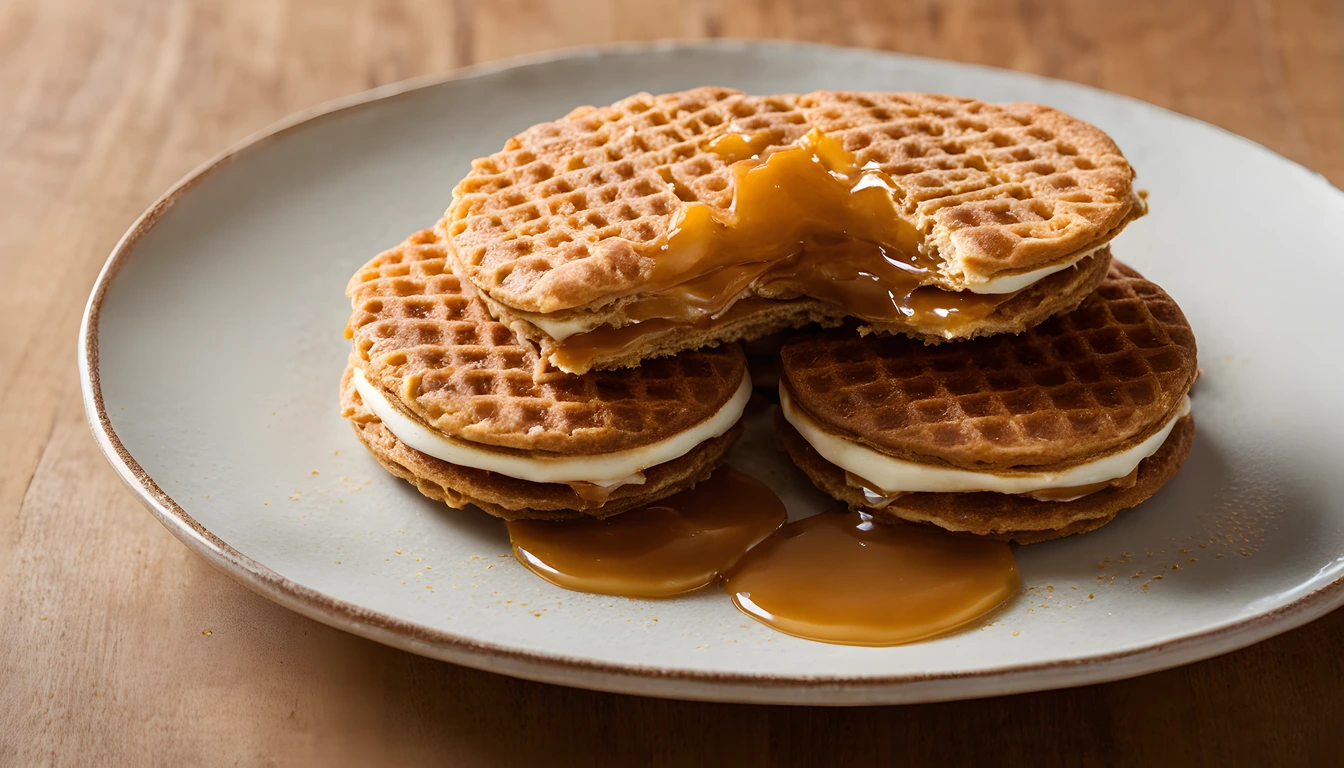
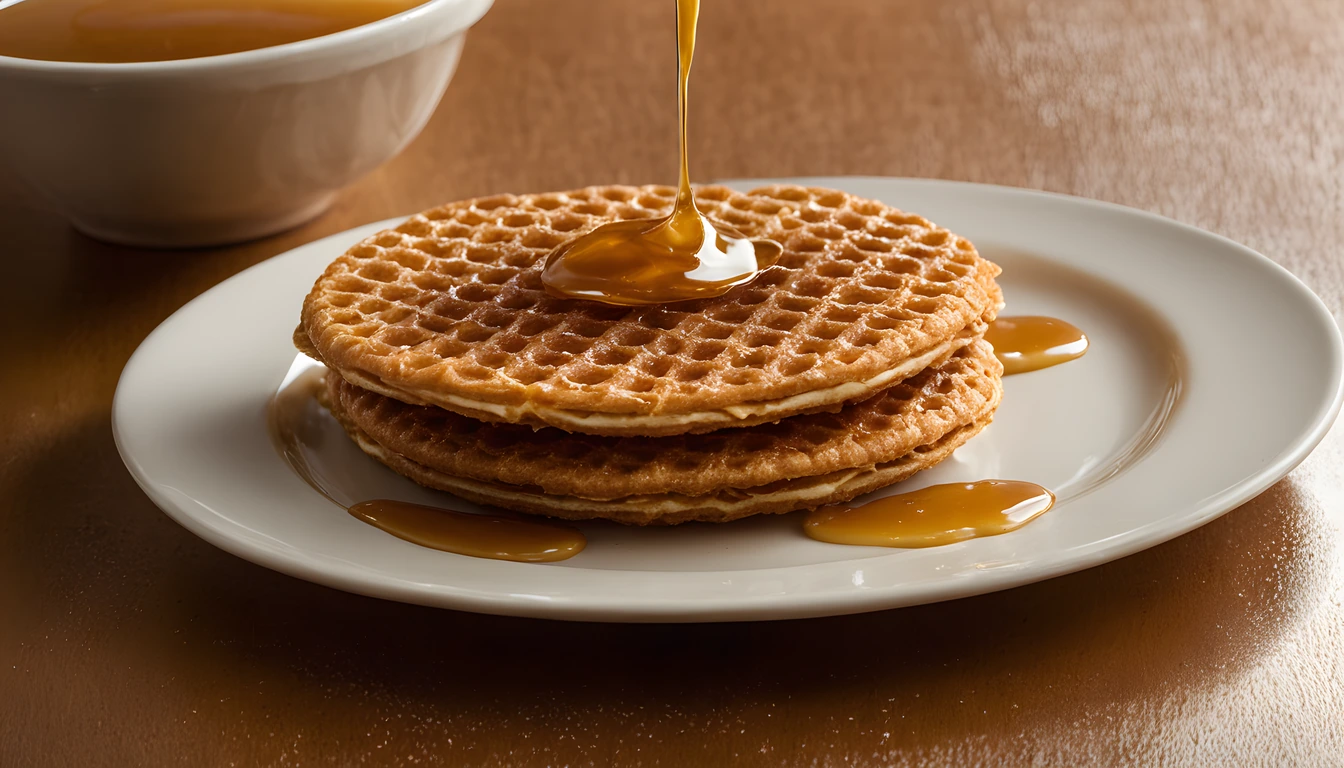
Honey stroopwafels are thin waffle cookies pressed on a grid iron, split open while they are still hot, and sandwiched around a soft honey caramel. The dough is yeast-leavened and rises for an hour, which leaves it slack enough to press thin without tearing.
Timing matters more than the ingredient list. Each wafer has to be split within a minute or two of coming off the iron, while the middle is still soft; once it cools it turns brittle and cracks instead of opening cleanly. The filling has to reach soft-ball stage, or it runs out at the edges rather than sitting in a chewy layer.
Honey goes into both the dough and the filling, so the variety you use sets the flavor. Pale clover or orange blossom keeps the caramel in the background and lets the cinnamon come through; buckwheat takes over the whole cookie.
Recipe
Honey Stroopwafels Recipe
Thin pressed waffle cookies, split while hot and filled with a soft honey caramel. Makes 16 stroopwafels, about 736 g, in about 2 hours 20 minutes.
13Ingredients
Yield: 16 servings
- 250 g all-purpose flour (about 2 cups)
- 105 g honey, for the dough (5 tbsp)
- 57 g unsalted butter, melted (4 tbsp)
- 50 g egg (1 large)
- 61 g whole milk, warmed (2 fl oz)
- 4 g active dry yeast (1 tsp)
- 3 g fine salt (1/2 tsp)
- 1.3 g ground cinnamon (1/2 tsp), for the dough
- 147 g honey, for the filling (7 tbsp)
- 100 g packed light brown sugar (about 7 tbsp plus 1 tsp)
- 57 g unsalted butter, for the filling (4 tbsp)
- 1.3 g ground cinnamon (1/2 tsp), for the filling
- 0.75 g fine salt (1/8 tsp)
Ingredient amounts scale; instructions show the original batch. Cooking times and pan sizes may need adjustment. Season to taste. Honey grams use US measures at 20°C and 17.5% moisture, a density estimate; weigh your honey for precision.
Instructions
- 1Bloom the yeastWarm the milk to about 110°F (43°C), warm on a fingertip but not hot enough to sting. Stir in the yeast and 1 teaspoon of the dough honey and leave 5 minutes. The surface should turn foamy; if it stays flat, the yeast is dead and the dough will not rise. About 5 minutes.
- 2Mix the doughWhisk the flour, salt and 1/2 teaspoon cinnamon in a wide bowl. Add the rest of the dough honey, the melted butter, the egg and the yeast mixture. Stir until no dry flour remains, then knead on a lightly floured counter 4 to 5 minutes, until smooth, soft and barely tacky. About 10 minutes in all.
- 3Let it riseShape the dough into a ball, cover the bowl and leave at room temperature 60 minutes, until roughly doubled. It is ready when a floured finger leaves a dent that fills back slowly.
- 4Heat the ironSet a stroopwafel iron or a shallow waffle iron to medium-high and let it heat 10 minutes. It is ready when a flick of water sizzles and skitters across the plates. Start slightly cooler than you think you need: honey in the dough browns quickly, and a dark wafer turns brittle before it can be split. Brush a nonstick iron with neutral oil once if it looks dry.
- 5Divide the doughDivide the dough into 16 pieces, about 33 g each, and roll them into balls, about 5 minutes. Keep them covered so they do not dry out.
- 6Press and splitPress one or two balls at a time, closing the lid firmly, for 60 to 75 seconds, until deep golden with darker grid lines. Lift each wafer out, wait a few seconds, then split it horizontally with a thin knife and lay the halves open under a clean towel. Press and split all 16, about 25 minutes. The towel keeps them from drying out; a wafer that stiffens can go back in the closed iron for 10 seconds before filling.
- 7Cook the honey fillingPut the filling honey, brown sugar, filling butter, the remaining 1/2 teaspoon cinnamon and the salt in a small heavy saucepan. Warm over medium heat, stirring just until the sugar dissolves and the mixture boils. Stop stirring, clip on a thermometer and cook to 235°F (113°C), about 4 to 6 minutes from the boil. Without a thermometer, drop a little into cold water: it should form a soft ball that flattens when you lift it out. Pour into a warm bowl and set it off the heat; do not leave the pan on the burner. If it firms before you fill, set the bowl in a pan of hot water for a minute and stir once.
- 8Fill the wafersSpread about 18 g (1 tbsp) of the warm filling over one half of each pair, leaving a 1/4-inch border, then press the second half on top. Wipe away filling that pushes out at the edge with a warm knife. Work in batches of four so the wafers stay warm and flexible; one that has stiffened can go back in the closed iron for 10 seconds. About 10 minutes for all 16.
- 9Cool and serveStand the filled stroopwafels on a rack for 10 minutes. The filling firms to a chewy layer and the wafers crisp again. Eat them the same day for the softest center, or let them cool completely for a firmer bite.
Estimated nutrition per serving
187.6 calories · 6.37 g fat · 31.47 g carbohydrate · 2.35 g protein · 100.63 mg sodium
Serving: 1 stroopwafel (about 46 g), 1 of 16 servings
Calculated from ingredient weights and USDA FoodData Central: 168894, 169640, 173430, 171287, 171265, 175043, 173468, 171320, 168833. Estimates use ingredient input weights; actual portions, brands and cooking losses vary. Omitted nutrient values are unavailable, not zero.
What the wafers should look and feel like
A wafer comes off the iron deep golden, with darker lines where the grid pressed hardest. Pale patches mean it needed another 15 seconds. It should be rigid enough to lift with tongs and still soft at the center, not brittle right through.
Split open, the inside is paler and slightly spongy, and that open crumb is what grips the filling. A wafer that shatters under the knife cooled too long; 10 seconds back in the closed iron softens it enough to open.
Flavor intensity is computed from the listed flavor notes of 85 honeys in our catalog: 1 means most are described as mild or light, 5 means most are described as bold or dark. It is a tasting guide, not a laboratory measurement.
Sources: Honey (UC Agriculture and Natural Resources, Cottage Foods); USDA FoodData Central: Wheat flour, white, all-purpose, enriched, bleached; USDA FoodData Central: Honey; USDA FoodData Central: Butter, without salt; USDA FoodData Central: Egg, whole, raw, fresh; USDA FoodData Central: Milk, whole, 3.25% milkfat, with added vitamin D; USDA FoodData Central: Leavening agents, yeast, baker's, active dry; USDA FoodData Central: Salt, table; USDA FoodData Central: Spices, cinnamon, ground; USDA FoodData Central: Sugars, brown.
- Deep golden with darker grid lines
- Firm enough to lift, soft at the center
- Splits into two even rounds without shards
- Pale, slightly spongy interior
Pro Tip
Press one ball as a test and split it before you commit the rest; it tells you more about your iron than any timing chart.
1 = mild, 5 = bold. Editorial pairing guidance, not laboratory measurements; jars vary.
- Clover
- Dough and filling for a mild, cinnamon-forward cookie
- Orange Blossom
- Filling with a citrus edge against the cinnamon
- Wildflower
- All-purpose choice for dough and filling together
- Linden
- Filling with a tea-like note; hold back the cinnamon
- Buckwheat
- Half the filling honey, for a dark malty caramel
Matching a honey to another dish: the honey flavor map
Get the Honey Buyer's Cheat Sheet (free PDF)
16 varieties on one page — color, flavor, best use and what a fair price looks like — from the 304 honeys we track.
Getting the filling to hold
The filling is a honey caramel, and its temperature decides how it behaves in the finished cookie. At 235°F (113°C) it cools to a soft, chewy layer that stays between the wafers. Stop at 225°F and it stays syrupy and leaks; take it past 245°F and it hardens toward candy.
Stir only until the sugar dissolves. Stirring a boiling syrup pulls crystals back into the pan, and a grainy filling spreads unevenly and feels rough on the tongue. Once it reaches 235°F, pour it into a warm bowl and keep it off the burner; a caramel left on the flame climbs past the soft-ball stage while you press the wafers.
- 235°F (113°C) on a thermometer
- A soft ball that flattens in cold water
- Falls from the spoon in a slow ribbon
- Pale amber and glossy, with no sugar grains
Pro Tip
If the filling stiffens before you fill the wafers, set the bowl in a pan of hot water for a minute and stir once; do not put it back on direct heat.
Storage and reheating
Stroopwafels keep well because neither the wafer nor the filling holds much water. A sealed tin at room temperature keeps them for up to a week; they soften slightly on the second day and stay chewy. Keep them out of the refrigerator, where the filling turns grainy and the wafers stale faster.
To bring back a fresh-pressed texture, warm one in a dry skillet over low heat for 15 seconds a side, or rest it on a mug of hot tea for a minute. A few seconds in a microwave softens the wafer rather than crisping it.
- Sealed tin at room temperature: up to 1 week
- Wrapped individually and frozen: up to 2 months
- Dry skillet, 15 seconds a side, to refresh
- Not the refrigerator
Pro Tip
Slip a small square of parchment between stacked stroopwafels you plan to give away; warm filling sticks to whatever it touches.
Choosing the Honey
Use Clover Honey or Wildflower Honey or Orange Blossom Honey for the flavor described in this recipe. See our honey selection guide for other culinary choices.