About This Recipe
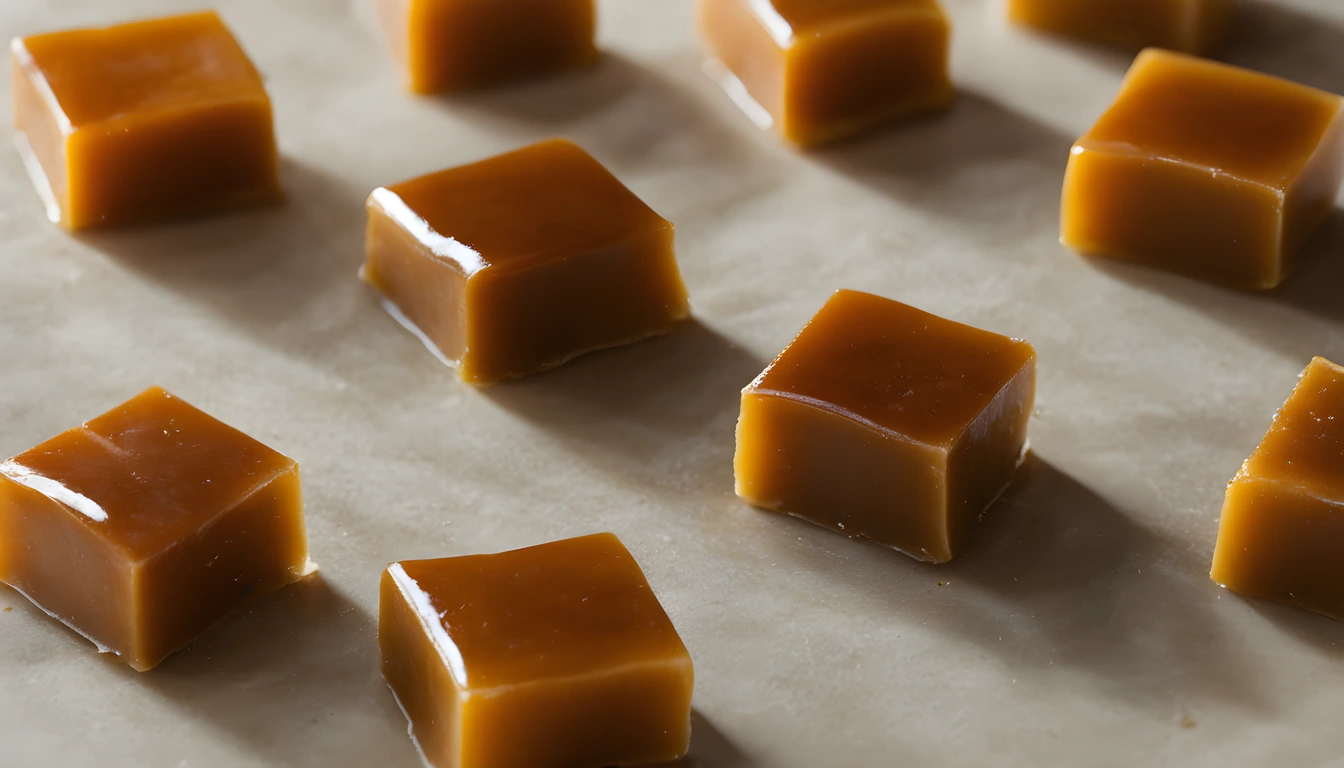
Honey and cream cook into a firm slab that you can slice into small chewy squares. Honey supplies most of the sweetness and carries its own aroma through the butter and vanilla. An 8-inch pan yields 64 small pieces, with two pieces per serving.
Unlike pourable honey caramel sauce, these candies must reach the firm-ball stage. There is no separate step for browning dry sugar: the honey, sugar and dairy cook together. Start with a candy thermometer and a deep saucepan, then allow four undisturbed hours for the poured slab to firm up.
Recipe
Honey Caramels Recipe: Chewy Cut-and-Wrap Cream Candies
Cook honey-and-cream caramels to 246°F, let them set for four hours, then cut and wrap 64 small chewy squares. Includes thermometer and elevation guidance.
6Ingredients
Yield: 32 servings
- 336 g honey
- 100 g granulated sugar
- 240 g heavy whipping cream
- 56 g unsalted butter
- 5 g vanilla extract
- 2 g table salt
Ingredient amounts scale; instructions show the original batch. Cooking times and pan sizes may need adjustment. Season to taste. Honey grams use US measures at 20°C and 17.5% moisture, a density estimate; weigh your honey for precision.
Instructions
- 1Line the panLine an 8-inch square pan with parchment, leaving overhang on two sides. Use parchment only — no greasing agent beyond the liner.
- 2Combine in a deep potUse a heavy 3-quart saucepan; the mixture bubbles up substantially. Add the honey, granulated sugar, cream, butter and salt. Warm over medium heat, stirring, until the sugar dissolves and the butter melts.
- 3Boil to 246FRaise to a steady medium-low boil. Stir constantly, scraping the bottom of the pan, so the cream does not scorch. Clip a thermometer so the tip is fully immersed but not touching the pan bottom. Cook to 246F / 119C at sea level.
- 4Add vanilla off heatPull the pan off the heat and add the vanilla carefully — it will bubble. Stir it in.
- 5Pour and coolPour into the lined pan without scraping down the crystallized sides of the saucepan. Cool undisturbed for 4 hours until firm.
- 6Cut and wrapLift out by the parchment and cut an 8x8 grid into 64 small squares. Wrap each in waxed paper and store airtight, cool and dry.
Estimated nutrition per serving
82.51 calories · 4.13 g fat · 12.01 g carbohydrate · 0.26 g protein · 26.93 mg sodium
Serving: 1 of 32 servings
Calculated from ingredient weights and USDA FoodData Central: 169640, 169655, 170859, 173430, 173471, 173468. Estimates use ingredient input weights; actual portions, brands and cooking losses vary. Omitted nutrient values are unavailable, not zero.
Why the Final Temperature Decides the Chew
A caramel's chew is set by how much water remains, and that is a temperature question, not a color question. At 246F (119C) you are inside the firm-ball band of 244–248F that candy makers use for chewy candies. Pull it lower and the candy leans soft and sticky; push it higher and it heads toward hard and brittle.
Because of that, judge the pan by the thermometer, not by how dark the syrup looks. A honey-and-cream caramel browns gently and can still be pale when it is perfectly done.
Flavor intensity uses an editorial culinary scale: 1 is mild and 5 is bold. These are tasting suggestions, not laboratory measurements.
Sources: Colorado State University Extension: Candy Making at High Elevation; UC ANR: Honey.
- Cook at sea level to 246F / 119C.
- Stay within the 244–248F firm-ball range.
- Let the thermometer, not color, tell you when to stop.
Pro Tip
If the candy is already very dark before it reaches temperature, your heat is too high — lower it and keep scraping.
1 = mild, 5 = bold. Editorial pairing guidance, not laboratory measurements; jars vary.
- Clover
- Mild, buttery caramels
- Wildflower
- Everyday chewing candies
- Orange blossom
- Floral, citrus-leaning caramels
- Buckwheat
- Strong, molasses-like caramels
Get the Honey Buyer's Cheat Sheet (free PDF)
16 varieties on one page — color, flavor, best use and what a fair price looks like — from the 304 honeys we track.
High-Altitude Adjustments
Water boils at a lower temperature as elevation rises, so sugar syrups need lower finish temperatures. Colorado State University Extension gives the rule of thumb: subtract 2F for each 1,000 feet above sea level. At 5,000 feet, that means targeting roughly 236F rather than 246F.
Check the thermometer in boiling water before you begin, using the expected boiling point at your elevation. Account for any instrument error as well as the elevation adjustment; those are separate corrections. Keep the probe immersed in the caramel without letting it rest against the hotter pan bottom.
Pro Tip
A thermometer that reads a few degrees off will shift your chew more than any stirring technique.
Keeping the Cream from Scorching
The bubbles become thicker as water leaves the pan. Keep the heat moderate and move a heatproof spatula across the bottom and into the corners throughout cooking. A heavy pan spreads heat more evenly, but it still needs attention. If brown flecks or a burnt smell appear, the cream may be scorching; extra vanilla will not hide that flavor.
Thirty minutes is a cooking estimate. Use the corrected thermometer endpoint even if your pan takes a different amount of time. After pouring, leave the candy alone to cool; later, humid air can make the cut surfaces tacky, which is one reason to wrap the pieces promptly.
Pro Tip
Have the lined pan and measured vanilla ready before cooking. The finished syrup needs prompt attention.
Cooling, Cutting and Wrapping
Pour the caramel without scraping the crystallized film from the pan sides; those sugar crystals can seed graininess in the candy. Let it sit undisturbed for 4 hours until it is firm enough to cut cleanly.
An 8-by-8 grid makes 64 small pieces; two pieces form one serving. Wrap each square in waxed paper and keep the wrapped candies in an airtight container in a cool, dry place. Use within a week for best quality. This short storage guideline does not establish a long pantry shelf life. Refrigeration makes the candy firmer, so let chilled pieces stand briefly before serving.
Allow about 35 minutes for measuring, lining, cutting and wrapping, in addition to roughly 30 minutes of cooking and four hours of cooling. That gives a total of about 5 hours 5 minutes; a slower cook or a warm room can extend it.
- 64 small pieces from an 8-inch pan.
- Two pieces per serving, 32 servings.
- Wrap individually; store airtight, cool and dry, up to 1 week for best quality.
Pro Tip
Humidity can make unwrapped pieces tacky, so wrap them soon after cutting.
Choosing the Honey
Honey brings both sweetness and flavor here, and its own color carries into the candy. A mild clover or wildflower honey keeps the caramels gentle and golden; a darker buckwheat honey pushes a stronger, more assertive taste.
The small amount of granulated sugar contributes dissolved solids without diluting the honey flavor. Keep the written amounts for this batch: replacing cream with milk or increasing the honey changes the water and fat balance and can change the finished texture.
Pro Tip
Crystallized honey is fine to use — warm it gently so it pours evenly.
Choosing the Honey
Use Clover Honey or Wildflower Honey or Orange Blossom Honey or Buckwheat Honey for the flavor described in this recipe. See our honey selection guide for other culinary choices.