What honeycomb toffee is, and why it has no honeycomb in it
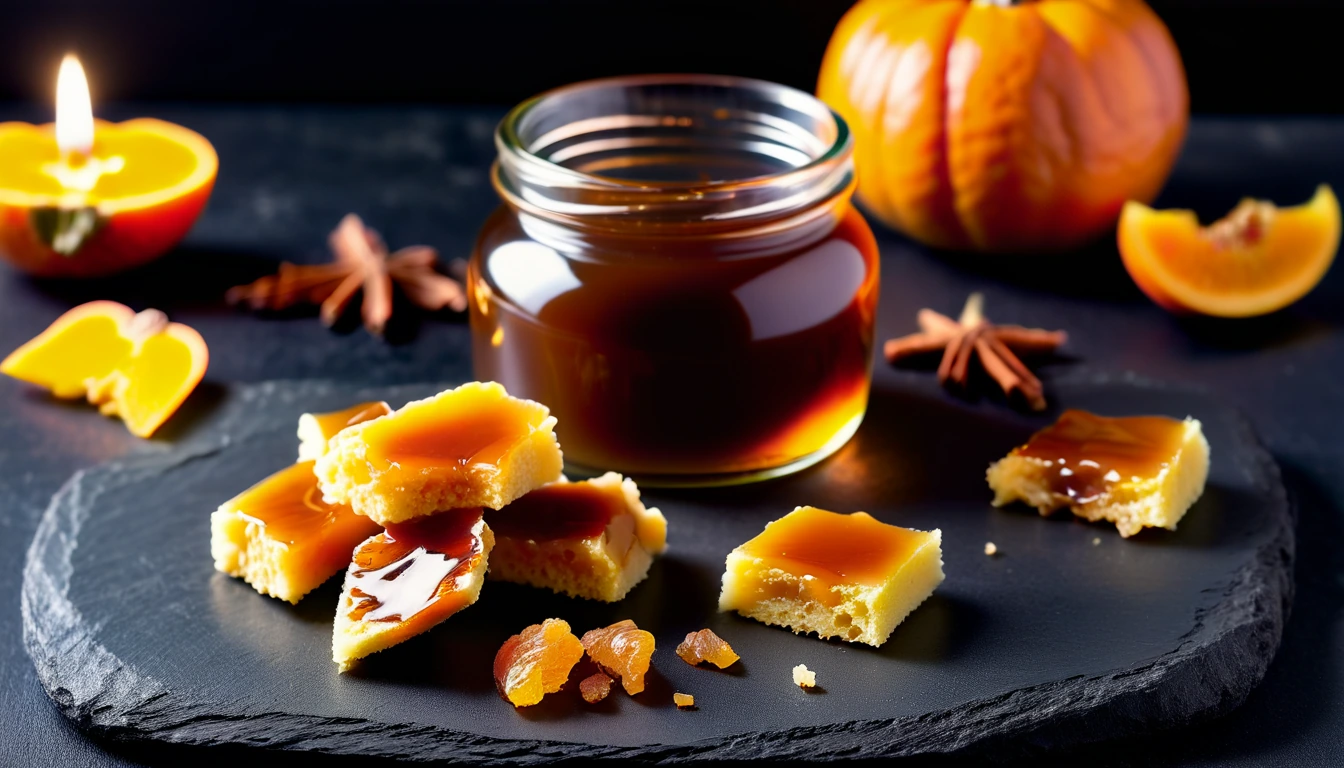
Honeycomb toffee is sugar syrup cooked to 300°F, then foamed with baking soda and left to set. The bubbles freeze in place and you get a crunchy, airy slab that snaps into golden shards. The name comes from the look of the holes. There is no beeswax comb in it; if you want the real thing, see eating honeycomb.
It goes by several names. In Buffalo and western New York it is sponge candy, which began to show up there in the 1940s and 1950s (Taste of Home). In the UK it is cinder toffee, a common Bonfire Night sweet, and Bonfire Night falls on Thursday, November 5, 2026. In New Zealand it is hokey pokey, and hokey pokey ice cream, vanilla with chunks of it, is the country's most popular flavour after vanilla (Te Ara, the Encyclopedia of New Zealand).
It is also an easy Halloween candy: Halloween is Saturday, October 31, 2026. One slab breaks into about 30 pieces, and chocolate-dipped shards pack well into party bags.
The recipe in short
1½ cups (300 g) sugar, ¼ cup (85 g) honey, ¼ cup water and 1 tablespoon of baking soda, cooked to 300°F. These are the proportions of the National Honey Board's Honey Comb Brittle. BBC Good Food's honey version uses 200 g sugar, 100 g honey, 4 tablespoons water and 1 tablespoon bicarbonate of soda, cooked to 149°C, the same temperature in Celsius.
The honey does the job that golden syrup or corn syrup does in other versions: it keeps the sugar from crystallizing into grit as it cooks. It also adds flavour. Use a mild honey, clover, wildflower or orange blossom. A dark honey like buckwheat tastes bitter by the time the syrup reaches hard crack.
You need a candy thermometer and a big saucepan. Everything else is in a normal kitchen.
Get the Honey Buyer's Cheat Sheet (free PDF)
16 varieties on one page — color, flavor, best use and what a fair price looks like — from the 268 honeys we track.
Why 300°F: the sugar stages
As sugar syrup boils, it loses water and gets hotter, and each temperature range sets differently when it cools. The Exploratorium gives the sea-level stages as thread 230–235°F, soft ball 235–240°F, firm ball 245–250°F, hard ball 250–265°F, soft crack 270–290°F and hard crack 300–310°F. Honeycomb needs hard crack. Pull it at 280°F and you get a chewy, sticky slab that never snaps.
Honey changes one thing: colour. Fructose, one of honey's two main sugars, starts to caramelize at 230°F (110°C), against 320°F (160°C) for table sugar (Belitz, Grosch and Schieberle, Food Chemistry). So a honey syrup turns amber well before 300°F. Go by the thermometer, not the colour, and keep the heat at medium so the outside of the pan does not scorch while the middle catches up.
stage range target in this post fructose starts to caramelizeSources: Exploratorium; Belitz et al., Food Chemistry.
How the bubbles form
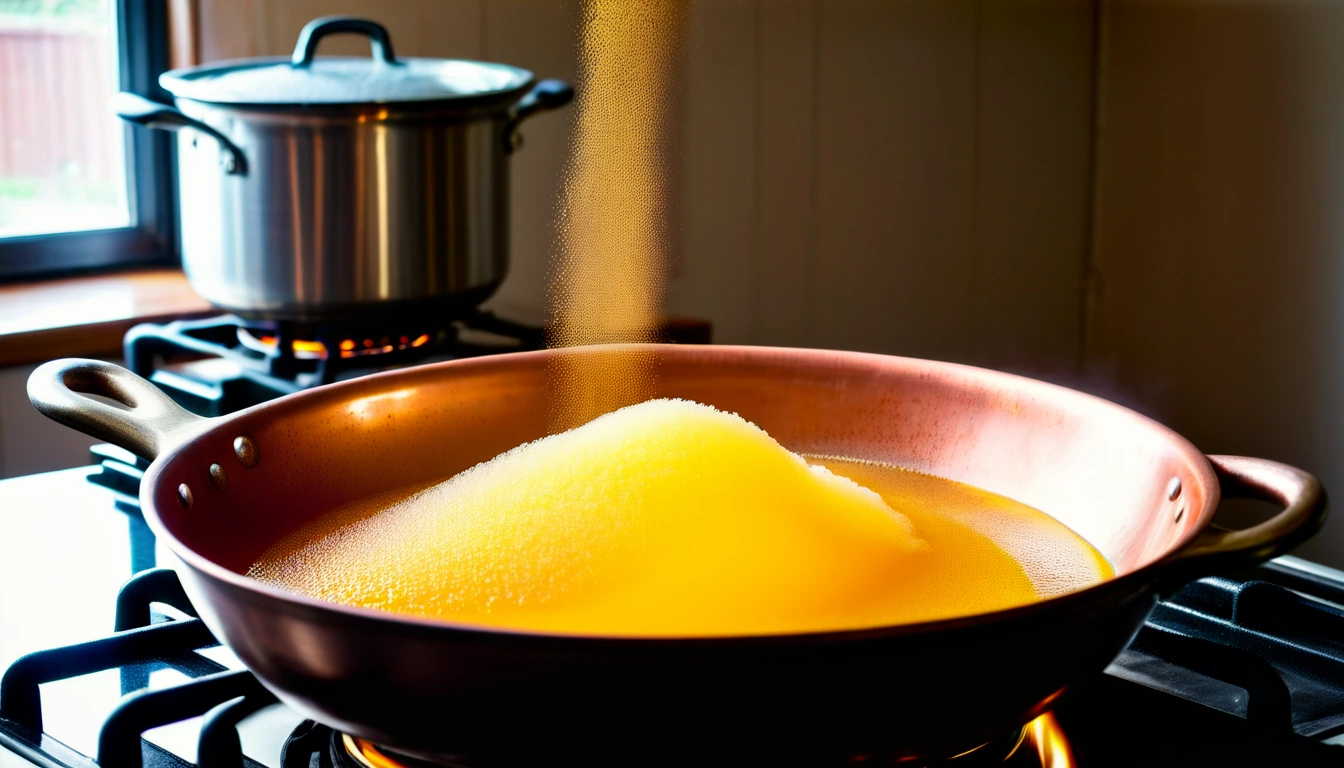
Baking soda is sodium bicarbonate. Above about 176°F (80°C) it starts to break down into sodium carbonate, water and carbon dioxide (Scientific American). Whisked into 300°F syrup, it releases its gas all at once, and the syrup is setting as it foams, so the bubbles stay.
That is also why the two technique rules matter. Whisk for only 3 to 5 seconds: longer and you beat the gas out. Pour and leave it: spreading the foam in the pan pops the bubbles you just made. Sift the baking soda first, because a lump of it leaves a bitter, soapy spot in the finished candy.
Making it at altitude
Water boils at 212°F at sea level and cooler as you go up, and sugar syrup reaches each stage at a lower reading too. Colorado State University Extension's rule: reduce the recipe temperature by 2°F for every 1,000 feet above sea level. In Denver, at 5,280 feet, that puts hard crack at about 289°F.
The more exact method, from New Mexico State University Extension: boil a pan of water, read your thermometer, and lower the recipe temperature by the difference between that reading and 212°F. It also catches a thermometer that reads a few degrees off at sea level. The calculator below does both.
Your candy temperature
Water boils cooler the higher you live, so sugar reaches each stage at a lower reading. Enter your altitude, or boil water and enter what your thermometer shows.
No change: use the recipe temperatures.
Honeycomb toffee
300 °F
149 °C · recipe says 300 °F
Honey caramel for apples
250 °F
121 °C · recipe says 250 °F
| Stage | Sea level | Yours | Used for |
|---|---|---|---|
| Thread | 230–235 °F | 230–235 °F | syrups |
| Soft ball | 235–240 °F | 235–240 °F | fudge, fondant |
| Firm ball | 245–250 °F | 245–250 °F | caramels |
| Hard ball | 250–265 °F | 250–265 °F | nougat, marshmallow |
| Soft crack | 270–290 °F | 270–290 °F | taffy, butterscotch |
| Hard crack | 300–310 °F | 300–310 °F | toffee, brittle, honeycomb |
Stages: Exploratorium. Altitude: Colorado State University Extension (2 °F lower per 1,000 ft). Boiling-water method: New Mexico State University Extension E-215.
Honey caramel apples: the other Halloween candy
Caramel for apples stops far below hard crack, because it has to bend, not snap. Sue Bee Honey's honey caramel apples use 1¼ cups honey, 1 cup heavy cream, 2 tablespoons butter and ½ teaspoon sea salt, cooked to 250°F, for 6 apples. Local Hive's version, 1 cup honey to 1 cup cream, goes to 260°F for a firmer coat.
Both are honey-and-cream caramels, so they need a thermometer and a steady hand on the heat just like the toffee. The calculator below gives your caramel-apple temperature at altitude too. For a no-thermometer version, honey caramel sauce makes a 15-minute dip for apple slices.
When it goes wrong
Most honeycomb failures come from temperature, timing or air.
- Chewy or sticky: the syrup did not reach 300°F (or your altitude's hard crack), or the candy sat out in humid air. Store it airtight.
- Flat and dense: whisked too long, or spread in the pan after pouring.
- Bitter, soapy spots: lumps of baking soda. Sift it.
- Burnt taste: the syrup went past deep amber. Honey browns early; keep the heat at medium.
- Grainy: the syrup was stirred after it started boiling, or sugar crystals on the pan wall fell back in. Swirl, do not stir.