What coffee blossom honey means
Coffee blossom honey is honey made by bees using nectar from the flowers of coffee plants, the genus Coffea. The name identifies a botanical source. Coffee-flower honey is another way of describing that source; coffee-infused or coffee-flavored honey describes a product to which a coffee ingredient or flavor has been added. Those are different things to buy, even when their jars share pictures of coffee plants.
The distinction starts before the honey reaches the kitchen. Flower nectar is the material bees collect for blossom honey. Coffee beans used for brewing are a different part of the plant. A coffee-blossom label therefore does not promise the aroma, bitterness or flavor of roasted coffee. It also does not tell you whether a particular jar will suit your taste.
Our coffee blossom honey profile is the catalog reference for the variety. This guide explains how to read the ingredient and origin claims across producers, then separates those claims from laboratory findings. The most useful purchase question is simple: what does the producer mean by coffee, and what information supports that meaning?
Follow the flower or the added flavor
Read the full product name and description before relying on the front-label artwork. “Honey from coffee blossoms” describes the bees’ nectar source. “Honey with coffee extract” describes an added ingredient. “Coffee honey” on its own leaves the distinction unresolved. If the online listing does not show the back label, ask for a photograph or a complete ingredient description.
In the United States, FDA’s honey-labeling guidance distinguishes single-ingredient honey from honey containing flavor ingredients. It explains that a flavored product needs an appropriate descriptive name and declaration of its ingredients. It also says that a package containing only honey does not need an ingredient statement. An absent ingredient list on a US jar is therefore not, by itself, evidence of a problem.
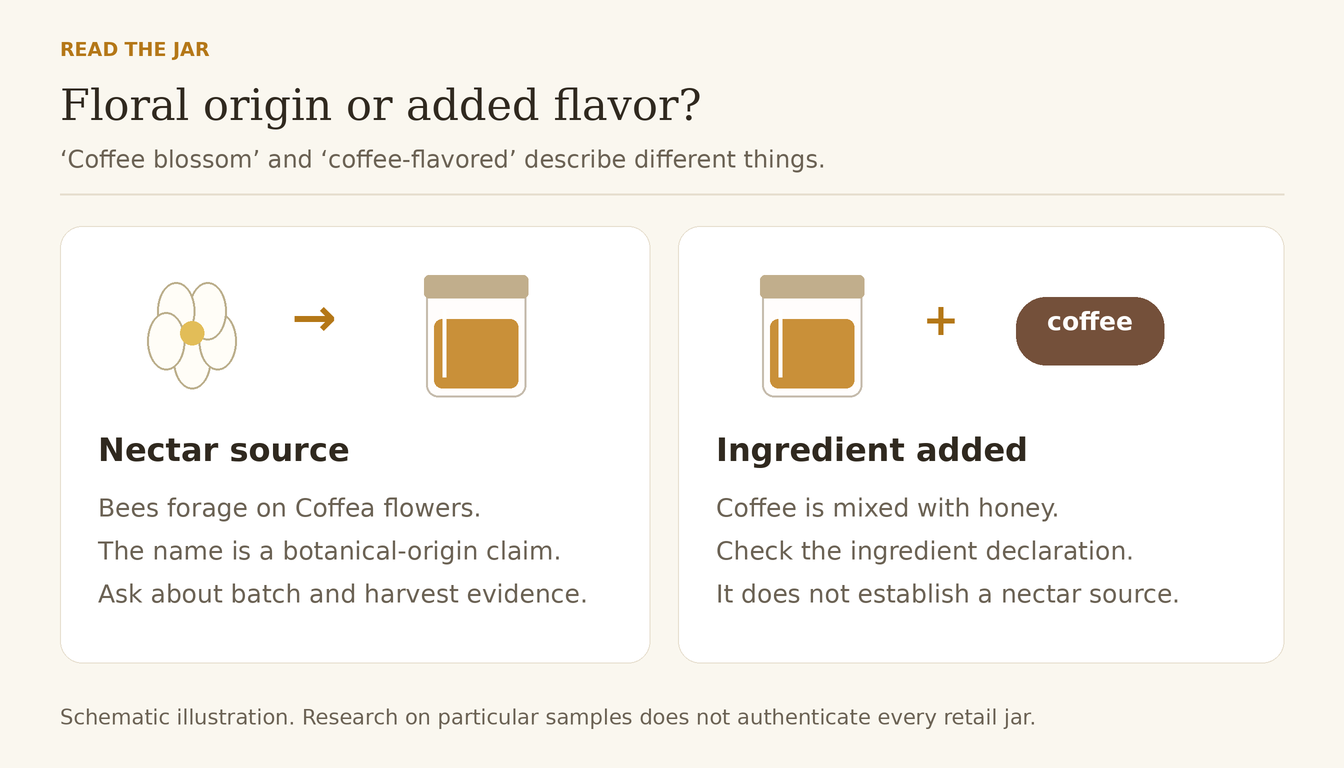
A clearly described coffee-flavored product can be a sensible choice if added coffee flavor is what you want. If you want to explore a floral-source honey, ask specifically whether coffee extract, beans, grounds or flavoring were added. The illustration below shows the two routes; the same distinction is written out here so you do not need the image to follow it.
- Botanical source: a Coffea flower supplies nectar, bees make honey, and the producer describes that floral origin.
- Added flavor: honey is already made, then a coffee ingredient or flavoring is incorporated into the product.
Get the Honey Buyer's Cheat Sheet (free PDF)
16 varieties on one page — color, flavor, best use and what a fair price looks like — from the 268 honeys we track.
A coffee farm is context; a floral claim needs support
An apiary on a coffee farm and a jar described as coffee-blossom honey make different claims. The first tells you where the hives were placed. The second says something about the source of the honey. A farm photograph, a coffee-growing region or the beekeeper’s proximity to coffee plants can explain the production setting without independently establishing the botanical composition of a harvested lot.
For a floral name on US honey, FDA’s guidance says the producer or seller should have information supporting the named plant as the chief floral source, and the claim must be truthful. Read “monofloral” as a claim that one floral source predominates, rather than a promise that every drop of nectar came from one plant. Ask how the producer supports that description for the batch on sale.
Useful support might include harvest records tied to the apiary and a botanical analysis of the relevant honey. These answer different questions and are stronger when they can be connected to the same lot. A detailed farm story is helpful context; a lab report is helpful analytical evidence. Neither becomes more informative merely because the label adds words such as rare, premium or exclusive.
Separate place, harvest and batch information
Look for a statement of where the honey was produced, then distinguish it from where it was packed or sold. A shop address gives you a contact point. A packing location explains one stage of handling. Neither, on its own, identifies the place where bees made the honey. If a product claims a particular country, region or farm, ask which part of the sourcing chain that name describes.
A harvest date and a lot code also serve different purposes. The date supplies a time reference. The code lets you connect your jar to the producer’s records and any supporting report. “Single origin” is more useful when the seller defines the unit of origin: one country, one region, one farm or one apiary. Ask whether honey from several harvests or producers is combined within that description.
A hypothetical label reading “coffee-blossom honey, produced in a named region, harvest 2026, lot CB-04” gives you four specific points to follow up. It does not itself verify them. For regional context, explore our Colombia honey guide and Vietnamese honey guide. Country context helps you understand a place; documentation tied to the jar helps you assess the particular purchase.
What the botanical research actually measured
A 2015 preliminary Coffea-honey study proposed a method using proton nuclear magnetic resonance, or 1H NMR. Researchers analyzed diluted honey to quantify caffeine, theobromine and trigonelline, among other compounds. They reported a strong correlation between these chemical markers and the relative amounts of Coffea pollen measured in the same samples. They proposed the concurrent presence of the three compounds as an indicator of botanical origin.
That study connects two kinds of evidence: a chemical pattern and pollen observations. Its conclusion is a proposed botanical indicator, rather than a certificate covering every honey sold under the name. A retail claim such as “NMR tested” needs more detail: what sample was tested, what question the method addressed, and what the report actually concluded.
A 2016 study in Espírito Santo, Brazil characterized blended honey obtained from three Coffea arabica crops, each with ten colonies of Africanized Apis mellifera. The authors reported Coffea arabica pollen proportions of 75–78% in their honey samples. Their study included pollen, physicochemical, nutritional, mineral and caffeine analyses.
The crop and colony description explains the study’s production setting; it is not a survey of thirty independently purchased retail jars. Likewise, 75–78% is a finding for those samples, not a universal pollen percentage that buyers can apply as a pass-or-fail rule for coffee-blossom honey. Keep the measured result attached to its sample set.
Does coffee blossom honey contain caffeine?
Caffeine was measured in the honey studied in the Brazilian paper. The authors reported 12.02 ± 0.81 mg/kg for their coffee honey. That is a concentration reported for the study material, expressed as milligrams per kilogram of honey. It is not a declared caffeine amount for an unrelated jar, and the number after ± should not be read as the range of all coffee-blossom honeys. Read the study abstract.
The practical conclusion is that coffee-blossom honey should not automatically be assumed caffeine-free. The finding also does not establish a predictable caffeine dose for the category. Without a result for your lot, a calculation for a spoonful or a comparison with a cup of coffee would still leave the amount in your own honey unverified.
If the caffeine content matters to your purchase, request a result for the product’s lot rather than a link to a coffee-honey paper. Ask for the units, the analytical method and the laboratory’s reporting limit. A statement such as “not detected” needs that limit to be interpretable. A floral name, a raw-honey claim or a description of the farm does not supply a caffeine measurement.
Make a laboratory report useful to the purchase
A laboratory report is most useful when you can follow it back to the jar. Start with the sample identifier and the producer’s lot code. If they differ, ask the seller to explain the connection. Check the report date, the laboratory’s name, the test performed and the stated result. A report for an earlier harvest may explain the producer’s process, but it leaves the current lot’s result unanswered.
Keep the question narrow. A caffeine measurement answers a composition question. A pollen analysis examines the pollen present. A botanical interpretation combines relevant findings to address floral origin. A result for moisture or another general quality parameter answers its own question; it should not be presented as proof of coffee-flower origin simply because the report concerns honey.
You do not need to diagnose a spectrum or count pollen yourself. Ask the seller for the laboratory’s conclusion in plain language and the scope of the test. If a report contains several measurements, identify which one supports the claim you care about. If no report is available, you can still assess the producer’s records and explanations, while recognizing that you have not been shown independent analytical support for the claim.
A buyer’s checklist for coffee blossom honey
Use these questions before paying extra for a named floral source. They work for a direct beekeeper purchase, a specialty shop or an online listing. A specific answer is more useful than a long description that never identifies the honey being sold.
- Product identity: does coffee mean flower nectar, or an ingredient added to honey? Read the complete name and ingredient information.
- Botanical claim: is the product described as coffee-blossom, predominantly coffee-flower or a broader mixed-flower honey? Ask what supports that wording.
- Production origin: which country, region, farm or apiary is claimed, and is that where the honey was produced?
- Harvest and lot: can the seller identify the harvest and connect the jar’s lot code to their sourcing records?
- Analytical evidence: if testing is advertised, does the available report concern this lot and the particular claim being made?
- Caffeine wording: if a content claim is important to you, is there a lot-specific result with units and a reporting limit?
- Buying fit: is a small jar available, and does the sourcing information justify the premium for your intended use?
Pro Tip
A concise message to the seller: “Is this honey made from coffee-flower nectar, with no added coffee ingredient? Where was it produced, what is the harvest and lot, and what supports the floral claim for this batch?” For other label terms, see how to read a honey label.
Try it in the kitchen without assuming a tasting profile
Buy a small quantity first if you are exploring the variety. Try a little on plain bread or stir it into plain yogurt, then decide what you notice and whether you enjoy it. To compare two jars, use the same food and similar amounts. This is a way to make your own preference visible; it is not a home test of floral authenticity.
You can also try it as the honey sweetener in tea or coffee. Start with a small amount and adjust to taste. Keep the beverage and other ingredients consistent if you want to compare it with a honey you already use. The fact that the nectar came from a coffee plant does not establish that it will be the best match for brewed coffee.
For a dressing or glaze, test a small portion before committing the whole jar. Whether a specialty honey is worth using in a strongly flavored recipe is your decision about taste and cost. If you enjoy it most on bread, keep the jar for that purpose. Choose the product for its clear identity, the evidence behind its source claim and how you find it works in your own kitchen.