Vietnam in the World Honey Map: Scale, Export Dependence, and Two Different Honey Economies
Vietnam is one of the largest honey-producing countries in Asia, with annual production in the range of 55,000–65,000 metric tons according to the Vietnam Beekeepers Association (Hội Nuôi ong Việt Nam, VBA) and the Ministry of Agriculture and Rural Development (Bộ Nông nghiệp và Phát triển nông thôn, MARD). The overwhelming majority of that output — typically 85–95% by volume — is exported, making Vietnam one of the most export-dependent honey industries in the world. The single largest export market is the United States, which has historically purchased roughly half of Vietnamese honey output at commodity price points for industrial use (baking, cereals, sports nutrition, foodservice). The domestic Vietnamese premium market is real but much smaller, and the gap between the two — export commodity on one hand, artisan single-origin on the other — is the central tension that shapes any serious Vietnamese honey guide.
This split is unusually stark. The export industry is built on Apis mellifera in migratory commercial operations, concentrated in the Central Highlands (Tây Nguyên) for coffee, rubber, and cashew blossom flows and in the Mekong Delta for cajuput and longan flows. The premium domestic market is built on three very different things: (1) the U Minh cajuput honey tradition of Cà Mau and Kiên Giang provinces, which uses wild and semi-wild Apis dorsata colonies attracted to hand-placed rafters in the Melaleuca mangrove forests; (2) wild Apis dorsata cliff and forest honey (mật ong rừng) harvested from free-hanging combs in Central Highlands and Mekong forests; and (3) named regional Apis mellifera monoflorals — particularly Đắk Lắk coffee-flower honey and Hưng Yên longan honey — produced by small cooperatives who have deliberately stepped outside the commodity export channel.
For comparison with other regional honey traditions this guide references, see our Chinese honey guide, the Japanese honey guide, the South Korean honey guide, the Indian honey guide which covers the closely related Himalayan Apis dorsata cliff-honey tradition, the Ethiopian honey guide for another coffee-forest honey story, and the broader World Honey Guide.
Three Bees, Not One: Apis mellifera, Apis cerana indica, and Apis dorsata
Understanding Vietnamese honey requires understanding that three distinct honeybee species are actively producing honey in Vietnam — far more ecologically complex than a country with a single dominant managed species. The first is Apis mellifera (the European honeybee), introduced to Vietnam primarily after 1975 and now the basis of the commercial export industry. Within Vietnam, the dominant subspecies is A. m. ligustica (the Italian bee), managed in Langstroth hives in migratory commercial operations that truck colonies between the Central Highlands coffee bloom (February–April), the Mekong Delta cajuput and longan flows (November–March), and northern lychee and rubber flows. A. m. ligustica is well-suited to Vietnam's warm climate and produces the high per-colony yields that make the export industry economically viable; it is the species behind essentially all coffee, rubber, longan, lychee, and cashew monofloral honeys described later in this guide.
The second is Apis cerana indica — the Indian race of the Asian honeybee, known in Vietnamese as ong nội or ong mật Việt Nam. A. c. indica is native to Vietnam and is a sister population to the Apis cerana cerana of southern China (see the Chinese honey guide) and Apis cerana koreana of Korea; genetic and morphometric studies (Radloff et al., 2010; multiple Southeast Asian research groups) place the Vietnamese population as a distinct regional member of the A. cerana species complex. Like its East Asian relatives, A. c. indica is smaller-bodied than A. mellifera, produces smaller colonies, shows strong Varroa resistance, has a strong absconding tendency, and has been largely displaced for commercial honey production. A small but growing traditional-and-specialty sector — particularly in northern mountain provinces (Hà Giang, Lào Cai, Cao Bằng) and in parts of the Central Highlands — uses A. c. indica in simple box and log hives to produce a dark-amber polyfloral honey with considerable aromatic complexity, sold in Vietnamese specialty retail as mật ong ong nội or mật ong bản địa (native honey).
The third and most culturally distinctive is Apis dorsata, the giant honeybee — known in Vietnamese as ong khoái (or ong ruồi for the smaller A. florea, which also occurs in Vietnam but is not a major honey source). A. dorsata is a wild, unmanaged species that builds massive single-comb open-air nests on the undersides of tree branches, cliff faces, and — uniquely to the U Minh region — on horizontally placed wooden rafters (see the gác kèo ong section below). A. dorsata colonies can contain 30,000–100,000 bees, produce large combs weighing 5–20 kg, and perform dramatic long-distance migratory movements between dry-season and wet-season ranges. The honey is typically harvested once or twice per season by cutting away the honey portion of the comb and pressing it — a process very close to what produces Himalayan A. dorsata cliff honey (see our Indian honey guide) but in the Mekong Delta cajuput-forest ecosystem rather than in high-altitude rhododendron forests. The resulting honey is Vietnam's most prized and is genuinely produced by wild bees, not domesticated ones.

Get the Honey Buyer's Cheat Sheet (free PDF)
16 varieties on one page — color, flavor, best use and what a fair price looks like — from the 304 honeys we track.
U Minh Cajuput Honey (Mật Ong Tràm U Minh) — The Flagship Vietnamese Monofloral
U Minh cajuput honey — mật ong tràm U Minh in Vietnamese, sometimes translated as "U Minh Melaleuca honey" — is the single most convincing answer to the question "what is a world-class Vietnamese honey?" It is produced in the U Minh region of the southwestern Mekong Delta, comprising U Minh Thượng National Park in Kiên Giang Province and U Minh Hạ National Park in Cà Mau Province. Together these protected areas preserve one of the largest remaining Melaleuca cajuputi (cajuput) mangrove-forest ecosystems in continental Southeast Asia, on peat soils that support a very specific wet-forest flora. Cajuput is the dominant tree — locally called cây tràm — and produces a prolific nectar flow during the November–March dry season that is the biological engine of the entire U Minh honey industry.
The U Minh bloom is long by Southeast Asian monofloral standards — roughly four to five months of progressive cajuput flowering — and the resulting honey has a botanical signature that is immediately recognizable. Authentic U Minh cajuput honey is pale golden to light amber (somewhat darker during the late bloom), with a distinctive aromatic profile: a cool medicinal-eucalyptol top note (cajuput oil is the traditional source of eucalyptol/1,8-cineole, and trace amounts carry through into the honey) over a medium-sweet, slightly resinous base and a long clean finish with a subtle menthol-like cooling sensation. The eucalyptol signature is what distinguishes U Minh cajuput from other light-amber Southeast Asian honeys and is the closest thing to a single-molecule flavor identifier in the Vietnamese premium category. Pollen analysis (melissopalynology) of authentic product typically shows Melaleuca pollen as the dominant fraction, well above the thresholds used in European monofloral labeling traditions.
Physicochemically, U Minh cajuput honey shows a characteristic profile: water content commonly 19–22% (relatively high by temperate-honey standards but normal for wet-tropical monoflorals — an important point when evaluating against Codex Alimentarius CXS 12-1981 tolerances), moderate electrical conductivity in the 0.3–0.6 mS/cm range (below chestnut, above acacia), F/G ratio around 1.1–1.3 producing slow crystallization (authentic samples typically remain liquid for 6–12 months at ambient tropical temperatures), and measurable diastase activity consistent with raw unheated product. Prices inside Vietnam for authenticated U Minh cajuput honey from named Cà Mau or Kiên Giang cooperatives have no dated retail price cited here. Wild gác-kèo product is the scarcer of the two. In international specialty channels, single-origin U Minh cajuput honey is rare and typically commands a significant premium when available.
Gác Kèo Ong: The 300-Year Rafter-Beekeeping Tradition
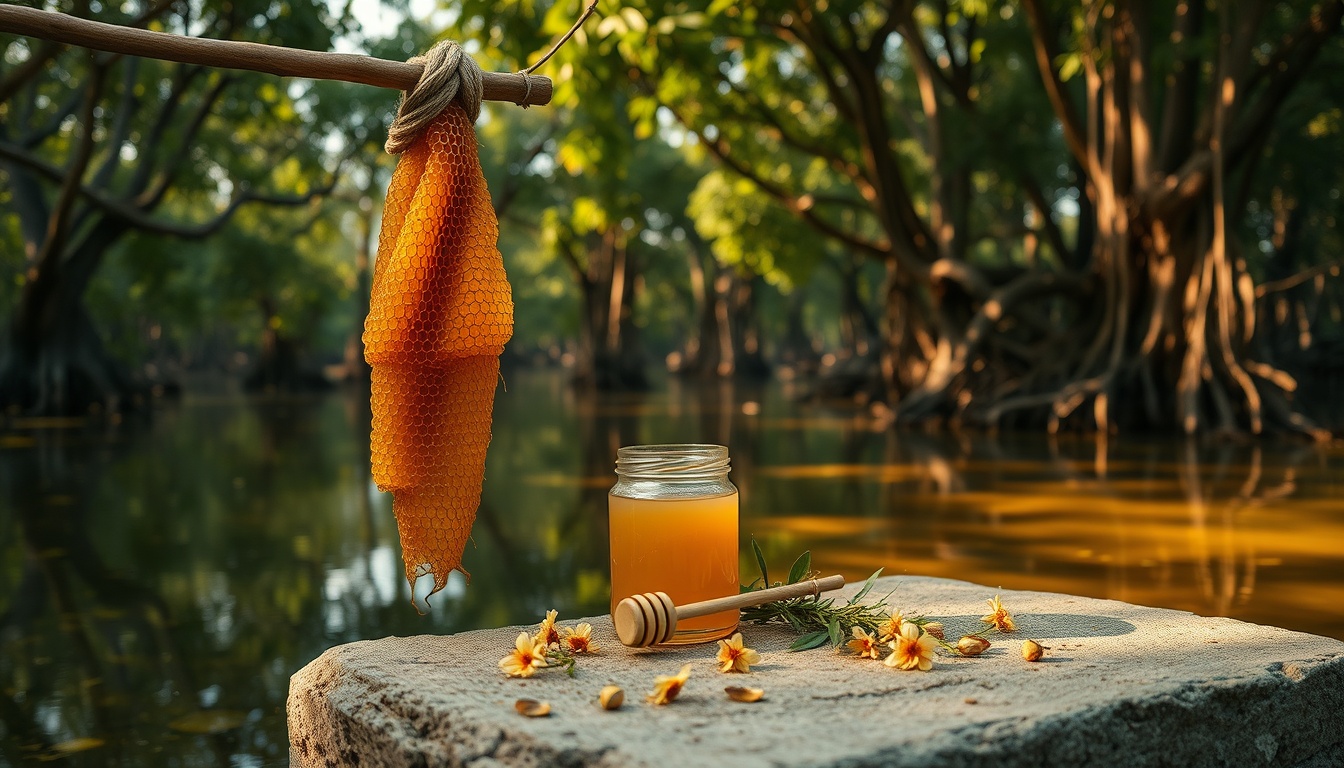
What makes U Minh cajuput honey genuinely unique, beyond the cajuput botany itself, is the production method — a centuries-old practice called gác kèo ong (literally "placing bee rafters") that has no real parallel in the rest of the world honey map. Gác kèo ong is neither modern apiculture nor pure wild harvesting: it is a wild-attraction system in which beekeepers cut long straight branches of cajuput or similar forest hardwood, trim them to specific dimensions (typically 2–3 m long), treat them with a traditional preparation, and suspend them in carefully chosen orientations in the forest — typically under a light-dappling canopy opening, roughly 1.5–2.5 m above the forest floor or water surface, at a precise downward angle calculated to match A. dorsata's preferred comb-attachment sites. The colonies then locate, colonize, and build their open-air combs on these hand-placed rafters, and beekeepers return during the honey-flow window to harvest the honey portion of the comb while leaving the brood intact — a sustainable semi-wild harvest model that has been practiced in U Minh for more than 300 years.
The tradition is documented historically to the 18th-century Khmer-Vietnamese southern frontier and is recorded in ethnographic literature, local chronicles, and more recently in Vietnamese academic beekeeping research. In 2020 the Vietnamese Ministry of Culture, Sports and Tourism formally inscribed nghề gác kèo ong của người U Minh — the U Minh rafter-beekeeping craft — on the National List of Intangible Cultural Heritage (Di sản Văn hóa Phi vật thể Quốc gia), the national-level precursor to a UNESCO intangible-heritage submission. The inscription recognizes both the technical knowledge (rafter selection, orientation, siting, harvest methods) and the embedded traditional ecological knowledge about A. dorsata behavior, forest succession, and sustainable harvest timing. It is one of only a handful of globally recognized wild-honey traditions with formal cultural-heritage protection, alongside the Gurung and Kulung Himalayan honey-hunting traditions in Nepal (see our Indian honey guide for the broader Himalayan context).
For consumers, the practical implication is that "U Minh honey" covers a range from fully-commercial Apis mellifera cajuput production (which is also genuine U Minh cajuput honey — the Melaleuca nectar is the same) through to the premium gác-kèo–produced wild A. dorsata product. Labels should distinguish these: mật ong nuôi (apiary-produced A. mellifera) versus mật ong rừng gác kèo or mật ong ruồi U Minh (wild A. dorsata gác kèo product). The wild product is typically pressed rather than centrifuged, carries a slightly different aromatic profile (more pronounced forest-resin notes from the open-air comb aging process), and is the one most often produced by craftsperson beekeepers registered under the provincial gác kèo ong heritage programs. Named U Minh cooperatives and individual heritage beekeepers in Cà Mau's U Minh Hạ district and Kiên Giang's U Minh Thượng district are the primary authenticated supply chain.
Central Highlands Coffee-Flower Honey (Mật Ong Hoa Cà Phê) — The Sleeper Premium
Vietnam is the world's second-largest coffee producer (after Brazil) and by a wide margin the largest Robusta coffee producer, with approximately 600,000–700,000 hectares of coffee under cultivation, concentrated in the Central Highlands provinces of Đắk Lắk, Gia Lai, Lâm Đồng, Đắk Nông, and Kon Tum. Robusta coffee (Coffea canephora) produces short, intense flowering cycles — typically two to four distinct blooms per year, triggered by post-dry-season rainfall, with the main flow concentrated in February and March. Each bloom lasts only 3–7 days at the individual-plant level but sweeps progressively through the landscape over 3–4 weeks. This creates one of the most productive and shortest monofloral flows in Vietnamese beekeeping, and is the economic engine of the Central Highlands Apis mellifera industry — a substantial share of Vietnam's national export honey originates from the coffee bloom.
Sensorially, Vietnamese coffee-flower honey (mật ong hoa cà phê) is pale golden to medium amber depending on the fraction of non-coffee pollen (intercropped pepper, avocado, macadamia, and wildflower can all contribute), with a distinctive aromatic profile that serious Vietnamese honey enthusiasts describe as "coffee-flower floral without coffee bitterness" — a delicate sweet-floral top note reminiscent of jasmine and orange blossom, a medium-full sweet base, and a subtle spicy finish that is the most recognizable single marker. It is nothing like drinking-coffee flavor — coffee-flower honey is not coffee — but carries a faint warm-spice character that is its own signature. Physicochemically, authentic coffee-flower honey shows water content around 17–19%, moderate electrical conductivity, and a characteristic pollen spectrum with Coffea canephora as the dominant fraction.
The commercial reality is that most Vietnamese coffee-flower honey is sold into the export commodity channel where it is blended with other origins and loses its single-origin character. A growing premium domestic tier — small cooperatives in Đắk Lắk (notably the Buôn Ma Thuột area) and Lâm Đồng — has begun bottling single-harvest single-origin coffee-flower honey with clear labeling, harvest year, and producer identification. This tier is roughly comparable in flavor distinctiveness to the Ethiopian coffee-forest honey tradition covered in our Ethiopian honey guide (though the botanical context differs — Ethiopian coffee-forest honey is produced from wild Coffea arabica in shade-grown forest systems, while Vietnamese coffee-flower honey is from cultivated C. canephora in monoculture plantations). For consumers outside Vietnam, single-origin Central Highlands coffee-flower honey is uncommon in retail but worth seeking out from Vietnamese specialty importers — the combination of a genuine botanical distinctiveness and the world's largest Robusta production base makes it one of the most under-rated Asian monoflorals.

Longan, Lychee, Rubber, and Cashew: The Regional Monoflorals
Beyond the two headline premium categories, Vietnamese Apis mellifera beekeeping produces a wide range of regionally specific monofloral honeys that deserve consumer-guide treatment. Four stand out. Longan honey (mật ong nhãn) comes from Dimocarpus longan, the longan tree — closely related to lychee and rambutan and traditionally cultivated at large scale in the Red River Delta provinces, particularly Hưng Yên (whose longan cultivation dates to imperial-tribute production for the Nguyễn dynasty court). The longan bloom occurs in March–April and produces a light-to-medium amber honey with a characteristic rich sweet-fruited aroma — Vietnamese tasters describe it as "honey that tastes like dried longan" (mật ong có vị nhãn khô) — and a long warm finish. Hưng Yên longan honey (mật ong nhãn Hưng Yên) is the most culturally prestigious regional Vietnamese monofloral and carries a Vietnamese geographical-indication (chỉ dẫn địa lý) registration administered through the National Office of Intellectual Property (NOIP), which functions similarly in intent to European PGI designations.
Lychee honey (mật ong vải) from Litchi chinensis is produced primarily in Bắc Giang and Hải Dương provinces in the Red River Delta, from the same lychee cultivation base that supplies Vietnam's large fresh lychee export industry. The lychee bloom is short (typically two to three weeks in March) and produces a pale amber honey with a pronounced lychee-floral aroma and a clean short-to-medium finish. It is closely related in character to Chinese lychee honey (see our Chinese honey guide) — the botanical species is identical and the honey profiles are similar. Rubber honey (mật ong cao su) from Hevea brasiliensis extrafloral nectaries is a large-volume southern-Vietnamese commodity monofloral produced from the rubber-plantation belt in Bình Phước, Đồng Nai, Bình Dương, and Tây Ninh. Hevea nectar comes from extrafloral nectaries on young leaves rather than from true flowers, which is an ecologically unusual honey source; the resulting honey is light-colored, mild, and crystallizes readily — the Vietnamese workhorse bulk-commodity honey that forms much of the US-export base.
Cashew honey (mật ong điều) from Anacardium occidentale is produced in the Southeast Region (Đông Nam Bộ) and is a significant commodity monofloral tied to Vietnam's large cashew-nut industry (Vietnam is the world's largest cashew processor). Cashew honey is medium amber, with a distinctive faint cashew-blossom aroma and a moderately long finish; it commodity-exports alongside rubber honey. Two additional minor but interesting varieties: sunflower honey (mật ong hoa hướng dương) produced from the sunflower fields of Nghệ An Province; and highland wildflower honey (mật ong hoa rừng) from the northern mountain provinces (Hà Giang, Cao Bằng, Lào Cai, Sơn La) where Apis cerana indica beekeeping in cool-climate karst landscapes produces polyfloral honeys of considerable aromatic depth. The Hà Giang honeys from the Đồng Văn Karst Plateau Geopark are particularly noteworthy and are beginning to receive Vietnamese geographical-indication recognition.
The 2021–2022 US Anti-Dumping Case: Why Export Economics Shape What You Can Buy
It is not possible to write a serious Vietnamese honey guide without addressing the 2021–2022 US anti-dumping case against Vietnamese honey, because it is the single most important recent event shaping Vietnam's honey export economics and therefore the product available to consumers. The case began in April 2021 when the American Honey Producers Association (AHPA) and the Sioux Honey Association filed an anti-dumping petition with the US Department of Commerce covering raw honey imports from five countries: Argentina, Brazil, India, Ukraine, and Vietnam. The petition alleged that imports from these countries were being sold in the US at less than fair value, injuring the US domestic honey industry. The US International Trade Commission found preliminary material injury in June 2021 and the Department of Commerce's International Trade Administration began calculating dumping margins.
In November 2021 the Department of Commerce announced preliminary anti-dumping duty rates for Vietnamese honey that were among the highest in modern US trade-remedy history: the all-others rate was set at 412.49% (Daklak Honeybee Joint Stock Company received 410.93%; Ban Me Thuot Honey Bee JSC received 413.99%). For comparison, preliminary rates for the other four countries in the same case ranged from 6% (Argentina) to 144% (India). The effect on Vietnamese honey exports to the US was immediate and catastrophic — by Q1 2022 Vietnamese honey shipments to the US had collapsed from their pre-petition levels, many migratory Vietnamese Apis mellifera operations suspended or sharply reduced activity, and the VBA reported severe economic disruption across the Central Highlands beekeeping sector. In April 2022 the Department of Commerce issued final dumping margins that reduced the Vietnamese rates substantially (all-others rate revised to 58.74%) following further administrative review, but even at the reduced rates Vietnamese honey remained effectively uncompetitive in the US market for extended periods.
The practical consequences for consumers today. First, Vietnamese export honey channels have substantially redirected from the US toward the EU, Japan, South Korea, the Middle East, and other Asian markets, which has changed which Vietnamese honey appears on Western shelves. Second, the commodity-export squeeze has paradoxically created more room for the premium domestic tier — cooperatives that previously sold everything into the export channel have redirected more product into Vietnamese specialty retail and, increasingly, into Asian-specialty channels abroad. Third, the case and the underlying transshipment concerns (Vietnam was historically one of the transshipment countries implicated in the 2013 US "Honeygate" Chinese-honey prosecution — see our Chinese honey guide for that story) have reinforced the importance of buying authenticated single-origin product: named region, named cooperative, clear botanical designation, and preferably Vietnamese geographical-indication certification.
Authentication: TCVN 5267, VietGAP, and the Geographical-Indication System
Inside Vietnam, honey is regulated under national standard TCVN 5267 (Tiêu chuẩn quốc gia TCVN 5267 "Mật ong — Yêu cầu kỹ thuật" / "Honey — Technical requirements"), issued by the Ministry of Science and Technology's Directorate for Standards, Metrology and Quality (Tổng cục Tiêu chuẩn Đo lường Chất lượng, STAMEQ) in coordination with MARD and the Vietnam Food Administration (Cục An toàn thực phẩm, VFA). TCVN 5267 defines compositional requirements (moisture content — typically ≤20% for most categories, with U Minh cajuput honey permitted a slightly higher ceiling reflecting its tropical wet-forest origin — reducing sugar, sucrose, HMF, diastase activity), labeling rules, and the legal distinction between mật ong nguyên chất (pure raw honey) and honey-containing products. TCVN 5267 tracks Codex Alimentarius CXS 12-1981 closely and provides the Vietnamese legal baseline for what can be sold as honey.
The geographical-indication system — administered by NOIP under the Ministry of Science and Technology — is the most consumer-relevant certification for authenticated regional Vietnamese honey. Protected Vietnamese honey geographical indications include mật ong bạc hà Mèo Vạc (Hà Giang highland mint honey from the Đồng Văn Karst Plateau — a genuinely distinctive high-altitude monofloral), mật ong nhãn Hưng Yên (Hưng Yên longan honey), and a growing list of regional registrations. GI-certified product carries a NOIP-registered mark and can be traced to specific production regions; it is the closest Vietnamese analog to European PDO / PGI and the strongest single label-level authentication signal available to domestic consumers. Separately, the VietGAP (Vietnamese Good Agricultural Practices) scheme administered by MARD certifies production practices for a subset of beekeepers and is a meaningful (though not origin-specific) third-party signal.
Technical authentication of Vietnamese honey follows the international methods: AOAC Official Method 998.12 for δ¹³C stable carbon isotope ratio analysis (the standard test for detecting C4-plant-derived syrup adulteration — see our honey authentication primer), HPLC profiling for rice-syrup and corn-syrup–specific markers that can evade δ¹³C alone, melissopalynology for pollen-based botanical and geographic origin verification, and increasingly NMR profiling (Bruker Honey-Profiling, SGS, Intertek) which simultaneously checks for adulteration and profiles origin. Vietnamese export-tier honey destined for EU markets routinely runs full NMR profiling because EU buyers require it. For consumers, the practical implication is the same as for Chinese honey: the tools exist to authenticate premium Vietnamese honey; the question is whether the particular seller can demonstrate they have used them, which is why named-producer and named-cooperative channels with traceability claims remain the most reliable route to genuinely authenticated product.
Buying Vietnamese Premium Honey: A Variety-by-Variety Guide
The buying picture differs sharply between Vietnam and Western markets. Inside Vietnam, every premium Vietnamese honey category described above is broadly available through the U Minh and Central Highlands cooperatives, specialty retailers in Ho Chi Minh City and Hà Nội, and increasingly through curated Vietnamese e-commerce channels (Tiki, Shopee, and Lazada specialty-food storefronts and direct cooperative websites with traceability links). Outside Vietnam, channels are narrow and the premium tier is underrepresented relative to the enormous commodity-export volume.
**U Minh cajuput honey (mật ong tràm U Minh).** Inside Vietnam: look for named Cà Mau (U Minh Hạ) or Kiên Giang (U Minh Thượng) producer or cooperative, clear wild-versus-apiary labeling (mật ong rừng gác kèo for the premium wild product; mật ong nuôi for the apiary tier), single-harvest-year labeling, and where possible participation in the provincial gác kèo ong heritage programs registered with the Cà Mau or Kiên Giang Department of Culture, Sports and Tourism. No dated retail price is cited for the premium domestic tier. Wild gác-kèo product is the scarcer of the two. Outside Vietnam: rarely exported at retail scale — specialty Vietnamese import channels in the US (where large Vietnamese-American populations in Orange County, San Jose, and Houston have created genuine specialty retail), Australia, and Germany occasionally carry single-origin U Minh cajuput honey at substantial markup.
**Central Highlands coffee-flower honey (mật ong hoa cà phê).** Inside Vietnam: look for named Đắk Lắk (particularly Buôn Ma Thuột), Gia Lai, or Lâm Đồng cooperative sourcing, single-harvest labeling (the coffee bloom varies year to year), and preferably NMR-profile documentation. No dated retail price is cited for the single-origin premium tier. Outside Vietnam: Vietnamese coffee-flower honey is under-represented in Western retail relative to Ethiopian coffee-forest honey — specialty Vietnamese-American importers are the most realistic channel. Worth seeking out as one of the most distinctive and under-appreciated Asian monoflorals.
**Longan honey (mật ong nhãn Hưng Yên).** Inside Vietnam: look for the chỉ dẫn địa lý (geographical-indication) mark for Hưng Yên longan honey, named commune-level producer or cooperative within Hưng Yên Province, and harvest-year labeling. No dated retail price is cited. Outside Vietnam: occasionally available through Vietnamese-specialty retailers; culturally the most prestigious Vietnamese regional monofloral.
**Highland mint honey (mật ong bạc hà Hà Giang).** Inside Vietnam: look for the Mèo Vạc / Đồng Văn Karst Plateau geographical-indication mark — this is one of the most botanically specific Vietnamese monoflorals, produced from the wild mint (Elsholtzia spp.) bloom of the high-altitude karst landscape in the northernmost highlands of Hà Giang Province, by cooperatives of the H'Mông, Lô Lô, and other ethnic-minority communities. No dated retail price is cited for authenticated product. It is sold as Vietnam's highest-priced domestic honey. Outside Vietnam: essentially only available through specialist importers.
**Wild forest honey (mật ong rừng).** Inside Vietnam: wild A. dorsata forest honey from Central Highlands, Mekong Delta, and Cát Tiên National Park regions is sold through specialty retail with named provincial origin. Authentication is harder (wild-harvest product is by definition not from a registered cooperative) — look for clear regional origin, transparent harvest-method description, and ideally third-party laboratory test results. Across all Vietnamese honey categories, the consistent buying principles are: (1) named region, preferably with Vietnamese GI certification; (2) named producer or cooperative; (3) clear botanical and bee-species designation (particularly important for U Minh wild-versus-apiary distinction); (4) reputable retailer or importer with verifiable sourcing chain; (5) price consistent with genuine regional production; and (6) where possible, NMR profile documentation for export-channel premium products.

