Thailand in the World Honey Map: Longan Monopoly Meets Stingless Bee Science
Thailand occupies a distinctive position in the Southeast Asian honey economy that is best understood through two simultaneous stories. The first is industrial scale: Thailand is the world's largest producer of fresh longan (Dimocarpus longan), producing more than 1 million tonnes of fresh fruit in a typical season (Office of Agricultural Economics, Ministry of Agriculture and Cooperatives), with a specialised Lamphun–Chiang Mai–Chiang Rai production belt that dominates the world market for fresh longan and, by direct consequence, for longan honey. Thai lamyai (ลำไย) honey — n̂ảmp̄hụ̂ng lảy, น้ำผึ้งลำไย — is the single largest monofloral Apis mellifera honey produced in mainland Southeast Asia by volume, and one of the most exported Thai specialty agricultural products. The second story is scientific: Chiang Mai University has emerged over the past decade as one of the world's two principal research centers for stingless bee (Meliponini) honey, alongside Universiti Sains Malaysia's tualang program and The University of Queensland's Australian Tetragonula work. The research group led by Patcharin Chuttong, working with Michael Burgett (Oregon State emeritus) and collaborators across the region, has produced the foundational physicochemical characterisation of Southeast Asian stingless bee honey — papers in Food Chemistry and Journal of Apicultural Research that sit directly alongside the 2020 Fletcher et al. trehalulose paper as the reference literature for the entire Meliponini specialty honey category.
This combination — industrial-scale commercial Apis monofloral production plus a globally relevant academic research program in native-bee apiculture — is what makes Thailand distinctive. The country is not trying to be a high-value niche producer the way New Zealand is with manuka, or a heritage producer the way Yemen is with sidr. Thailand is simultaneously a volume leader in one globally distinctive Apis monofloral and a scientific leader in a related but compositionally separate stingless bee category. Both stories are visible in any serious Thai retail setting: the supermarket shelf at Central Food Hall or Tops carries competitively priced lamyai honey alongside premium-tier kelulut or chan rong stingless bee honey at five to ten times the price, and both categories are genuinely rooted in the country's bee-botany and in published science.
For comparison with neighbouring traditions referenced in this guide, see our Malaysian honey guide for the closely related kelulut stingless bee story and the MSM 2683:2017 national standard that Thailand's regulatory framework parallels but does not yet match, the Vietnamese honey guide for the gác kèo ong Apis dorsata tradition and the regional coffee-flower comparison, the Chinese honey guide for the Apis cerana cerana parallel, the Japanese honey guide for the Nihon mitsubachi tradition, the Indian honey guide for the Himalayan Apis dorsata cliff-hunting comparison, and the broader World Honey Guide.
The Four-Bee Story: A. mellifera, A. cerana indica, A. dorsata (and A. florea), and the Meliponini
Thai honey production is structured around four functionally distinct honey-producing bee categories, a pattern broadly shared with neighbouring Southeast Asian countries but with Thai-specific emphases. The largest by commercial volume is Apis mellifera — almost entirely A. m. ligustica — which was introduced to Thailand in the late 1940s and scaled into a full migratory commercial industry by the 1980s. Thai commercial beekeepers move colonies north-to-south and east-to-west following the bloom calendar: the lamyai (longan) flow in Lamphun and Chiang Mai in February–March, the sunflower (ทานตะวัน) flow in Lopburi and Saraburi in November–December, the lychee (ลิ้นจี่) flow in Chiang Rai and Phayao in March, the rubber (ยางพารา) flow in the southern provinces year-round, the sesame and sesbania flows in the central plains, and seasonal polyfloral moves throughout the year. The Thai Beekeeping Association (สมาคมผู้เลี้ยงผึ้งไทย) and the Department of Agricultural Extension (DOAE) publish the bloom calendar that coordinates this migratory industry.
The second category is Apis cerana indica, the Indian race of the Asian honeybee, known in Thai as ผึ้งโพรง (phueng phrong, the "cavity bee") because it naturally nests in hollow logs and cavities rather than on open comb. A. cerana indica is native to Thailand and is kept in traditional hollow-log hives (รังผึ้งโพรง) and, increasingly, in modern movable-frame hives by smallholder beekeepers across the northern hill-country provinces (Chiang Mai, Chiang Rai, Mae Hong Son, Nan, Phrae) and by hill-tribe communities (Lahu, Akha, Karen, Hmong, Lisu). Yields are modest — typically 5–10 kg per colony per year versus 30–40 kg for a commercial A. mellifera colony — but the honey has a distinct dark-amber, complex polyfloral character and a cultural significance embedded in several hill-tribe beekeeping traditions that the Royal Project Foundation and the Highland Research and Development Institute have supported since the 1970s as an income substitute for opium cultivation. The third and fourth categories are the two wild Apis species: Apis dorsata, the giant honeybee, which builds single-comb open-air nests on tall trees and cliff faces across Thai forest ecosystems (Mae Hong Son, Chiang Rai, the Huai Kha Khaeng Wildlife Sanctuary in Uthai Thani, the peninsular forests), harvested traditionally by Karen and Mon communities; and Apis florea, the dwarf honeybee — much smaller and less productive than dorsata, building small single-comb nests often at human height, sometimes harvested opportunistically by rural gatherers for household use rather than commercial sale.
The fifth category — not an Apis at all — is the Meliponini, the stingless bees, known collectively in central Thai as ชันโรง (chan rong, "the resin bee") and regionally as อุ้ง (ung), แมลงภู่ (malaeng phu), and other local names. More than 30 Meliponini species are recorded from Thailand, with commercial production focused on Tetragonula pagdeni (the most widely kept species), Heterotrigona itama (the same species that anchors Malaysian kelulut production — it is native to southern Thailand as well), Lepidotrigona ventralis, Lepidotrigona terminata, and several smaller Tetragonula species. Commercial meliponaries are concentrated in the northern and central provinces, particularly Chiang Mai, Chiang Rai, Kanchanaburi, Chanthaburi (where stingless bees are kept alongside durian and rambutan orchards), and Nakhon Nayok. Production is still smaller in scale than Malaysian kelulut — perhaps several hundred commercial meliponaries across Thailand versus several thousand in Malaysia — but growing rapidly on the back of the Chuttong research program and sustained consumer demand in Bangkok's specialty retail and in Chinese-Thai export channels.

Get the Honey Buyer's Cheat Sheet (free PDF)
16 varieties on one page — color, flavor, best use and what a fair price looks like — from the 304 honeys we track.
Lamyai Longan Honey — The Thai Flagship and World's Largest Monofloral Longan Export
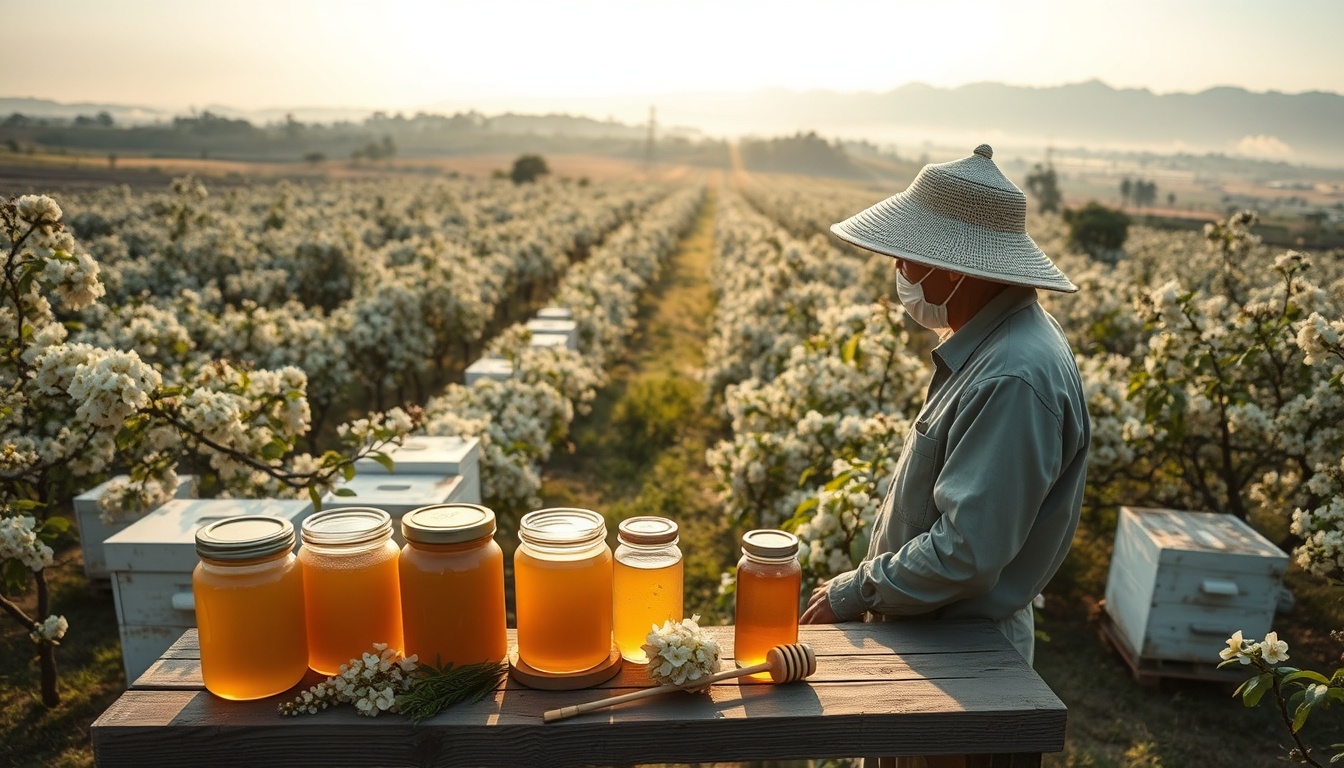
Lamyai (ลำไย, longan) honey is Thailand's flagship Apis mellifera monofloral and one of the most globally significant single-botanical honeys produced in Southeast Asia by volume. The botanical source is Dimocarpus longan, the longan tree, a Sapindaceae relative of lychee and rambutan. Thailand produces more than 1 million tonnes of fresh longan per season (Office of Agricultural Economics), the bulk of it grown in the northern production belt that runs from Lamphun province (the historical heart of Thai longan cultivation) through Chiang Mai, Chiang Rai, and Phayao. The longan bloom is typically concentrated in February and March, coinciding with the end of the cool-dry season and the start of the hot season; it is intense, short, and uniform across the production belt, producing conditions nearly ideal for migratory commercial beekeeping. Thai commercial beekeepers position colonies at the orchard edge during the bloom window, with yields per hive that can exceed 30 kg of honey in a strong season — exceptional for a tropical monofloral flow.
Sensorially, lamyai honey is light amber to medium amber, clear and moderately thick, with a distinctive tropical-fruit floral top note that many tasters describe as reminiscent of the longan fruit itself — a gentle musky sweetness with a faint hint of rose water and cool green-herbaceous undertones. The finish is medium-long with a subtle caramel-like warmth. Granulation is slow but not absent; refrigerated lamyai honey can set into a very fine-crystal paste over several months, while room-temperature lamyai in a tropical climate remains liquid for a year or more. Physicochemically, Thai lamyai honey is typically in the 17–20% moisture range (within Codex CXS 12-1981 limits despite tropical humidity because the short intense bloom allows the bees to cap properly), with reducing sugar content in the 68–74% range, low sucrose, low HMF in raw unheated product, and a characteristic pollen spectrum dominated by Dimocarpus longan pollen with small contributions from sympatric Sapindaceae (lychee, rambutan) and early-season wildflowers.
Economically, lamyai honey is Thailand's most internationally visible honey export. Major destinations include China (both as bulk and as branded Thai-origin specialty product), Taiwan, Hong Kong, Singapore, Malaysia, and — in increasing volume since 2018 — the Middle East and the United States. Authentic Lamphun-origin longan honey is protected as a geographical indication (สิ่งบ่งชี้ทางภูมิศาสตร์) under the Thai GI system administered by the Department of Intellectual Property (DIP) of the Ministry of Commerce. "น้ำผึ้งลำไย ลำพูน" (Lamphun longan honey) is one of the most consumer-relevant Thai honey GI registrations and is the single most important label-level signal for authentic premium Thai lamyai honey. Thailand is also the reference origin for most of the global "longan honey" specialty category — Vietnamese Hưng Yên longan honey, Chinese Guangdong and Fujian longan honey, and Taiwanese longan honey exist (and are excellent regional variants), but Thai Lamphun product is the volume and reputational benchmark.
Sunflower Honey from Lopburi — The Dok Thanthawan Photogenic Flow
Sunflower honey (น้ำผึ้งดอกทานตะวัน, nam phueng dok thanthawan) is Thailand's second major commercial monofloral, produced primarily in the central province of Lopburi and the adjacent parts of Saraburi, Nakhon Sawan, and Chai Nat during the sunflower bloom in November, December, and early January. The Lopburi sunflower fields — particularly the Phatthanaya Khao Chin Lae district and the hillsides around Pa Sak Chonlasit Reservoir — are among the most photographed agricultural landscapes in Thailand, drawing domestic and international tourists during the late-year bloom window for the combination of the golden flower fields and the limestone-hill background. Agriculturally, Thai sunflower (Helianthus annuus) is grown primarily as a rotation crop after the rice harvest, making use of residual soil moisture and replacing nutrient load in the paddy cycle. Honey is a secondary but commercially significant product of the rotation: commercial Apis mellifera beekeepers move colonies into the sunflower districts during the flower tours season, producing a distinctive monofloral with economics that work well alongside the agricultural tourism economy.
Sensorially, Thai sunflower honey is medium to deep amber-yellow, with a distinctive buttery-sweet fresh-grass nose, medium sweetness, and a notably rapid natural granulation — sunflower honey crystallises faster than almost any other Thai monofloral, typically setting into a pale-yellow fine-crystal cream within 4–8 weeks of extraction at ambient temperature. Many Thai producers lean into this granulation and sell sunflower honey as a creamed honey (น้ำผึ้งครีม) rather than trying to keep it liquid with heat treatment. Physicochemically, sunflower honey is somewhat higher in glucose-to-fructose ratio than lamyai honey (which is part of why it crystallises so readily — high glucose favours rapid nucleation), with moisture in the 17–19% range, substantial pollen content from Helianthus annuus, and a relatively high pH that gives it a milder, less-acidic character than some tropical monoflorals.
Lopburi sunflower honey is a good entry-level premium Thai monofloral — distinctive in both flavor and setting behavior, inexpensive by international premium-honey standards (typically bottle at farmgate, approximately $6–12 USD), and culturally embedded in a tourist-season economy that makes authentication straightforward when purchased on-site. Exported sunflower honey from Thailand is less commonly seen than lamyai in Western specialty retail because the European sunflower honey category is already heavily supplied by Ukrainian, Hungarian, Romanian, and Argentinian product; Thai sunflower honey's export footprint is mainly within Asia and in Thai-specialty retail in diaspora communities.
Stingless Bee Honey (น้ำผึ้งชันโรง) and the Chiang Mai University Research Program
Thai stingless bee honey — น้ำผึ้งชันโรง (nam phueng chan rong) — is the country's fastest-growing premium honey category and the one most actively advanced by ongoing scientific research. The name comes from the Thai word ชันโรง (chan rong), the "resin bee," referring to the propolis and resin that stingless bees incorporate heavily into nest construction. Thai commercial meliponaries keep primarily Tetragonula pagdeni (the most widespread and productive native species, kept across all regions of Thailand), Heterotrigona itama (the same species anchoring Malaysian kelulut production, with native range extending into southern Thailand and the Isthmus of Kra), Lepidotrigona ventralis, Lepidotrigona terminata, and several smaller Tetragonula species (T. laeviceps, T. fuscobalteata). Per-colony yield is low — typically 0.3–1.5 kg per year depending on species and forage — which is the main reason commercial Thai chan rong honey prices are an order of magnitude above ordinary Apis honey.
The Chiang Mai University research program, led by Patcharin Chuttong and built over more than a decade of collaboration with Michael Burgett (Oregon State emeritus) and regional collaborators across Thailand, Malaysia, Vietnam, and Australia, is the defining scientific voice on Thai stingless bee honey. The program's 2016 Food Chemistry paper — "Physicochemical profiles of stingless bee (Apidae: Meliponini) honey from South East Asia (Thailand)" — established the baseline compositional reference for Thai Meliponini honey: moisture content substantially higher than Codex CXS 12-1981 for Apis honey (typically 25–35%, with T. pagdeni often in the 27–32% range), free acidity far above the Apis norm (commonly 200–400 meq/kg), low reducing sugar content with high non-reducing disaccharide content, high electrical conductivity, and a characteristic species-specific flavor profile driven by organic acids and volatile compounds. Subsequent work by the group has extended the Fletcher et al. (2020) trehalulose findings into Thai Meliponini species — documenting substantial trehalulose content in T. pagdeni and H. itama honey and supporting the same functional-food positioning that Malaysian kelulut has achieved internationally.
Sensorially, Thai chan rong honey is pronouncedly sour-tart — notably more acidic than Apis honey, with a distinctive clean citric-organic-acid note that Thai tasters describe as "เปรี้ยวหวาน" (prieo wan, "sour-sweet"). Color ranges from pale-amber (young T. laeviceps honey and early-season T. pagdeni) through medium amber (mainstream T. pagdeni) to dark amber (H. itama and some wild-captured colonies). The product is typically more liquid at room temperature than Apis honey due to higher water content and rarely crystallises. Specialty Bangkok retail (Central Food Hall, Tops Wine Cellar honey section, Paragon Food Hall, direct meliponary outlets in Chiang Mai and Chanthaburi) carries Thai chan rong honey as a premium product, in the same category as Malaysian kelulut. No dated retail price is cited.

Wild Apis dorsata Forest Honey and the Karen / Mon Harvest Tradition
Wild Apis dorsata honey is a small but culturally significant category in the Thai honey landscape, produced by the giant honeybee from single-comb open-air nests on tall forest trees and, less commonly, on cliff faces across Thai protected forest and national park areas. The main production ecologies are the northern mixed-deciduous and evergreen forests (Huai Nam Dang National Park in Mae Hong Son and Chiang Mai, Doi Chiang Dao Wildlife Sanctuary, Doi Inthanon National Park peripheries), the western forest complex centered on Huai Kha Khaeng Wildlife Sanctuary in Uthai Thani (the largest remaining contiguous forest in mainland Southeast Asia and a UNESCO World Heritage site), and the peninsular forests of Khao Sok National Park and the Thai-Malay border ranges. Harvest is traditionally conducted by Karen (Pgakenyaw, Sgaw Karen) and Mon communities in the western and northern regions, and by other local harvesters in southern Thailand, using rope-and-ladder climbing techniques and smoking with damp forest-plant torches similar to those described in the Vietnamese honey guide and the Malaysian honey guide tualang tradition.
The Thai A. dorsata honey product differs from Malaysian tualang honey in its ecology and botany. Where Malaysian tualang honey comes specifically from nests on Koompassia excelsa trees in primary lowland rainforest, Thai A. dorsata honey comes from nests on a wider variety of emergent and riparian forest trees — Dipterocarpus, Shorea, Tetrameles, Ficus (bodhi and strangler figs), and large Lagerstroemia and Afzelia species — spread across more botanically diverse mixed-deciduous and evergreen forests. The resulting honey is typically dark amber, complex and polyfloral, with smoky forest-resin and dried-fruit notes and a long finish. Harvest volumes are smaller than in Malaysia or Vietnam because Thai protected-area management has reduced commercial access to the largest tualang-type trees; most Thai A. dorsata honey at retail comes from village-adjacent harvests rather than from deep-forest operations.
Authentication is the key buyer concern with wild-honey claims. Legitimate Thai wild-forest honey (น้ำผึ้งป่า, nam phueng pa) typically carries named forest or community-sourcing information — "Karen-harvested Huai Kha Khaeng wild honey," "Mon community cooperative Sangkhlaburi wild honey," or "Doi Inthanon upland A. dorsata forest honey." The term "wild honey" without specific origin is over-used in Thai retail and on tourist-market shelves, and is frequently generic Apis mellifera polyfloral or, in some cases, imported Myanmar or Lao honey relabeled for the tourist market. Verifying source is essential if paying a wild-honey premium; expect for genuine community-sourced product with documentation, lower for generic "wild" labels of uncertain origin.
Royal Project Coffee-Flower Honey, Lychee, Rubber, and the Secondary Monoflorals
Beyond lamyai, sunflower, stingless, and wild honey, Thailand produces a set of regional secondary monoflorals that belong in any serious guide. The most culturally significant is Royal Project coffee-flower honey — น้ำผึ้งดอกกาแฟ (nam phueng dok kafae) — produced by Apis mellifera colonies placed in the Arabica coffee plantations of the northern highlands during the February–March bloom, primarily in Doi Chaang (Chiang Rai province), Doi Tung (Chiang Rai), Doi Mae Salong, and Doi Inthanon. These plantations were established from the 1970s onward as part of the Royal Project Foundation (มูลนิธิโครงการหลวง) and the Doi Tung Development Project (Mae Fah Luang Foundation) as crop-substitution programs for hill-tribe communities previously cultivating opium. Coffee-flower honey is a secondary product of the Arabica harvest cycle, and is botanically parallel to Vietnamese Central Highlands coffee-flower honey (from Coffea canephora Robusta) described in our Vietnamese honey guide and to Ethiopian coffee-forest honey in our Ethiopian honey guide, but with a distinct profile because the nectar source is Coffea arabica rather than C. canephora. The honey is light amber, delicate, with a subtle floral-jasmine top note and a faint coffee-blossom aromatic that is quite different from the taste of brewed coffee itself. Royal Project and Doi Tung branded product carries royal-initiative provenance and is one of the most internationally credible Thai honey labels.
Lychee honey (น้ำผึ้งลิ้นจี่, nam phueng linchi) is produced from Litchi chinensis bloom in the northern provinces of Chiang Rai and Phayao, with the main bloom following closely on the lamyai flow in March. The honey is light amber, delicate, with a distinctive floral-rose top note. Lychee honey is less-produced than lamyai because lychee bloom is more weather-sensitive and the Thai lychee industry is smaller than the longan industry, but a good Chiang Rai lychee honey (particularly from the Mae Chan district) is among the most aromatic monoflorals in Thai specialty retail. Rubber honey (น้ำผึ้งดอกยาง, nam phueng dok yang) is produced from Hevea brasiliensis extrafloral nectaries in the large rubber-plantation base of southern Thailand (Surat Thani, Nakhon Si Thammarat, Songkhla, Trang, Yala), paralleling the Malaysian and Vietnamese rubber honey traditions — pale to medium amber, mild, workhorse commodity honey that crystallises readily and sells primarily domestically and into regional commodity channels.
Secondary Thai monoflorals include sesame honey (น้ำผึ้งดอกงา) from the central and northeastern plains (a relatively rare single-origin Thai monofloral with an unusual nutty-grain character); longkong honey (น้ำผึ้งดอกลองกอง) from Lansium parasiticum bloom in the southern provinces, a small-volume aromatic honey with a tropical-fruit-floral profile; wild meadow / polyfloral mountain honey from the hill country (commonly marketed as น้ำผึ้งดอกไม้ป่า, nam phueng dok mai pa); and — in small volumes — sesbania (ดอกแค) honey from sesbania flowering around rice paddies in the central plains. None of these are at the commercial scale of lamyai or sunflower, but the diversity of Thai monofloral production is larger than the international profile of Thai honey might suggest.
TAS 8003-2005 and Thai Honey Regulation
Thailand's principal honey standard is TAS 8003-2005 "Thai Agricultural Standard: Honey" (มาตรฐานสินค้าเกษตรและอาหารแห่งชาติ, Rạy x̄nạkṡ̄hā phkẹs̄ ks̄. 8003-2548) issued by the National Bureau of Agricultural Commodity and Food Standards (ACFS; สำนักงานมาตรฐานสินค้าเกษตรและอาหารแห่งชาติ, มกอช.) under the Ministry of Agriculture and Cooperatives. TAS 8003 aligns closely with Codex Alimentarius CXS 12-1981 and covers Apis honey: moisture content (≤ 20% for most honeys, ≤ 23% for heather), reducing sugar content (≥ 65% for Apis honey; lower limits for honeydew), sucrose content (≤ 5% with varietal exceptions up to 10% for lamyai and some others), HMF, diastase activity, water-insoluble matter, electrical conductivity, and free acidity. The standard covers labeling, botanical origin claims, and the distinction between raw honey and honey-containing products. Thai honey entering domestic retail or export is subject to TAS 8003 compliance, with Ministry of Public Health (Food and Drug Administration) enforcement of the Food Act B.E. 2522 (1979) and related labeling and safety regulations.
TAS 8003 is explicitly an Apis honey standard and does not currently define a separate category for stingless bee honey. This is the most important regulatory gap in the Thai framework and is a live issue that the Chuttong group and the Thai meliponiculture industry have been advocating to close. The practical consequence is that Thai chan rong honey cannot currently be labeled simply as "honey" (น้ำผึ้ง, nam phueng) because its moisture content and free acidity profile fail TAS 8003 Apis parameters; compliant labeling is "stingless bee honey" (น้ำผึ้งชันโรง) or "Meliponini honey" to make clear that it is a separate regulated category. This parallels the Malaysian situation before MSM 2683:2017 was finalised and is one of several reasons the Thai industry looks to the Malaysian standard as a regulatory template. An ACFS stingless bee honey standard is reportedly in development but not yet finalised as of early 2026.
Geographical-indication protection is administered by the Department of Intellectual Property (DIP; กรมทรัพย์สินทางปัญญา) of the Ministry of Commerce under the Geographical Indications Protection Act B.E. 2546 (2003), Thailand's equivalent of the European PDO/PGI system. The Thai GI registry is large relative to the regional comparison — over 180 GI registrations as of 2024 — and honey registrations include Lamphun longan honey (น้ำผึ้งลำไย ลำพูน, the flagship Thai honey GI) and a small number of other regional honey specialties. GI registration is a meaningful consumer-facing authentication signal: it requires a defined geographic production area, documented production methodology, compositional criteria, and ongoing quality control, and GI-certified product carries a legally distinctive label. For authentic lamyai honey in particular, the GI registration is the clearest single sign of genuine Lamphun-origin product. Authentication of Thai honey at the analytical level uses the standard international methods: AOAC 998.12 for δ¹³C stable carbon isotope ratio adulteration screening, HPLC and LC-MS/MS for specific syrup markers (rice syrup, corn syrup, high-fructose corn syrup), melissopalynology for pollen-based botanical and origin verification (important for lamyai / lychee / sunflower authentication), and increasingly quantitative NMR profiling — the Chiang Mai University analytical facility is one of the principal regional NMR honey characterisation centres.
Buying Authentic Thai Honey: A Variety-by-Variety Guide
The buying picture for Thai honey differs sharply between domestic and export channels, and between the four main category tiers (commercial lamyai / sunflower / secondary monoflorals, Royal Project and GI-designated premium, stingless bee, and wild forest). Inside Thailand, every category described above is broadly available through specialty supermarket chains (Central Food Hall, Tops Wine Cellar, Rimping Chiang Mai, Villa Market Bangkok), Royal Project shops (Doi Kham, Royal Project Foundation outlets at Doi Tung, Doi Angkhang, Inthanon), direct meliponary sales and Saturday farmers markets particularly in Chiang Mai and Lamphun, and — increasingly — through direct producer e-commerce. Outside Thailand the premium tier is reasonably well represented in Chinese, Taiwanese, Singaporean, Hong Kong, and Malaysian retail, and expanding but still thin in Western specialty channels.
**Lamyai longan honey (น้ำผึ้งลำไย).** Inside Thailand: look for "GI" marking with "น้ำผึ้งลำไย ลำพูน" (Lamphun longan honey geographical indication) on the label — this is the single most authoritative authentication signal. Named apiary, specific province/district of harvest, harvest year, and clear February–March bloom window dating add confidence. Expect bottle for genuine GI-registered product. Outside Thailand: relatively common in specialty Asian retail, especially in Chinese-diaspora and Thai-diaspora channels, and increasingly in Western specialty honey retailers. Expect jar for genuine Thai lamyai at export retail; be skeptical of premium-priced "longan honey" from non-Thai origins relabeled for the Thai-style premium category.
**Sunflower honey (น้ำผึ้งดอกทานตะวัน).** Inside Thailand: look for Lopburi or Saraburi province origin, Nov–Dec–Jan harvest window, and named apiary. Many Thai producers sell sunflower honey as a naturally granulated cream honey (น้ำผึ้งครีม) rather than liquid — this is a sign of authenticity rather than a defect, because glucose-rich sunflower honey naturally crystallises rapidly. Expect bottle. Outside Thailand: rarely available because European sunflower honey dominates export channels; Thai diaspora retail occasionally stocks it.
**Stingless bee honey (น้ำผึ้งชันโรง).** Inside Thailand: look for species designation (Tetragonula pagdeni is the mainstream commercial species; Heterotrigona itama is the more expensive premium species in southern Thailand), named meliponary with geographic specificity, and harvest year. Expect bottle for genuine product. The Chiang Mai University spin-off meliponaries, Chanthaburi Heterotrigona itama product, and several Nakhon Nayok and Kanchanaburi producers are reliable sources. Outside Thailand: underrepresented relative to Malaysian kelulut in Western specialty retail, but available in Bangkok-originating specialty imports in several Asian export markets. Be particularly skeptical of Thai "stingless bee honey" sold without species or meliponary name — the same relabeling issue exists as with Malaysian kelulut product.
**Royal Project coffee-flower and other Royal Project honeys.** Inside Thailand: look for the Royal Project / Doi Kham / Mae Fah Luang Foundation logos on the label — these indicate royal-initiative provenance. Coffee-flower honey specifically comes from Doi Chaang, Doi Tung, Doi Mae Salong, and Doi Inthanon apiaries. Expect bottle. Outside Thailand: available through Royal Project export channels and specialty Thai retail abroad, though less common than lamyai.
**Lychee honey (น้ำผึ้งลิ้นจี่).** Inside Thailand: look for Chiang Rai, Phayao, or Mae Chan district origin and March bloom window. Typically. A good delicate aromatic honey — worth seeking out while in northern Thailand. Outside Thailand: rare in retail.
**Wild forest honey (น้ำผึ้งป่า).** Inside Thailand: the authenticated supply chain is narrow and over-claimed. Look for named community sourcing (Karen cooperative, Mon community, specific national park or wildlife sanctuary forest origin), documented harvest methodology, and realistic pricing. Expect bottle for genuine community-sourced product with documentation. The term "wild honey" without specific origin is over-used in tourist-market retail and should be treated skeptically. Outside Thailand: essentially unavailable at export retail.
Across all Thai honey categories, the consistent buying principles are: (1) for lamyai, GI registration "น้ำผึ้งลำไย ลำพูน" is the single most authoritative signal; (2) named apiary, meliponary, forest-concession, or community cooperative with geographic specificity; (3) species designation for stingless bee honey (Tetragonula pagdeni vs. Heterotrigona itama vs. Lepidotrigona species); (4) harvest year and bloom-window dating; (5) for premium Royal Project product, explicit royal-initiative branding; (6) reputable retailer with traceable supply chain; and (7) price consistent with genuine premium regional production. Commodity pricing on a supposedly GI-registered lamyai, on premium stingless bee honey, or on a named-community wild forest honey is the single most common red flag and typically indicates generic A. mellifera product relabeled to capture the premium category's marketing halo.