South Korea: The World's Most Acacia-Dominant Honey Origin
South Korea occupies an unusual position in the global honey map. Most honey-producing countries have diverse commercial monoflorals — Italy splits its production across acacia, chestnut, orange, eucalyptus, and a dozen millefiori types; Spain across romero, eucalipto, tomillo, and azahar; Australia across jarrah, leatherwood, yellow box, and manuka. South Korea does not. Roughly two-thirds to three-quarters of Korean commercial honey production — the exact share fluctuates year to year — comes from a single species: Robinia pseudoacacia, the false acacia or black locust, known in Korea as 아까시나무 (akkasinamu) or more loosely 아카시아 (akasia). By volume, Korean acacia honey (아카시아꿀, akasia-ggul) is the backbone of the domestic market, the default product on supermarket shelves, and the variety most Korean consumers mean when they simply say 꿀 (ggul, "honey").
But Korea also has a second, deeply traditional honey category that sits at the opposite end of scale, price, and cultural meaning: 토종꿀 (toejong-ggul), "native honey" — honey produced by Apis cerana koreana, the indigenous Korean honeybee subspecies, typically harvested once per year from traditional log hives by pressing the entire annual comb. Toejong-ggul has been part of Korean medicine, cuisine, and gift-giving for centuries, and commands prices an order of magnitude above commercial acacia honey. Between these two poles sit Korean chestnut honey (밤꿀, bam-ggul) from Castanea crenata, buckwheat honey (메밀꿀, memil-ggul) from northern regions, lotus honey (연꽃꿀, yeonkkot-ggul), and polyfloral wildflower honey (잡화꿀, japhwa-ggul). This guide covers all of them, plus the 2009–2010 sacbrood virus catastrophe that nearly eliminated the native bee, the Ministry of Food and Drug Safety carbon-isotope rules that make Korean honey authentication unusually rigorous, and practical buying advice for each variety.
For comparison with other East Asian honey traditions, see our Japanese honey guide (Japan's very different tochi, renge, soba, and Nihon mitsubachi traditions) and the World Honey Guide.
Acacia Honey (아카시아꿀) — The 70% Crop
Robinia pseudoacacia is not actually an acacia. It is a leguminous tree in the family Fabaceae, native to the southeastern United States, widely introduced to East Asia, Europe, and elsewhere as a fast-growing pioneer species prized for timber, erosion control, and — crucially for this guide — an exceptionally clean, high-volume nectar flow. In Korea the tree is colloquially called 아카시아 (akasia) despite not being a true Acacia, a botanical misnomer shared with Italian and Hungarian "acacia" honey (which comes from the same species). The tree was planted extensively across Korean hillsides in post-war reforestation programs from the 1950s through the 1970s, which is why Robinia now covers enormous contiguous acreages in Gyeonggi, Gangwon, Chungcheong, and the Jeolla provinces — ideal conditions for migratory Korean beekeepers who move hives northward as the bloom front advances up the peninsula.
The Korean acacia bloom is a brief, intense phenomenon. Depending on the year and latitude, it runs from roughly mid-May in the southern provinces through early June in Gangwon — a two-to-three-week window during which a well-positioned Korean beekeeper can harvest the bulk of their annual honey crop. Beekeepers routinely truck hives 200–400 km northward during this period to extend the bloom. This migratory concentration is why a single variety dominates Korean production so overwhelmingly: the acacia bloom simply overwhelms every other flow in sheer volume per week. Korean national production statistics maintained by the Rural Development Administration (농촌진흥청, RDA) and its National Institute of Animal Science (축산과학원, NIAS) consistently show acacia as the largest single-variety component of annual honey output.
Korean acacia honey has the characteristic Robinia profile — very pale water-white to light straw color, exceptionally high fructose (~41% fructose, ~28% glucose, F/G ratio ~1.47; White 1975), correspondingly slow crystallization (authenticated Korean acacia often stays fully liquid for 2+ years at room temperature), mild delicate floral-sweet aroma, a clean non-cloying sweetness, and a short clean finish. It is the stereotypical "children's honey" in Korea — the variety most commonly stirred into warm water as 꿀물 (ggulmul), spread on tteok (rice cake), or used as the base sweetener in hanbang (traditional medicine) preparations for adults. The Korean domestic premium — a jar of single-origin Gangwon or Gyeonggi-produced acacia honey with NIAS-registered producer traceability — sells at a significant premium over imported commodity acacia from China, which dominates the lower price tier. The price gap and the honey's visual cleanliness together make Korean acacia one of the most common adulteration targets in the domestic market, which is the backdrop for the MFDS δ¹³C rules described in the science section.

Get the Honey Buyer's Cheat Sheet (free PDF)
16 varieties on one page — color, flavor, best use and what a fair price looks like — from the 304 honeys we track.
Chestnut Honey (밤꿀) — Korea's Dark, Bitter Counterpoint
If Korean acacia is the pale, mild, sweet center of the national honey tradition, Korean chestnut honey (밤꿀, bam-ggul) is its dark, intense, slightly bitter counterpoint. Produced from Castanea crenata — the Japanese / Korean chestnut, a species distinct from the European Castanea sativa that produces Italian and Spanish chestnut honey — bam-ggul comes from Korea's significant chestnut-producing regions, above all Gongju and Buyeo in South Chungcheong Province, where Korean chestnut cultivation has been documented since the Joseon Dynasty. The C. crenata bloom is shorter and later than Robinia, typically mid-to-late June, producing a concentrated nectar and pollen flow in regions where chestnut orchards are planted at commercial scale.
Korean chestnut honey is dark amber to deep reddish-brown, considerably darker than acacia and typically even darker than most millefiori wildflower honeys. The aroma is immediately distinctive and not universally loved: assertive tannic-woody notes, a suggestion of bitter dark chocolate, roasted chestnut skin, and an underlying mineral-earthy depth that contrasts sharply with the delicate character of Korean acacia. The taste is where bam-ggul stakes its cultural claim: a measurable bitterness that Korean consumers have historically valued as medicinal-grade complexity, balanced by a long mineral-herbal finish that lingers meaningfully. It is the honey Korean tradition reaches for when a preparation is meant to be emphatically restorative rather than simply sweet — included in many hanbang formulations specifically because of (not despite) its bitter-edged profile.
Physicochemically, bam-ggul shows the characteristic chestnut-honey signature found across Castanea species globally: very high electrical conductivity (often above 1.0 mS/cm, several times higher than acacia), elevated mineral content, high total phenolic content, and a distinctive pollen signature. It crystallizes slowly into a fine-grained dark paste over 6–12 months. Korean chestnut honey is never as dominant by volume as acacia — chestnut orchards occupy a much smaller land area than post-war Robinia plantings — but it is consistently the second-most-distinctive Korean monofloral and a common specialty-gift category. Retail prices for authenticated Korean bam-ggul from Gongju or Buyeo producers are a specialty-gift price.
Toejong-ggul (토종꿀) — Native-Bee Comb Honey and the Sacbrood Tragedy
The most culturally prized Korean honey is not a botanical variety at all — it is a bee-species category. Toejong-ggul (토종꿀, "native honey") refers to honey produced by Apis cerana koreana, the indigenous Korean honeybee subspecies, rather than by the introduced Apis mellifera ligustica (Italian bee) that produces virtually all Korean commercial acacia and chestnut honey. A. cerana is the broader Asian honeybee species, native from Korea through Japan, China, and South Asia; A. cerana koreana is the Korean regional population, smaller-bodied and better adapted to the Korean climate than the introduced European A. mellifera. A. mellifera was first brought to Korea around 1910 during the late Joseon / Japanese colonial period and rapidly displaced native-bee beekeeping for commercial production because it produces vastly larger honey harvests per colony.
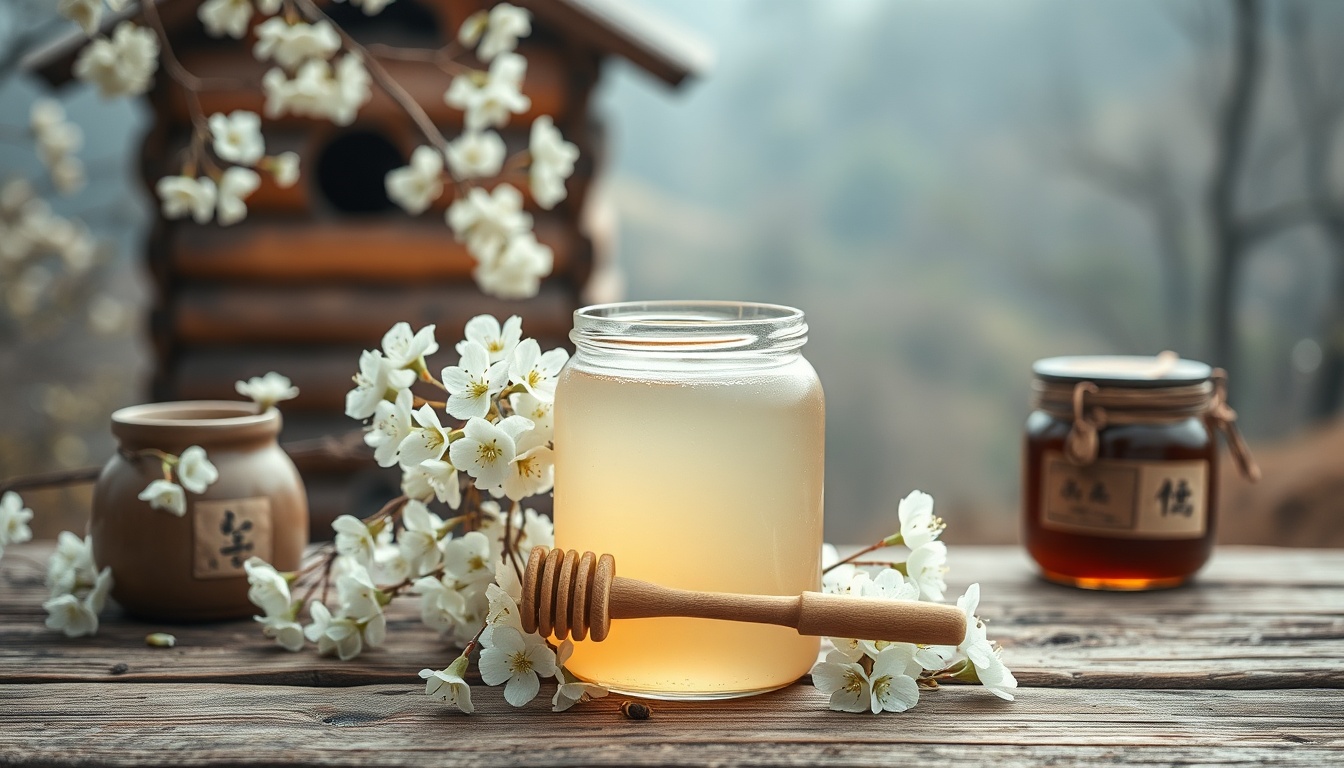
What has kept toejong-ggul alive as a tradition — and priced at roughly 5–10× the rate of commercial acacia honey — is its production method and sensory character. Traditional Korean native-bee beekeeping uses 통벌통 (tong beoltong) — hollow log hives, typically made from a short section of a naturally hollowed oak or pine log with a small entrance hole, placed on a stone base in a forest clearing or beside a traditional farmhouse. The hive is never opened during the active season; the bees build their comb naturally inside the cavity. Harvest happens only once per year, in autumn, and takes the entire comb — the beekeeper pours the comb into a cheesecloth press and extracts the honey by gravity and gentle weight, with no heat, no extractor, no filtration beyond removing wax particles. This is definitionally raw honey, with all pollen, propolis traces, and enzymes intact. The resulting product is a dark amber polyfloral honey — whatever happened to be in bloom within the bees' foraging radius from spring through early autumn — with a characteristic aromatic complexity, a full round sweetness, subtle propolis depth, and a long layered finish that commercial honey produced by A. mellifera in Langstroth boxes simply does not replicate.
In 2009 and 2010, a catastrophic outbreak of Korean sacbrood virus (KSBV) devastated Korean native-bee populations. Published Korean research (Choi Y.S. et al., and several NIAS groups) documented colony losses estimated at 75–90% of Apis cerana koreana populations nationwide, functionally eliminating traditional native-bee beekeeping in many regions. Recovery has been slow: native bees are being gradually restored through RDA-supported disease-resistant breeding programs and remnant-colony redistribution, but annual toejong-ggul production remains a small fraction of pre-2009 volumes. The practical market consequence is that genuine toejong-ggul is now both scarce and expensive — retail prices for authenticated A. cerana comb-pressed honey from Jirisan (지리산, the traditional native-bee mountain region), Songgwangsa and other temple beekeeping traditions, or Gangwon highland small-producers sit well above commercial acacia, with the highest prices for single-producer, named-hive, gift-grade product.

Regional and Lesser-Known Korean Honeys
Beyond the big three — acacia, chestnut, and toejong-ggul — Korea produces a secondary constellation of smaller-volume regional honeys that complete the national tradition. Buckwheat honey (메밀꿀, memil-ggul) comes primarily from the buckwheat (Fagopyrum esculentum) fields of Gangwon Province, particularly around Bongpyeong (봉평) — the village immortalized in Lee Hyoseok's 1936 short story "When Buckwheat Flowers Bloom" (메밀꽃 필 무렵). Memil-ggul is very dark brown to near-black, with the characteristically malty, molasses-like, slightly medicinal aroma typical of buckwheat honeys globally (comparable to New York State buckwheat honey or Eastern European grechishny myod). It crystallizes rapidly — within 1–3 months — into a dark, grainy paste. Korean buckwheat honey is a niche product, sought out for its robust character and its high antioxidant and mineral content rather than for any mass appeal.
Lotus honey (연꽃꿀, yeonkkot-ggul) is a very small-volume specialty honey produced in regions with commercial lotus cultivation — most notably Buyeo (부여) and Muan (무안), where Nelumbo nucifera is grown both as a crop (lotus root, lotus seed) and as a cultural-tourism planting. Yeonkkot-ggul is pale amber with a distinctive aromatic profile — delicate floral notes overlaid with the faintly sweet, slightly green aroma Koreans associate with lotus pond air. It is rarely encountered outside specialty Buddhist-market and temple-gift channels. Wildflower / polyfloral honey (잡화꿀, japhwa-ggul) is the catch-all category for Korean mixed-flora honey produced outside the main acacia and chestnut flows — the colour, flavor, and aroma vary widely by region and year. High-quality named-region japhwa-ggul from, for example, Jeju Island or the Jiri Mountain foothills can be a genuinely interesting single-origin product; unnamed bulk japhwa-ggul is typically the lowest-priced Korean domestic honey tier.
Several rarer regional productions deserve a mention for completeness. Apple-blossom honey (사과꽃꿀) is produced in small volumes in the apple-growing regions of Chungju, Yeongju, and Andong. Citron-blossom honey (유자꿀) from the Goheung and Namhae yuja-growing coasts is produced seasonally. Honeydew honey — the forest honeydew tradition that dominates German Waldhonig and Greek çam balı — exists in Korea from oak and Mongolian oak honeydew flows but has never developed into a named commercial category; see our Waldhonig guide and Greek honey guide for the dominant global honeydew traditions. Finally, Jeju Island produces distinctive canola (유채꽃, yuchae) honey in spring — a pale golden honey with a uniquely soft floral character, timed to the famous yellow yuchae blooms that are themselves a major Jeju tourism draw.
The Science: MFDS Authentication, δ¹³C Testing, and the Syrup Problem
South Korea runs one of the world's strictest honey authentication regimes. The underlying problem is older than the current rules: because the Korean domestic market has a strong cultural preference for domestic acacia honey — and because Korean domestic acacia retails at a 2–3× premium over imported Chinese acacia — there has been an enduring economic incentive to dilute honey with cheap invert syrups (rice syrup, corn syrup, sugar syrup) and sell the result as premium domestic product. Successive Korean food-safety agencies — the former Korean Food and Drug Administration (KFDA), reorganized in 2013 into the Ministry of Food and Drug Safety (식품의약품안전처, MFDS) — have responded by building a regulatory framework that treats honey adulteration as a priority enforcement area.
The technical backbone of Korean honey authentication is stable carbon isotope ratio analysis (δ¹³C, delta-13-carbon, the ratio of ¹³C to ¹²C). The test exploits the difference between honeys produced from C3 plants (most temperate-climate flowering plants, including Robinia, Castanea, and Korean wildflowers — δ¹³C typically around −23‰ to −27‰) versus adulterants derived from C4 plants like corn or sugarcane (δ¹³C around −10‰ to −14‰). A genuine Korean acacia honey will show a δ¹³C value and an internal protein-to-honey δ¹³C difference consistent with pure C3-origin nectar; a syrup-adulterated sample will show a shift toward less-negative values or, more sensitively, a protein-fraction-versus-whole-honey δ¹³C difference exceeding the AOAC 998.12 threshold. MFDS maintains published limits based on the AOAC method, and testing is routine for commercial products labeled "100% pure" (100% 순수). The MFDS additionally sanctions producers using HPLC / NMR profiling methods for rice-syrup and corn-syrup–specific adulterants that can evade δ¹³C detection (the so-called "designer syrup" problem).
Regulatory categories under current Korean food law distinguish between 벌꿀 (beolkkul, "bee honey" — the strictest category, compositionally near-pure honey passing all authentication tests), 사양벌꿀 (sayang-beolkkul, "sugar-fed bee honey" — honey produced by bees deliberately fed sugar syrup during dearth periods, a legal but separately-labeled product), and 벌꿀 가공품 (beolkkul gagongpum, "honey processed product" — anything further processed or blended). For Korean consumers, the practical rule is that a jar labeled simply 벌꿀 and passing MFDS inspection is genuine pure honey; a jar labeled 사양벌꿀 is a different category at a different price point and should be valued accordingly; anything without an MFDS registration number (식품안전나라 verification) or a KBA (한국양봉협회, Korean Beekeeping Association) traceability marker should be treated with appropriate skepticism, especially at premium prices. A useful practical reference for the broader physicochemical standards that apply to Korean honey is Codex Alimentarius CXS 12-1981 (revised 2019); Korea's domestic KS (Korean Standards) specifications track Codex parameters closely. Korean academic work on honey authentication is extensive — NIAS groups including Choi Y.S., Lee M.L., and colleagues have published on Korean acacia authentication, on the sacbrood crisis and its A. cerana impact, and on melissopalynology of Korean regional honeys; work on Korean chestnut honey authentication has appeared in the Journal of Apicultural Research and the Korean Journal of Apiculture.
Buying Korean Honey: A Practical Variety-by-Variety Guide
Korean honey is more widely exported than Yemeni honey and less widely exported than Italian or Spanish honey. Inside Korea, both the domestic consumer and the tourist have a fairly straightforward path to authentic product; outside Korea, the channels narrow quickly. The following is a practical guide keyed to each major variety.
**Acacia honey (아카시아꿀).** Inside Korea: look for jars labeled 국산 100% (gooksan 100%, "100% Korean-origin"), 벌꿀 (not 사양벌꿀), and carrying an MFDS registration number — ideally with a specific provincial origin (강원산 Gangwon, 경기산 Gyeonggi, 충북산 North Chungcheong) and a named producer or cooperative. Small-producer bottled acacia from Gangwon highlands is the premium tier; large-producer bottled acacia from mixed Korean sources is the mainstream tier; jars simply labeled 아카시아꿀 without Korean-origin proof are typically Chinese-blended product sold at comparable shelf positions. Outside Korea: Korean acacia honey is available through Korean grocery chains (H Mart, Han Ah Reum in the US and UK), and online Korean-food specialist importers. Expect a significant markup at specialist retail.
**Chestnut honey (밤꿀).** Inside Korea: the Gongju and Buyeo chestnut cooperatives and small-producer channels are the authoritative sources; product carrying the named Gongju or Buyeo cooperative label is the safest purchase. Outside Korea: availability is genuinely scarce — Korean chestnut honey is produced in much smaller volumes than acacia and is a less-prioritized export category. When it is available through specialist importers, it is a small-volume export. Readers who want chestnut honey character without the Korean sourcing difficulty can consider Italian castagno or Spanish miel de castaño (Castanea sativa) — different species, broadly similar flavor profile, much easier to source in Europe and North America. See our Italian honey guide for that tradition.
**Toejong-ggul (토종꿀) / Korean native-bee comb honey.** This is the hardest Korean honey category to buy authentically, both inside and outside Korea. Inside Korea: specialty traditional-market and temple channels are the realistic sources — Jirisan regional cooperatives, Buddhist temple shops at Songgwangsa, Haeinsa, and other beekeeping-tradition temples, named small-producer channels verified through the Korean Beekeeping Association (한국양봉협회), and the small number of dedicated toejong-ggul specialty retailers. Anything labeled 토종꿀 at prices comparable to commercial acacia is not what it claims. Outside Korea: authentication is effectively impossible for most consumers — the product is rare enough that specialist Korean-import retailers rarely stock it, and when stocked, specialist prices apply. Readers interested in the broader Asian native-bee honey category may find Japanese Nihon mitsubachi honey (from Apis cerana japonica — the Japanese sister subspecies to Korean A. cerana koreana) easier to source in Western specialty channels; see our Japanese honey guide.
**Buckwheat (메밀꿀), lotus (연꽃꿀), and other regional varieties.** Inside Korea: regional cooperative channels and local farmers' market outlets are the primary sources. Bongpyeong in Gangwon for buckwheat honey; Buyeo and Muan for lotus honey; Jeju for yuchae (canola) honey; Chungju and Yeongju for apple-blossom honey. Outside Korea: these are essentially not available through retail channels — travelers should expect to source them in Korea directly. For the broader global buckwheat and lotus honey context, see our World Honey Guide. Across all Korean honey categories, the same core principles apply: named provincial origin, named producer or cooperative, clear category labeling (벌꿀 vs 사양벌꿀), MFDS registration number, and price consistency with genuine domestic product.