Malaysia in the World Honey Map: Why Trehalulose Changed Everything
Malaysia occupies an unusual position in the world honey economy. It is not a major global honey exporter by tonnage — domestic production is modest, and net imports substantially exceed exports in most years (Department of Statistics Malaysia trade data). But Malaysia is arguably the country that has had the single largest impact on how the specialty-honey world thinks about stingless bee honey. The reason is a 2020 paper by Fletcher, Hungerford, Webber, Carpinelli de Jesus, Zhang, Stone, Brooks, and Smyth published in Scientific Reports (Nature Publishing Group) titled "Stingless bee honey, a novel source of trehalulose: a biologically active disaccharide with health benefits." That paper reported that stingless bee honey — including samples from the Malaysian native species Heterotrigona itama and from closely related Australian Tetragonula carbonaria and T. hockingsi — contains trehalulose as a major sugar, in many samples at levels exceeding 50% of total sugars and in some samples approaching 85%. Trehalulose is a rare isomer of sucrose with a low glycemic index and no significant cariogenicity — a composition previously known only in trace amounts from industrial bacterial fermentation, never identified as a major natural food sugar in any other source. Overnight, "stingless bee honey" stopped being a local Southeast Asian curiosity and became a globally distinctive functional food.
This is the frame for any serious Malaysian honey guide. The country's flagship premium honey — kelulut — is not a monofloral story and is not a terroir story in the European sense. It is a species story: a product of bees in the tribe Meliponini that are evolutionarily separate from the Apis honeybees by more than 50 million years, that collect and transform nectar differently, and that produce a honey with composition unlike anything Apis bees make anywhere in the world. The second Malaysian story is older and more romantic: tualang honey, wild Apis dorsata honey harvested from the tallest tropical rainforest tree in Southeast Asia (Koompassia excelsa), has been the subject of a sustained and internationally respected research program at Universiti Sains Malaysia (USM) and other Malaysian universities documenting its antibacterial and wound-healing properties. Together, kelulut and tualang give Malaysia two premium honey categories that genuinely do not exist in equivalent form anywhere else.
For comparison with other regional honey traditions this guide references, see our Vietnamese honey guide for the closely related Southeast Asian Apis dorsata story (gác kèo ong rafter-attraction in the U Minh Melaleuca forests), the Indian honey guide for the Himalayan Apis dorsata cliff-hunting tradition, the Chinese honey guide for the Apis cerana cerana parallel, the Japanese honey guide for the Nihon mitsubachi tradition, the Yemeni honey guide for Sidr honey, and the broader World Honey Guide.
The Four-Bee Story: Meliponini, Apis dorsata, Apis cerana indica, and (Marginally) Apis mellifera
Malaysia is unusual among Southeast Asian honey-producing countries in that the dominant managed honey-producing insect is not Apis mellifera — it is the stingless bees of the tribe Meliponini, locally called kelulut (peninsular Malay) or kerieieng / kelulut (in Sabah and Sarawak on Borneo). Over 30 Meliponini species are recorded from Malaysia (Kelantan State Department of Agriculture surveys; MARDI meliponiculture research), but two dominate managed production: Heterotrigona itama (the larger, more productive species, kept in the vast majority of commercial meliponaries) and Geniotrigona thoracica (a smaller species with distinctive honey character). Tetragonula laeviceps and Lepidotrigona terminata also appear in smaller-scale production. All of these store their honey not in hexagonal wax combs (the Apis pattern) but in spherical or ovoid resin-wax pots typically the size of a quail egg or smaller — structures called "pot-honey" in the Meliponini literature. The honey is fundamentally different in composition, water content, acidity, and flavor from anything an Apis bee produces.
The second species is Apis dorsata, the giant honeybee — locally called lebah tualang when nesting in Koompassia excelsa (the tualang tree), lebah hutan (forest bee) in other contexts. A. dorsata is a wild, unmanaged species that builds massive single-comb open-air nests on the undersides of tall tree branches and cliff faces. In Malaysia, A. dorsata colonies preferentially nest on Koompassia excelsa, one of the tallest tropical rainforest trees in the world (regularly 50–80 m, with exceptional specimens over 88 m documented in Malaysian forest reserves). A single tualang tree may host 50–100 simultaneous A. dorsata nests, making it the most productive single-tree honey resource known in tropical Asia. Harvest is traditionally conducted at night by Orang Asli indigenous communities (particularly Temiar, Jahai, and Semai peoples in Peninsular Malaysia; Penan in Sarawak) using fire-torch smoking and rope-climbing techniques passed down across generations — a practice continuously documented from pre-colonial Malay manuscripts through to contemporary ethnographic research at Universiti Sains Malaysia and Universiti Kebangsaan Malaysia.
The third is Apis cerana indica, the Indian race of the Asian honeybee, known in Malay as lebah kelulut liar (historically) or more precisely lebah madu asli. A. cerana indica is native to Malaysia and produces honey in both wild and managed contexts, though its contribution to commercial honey output is minor — the bees are small, colonies abscond easily, and yields are low compared to either A. mellifera or managed kelulut. Traditional A. cerana beekeeping in hollow-log hives (sarang kayu) survives in rural Kelantan, Terengganu, Kedah, and interior Sabah, but is not a significant commercial category. The fourth is the introduced Apis mellifera — typically A. m. ligustica — which performs poorly in equatorial Malaysia. The main constraints are: (1) year-round brood rearing with no winter cluster, leading to chronic Varroa destructor pressure without the seasonal brood break that temperate beekeepers rely on; (2) heavy small-hive-beetle (Aethina tumida) pressure, endemic in the region; and (3) competition from A. cerana and from kelulut at the colony-scouting level. Apis mellifera does produce Malaysian honey, but it is a minor share of the managed-honey market and is generally not the basis of Malaysia's premium product.

Get the Honey Buyer's Cheat Sheet (free PDF)
16 varieties on one page — color, flavor, best use and what a fair price looks like — from the 304 honeys we track.
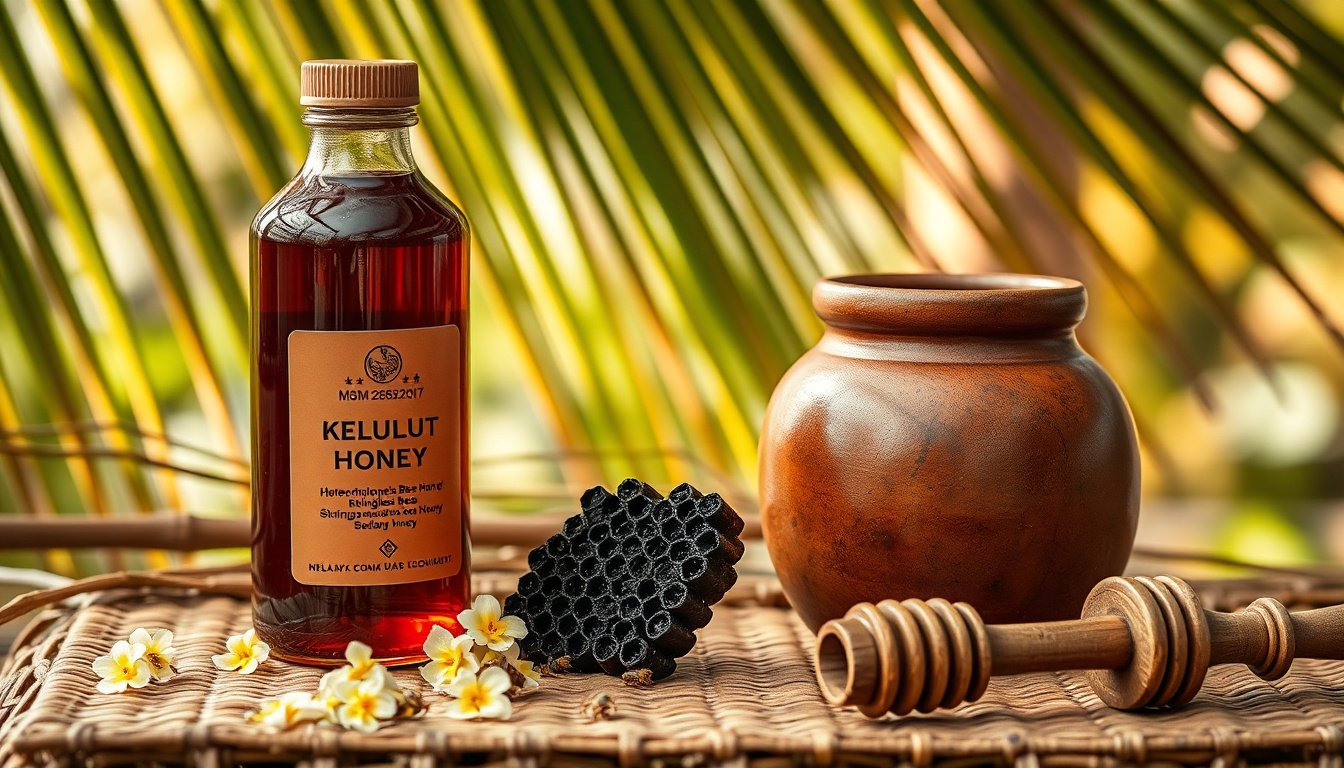
Kelulut Stingless Bee Honey (Madu Kelulut) — The Malaysian Flagship
Kelulut honey, or madu kelulut in standard Malay, is the flagship Malaysian premium honey and — thanks to the 2020 trehalulose paper — one of the most scientifically distinctive honeys in the world specialty market. The production base is small but growing rapidly: Malaysian Department of Agriculture (Jabatan Pertanian) census data and MARDI meliponiculture reporting document several thousand commercial meliponaries across Peninsular Malaysia, Sabah, and Sarawak, concentrated in Terengganu, Kelantan, Pahang, Johor, and the fruit-orchard districts of Sabah (Kudat, Kota Marudu) and Sarawak (Serian, Padawan). Commercial meliponaries typically run anywhere from 20 to 1,000 colonies; per-colony honey yield is modest — typically 1–2 kg per year per Heterotrigona itama colony, roughly a tenth of a typical commercial Apis mellifera yield — which is the main reason kelulut honey commands prices several times those of ordinary Apis honey.
Sensorially, authentic kelulut honey is nothing like Apis honey. The defining characteristic is a pronounced sour-tart note, not a gentle fruit-acid tang but a distinct astringency that Malaysian producers and consumers describe as masam (sour) — a word that also applies to sour tamarind or green mango. This is not a defect and it is not fermentation artifact; it is the natural state of stingless bee honey and is driven by high levels of organic acids (gluconic, citric, malic, acetic) combined with active glucose oxidase activity that the bees produce. Color ranges from pale golden (young Tetragonula laeviceps honey) through medium amber (mainstream Heterotrigona itama) to dark amber (Geniotrigona thoracica and some wild-captured colonies), with the darker honeys carrying more resinous forest-floor notes inherited from the propolis-rich wax-resin used to build the storage pots. Viscosity is noticeably lower than Apis honey — kelulut honey pours more freely at room temperature, a direct consequence of its higher water content. Crystallization is rare; the combination of high water, high trehalulose, and very low sucrose keeps the product liquid indefinitely at ambient tropical temperature.
Physicochemically, authentic kelulut honey shows a profile that would fail conventional Apis-honey standards but is entirely normal — and is codified — for its own category. Water content is typically 25–35%, often substantially above the Codex CXS 12-1981 20% ceiling for Apis honey (this is the single most-misunderstood fact about stingless bee honey and the main reason it cannot be labeled as simply "honey" under Apis-oriented regulation). Free acidity is high (commonly 200–400 meq/kg vs. the ≤50 meq/kg typical of Apis honey). Reducing sugar content is lower than Apis honey, with the balance made up by non-reducing disaccharides — particularly trehalulose, which in Malaysian Heterotrigona itama samples has been measured at 13–44% of total sugars (Fletcher et al. 2020; Chuttong et al. follow-up work at Chiang Mai University; subsequent MARDI analytical surveys), making it the single largest trehalulose source known in any natural food. HMF levels are generally very low in raw kelulut honey because the product is not heated. Electrical conductivity and ash content are elevated compared to Apis honey, reflecting the mineral-rich propolis and resin incorporated into storage pots.
The 2020 Trehalulose Discovery: What It Is and Why It Matters
The 2020 Fletcher et al. paper (Scientific Reports 10: 12128) is the single most important modern scientific finding about any Southeast Asian honey. The research team analyzed stingless bee honey samples from Heterotrigona itama (Malaysia), Tetragonula carbonaria and Tetragonula hockingsi (Australia) by quantitative NMR spectroscopy and HPLC, compared them against Apis mellifera honey from equivalent floral sources, and identified trehalulose — a 1,1-linked α-D-glucopyranosyl-β-D-fructofuranose, an isomer of sucrose — as a major sugar component. Mean trehalulose content across 110 analyzed Meliponini honey samples was 29% of total sugars, with individual samples up to 44% (H. itama) and up to 70%+ (Australian T. carbonaria). The same analytical protocol applied to Apis mellifera honey from the same regions returned trehalulose values below the detection limit. Trehalulose is not a trace component in stingless bee honey; it is frequently the single most abundant sugar.
Why this matters biochemically: trehalulose is digested by the human small intestine (unlike, say, trehalose), but at a substantially slower rate than sucrose. Published glycemic index values for trehalulose are in the range of 32 (low GI) versus sucrose at 65 (medium-high GI), and trehalulose is not fermented by oral Streptococcus mutans — meaning it does not contribute to dental caries the way sucrose or glucose do. These functional properties had been known from industrial microbiology for decades (trehalulose is produced commercially via bacterial isomerization of sucrose for use as a functional sweetener under trade names such as NutraFlora), but trehalulose had never been identified as a natural major component of any food before the 2020 paper. The practical consequence is that stingless bee honey is the only known natural food source of trehalulose at dietary-relevant levels.
The claim we are careful NOT to make. It is important to be specific about what the trehalulose finding does and does not support. It supports the statements that (1) stingless bee honey has a meaningfully different sugar profile from Apis honey, (2) its glycemic response is plausibly lower than an equivalent-calorie serving of Apis honey, and (3) it carries specific compositional markers that analytical labs can use to distinguish it from adulterated Apis honey. It does not support broader unqualified claims about diabetes, weight loss, or general "healthier" status; those claims require human clinical trials that are underway but not conclusive. The Fletcher et al. paper is explicit about this scope, and any Malaysian honey retailer making dramatic health claims solely on the basis of the trehalulose discovery is overreaching. What the discovery does unambiguously support is the recognition that stingless bee honey belongs in its own regulatory and commercial category — which is exactly what happened next with the MSM 2683 national standard.
Tualang Honey and the Tallest Tropical Tree
Tualang honey — madu tualang in Malay — is the wild counterpart to kelulut and is the Malaysian honey with the longest continuous documentary and scientific history. The name comes from the tualang tree, Koompassia excelsa, an emergent leguminous canopy tree of the family Fabaceae (subfamily Detarioideae) that is among the tallest tropical hardwoods in the world. Mature tualang trees regularly reach 50–80 m in height, with documented specimens in Malaysian forest reserves exceeding 88 m; the trunk is smooth, grey-white, and largely branch-free until the emergent crown — a morphology that happens to make it unusually hostile to climbing mammalian predators and unusually attractive to Apis dorsata giant honeybees. A single large tualang tree may host 50–100 simultaneous A. dorsata colonies, each building a single open-air comb up to 1–2 m across on the undersides of the emergent branches. The total honey yield from a single productive tree in a single good season can be several hundred kilograms.
The harvest tradition is among the most dramatic in the world honey map. In Peninsular Malaysia, tualang honey harvest is conducted primarily by Orang Asli indigenous communities — Temiar, Jahai, Semai, and Batek peoples — whose relationship with the tualang tree is embedded in cosmology, ritual, and customary tenure. Harvests occur after dark (when A. dorsata is less aggressive and cannot easily orient on light-less human targets), using a single tall-ladder or rope-pulley system anchored to the tualang trunk, and a lead harvester ascends 40–70 m to reach the combs. The principal tool is a smouldering torch of damp Licuala palm fronds which, when swung below a nest, produces a cascade of burning fragments; the bees pursue the sparks downward rather than the harvester above, clearing each nest for a brief harvest window. The honey portion of the comb is cut free and lowered in a hide or woven bag; brood is traditionally left intact where possible, though historical commercial pressure has at times led to less sustainable harvest. In Sarawak, equivalent tualang-tree harvests are conducted by Penan and related Dayak communities. Similar traditions exist in Indonesia (see our future Indonesian guide for the Sumatran and Kalimantan parallels).
Scientifically, tualang honey has been the subject of one of the most sustained single-variety honey research programs in the world, centered at Universiti Sains Malaysia (USM) in Penang. Research groups led by Erejuwa, Sulaiman, Wahab, and colleagues have published on tualang honey's antibacterial activity against Staphylococcus aureus and Pseudomonas aeruginosa (in vitro work and clinical wound-care trials), its antioxidant profile (phenolic acid and flavonoid content), and comparative wound-healing studies against Manuka honey. The honey itself is dark amber to nearly black, substantially darker than most Malaysian kelulut honey, with a complex flavor profile dominated by smoky-resinous forest notes, medium sweetness, and a long finish reflecting the mixed-forest polyfloral nectar base (Koompassia excelsa itself contributes little nectar — the bees forage across the surrounding primary rainforest, including Shorea, Dipterocarpus, and many other canopy species). Authentic tualang honey is produced in only a small number of locations: Gua Musang district in Kelantan, Royal Belum State Park in Perak (where tualang-tree harvest is integrated with protected-area management), parts of Taman Negara National Park in Pahang, and specific concessions in Sarawak. Production is seasonal, following the mast-fruiting cycles of the surrounding dipterocarp forest rather than a simple calendar schedule.

Regional Monoflorals: Gelam, Acacia mangium, Rubber, Durian, and Coconut
Beyond the two flagship categories, Malaysia produces several regionally distinctive Apis mellifera and kelulut monoflorals that belong in any serious guide. The most important is gelam honey (madu gelam) from Melaleuca cajuputi — the same cajuput species that produces U Minh honey in Vietnam (see our Vietnamese honey guide for the Mekong Delta story). In Malaysia, gelam forests grow along the east coast of Peninsular Malaysia in Terengganu, Kelantan, and Pahang, particularly in the peat-swamp and lowland coastal zones. Gelam honey is produced by both Apis mellifera apiaries placed along the forest edge during the dry-season bloom and by kelulut colonies that incorporate gelam nectar into a multiforage base. Apis-produced gelam honey carries the characteristic cool eucalyptol-inflected signature associated with all Melaleuca cajuputi honeys — a cross-regional flavor marker — though Malaysian gelam is generally somewhat milder than U Minh product because the Malaysian forests are smaller and more mixed. Kelulut-produced gelam honey retains the species-level kelulut tartness while carrying a noticeable eucalyptol top note and is one of the most distinctive single-forage kelulut products available.
Acacia mangium honey (madu akasia) is a large-volume Malaysian commodity monofloral produced from Acacia mangium plantations — originally established as industrial timber plantations but supporting a substantial Apis mellifera and kelulut forage base, particularly in Johor, Pahang, and parts of Sabah. The honey is light to medium amber, moderately sweet, with a relatively simple profile compared to gelam or forest-polyfloral honey; it is the Malaysian workhorse commercial Apis monofloral and much of the domestic supermarket Apis honey by volume originates here. Rubber honey (madu getah) from Hevea brasiliensis extrafloral nectaries is produced from Malaysia's large rubber-plantation base (Johor, Kelantan, Perak) and has a similar ecology to Vietnamese rubber honey — pale, mild, crystallizes readily, workhorse commodity product.
Two tropical-fruit monoflorals deserve mention. Durian honey (madu durian) is produced from the short and intense bloom of Durio zibethinus (the durian tree) and its cultivars, primarily in Pahang and Johor. Durian bloom is unusual in that it is pollinated primarily by nectar-feeding bats (Eonycteris spelaea) rather than by bees, but managed honeybee colonies placed in durian orchards during the bloom window do produce a small volume of distinctive amber honey with a notably sulfurous-fruited aroma that some tasters find reminiscent of the fruit itself — a genuine rarity that is essentially only available in Malaysia and Thailand. Coconut-flower honey (madu kelapa) is produced from Cocos nucifera coastal plantations along both east and west coasts of Peninsular Malaysia; it is a mild, pale, relatively simple Apis honey that is culturally significant because coconut is one of the most important cultivated crops in Malaysian agriculture. Longan and lychee honeys also appear on a smaller scale in northern Peninsular Malaysia (Perlis, Kedah), mirroring the much larger Vietnamese and Chinese longan/lychee honey traditions.
MSM 2683:2017 and MS 1041:2017 — The Malaysian Standards
Malaysia is one of only a handful of countries in the world that has published a formal national standard for stingless bee honey — a distinction that reflects both the 2020 trehalulose research and the pre-existing growth of the Malaysian meliponiculture industry. The key document is MSM 2683:2017 "Kelulut (Stingless bee) Honey — Specification," published by the Department of Standards Malaysia (Jabatan Standard Malaysia, DSM) under the Ministry of International Trade and Industry, and developed with SIRIM Berhad (the Standards and Industrial Research Institute of Malaysia) and MARDI. MSM 2683 is explicit that kelulut honey is a separate category from Apis honey: its moisture ceiling is set far higher than Codex CXS 12-1981 (commonly in the 30–35% range depending on edition and sub-category), its free acidity limits are set appropriately higher, and it requires honey-pot harvest methodology rather than extraction from wax combs. The standard covers sensory requirements, physicochemical parameters, microbiological criteria, and labeling — the single most important consumer-facing element being the requirement that the label identify the product as kelulut or stingless bee honey and not as "honey" simpliciter.
The companion standard is MS 1041:2017 "Kelulut (Stingless bee) Honey — Code of Good Hygiene Practice," which addresses the hygienic harvest methodology — pot integrity, extraction method (vacuum aspiration versus crushing), filtration, storage, and packaging — required to produce compliant product. Together MSM 2683 and MS 1041 constitute the legal-technical backbone of the Malaysian kelulut industry and are the only national stingless bee honey standards currently in force in Southeast Asia; Indonesian, Thai, and Philippine equivalents are under development but not yet finalized.
For Apis honey, the relevant Malaysian standard is MS 1041 (older honey standard — not to be confused with the 2017 stingless-specific code of practice of the similar number), aligned with Codex CXS 12-1981, which covers moisture ≤ 20%, reducing sugar ≥ 65%, sucrose ≤ 5% (10% for some varietal exceptions), HMF, diastase activity, and electrical conductivity. Food safety is overseen by the Ministry of Health Malaysia (Kementerian Kesihatan Malaysia, KKM) under the Food Act 1983 and Food Regulations 1985, with import honey subject to border inspection by the Food Safety and Quality Division (Bahagian Keselamatan dan Kualiti Makanan, BKKM). Geographical-indication protection is administered by MyIPO (the Intellectual Property Corporation of Malaysia) under the Geographical Indications Act 2000; the system is relatively young and Malaysian honey GI registrations are limited compared to European PDO/PGI or the Vietnamese chỉ dẫn địa lý system, but specific tualang-producing regions (Royal Belum, Taman Negara peripheries) have initiated GI applications. Authentication of Malaysian honey — particularly in export channels — uses the standard international methods: AOAC 998.12 for δ¹³C stable carbon isotope ratio analysis (adulterant-syrup screening), HPLC and LC-MS/MS for specific-syrup markers, melissopalynology for pollen-based botanical and origin verification, and for kelulut specifically, direct trehalulose quantification by quantitative NMR or HPLC as a positive stingless bee honey marker.
Buying Authentic Malaysian Honey: A Variety-by-Variety Guide
The buying picture for Malaysian honey differs sharply between domestic and export channels, and between kelulut, tualang, and the Apis monoflorals. Inside Malaysia, every category described above is broadly available through specialty retail (Urban Fresh, Village Grocer, Jaya Grocer), Sunday farmers markets (Pasar Tani) in major cities, meliponary direct-sale channels particularly in Terengganu and Kelantan, and — increasingly — through curated Malaysian e-commerce (Shopee Mall, Lazada LazMall, direct meliponary websites with traceability links). Outside Malaysia the premium tier is underrepresented relative to the scale of both the domestic industry and the international scientific interest in kelulut since 2020.
**Kelulut stingless bee honey (madu kelulut).** Inside Malaysia: look for MSM 2683:2017 compliance noted on the label, named meliponary with traceability (e.g. "Ladang Kelulut [Name], Hulu Terengganu"), species designation (Heterotrigona itama is the mainstream; Geniotrigona thoracica is a distinct and somewhat rarer offering), clear harvest year and batch numbering, and ideally trehalulose content disclosure for premium-tier product. Expect bottle for genuine MSM 2683 compliant product, with trehalulose-disclosed premium-tier kelulut toward the top of the range. Outside Malaysia: a growing number of functional-food specialty channels carry Malaysian kelulut — Australian specialty retailers (where domestic T. carbonaria honey is the reference), UK and Dutch specialty honey importers, Singapore and Hong Kong specialty retail. Expect substantial markup at export retail (often jar); verify species, meliponary origin, and MSM 2683 compliance before paying export prices.
**Tualang wild honey (madu tualang).** Inside Malaysia: the authenticated supply chain is narrow. Look for named forest-reserve origin (Royal Belum Perak, Taman Negara Pahang, Gua Musang Kelantan) and ideally Orang Asli-producer cooperative sourcing (Persatuan Penggembala Lebah [local]) or named commercial harvester with clear forest-concession documentation. Expect bottle for authenticated product. The term "tualang honey" is widely misused in general retail — much product labeled "tualang" is actually generic Apis mellifera forest honey from plantation peripheries; genuine Apis dorsata tualang-tree–harvested honey is uncommon even in Malaysian retail. Outside Malaysia: Malaysian tualang honey appears occasionally in functional-food channels on the strength of the USM research program; verify the specific supply chain because mislabeling is widespread.
**Gelam honey (madu gelam).** Inside Malaysia: look for east-coast Peninsular origin (Terengganu, Kelantan, Pahang) and bee-species labeling — both Apis mellifera gelam and kelulut gelam are distinct products with different flavor profiles and different price points. Outside Malaysia: rare in retail, mainly specialty imports.
**Acacia mangium honey (madu akasia).** Inside Malaysia: the Malaysian workhorse Apis monofloral, widely available at supermarket price points. Useful entry-level Malaysian Apis honey but not the premium story.
**Durian honey (madu durian).** Inside Malaysia: a genuine rarity worth seeking out for curiosity value — intense fruited-sulfurous aroma that divides tasters. Look for Pahang or Johor origin and a clear single-bloom-window harvest date. Expect. Outside Malaysia: essentially not available.
Across all Malaysian honey categories, the consistent buying principles are: (1) MSM 2683:2017 compliance for kelulut; (2) named meliponary, forest concession, or apiary; (3) specific species designation (Heterotrigona itama vs. Geniotrigona thoracica vs. Apis mellifera vs. Apis dorsata) — this is the single most consumer-relevant label-level distinction; (4) harvest year and batch; (5) for premium kelulut, trehalulose content disclosure; (6) reputable retailer with traceable supply chain; and (7) price consistent with genuine premium regional production. Commodity-tier pricing on a purportedly kelulut or tualang product is the single most common red flag and usually indicates Apis honey relabeled to capture the premium category's marketing halo.