The Coffee Country Paradox: Extraordinary Honey in the World's Most Celebrated Coffee Landscape
Colombia is the world's third-largest coffee exporter and the source of some of the most sought-after single-origin specialty coffees — Huila, Nariño, Cauca, and Geisha lots from the Eje Cafetero fetch at specialty roasters from Seoul to Stockholm. The same Andean cloud forests that produce this coffee — wet, high-altitude, botanically hyperdiverse, with two distinct bloom cycles per year — also produce honey from nectar sources found nowhere else on Earth. The bees that pollinate coffee farms across Caldas, Risaralda, Quindío, Valle del Cauca, Huila, and Nariño departments collect nectar from coffee blossoms, from the native cloud-forest flora on forest edges and shade-grown corridors, and from the extraordinary diversity of Andean wildflowers that bloom from 1,400 to 2,500 metres above sea level.
Colombia produces an estimated 4,000–6,000 tonnes of honey per year — a figure that is likely understated because informal production and indigenous meliponicultura (stingless bee honey) are poorly documented in official agricultural statistics. Despite this production, Colombia is a net honey importer: domestic demand for honey exceeds domestic supply, and Argentine and Chilean honey regularly enters the Colombian market. The paradox is structural: Colombia's honey industry is fragmented into thousands of small-scale beekeepers and indigenous community operations with no coordinated marketing infrastructure, while coffee — another agricultural product produced by the same smallholder community — has built a globally recognized geographic-indication system and premium export market over 60 years. Honey has not. The brands, the stories, and the premium-market infrastructure that transformed Huila coffee from an anonymous export commodity into a specialty product do not yet exist for Huila honey.
This is not a story of poor quality. Colombian honey from the Andean cloud-forest zones — particularly the high-altitude wildflower honeys from the Sierra Nevada de Santa Marta, the Eastern Cordillera above Bogotá, and the coffee-growing slopes of the Central Cordillera — is genuinely distinctive: rich, botanically complex, and produced under ecological conditions (altitude, botanical diversity, year-round bloom) that create honey with a different chemical fingerprint from the temperate-crop honeys that dominate global commerce. Coffee blossom honey from Nariño and Huila is mild, clean, and subtly aromatic in a way that directly reflects the fragrant Coffea arabica bloom — the same floral complexity that specialty roasters call 'jasmine' and 'citrus blossom' in the cup is present in the nectar and therefore in the honey. The story simply hasn't been told. This guide attempts to tell it.
Coffee Blossom Honey — From the Eje Cafetero
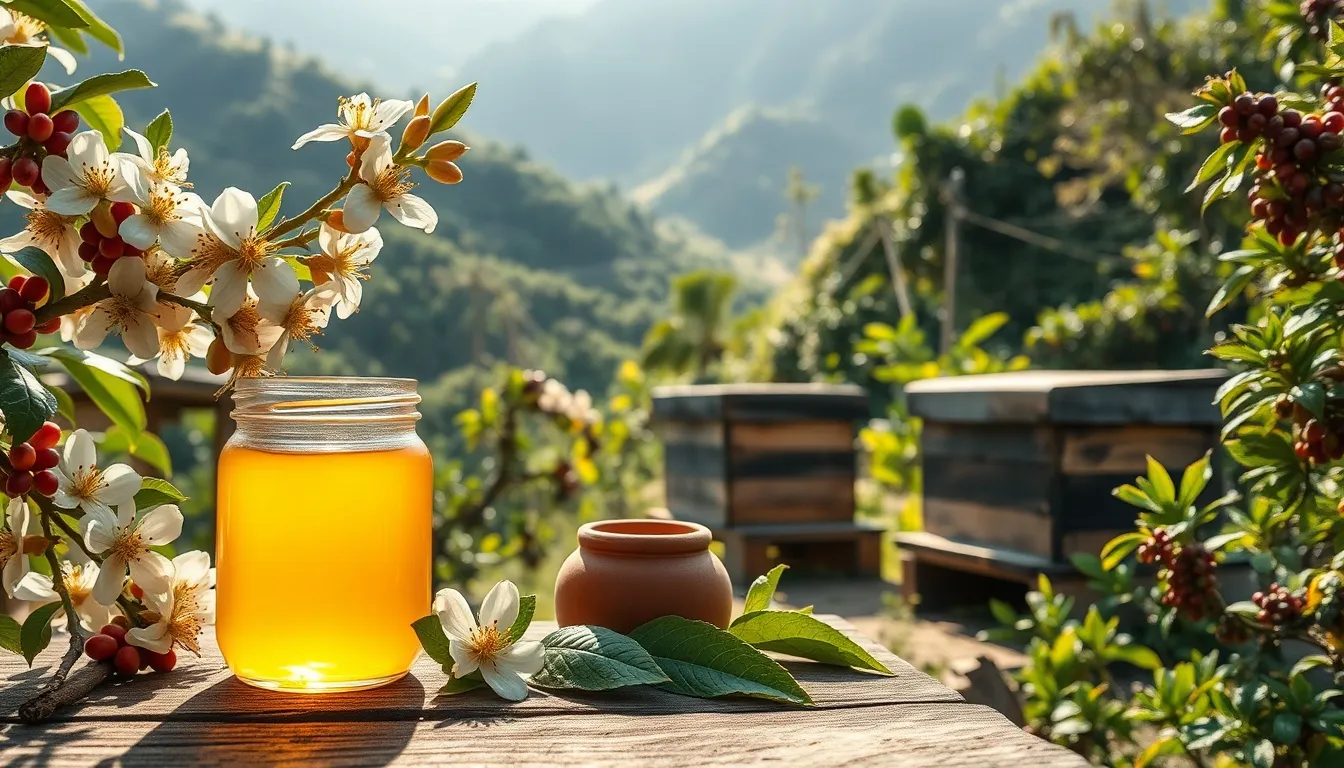
Coffea arabica in Colombia blooms twice per year: the principal flowering (florección) in March–May, triggered by the first rains after the dry season (verano), and a secondary flowering (traviesa) in September–November. Both flowering events produce large quantities of delicate white five-petalled flowers with a strong jasmine-citrus fragrance, abundant in nectar for approximately five to eight days per individual bloom. For beekeepers with apiaries on or near coffee farms — which is most of the coffee-zone beekeeping in Caldas, Risaralda, Quindío, and the coffee-growing areas of Huila and Nariño — coffee blossom provides one of the most reliable and distinctive nectar flows of the year.
Coffee blossom honey is pale to light amber, with a mild, clean sweetness and a delicate floral note that experienced tasters associate with jasmine, white flower, and — when the honey is particularly fresh and raw — a faint mineral-herbal quality reminiscent of the bloom itself. The flavor is not 'coffee-tasting' in the familiar roasted-bean sense: raw Coffea arabica nectar carries the aromatic compounds of the unroasted plant, which are floral and sweet rather than bitter. Some tasters note a mild citrusy finish, consistent with the known volatile chemistry of coffee blossom (primarily linalool, benzaldehyde, and various monoterpene esters — the same compounds that give washed Geisha and Ethiopian natural coffees their signature aromatic complexity at the green-bean stage). Crystallization is moderate — typically two to four months to full granulation — because coffee blossom honey has a balanced fructose-to-glucose ratio near the slow-setter range.
Monofloral coffee blossom honey is most reliably produced in the Huila and Nariño departments, which are Colombia's most geographically concentrated specialty coffee zones and which have high proportions of shade-grown and mixed-system farms where forest-edge flora supplements the coffee bloom. The Cauca department — Colombia's most recent addition to the international specialty coffee map — also produces coffee blossom honey from the indigenous Nasa and Misak communities who maintain beekeeping traditions alongside their coffee farming. Labeled 'miel de café' (coffee honey) or 'miel de flor de café' (coffee blossom honey) in Colombian specialty food markets, authentic coffee blossom honey from identified farms or cooperatives is sold in Bogotá's Usaquén farmers' markets, Medellín's Mercado del Río, and the specialty food sections of Juan Valdez Café stores.
Pro Tip
The most reliable source of authenticated coffee blossom honey in Colombia is direct purchase from beekeepers at the Feria Nacional Agropecuaria in Medellín (Antioquia, August), the Expo Café specialty coffee events in Armenia (Quindío), or through the Federación Nacional de Apicultores de Colombia (FENAPICOL) producer network. Coffee-blossom honey labeled with a department of origin and harvest date is the authentic form; 'miel silvestre' (wild honey) without botanical sourcing may be coffee blossom or any other variety.
Get the Honey Buyer's Cheat Sheet (free PDF)
16 varieties on one page — color, flavor, best use and what a fair price looks like — from the 304 honeys we track.
Andean Cloud Forest Wildflower — High-Altitude Honey from the Cordillera
Colombia contains the world's highest concentration of plant diversity per unit area — approximately 55,000 plant species, nearly 30% of which are endemic to the country — and the Andean cloud forest zone (bosque andino nublado) between 2,000 and 3,200 metres above sea level is the most botanically complex component of this diversity. The cloud forest is characterized by perpetual mist, high rainfall, dramatically reduced sunlight, and an extraordinarily rich epiphytic flora: orchids (Colombia is home to over 4,000 species, including 1,500+ endemic to Andean altitude zones), bromeliads, Heliconia, and dozens of native Andean shrub and tree species — including many from the Ericaceae family (heaths, blueberry relatives), Asteraceae (the daisy/composite family, which includes many nectar-rich highland species), and the distinctive Espeletia (frailejón) of the páramo zone above 3,000 metres.
High-altitude Andean wildflower honey from Colombia's cloud forest zone is one of the most botanically complex honeys produced anywhere in the world. The nectar sources span elevation gradients, seasonal microclimates, and dozens of plant families simultaneously active at different times of year — meaning a productive hive at 2,200 metres in the Cundinamarca department above Bogotá, or in the Eastern Cordillera forests above Mérida and Sogamoso, is collecting from an extraordinarily diverse botanical palette with every foraging season. The resulting honey is dark amber to amber-brown, with a rich, herbal-resinous character that varies substantially between regions and harvest cycles. Notes of dried fruit, mild citrus, herbal bitterness (from Asteraceae compounds), and a distinctive mineral finish are characteristic of genuine Andean cloud-forest wildflower honey.
The páramo zone — the high Andean grassland and shrubland ecosystem above the cloud forest line, between 3,000 and 4,500 metres — is technically beyond the practical range of Apis mellifera apiculture (cold temperatures and thin air limit foraging efficiency above 3,000 metres), but native bumblebees (Bombus spp.) and several Meliponini species exploit the páramo flora. Frailejón honey (from Espeletia spp., the distinctive silver-leafed giant groundsel of the Colombian and Venezuelan páramos) is produced in very small quantities by Bombus and some Trigona stingless bees at elevations approaching 3,000 metres and has an intensely herbal, slightly bitter character. It is a curiosity item, not a commercial product, but its existence as a documented honey type reflects the extreme botanical diversity of Colombia's high-altitude ecosystems.
Angelita and Meliponicultura — Colombia's Pre-Columbian Stingless Bee Tradition
Colombia has one of the richest stingless bee (Meliponini) heritages of any country in the Americas. The country is home to more than 100 Meliponini species — approximately 25–30% of the total world species count — ranging from the tiny Trigonisca and Plebeia species to the larger Melipona and Scaptotrigona bees. The most commercially significant stingless bee in Colombia is Tetragonisca angustula, known locally as the angelita (little angel) or limoncillo bee. The angelita is widespread throughout the Caribbean lowlands, Andean foothills, and Pacific coast up to approximately 2,000 metres of altitude — it is tolerant of disturbed landscapes and human-managed environments to a degree unusual among stingless bees, making it the most common species in traditional rural meliponicultura.
Pre-Columbian meliponicultura in Colombia was most extensively practiced by the Zenú people of the Caribbean coastal lowlands (Córdoba, Sucre, and Bolívar departments), the Muisca confederation of the Altiplano Cundiboyacense (the high plateau around Bogotá), the Emberá and Wounaan of the Pacific coast, and various Amazonian communities. Honey was used as a medicine, ritual offering, food preservative, and currency in pre-contact Colombian societies. Spanish colonial records from the 16th and 17th centuries document the Zenú maintaining large-scale meliponicultura in hollowed-log hives (similar to the Mexican melario), with communal honey harvests organized around seasonal bloom calendars. These traditions survived in fragmentary form in the Zenú and Emberá communities and have been revived and expanded in the last 30 years as part of Colombia's indigenous cultural-heritage recovery programs.
Angelita honey is distinctly different from Apis mellifera honey in flavor, chemistry, and culinary application. The honey is typically very liquid (higher moisture content, usually 25–35%, compared to 17–19% in Apis honey), intensely sour due to high organic acid content (primarily gluconic acid, citric acid, and lactic acid from the more diverse microflora active in Meliponini pots), and has a complex flavor profile that combines honey-sweetness with fruity-sour acidity — experienced tasters describe angelita honey as honey-meets-fruit-vinegar, or as a honey with a built-in acidic brightness that Apis mellifera honey lacks entirely. Its high water activity (aw ~0.85–0.90 compared to 0.60 in Apis honey) means it ferments rapidly at room temperature; authentic angelita honey must be stored refrigerated or consumed within days of harvest. The fermentation itself is considered desirable in many indigenous traditions, producing a mild alcoholic-honey beverage (chicha de miel) that has been part of Zenú, Emberá, and Amazonian ceremonial culture for millennia.
Pro Tip
Angelita honey should be treated as a perishable fresh food, not a shelf-stable sweetener. In Colombia, it is sold in small containers (50–250ml) at indigenous community markets, cultural centers, and specialty food retailers in Cartagena, Montería, and Bogotá (particularly at the Mercado de las Pulgas and indigenous craft markets in La Candelaria). It should be refrigerated after opening and consumed within one to two weeks for best flavor and food safety. Authentic angelita honey from identified communities will typically come with the producer's name, community, and harvest date — the same provenance standards applied to specialty coffee.
Regional Honey Zones — From the Caribbean Coast to the Amazon Basin
Colombia's honey-producing landscape is divided by the three Andean cordilleras (Occidental, Central, and Oriental) and extends from the Caribbean coast in the north to the Amazon basin in the south, with Pacific coast and Orinoquía llanos zones providing additional honey-producing environments. Each ecological zone produces honey with a distinct character shaped by its dominant flora, climate, and bee species. The Caribbean lowlands (Costa Atlántica) — including the departments of Atlántico, Bolívar, Sucre, Córdoba, La Guajira, and Magdalena — produce honey primarily from tropical savanna and deciduous forest flora: maracuyá (Passiflora edulis, passion fruit), mango (Mangifera indica, naturalized), various tropical Leguminosae, and the palms and coastal shrubs of the Guajira Peninsula. Caribbean honey tends toward lighter amber with a tropical-sweet character.
The Orinoquía (Llanos Orientales) — the vast tropical grassland plains of Casanare, Arauca, Meta, and Vichada departments — produces honey primarily from the gallery forests along rivers and seasonal wetlands, including tropical Leguminosae trees (alcornoque, tara, acacias), the native Mauritia flexuosa moriche palm, and various savanna-edge wildflowers. The llanos are also home to some of Colombia's most extensive stingless bee habitats, with large populations of Scaptotrigona, Melipona, and Trigona species exploiting the diverse gallery forest flora. Orinoquía wildflower honey from the gallery forests of Casanare and Meta has an amber, herbal-caramel character with regional notes of moriche palm blossom.
The Colombian Amazon (Amazonas, Putumayo, Caquetá, Vaupés, Guainía departments) is dominated by Meliponini stingless bees and by indigenous honey-gathering traditions (including honey from wild Apis mellifera colonies that naturalized in Amazonian Colombia after their introduction in the 19th century). Amazon honey is primarily produced by Melipona spp. (uruçu, jandaíra, mandaçaia — regional names vary by community and language group) and by Trigona spp. in tree-cavity and termite-mound hives. Amazon honey tends to be dark, intensely acidic, and complex — reflecting the extraordinary botanical diversity of the Amazon basin flora, including Brazil nut (Bertholletia excelsa), cacao (Theobroma cacao), and hundreds of named and unnamed Amazonian nectar species that no systematic honey-source survey has yet fully catalogued.
Colombia's Honey Regulations — INVIMA, NTC 1292, and the Certification Gap
Colombia's honey regulatory framework is administered by INVIMA (Instituto Nacional de Vigilancia de Medicamentos y Alimentos), the national food safety authority. The primary honey quality standard is NTC 1292 (Norma Técnica Colombiana 1292), Colombia's national honey standard, which aligns with Codex Alimentarius CODEX STAN 12-1981 in its principal quality parameters: moisture ≤20%, HMF ≤40 mg/kg, diastase activity ≥8 Schade units, free acidity ≤50 mEq/kg, sucrose ≤5% (with exceptions for specific floral sources). For export, Colombian honey producers must meet INVIMA certification and demonstrate compliance with importing country standards — primarily EU Honey Directive 2001/110/EC and USDA requirements for the US market.
The domestic Colombian honey market has a documented adulteration problem, though less severe than some other Latin American countries: studies by the Universidad Nacional de Colombia and INVIMA-commissioned surveys have found varying proportions of adulterated honey in retail markets, with adulteration primarily through addition of sugars (panela syrup, cane sugar syrup) and — in some cases — corn syrup. The Federación Nacional de Apicultores de Colombia (FENAPICOL) has advocated for mandatory labeling improvements, expanded laboratory testing infrastructure, and consumer education programs, with some progress in the 2020–2025 period. The NTC 1292 standard provides the legal framework but enforcement capacity at the retail level remains limited, particularly for informal-market and small-producer channels.
Colombia does not yet have a geographic indication (GI) system for honey varieties equivalent to the EU's PDO/PGI framework. The Colombian Superintendencia de Industria y Comercio (SIC) administers Colombia's GI program, primarily focused on coffee (Café de Colombia — Colombia's most prominent GI product), Cartagena gold jewelry, and several agricultural products. Discussions around GI status for Huila coffee-blossom honey and Nariño Andean wildflower honey have been raised in academic and policy circles but have not progressed to formal registration. The coffee industry's 60-year investment in building the Café de Colombia brand (and its iconic Juan Valdez farmer persona) provides a template that Colombian honey advocates point to — but the institutional infrastructure, cooperative organization, and export-market development that the coffee GI required has not yet been replicated for honey.
How to Buy Colombian Honey — In Colombia and Abroad
In Colombia, the most reliable access to authentic botanical-variety honey is through FENAPICOL-affiliated producers and regional beekeeping cooperatives. Urban specialty food markets are the best starting point: Bogotá's La Paloquemao market (La Perseverancia section) and Usaquén artisan market carry a range of regional Colombian honeys; Medellín's Mercado del Río and La Minorista have honey stalls with producers from Antioquia, Caldas, and Risaralda; Cali's Galería Alameda has Valle del Cauca producers. The Juan Valdez Café chain — Colombia's coffee brand retail arm — has experimented with stocking labeled Colombian honey in some stores, particularly coffee-blossom honey from Huila and Nariño, making it one of the few retail channels where authenticated coffee-territory honey is consistently available.
Outside Colombia, authentic Colombian honey is rare. Some US specialty food importers carry Colombian honey under various private-label brands, primarily from Antioquia and Huila — check specialty honey retailers, Latin American food importers, and online artisan food platforms. German and Dutch natural food importers occasionally carry Colombian honey as part of 'South American raw honey' ranges, though Colombian varieties are less systematically available than Argentine or Brazilian honey. Colombian stingless bee honey (angelita, Melipona) is essentially unavailable outside Colombia except through direct purchase from community cooperatives or through the occasional specialty food importer serving the Colombian diaspora market.
Price as an authenticity signal: bulk Colombian wildflower honey (undifferentiated, no botanical sourcing) is sold in Colombian supermarkets — competitive with or below Argentine import pricing. Labeled botanical-variety honey from identified producers — coffee blossom, Andean wildflower with a specific departmental origin, or cloud-forest honey with a farm name — is sold in specialty channels. Angelita stingless bee honey from FENAPICOL-registered Zenú or Emberá producers is sold — reflecting its very low per-colony yield (300–500g per year, versus 20–40 kg for Apis mellifera) and the labor intensity of harvesting from traditional log hives.
Pro Tip
The single most useful indicator of Colombian honey quality is the presence of a botanical source identifier on the label: 'miel de flor de café' (coffee blossom), 'miel de bosque andino' (Andean forest wildflower), or 'miel de angelita' (Tetragonisca angustula stingless bee honey) with a named department or community. Honey labeled only 'miel pura' or 'miel natural' without a botanical or geographic identifier is likely an undifferentiated blend. The FENAPICOL quality mark, where present, confirms INVIMA registration and minimum NTC 1292 compliance.