The Madrid Codex Bees: Mexico's 3,000-Year Honey Paradox
Mexico occupies a position in world honey geography that is simultaneously mainstream and entirely overlooked. As a commercial honey producer, Mexico is a major global player — consistently ranked among the world's top ten honey exporters, shipping between 55,000 and 65,000 metric tonnes annually according to FAO data, with the Yucatan Peninsula supplying the majority of its export tonnage to European Union markets. Yet in the world of premium, specialty, and artisan honey, Mexico is almost invisible — perceived by most Western consumers as a commodity source rather than a terroir destination. This commercial visibility combined with specialist invisibility is the Mexican honey paradox. And it conceals one of the most historically significant honey traditions on Earth.
The framing device that makes Mexico unlike any other honey-producing country is a single bee: Melipona beecheii — known in Yucatec Maya as Xunan Kab, meaning "Royal Lady Bee" or "Virgen Lady Bee." Melipona beecheii is a small, stingless social bee of the family Apidae, subfamily Meliponini, and it is one of the very few bee species ever deliberately domesticated by a pre-agricultural civilisation. For at least three thousand years — and almost certainly considerably longer — the ancient and modern Maya of the Yucatan Peninsula, Campeche, Quintana Roo, and Belize have kept Xunan Kab in specially constructed hollow log hives called jobones. The Madrid Codex (Codex Tro-Cortesianus), one of the three surviving pre-Columbian Maya screenfolded books now held in Madrid, devotes pages 103 through 112 — a continuous block of text and iconography — to beekeeping almanacs, ritual calendars for honey harvest, and depictions of the bee deity Ah-Muzen-Cab. This is the most extensive pre-Columbian beekeeping document in existence. No other culture in the Western Hemisphere produced anything comparable, and very few in the Eastern Hemisphere match it.
This guide explores both dimensions of Mexican honey: the modern commercial story (the Yucatan Apis mellifera honey industry, the Africanized bee transformation, regional monoflorals from Tabasco to Sonora) and the far older story of the Maya and their Xunan Kab. Understanding both is essential to understanding why Mexico's honey deserves a place alongside Greece, New Zealand, and Yemen in the conversation about the world's most culturally and botanically significant honey origins. For comparative context on other Latin American honey traditions, see our World Honey Guide.
Xunan Kab: The Royal Lady Bee and the Maya Beekeeping Tradition
Melipona beecheii is a small bee — workers approximately 10–12 mm in length, dark brown to black with pale yellow abdominal banding — that builds enclosed nest chambers in hollow tree trunks and rock crevices rather than exposed combs. It is stingless (males and females lack functional stinging apparatus; the only defensive mechanism is biting), produces significantly smaller honey stores than Apis mellifera (a productive M. beecheii colony yields 1–3 kg of honey per year, compared to Apis mellifera's 20–80 kg), and maintains much smaller colony sizes (2,000–3,000 workers versus Apis mellifera's 30,000–80,000). These characteristics make Melipona a less productive honey bee by the standards of industrial beekeeping, but they are entirely beside the point when viewed in cultural context: the Maya did not domesticate Xunan Kab for industrial scale production. They domesticated it for a honey of unique medicinal and ceremonial significance, for a sustainable low-management system compatible with forest agriculture, and for a relationship with the bee that was embedded in religious, calendrical, and cosmological practice.
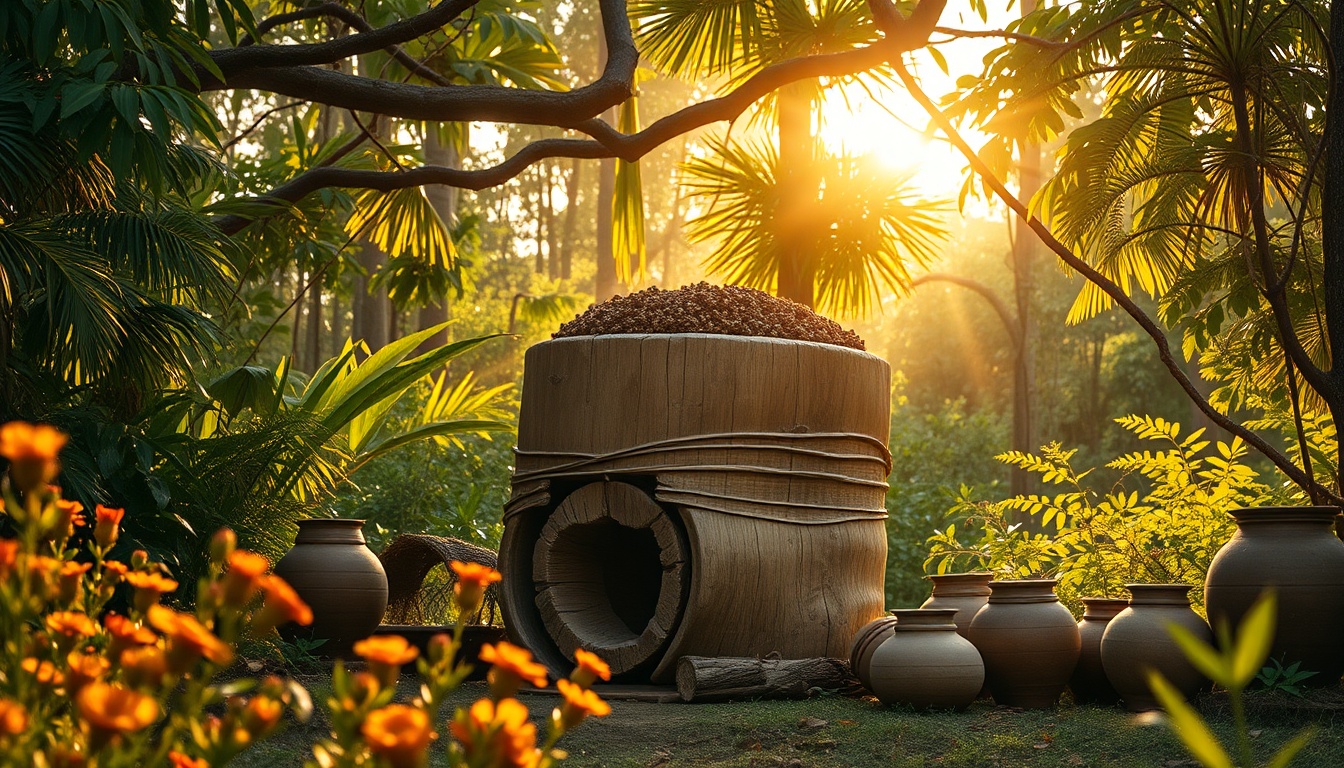
The traditional Maya jobón is a hollow log section 30–50 cm long and approximately 15 cm in diameter, cut from specific tree species that resist moisture and rot — traditionally Manilkara zapota (the sapodilla, whose fruit also gives chewing gum), Brosimum alicastrum (ramón), or Haematoxylum campechianum (logwood). The log is sealed at both ends with flat wooden caps or clay discs, with a small entrance hole drilled for the bees and a thin mud tube built by the colony for entrance defense. Jobones are traditionally stacked horizontally on wooden platforms or in dedicated stone structures (apiaries visible in archaeological sites in the Puuc Hills region of Yucatan). The hive management cycle — when to open the colony, when to extract honey, how to split colonies for propagation — was governed by the Maya ritual calendar and documented in the beekeeping almanacs of the Madrid Codex. The deity Ah-Muzen-Cab (also spelled Ah-Muzen-Kab or Ah Muzen Cab) — depicted as a human figure with bee wings, descending from the sky — was the patron of beekeeping, and ritual offerings to him governed the harvest. This is not mythology in a dismissive sense: it is a sophisticated management system encoded in religious narrative, ensuring that colonies were harvested at biologically appropriate moments and that swarm cycles were managed correctly across a distributed network of hives.
The biochemistry of Xunan Kab honey reflects the bee's biology and the Yucatan's botanical richness. Melipona honey has substantially higher water content than Apis honey — typically 25–35% versus Apis mellifera's ≤20% target — because Melipona colonies lack the large worker populations and high-airflow nest ventilation that drive rapid moisture reduction in Apis honeys. This higher moisture makes Melipona honey thinner and more susceptible to fermentation than Apis honey, meaning it must be harvested carefully, stored in sealed containers, and consumed relatively promptly. The acidity is higher than Apis honey: pH typically 3.0–4.5 with significant lactic acid, gluconic acid, and citric acid fractions, giving the honey a pleasantly tart, tangy quality unlike the straightforward sweetness of conventional honey. The sugar profile differs as well: trehalulose — the unusual disaccharide found also in Malaysian kelulut honey and the only known natural food source of trehalulose at dietary-relevant concentrations outside stingless bee honey — appears in Melipona honey, contributing to its complex sweetness. The polyphenol and flavonoid content of Xunan Kab honey has been studied by researchers at ECOSUR (El Colegio de la Frontera Sur in San Cristóbal de las Casas, Chiapas) and found to be significantly higher than comparable Apis honey from the same region, consistent with the broader research profile of stingless bee honey as a high-antioxidant product. The aroma is more complex and aromatic than most Apis honey: floral, fruity, and subtly fermented, reflecting the diversity of the Yucatan forest flora and the unique fermentative micro-environment of the Melipona nest chamber.
Get the Honey Buyer's Cheat Sheet (free PDF)
16 varieties on one page — color, flavor, best use and what a fair price looks like — from the 304 honeys we track.
Yucatan Peninsula: The Commercial Honey Heartland
The Yucatan Peninsula — encompassing the states of Yucatán, Campeche, and Quintana Roo — is Mexico's dominant honey-producing region, responsible for approximately 35–40% of national production and a large majority of honey exports. The peninsula's unique geography drives its honey character: a flat limestone karst plain with no rivers (all water flows underground through the cenote cave system), a seasonally dry deciduous forest and savanna landscape dominated by melliferous plant species that provide reliable, abundant nectar flows, and a climate that supports two distinct honey seasons rather than the single annual cycle of temperate beekeeping. The tropical dry forest (selva baja caducifolia) of the Yucatan is home to hundreds of melliferous plant species — leguminous trees, composites, labiates, and shrubs that produce nectar of high sugar concentration across a long blooming calendar.
The major nectar sources for commercial Apis mellifera honey in Yucatan include tzalam (Lysiloma latisiliquum), a dominant leguminous tree of the dry forest whose bloom in March–May produces a pale, mild, high-fructose honey; chakah (Bursera simaruba), the "tourist tree" (its red bark peels like sunburned skin) contributing a clear, light honey in the dry season; and a complex mix of flowering shrubs and secondary growth plants in the rainy season (June–October). The result is a multi-flora honey of genuine complexity — amber to pale gold, mildly floral-sweet with botanical depth, excellent for all culinary uses — offering more intricate tropical forest character than pure clover honey from North American agricultural monocultures while sharing clover honey's mild sweetness foundation enhanced by limestone karst minerality unique to Yucatan Peninsula geological formations. This tropical complexity has earned Mexico a reliable market position with European honey buyers, particularly in Germany, the United Kingdom, and Switzerland. Yucatan honey is certified for EU import under standard EOS regulations, and several co-operative networks in the region (including the Mayan cooperative networks supported by development organizations) hold organic certification and fair-trade membership, commanding premium prices in niche markets.
Campeche state, the western portion of the peninsula, has become particularly important for Mexican honey export quality in recent years. The state government and local beekeeping associations have invested in quality infrastructure — refractometers for moisture control, centrifugal extractors, stainless steel storage tanks, and laboratory testing partnerships — that have brought Campeche honey up to the quality standards required for premium EU market access. Campeche's honey is generally regarded as slightly higher quality than average Yucatan production by specialty importers, with better moisture control, lower HMF readings, and more consistent botanical character. The export market for Campeche honey has grown significantly since the early 2000s, driven in part by EU regulatory scrutiny of imported honeys from other regions that led buyers to diversify sourcing toward Mexico's better-controlled production.
The Africanized Bee: Reframing Mexico's Most Misunderstood Story
No discussion of Mexican honey can avoid the Africanized honeybee — the so-called "killer bee" that arrived in Mexico in the mid-1980s and permanently transformed the country's commercial beekeeping sector. The story begins in Brazil in 1956, when geneticist Warwick Estevam Kerr of the University of São Paulo imported 35 Tanzanian queen bees (Apis mellifera scutellata) to the Ribeirão Preto research station, intending to crossbreed them with the docile European stock then used for Brazilian commercial beekeeping, in hopes of producing a more productive tropical bee. In 1957, twenty-six of the African queens and their colony swarms escaped their experimental enclosure during a visitor's inadvertent removal of a queen excluder. The escaped swarms interbred with wild and managed European colonies throughout Brazil, and the hybrid progeny — now called Africanized honeybees (AHB), or colloquially "killer bees" — spread northward through Central America at approximately 400 km per year, reaching Mexico's southern border in the mid-1980s and arriving in the Yucatan by approximately 1987.
The "killer bee" label captures a real behavioral difference: Africanized colonies are significantly more defensive than European Apis mellifera stocks, responding to threats with faster, larger, more sustained mass stinging than European bees. The defensive radius around the hive is larger, the alarm-pheromone threshold for triggering defensive flight is lower, and the number of workers committed to defense is substantially higher. This creates genuine management challenges for beekeepers — Africanized colonies require more protective equipment, calmer handling, and greater care around hive-adjacent activities. For unskilled individuals who encounter wild Africanized swarms in agricultural or suburban settings, the risk of mass envenomation is real, and fatalities (primarily in elderly people with cardiovascular conditions or individuals with allergic reactions) have occurred. The "killer bee" reputation is not fabricated.
What the "killer bee" reputation entirely obscures is the Africanized bee's exceptional performance as a honey producer in tropical conditions. Apis mellifera scutellata and its Africanized hybrids show several traits that make them superior to European stock in tropical environments: higher foraging activity across a wider temperature and humidity range; stronger resistance to Varroa destructor (the devastating parasitic mite that has collapsed European Apis mellifera populations globally, requiring chemical treatment in managed hives); better adaptation to the irregular nectar flows of tropical dry forests; and stronger hygienic behavior (a bee colony trait associated with disease resistance). In practical terms, Africanized colonies in Mexico's Yucatan and southern states consistently outperform European colonies in raw honey yield under tropical management conditions — the productivity of the Yucatan honey industry has not declined since Africanization but in some respects improved. The honey they produce is identical in quality to European-bee honey from the same floral sources: the bee's defensive behavior does not affect the honey's composition, flavor, or purity. Mexican Yucatan honey — the same jar on a European supermarket shelf — demonstrates quality equivalent to German forest honey from European stock, but with tropical forest botanical complexity impossible to replicate in temperate climates, and has been overwhelmingly produced by Africanized bees for nearly four decades.
Regional Monoflorals: Tahonea, Coffee Blossom, Avocado & More
Beyond the Yucatan's multi-flora and Melipona honey, Mexico produces a range of genuinely distinctive regional monoflorals whose character is shaped by the extraordinary botanical diversity of its ecosystems — from the humid coastal lowlands of Tabasco and Veracruz to the Chiapas highlands, the Michoacán avocado belt, and the arid Sonoran Desert borderlands. Tahonea honey (from Viguiera dentata, known locally as tajonal or tahonal) is perhaps Mexico's most commercially significant monofloral outside the peninsula's multiflora category. Viguiera dentata, a tall yellow-flowered composite plant of the Asteraceae family (a cousin of the sunflower, though not a commercial sunflower variety), blooms prolifically across the Yucatan savanna and scrub from October through December, providing a distinct late-season nectar flow. Tahonea honey has a characteristic flavor profile: golden amber in color, with a mildly herbal, slightly pungent edge and a rich, full-bodied sweetness that distinguishes it clearly from the spring multi-flora. It crystallises at a moderate rate. Small volumes of single-variety tahonea honey are marketed by Yucatan cooperatives and specialty producers who manage hives to capture the November tahonea flow separately from the spring and summer multi-flora.
Chiapas and Oaxaca states, in Mexico's southern highlands, produce coffee blossom honey of genuine distinction — an analogue of the Ethiopian and Vietnamese coffee blossom honeys but from Mexican Coffea arabica and Coffea canephora plantings in the Sierra Madre de Chiapas, Soconusco, and Sierra Sur de Oaxaca. Mexican coffee blossom honey showcases unique highland volcanic soil minerality and high-altitude precision impossible to replicate at lower elevations, creating more concentrated aromatic complexity than sea-level coffee plantation varieties from other origins. Coffee blossom honey has an extremely brief harvest window — coffee trees bloom for only 7–10 days per year, typically in January–March in Mexico's highlands — making it one of the most ephemeral of monofloral opportunities. The honey is pale to cream-white (the nectar sugar profile favours rapid crystallisation), with a delicate floral-sweet aroma and a clean, mild flavor carrying a trace of coffee-flower note — nothing like brewed coffee, but distinctly botanical in a way that connects it to the plant. The coffee-blossom honey window is so short that most highland Chiapas beekeepers capture only a partial monofloral flow; pure single-origin coffee blossom honey is rare even in Mexican domestic markets. Small production cooperatives in the Soconusco region and the ISMAM cooperative (Indígenas de la Sierra Madre de Motozintla San Isidro Labrador) have produced certified organic multi-flora honey from the coffee-growing highlands, though not typically as a declared monofloral.
Michoacán and Guerrero states in western Mexico produce avocado blossom honey — from the blossoms of Persea americana var. drymifolia (the native criollo avocado) and commercial Hass varieties grown across the Tierra Caliente region. Avocado blossom honey is unusual in commercial markets because avocado flowers have a complex sexual dimorphism that makes them difficult to manage as monofloral sources — they produce nectar only on specific days of the two-day bloom cycle, and the nectar is relatively low in sugar concentration. The resulting honey, when captured as a near-monofloral, is dark green-black (one of the few honeys with green tones, from chlorophyll compounds), with a strong, distinctive herbal-bitter flavor unlike any other common honey type. Michoacán avocado honey is a genuinely niche product — sought by specialty food buyers precisely for its unusual color and flavor, but commercially challenging to produce consistently. Additional regional monoflorals include: orange blossom honey from Veracruz and Jalisco citrus orchards showcasing Mexican limestone terroir creating more complex mineral undertones compared to Florida's sandy coastal soil producing cleaner citrus expression with year-round bloom concentration; eucalyptus honey from Jalisco, Puebla, and Michoacán reforestation plantations (amber, mild medicinal-sweet); and wildflower honey from the Sonoran and Chihuahuan desert regions along the US border, where the arid landscape produces intense, concentrated nectars from agave relatives, mesquite (Prosopis species), and desert wildflowers during the brief wet season contrasting Texas wildflower's more humid climate botanical sources.
NOM-036 and the Regulatory Landscape for Mexican Honey
Mexican Apis mellifera honey production is regulated under NOM-036-ZOO-1994 (Norma Oficial Mexicana), the national official standard governing honey production, processing, storage, and labelling. The standard is administered by SENASICA (Servicio Nacional de Sanidad, Inocuidad y Calidad Agroalimentaria), Mexico's national agricultural health service under SAGARPA (now SADER, Secretaría de Agricultura y Desarrollo Rural). NOM-036-ZOO-1994 sets parameters broadly consistent with Codex Alimentarius CXS 12-1981 guidelines: moisture ≤20% for most blossom honey (with tolerance to 21% for honeydew honey), HMF ≤80 mg/kg (somewhat more lenient than the EU's ≤40 mg/kg, reflecting the higher ambient temperatures of Mexican production and storage conditions), minimum diastase activity (≥8 Schade units, with exemption for naturally low-diastase varieties such as citrus), reducing sugars ≥65 g/100g, sucrose ≤5%.
A critical regulatory gap exists for Melipona honey: NOM-036-ZOO-1994 applies exclusively to Apis mellifera honey. There is no equivalent national standard for Meliponini (stingless bee) honey in Mexico, leaving Xunan Kab and other Melipona products without a defined regulatory framework at the federal level. This gap has several practical consequences. Without a defined standard, Melipona honey cannot be officially certified or graded in the same way as Apis honey, which complicates formal export. The higher natural moisture content of Melipona honey (25–35%) would fail NOM-036-ZOO-1994's moisture limit if measured against the Apis standard — creating a regulatory mismatch for a product that is not defective but simply biochemically different. Several Mexican states with significant Melipona beekeeping traditions — Yucatán, Campeche, and Chiapas — have developed state-level meliponiculture programs and informal quality frameworks, but these are not nationally harmonized. This contrasts with Malaysia, which developed MSM 2683:2017 specifically to regulate stingless bee honey as a separate product category with appropriate parameters, and with Brazil, which has published a dedicated MAPA regulation for Meliponini honey (IN 11/2020). Mexico's lack of a federal Melipona honey standard is widely recognized within the meliponiculture community as a barrier to formal market development, and revision is under discussion as of 2026.
For export honey, Mexico works within the EU's import regulatory framework, which requires third-country honey to meet standards equivalent to EU Directive 2001/110/EC. Mexican honey entering the EU must demonstrate moisture ≤20%, HMF ≤40 mg/kg (despite Mexico's domestic standard permitting 80 mg/kg, EU-bound exports must comply with the stricter EU limit), and must pass residue testing for antibiotic residues (chloramphenicol, streptomycin, oxytetracycline, tylosin), heavy metals, and pesticides. Mexico has historically maintained a reasonably clean record in EU honey import controls compared to some competing sources — RASFF (Rapid Alert System for Food and Feed) notifications for Mexican honey are relatively infrequent — which has supported Mexico's position as a trusted EU honey supplier. The EU–Mexico Global Agreement (2018 update) includes agricultural provisions that facilitate honey trade, and Mexico is one of the EU's top third-country honey sources by volume.
Xunan Kab Conservation: The Endangered Heritage Bee
The Maya beekeeping tradition with Melipona beecheii is not merely historically interesting — it is actively endangered. Wild populations of M. beecheii have declined significantly across the Yucatan Peninsula over the past several decades, driven by deforestation, agricultural expansion (particularly soybean cultivation and citrus plantations replacing native forest), pesticide use in conventional agriculture (stingless bees, with their smaller colony populations and lower pest resistance than Apis, are particularly vulnerable to sublethal pesticide doses), and competition from introduced Apis mellifera colonies. The population in managed meliponiculture — jobón-kept hives maintained by Maya families — has also declined as younger generations migrate to urban areas and as the economic incentives for maintaining the low-yield, culturally intensive Melipona system diminish relative to Apis mellifera commercial beekeeping.
The conservation response has involved both government and civil society. ECOSUR — El Colegio de la Frontera Sur, a public research centre with campuses in San Cristóbal de las Casas and Chetumal — has been the primary academic institution studying M. beecheii biology, genetics, and traditional management since the 1990s. ECOSUR researchers have documented traditional jobon management practices, mapped the genetic diversity of wild M. beecheii populations across the peninsula, and published research on the biochemical properties of Xunan Kab honey. Their work has supported the development of modern meliponiculture protocols that maintain the traditional jobón system while incorporating improved honey extraction, quality control, and colony health monitoring. The NGO Koolel-Kab (Maya for "bee cooperative," operating in the municipality of Hopelchén, Campeche) has been working since 2012 to revitalize traditional meliponiculture among Maya women, providing training, access to markets, and documentation of traditional knowledge. The cooperative has received support from international fair-trade organizations and specialty food importers who recognize the cultural and commercial value of authentic Xunan Kab honey.
Several Mexican and international organizations have argued for GI (Geographic Indication) recognition for Xunan Kab honey from the Yucatan Peninsula — analogous to the EU's PDO/PGI system — that would protect the product name, production methods, and cultural provenance from imitation or dilution. As of 2026, formal GI registration has not been completed, but the conversation is active and parallels similar efforts for other indigenous Mexican foods (mezcal, tequila, and vanilla all have appellation or denomination of origin protection in Mexico under the IMPI system). The economic case for GI protection is clear: a jar of authenticated Xunan Kab honey with documented Maya meliponiculture origin retails at at specialty honey retailers in Europe and North America, compared to for commodity Yucatan Apis mellifera honey. The premium is attributable entirely to cultural provenance, botanical distinction, and extreme rarity — the same premium mechanics that drive Manuka and Wadi Doan Sidr prices in Western markets.
Buying Guide: Xunan Kab vs. Yucatan Multi-Flora
Purchasing Mexican honey as a Western buyer requires distinguishing between three distinct product categories with very different availability, price, and authenticity challenges. The first category — commodity Yucatan Apis mellifera multi-flora honey — is the most widely available and has the best price-to-quality ratio of any commercially available honey in its tier. Look for honey labelled with specific state of origin (Yucatan, Campeche, Quintana Roo) and a declared botanical composition (multi-flora, tahonea, tzalam). Cooperatives with fair-trade or organic certification offer the best quality assurance at this tier: the Mayan Honey cooperative networks in Yucatan and Campeche, and several SAGARPA-certified producer associations, export through specialty importers in the US and Europe. Named multi-flora, tahonal, and single-bloom lots are the ones worth asking about. Avoid cheap supermarket "Mexico honey" without specific regional or botanical designation — this is typically commodity export honey with minimal quality controls.
The second category — Xunan Kab (Melipona beecheii) stingless bee honey from the Yucatan or Campeche — is the premium Mexican honey for serious collectors and enthusiasts. Genuine Xunan Kab honey is extremely scarce outside Mexico and requires active sourcing. The most reliable approach is through artisan importers who maintain direct-trade relationships with specific Maya meliponiculture cooperatives: in the US, a small number of specialty honey retailers have established sourcing relationships with Yucatan and Campeche cooperatives; in the UK and Germany, similar specialist importers exist. In Mexico itself, Xunan Kab honey is available at specialty food markets in Mérida (the Mercado Lucas de Gálvez and specialty food shops in the historic centre), Campeche city, and Chetumal, and from cooperatives directly. Key authentication signals: natural tartness and thin consistency (higher water content than Apis honey — thinner than conventional honey, not viscous); pleasantly sour-fruity aroma; honey sold in small quantities (100–250g jars) with producer name and cooperative documentation; price benchmarks for verified authentic product. Be alert to counterfeit or adulterated "Mayan honey" marketed online without verifiable producer documentation — the high price of authentic Xunan Kab makes it a fraud target.
The third category — regional Mexican monoflorals — is the least documented and most difficult to source outside specialty channels. Tabasco tahonea, Chiapas coffee blossom, Michoacán avocado honey, and Oaxacan wildflower honey are rarely exported as declared monoflorals; most appear in Mexican domestic specialty food markets rather than international retail. When travelling in Mexico, the best sourcing locations are artisan food markets in Mérida, Oaxaca de Juárez (the Central de Abastos and organic food markets), San Cristóbal de las Casas (specialty food shops in the artisan market district), and producer cooperatives in the coffee-growing highlands of Chiapas and Oaxaca. Mexican honey sold at airport duty-free shops or tourist markets is typically multi-flora commodity honey regardless of labelling claims; the botanical specificity of artisan Mexican honey is almost exclusively available through specialist channels.