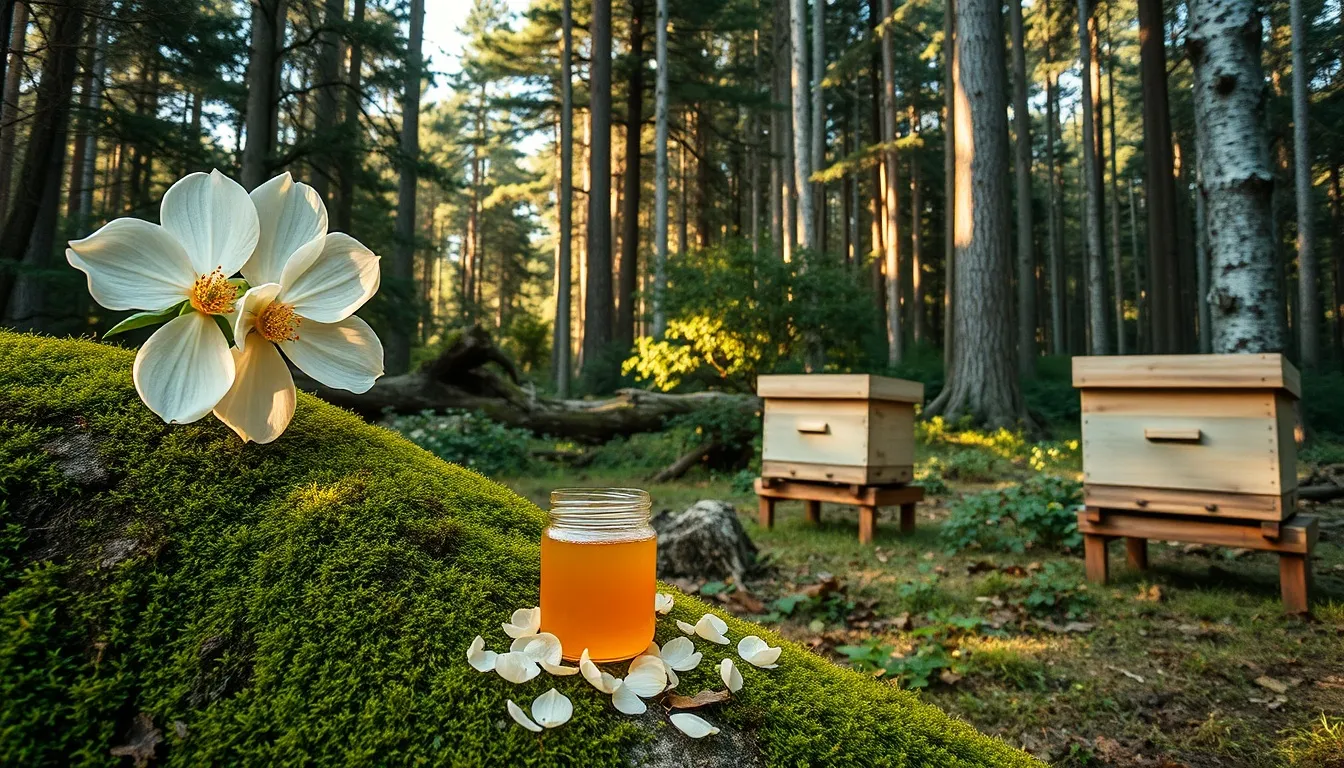
The Ulmo Paradox: Why the World's Most Bioactive South American Honey Has No Marketing Story
Chile produces one of the world's most botanically unusual honeys, from a plant genus shared with Tasmania's rarest wild honey, in a rainforest that survived the last ice age largely intact. Almost nobody outside Germany and Japan has heard of it. Ulmo honey — from Eucryphia cordifolia, the ulmo or muermo tree of the Valdivian temperate rainforest — is pale amber, mild, mildly floral, and produced in the ancient southern beech and coigüe forest zones of Biobío, La Araucanía, Los Ríos, and Los Lagos regions, at latitudes between 38°S and 43°S. Its closest botanical relative is Eucryphia lucida — the Tasmanian leatherwood, whose honey is Australia's most celebrated wild variety and stands out in premium food markets globally. Ulmo honey, from the same genus on the other side of the Pacific, sells into commodity markets at commodity prices, mostly in bulk to German importers who blend it into 'South American wildflower' — a commercial category that obscures its botanical identity completely.
The Gondwanan connection is not metaphorical. Eucryphia is a relict genus from the ancient supercontinent Gondwana, whose members now grow only in Chile and Tasmania — the two remnant fragments of temperate Gondwanan rainforest that survived the fragmentation of the southern landmasses. The genus split approximately 60 million years ago when Antarctica became too cold to serve as a biological bridge. Chilean Eucryphia cordifolia and Tasmanian Eucryphia lucida are botanically related in the same way that New Zealand kiwi fruit (Actinidia) and Chinese kiwi fruit are related — not identical, but from a shared ancient lineage. This matters for honey because the genus-level chemistry is partially conserved: both ulmo and leatherwood honeys have documented antimicrobial properties, mild floral-resinous flavor, slow crystallization, and a characteristic aromatic volatile profile. The specific compounds differ — leatherwood's distinctive pungency comes from terpenoid volatiles with no direct ulmo analog — but the bioactive foundation is the same genus-level chemistry.
Chile's honey industry processes approximately 7,000–10,000 tonnes of honey per year, and exports roughly 80–90% of total production — primarily to Germany (the single largest destination), the United States, Japan, and the United Kingdom. This export-intensity puts Chile in the same structural category as Argentina and New Zealand: a producer whose best varieties disappear into foreign value chains rather than building domestic premium-honey culture. The paradox is economic and marketing rather than botanical: the honey exists, the quality is documented, the plants are extraordinary, and yet the global consumer has no story to attach to it. 'Chilean ulmo honey' is an almost empty commercial category in international specialty food retail. This guide attempts to name what Chile actually produces — because the varieties are genuinely worth knowing.
Ulmo Honey — The Valdivian Forest's Defining Variety
Eucryphia cordifolia — known in Chile as ulmo or, less commonly, muermo — is a large evergreen broadleaf tree native to the Valdivian temperate rainforest, one of only five temperate rainforest zones in the world (the others are in Tasmania, New Zealand's South Island, the Pacific Northwest of North America, and Norway's Atlantic coast). The Valdivian rainforest spans a roughly 800-kilometer coastal strip of southern Chile from approximately 37°S (near the city of Temuco) to 43°S (around Chiloé Island), receiving 2,000–5,000 mm of rainfall annually and supporting a flora with more than 45% endemic species — including Fitzroya cupressoides (alerce, the world's second-longest-lived tree), multiple Nothofagus species (southern beeches), and the endemic Monkey Puzzle tree (Araucaria araucana). Eucryphia cordifolia reaches 30–40 meters in height, blooms with large white flowers in January and February (the peak of the Southern Hemisphere summer), and provides one of the most abundant nectar flows available to bees in southern Chilean forests.
The ulmo bloom window is compact — approximately four to six weeks in January–February — and bees exploit it intensively. The resulting honey is pale to medium amber, with a mild, clean sweetness and a delicate floral note that most tasters describe as mildly fragrant without the pungency that characterizes Tasmanian leatherwood honey. Unlike leatherwood, which has a self-authenticating aroma detectable by any experienced taster, ulmo honey's character is subtle enough that it blends invisibly into wildflower mixes — a fact that contributes to its commercial invisibility. Ulmo honey crystallizes slowly (typically three to six months to full granulation at room temperature) due to a relatively high fructose content, and is stable as a monofloral variety when produced from the dense ulmo stands of the Andes foothills and coastal mountain ranges of Los Ríos and Los Lagos.
Studies by Chilean research institutions — including INIA (Instituto de Investigaciones Agropecuarias) and Universidad de Concepción — have documented ulmo honey's antimicrobial activity against standard test organisms including Staphylococcus aureus and Escherichia coli, with inhibitory effects comparable to other documented raw honeys. The primary antimicrobial mechanism is hydrogen peroxide-dependent, generated by the enzyme glucose oxidase, as in most raw honeys — not the MGO-based, non-peroxide mechanism that makes manuka honey distinctive for wound care applications. This means that heating destroys ulmo honey's antimicrobial activity, and that its bioactive properties are most relevant in a raw form. Commercial ulmo honey sold in European markets is frequently heat-treated for filterability, which eliminates precisely the properties that differentiate it from generic wildflower honey.
Pro Tip
Authentic ulmo honey from small Chilean producers is sold with botanical source labeling (ulmo / miel de ulmo) and a regional identifier — Araucanía, Los Ríos, or Los Lagos are the key zones. Imported ulmo honey in German and Swiss specialty stores is the most reliable retail source outside Chile. In Chile, the Feria de Apicultura in Santiago and regional agricultural fairs in Temuco and Valdivia are the best direct-purchase venues.
Get the Honey Buyer's Cheat Sheet (free PDF)
16 varieties on one page — color, flavor, best use and what a fair price looks like — from the 304 honeys we track.
The Valdivian Rainforest Cluster — Tiaca, Murta, and Native Forest Honeys
Beyond ulmo, the Valdivian rainforest supports a cluster of secondary native-flora honey sources that together constitute 'miel de bosque nativo' (native forest honey) — a category recognized by Chilean beekeepers but without a formal designation or protected-origin status as of 2026. Tiaca (Caldcluvia paniculata, a member of the Cunoniaceae family — the same family as leatherwood) is a large-leaved forest tree that blooms in November–December, providing an early-season flow before ulmo. Tiaca honey is somewhat darker than ulmo, with a slightly more complex, mildly resinous character, and represents a genuine monofloral variety in the wetter forest zones of Los Ríos and Los Lagos. Commercial tiaca honey is rare: it is produced by small-scale beekeepers with apiaries in old-growth forest fragments and reaches specialty markets almost exclusively through farmers' markets and direct producer sales.
Murta (Ugni molinae, Chilean guava) is a native Myrtaceae shrub of the Chilean matorral and pre-Andean foothills that produces small red berries — the commercial basis of a Chilean artisan fruit industry — and also provides bee forage from its small fragrant flowers in October–November. Murta honey is light golden, mildly sweet, with a subtle fruity-floral character. It is more commonly produced in the Lake District (Región de los Lagos) and northern Patagonia, where murta grows at the interface between temperate rainforest and Andean steppe. Nalca (Gunnera tinctoria, giant Chilean rhubarb), copihue (Lapageria rosea, the Chilean national flower and sole member of the Philesiaceae family), and various Calceolaria species are minor but interesting additional nectar sources in the Valdivian zone — each producing distinctive trace-flavor components in wildflower-blend honeys from the region.
Chilean 'miel de aromo' deserves specific mention as a distinctly Chilean honey type. Aromo (Acacia caven, the Chilean acacia or espino) is the same species that produces Argentina's highly regarded espinillo honey — a light golden honey with an anise-vanilla character from the coumarins in Acacia caven pollen. In Chile, aromo blooms in August–September (late Southern Hemisphere winter), providing an important early-season flow in the dry Mediterranean-climate zone of central Chile (Coquimbo through O'Higgins regions). Miel de aromo is perhaps the most widely recognized Chilean artisan honey by domestic consumers — its seasonal availability in winter, distinctive mild anise sweetness, and crystallization to a fine-grained white paste make it a traditional household honey in central Chile, sold at roadside stands and feria libres (farmers' markets) from Santiago to Rancagua.
Northern Chile — Quisco Cactus Honey from the Atacama Fringe
Chile's Coquimbo and Atacama regions — the semi-arid Mediterranean and desert-fringe zones north of 32°S latitude — produce the country's most visually distinctive honey from one of its most unusual botanical sources. Quisco (Echinopsis chiloensis, formerly classified as Trichocereus chiloensis) is a columnar cactus native to the Chilean matorral, growing at elevations of 200–2,000 meters on the coastal slopes and inland valleys of Coquimbo (Elqui, Limarí, Choapa), Atacama, and northern Valparaíso regions. The plant reaches 3–7 meters in height, produces large white night-blooming flowers in November and December (Southern Hemisphere spring), and provides a significant nectar flow to bees that exploit the bloom during daylight hours when the flowers remain partially open.
Quisco cactus honey is pale gold to amber, with a clean, distinctive floral sweetness and a subtle warm-herbal note that distinguishes it from generic wildflower honeys from the same region. The flavor is mild enough to suit any palate but sufficiently distinctive that experienced tasters can identify it. Crystallization is moderate — typically two to four months to full granulation. Quisco honey is produced almost entirely by small beekeeping operations in the Elqui Valley and Limarí Valley of Coquimbo, where the cactus communities are dense enough to support monofloral harvests. The same landscape produces pisco grapes (Coquimbo is Chile's principal pisco denomination), and the combination of quisco cactus honey and Elqui Valley pisco has appeared in artisan food collaborations that bring together the region's two most distinctive agricultural products.
The Elqui Valley — famous internationally for its exceptional stargazing conditions (the driest permanent desert on Earth, the Atacama, is 200 km north) and for its terraced vineyards — is also home to a developing artisan honey culture that pairs quisco honey with the valley's aromatic herbs (hierba santa, muña, menta del campo) and the wild flowers of the puna and altiplano at higher elevations. Payachatas honey, named for a beekeeping operation in the pre-Andean zone above Vicuña (Elqui), has gained modest attention in Santiago specialty food circles as an example of high-altitude desert-edge honey with genuine terroir character. The Atacama desert proper, above 4,000 meters and into Bolivia, is not a viable beekeeping zone — but the foothills between 500 and 2,500 meters support diverse enough flora (cactus, queñoa, rica-rica, and chañar) to produce interesting wildflower honeys that are beginning to attract geographic-indication interest.
Pro Tip
Quisco cactus honey is most reliably found in the Elqui Valley (Vicuña, Pisco Elqui) at organic markets (ferias ecológicas) and at the PRODESAL artisan beekeeping cooperatives in Coquimbo Region. Miel de quisco labeled with a producer name and valley of origin is the authentic form; generic 'miel del norte' (northern honey) without source identification may be quisco or any of several introduced florals.
Central Chile — Matorral Wildflower, Avocado Blossom, and the Santiago Bowl
Central Chile's Mediterranean climate zone — spanning the regions of Valparaíso, O'Higgins, Maule, and the outskirts of the Biobío — is Chile's most intensively farmed honey-production landscape, producing the largest volume of the country's export honey from a mix of native matorral flora and agricultural crops. The Chilean matorral is a globally recognized biodiversity hotspot: a Mediterranean shrubland with approximately 2,400 native plant species and roughly 90% endemism among its flora, comparable in botanical diversity to California's chaparral or the South African fynbos. Native honey flora in the matorral includes quillay (Quillaja saponaria, soapbark tree — whose bark saponins give it its name), peumo (Cryptocarya alba, Chilean laurel), boldo (Peumus boldus, the aromatic shrub whose leaves are a traditional herbal tea), espino (Acacia caven, aromo), and various Alstroemeria, Calceolaria, and native grass species.
The most commercially significant crop-honey from central Chile is avocado blossom honey, produced from the vast Hass avocado orchards of the Valparaíso and Coquimbo regions — Chile is the world's fourth or fifth largest avocado exporter, with approximately 50,000–60,000 hectares under cultivation. Avocado (Persea americana) blooms in September–October in Chile, producing a dark amber to nearly brown honey with a rich, buttery-caramel character similar to the avocado honey produced in California and Mexico. Chilean avocado honey is produced primarily to support orchard pollination rather than as a honey crop in its own right, meaning that much of it is extracted as a byproduct and enters regional commercial channels without varietal labeling. Small-scale beekeepers in the Limarí Valley (Coquimbo) and the Aconcagua Valley (Valparaíso) do produce and sell labeled 'miel de palto' (avocado honey) at local markets.
Orange blossom honey from the limón de pica (Citrus aurantifolia) orchards of northern Chile and the commercial citrus plantings of Valparaíso represents another minor but genuine monofloral type. Chilean orange blossom honey is less commercially developed than its Spanish, Italian, or Florida equivalents but has the same characteristic pale-golden color and intensely fragrant floral sweetness. The bulk of central Chilean honey production, however, comes from undifferentiated wildflower mixes dominated by introduced European species — clover, phacelia, mustard, rapeseed, and various Eucalyptus species introduced for timber — that provide abundant nectar across the spring and summer but produce commodity-grade wildflower honey with limited botanical identity.
Patagonian Chile — Wildflower Honey from the Aysén and Magallanes Frontier
Chilean Patagonia — the Aysén and Magallanes regions south of 44°S latitude — represents the frontier edge of viable apiculture in South America. Beekeeping in Aysén operates at the ecological boundary where temperate rainforest gives way to Andean steppe and sub-Antarctic shrubland: cold winters, unpredictable summers, and a short foraging season of ten to sixteen weeks (December through March at lower elevations, January through February at altitude). The region's isolation has preserved native flora that disappeared from more accessible areas: Berberis darwinii (Darwin's barberry, whose orange flowers provide important early-season forage), Fuchsia magellanica (native fuchsia), various Escallonia species, and the famous nalca (Gunnera tinctoria) at lower-altitude wetlands.
Aysén honey is produced almost exclusively for domestic consumption and regional tourism — the logistical cost of transporting honey from Coyhaique (Aysén's regional capital, accessible only by boat or air from mainland Chile until the Carretera Austral was completed in the 1980s) makes commercial-scale export economically marginal. What reaches Santiago specialty food stores is typically labeled 'miel artesanal de Aysén' or 'miel patagónica' — a geographic label that carries premium associations similar to Argentine 'Patagonian wildflower honey,' even though the botanical sources differ. The flavor profile of genuine Aysén wildflower honey is complex, mildly herbal, and notably different from central Chilean wildflower: the dominance of native shrubs over introduced agricultural florals gives it a distinctive character that experienced tasters associate with the cold-climate Chilean south.
Magallanes (the southernmost region of Chile, including Punta Arenas at 53°S) is at the extreme limit of viable apiculture globally — only a handful of producers keep bees this far south, producing very small quantities of honey from a narrow native shrubland flora dominated by calafate (Berberis microphylla), lenga (Nothofagus pumilio), and various austral steppe plants. Magallanes honey, when it exists, is a curiosity item rather than a commercial product, prized by the small community of specialty food enthusiasts in Chile's far south and by travelers who encounter it at artisan markets in Puerto Natales or Punta Arenas. It occupies the same extreme-latitude niche as Alaskan fireweed honey or Scottish island wildflower honey — produced in tiny volumes at the edge of what is possible, and valued partly for that geographic extremity.
Chilean Honey Regulations — SAG Certification, NCh 2946:2005, and the Export Paradox
Chile's honey regulatory framework is built around SAG (Servicio Agrícola y Ganadero, the Agricultural and Livestock Service), which oversees honey export certification, apiary registration (through the Sistema de Registros de Colmenas), residue testing, and plant health controls. The primary honey quality standard is NCh 2946:2005 (Norma Chilena 2946, revised 2005) — Chile's national honey standard, aligned with Codex Alimentarius CODEX STAN 12-1981. Key parameters: moisture ≤20%, HMF ≤40 mg/kg, diastase activity ≥8 Schade units, free acidity ≤50 mEq/kg. For export to the European Union — Chile's principal destination — SAG-certified producers must additionally meet EU Honey Directive requirements and pass residue testing for antibiotics, pesticides, and heavy metals under the SAG-EU Equivalency Agreement.
The SAG-EU equivalency agreement, signed in 2003 and renewed periodically, allows Chilean honey to enter the EU market without border inspection for lots from certified producers — a significant trade facilitation that explains why Germany is Chile's primary export destination. Germany's large honey-blending industry purchases Chilean wildflower honey (and to a lesser extent monofloral ulmo and matorral varieties) as raw material for domestic blends. The commercial category 'blend of EU and non-EU honey' — which is permissible under EU labeling rules without naming the non-EU source — is where most Chilean honey effectively disappears from any consumer's ability to identify its origin. A jar of 'blend' honey in a German supermarket may be 30–50% Chilean honey with no indication of Chilean origin.
Chile does not yet have a designated protected-origin system (DOP/IGP equivalent) for honey varieties, despite having the botanical raw material for at least three plausible GI products: ulmo honey from the Valdivian rainforest, quisco cactus honey from the Elqui Valley, and aromo honey from central Chile's Mediterranean zone. INIA and SAG have conducted preliminary studies on geographic indication frameworks for Chilean honey, and the wine-industry model (where Chile built a globally recognized geographic-indicator system for Maipo Valley Cabernet and Colchagua Valley Syrah) is frequently cited as the template that Chilean apicultural associations aspire to follow. As of 2026, no honey GI products are registered under the Sistema Nacional de Indicaciones Geográficas y Denominaciones de Origen, though advocacy from FEDACH (Federación de Apicultores de Chile) and regional beekeeping associations is ongoing.
How to Buy Authentic Chilean Honey — In Chile and Abroad
In Chile, the most reliable route to authentic botanical-variety honey is direct purchase from beekeepers at ferias libres (weekly outdoor markets), ferias ecológicas (organic markets — larger in Santiago, Valparaíso, Temuco, and Valdivia), and artisan cooperatives. FEDACH (Federación de Apicultores de Chile) and regional beekeeping associations maintain producer directories accessible through their regional PRODESAL (Programa de Desarrollo Local) networks. The Santiago ferias at Parque Bustamante, Barrio Italia, and Nunoa are the most accessible urban starting points. For specific varieties: ulmo honey is most available in Valdivia, Osorno, and Puerto Montt markets; quisco cactus honey in Vicuña and La Serena (Coquimbo Region); aromo honey in central Chile in August and September at the peak of its bloom season.
Outside Chile, German and Swiss specialty food retailers carry the largest selection of Chilean honey — primarily ulmo and matorral wildflower — under various brand names. US specialty food retailers (Whole Foods, specialty honey retailers) occasionally carry Chilean ulmo honey, more often than not under a producer or importer brand rather than a well-known national brand (Chile does not have the equivalent of New Zealand's Comvita or Australia's Capilano). Japanese natural food importers carry small volumes of organic Chilean ulmo and Patagonian honey, primarily through the Okinawan-origin natural food retail networks. Online Chilean honey retailers ship internationally but primarily within the Americas.
Price is a useful authenticity signal for Chilean monofloral honeys. Generic 'Chilean honey' (bulk-grade wildflower) retails in European markets at commodity prices comparable to Argentine or Brazilian wildflower — roughly. Labeled Chilean ulmo honey from identified producers retails at in German and Swiss specialty stores; labeled quisco cactus honey from Coquimbo producers is rarer and commands when available internationally. In Chile, artisan ulmo honey sells for (approximately $8–20 USD at current exchange rates) — far below European retail, making direct purchase from Chilean producers the best value for anyone traveling in southern Chile's lake district.
Pro Tip
FEDACH's quality mark ('Miel Artesanal de Chile' with a producer registration number) is the most reliable Chilean domestic authenticity signal, equivalent to what Apisuisse's SwissHoney mark provides in Switzerland. Look for the SAG apiary registration number (Registro de Colmena) on artisan labels — it indicates the producer is part of the official registry and subject to periodic SAG inspections.
