The Triple Paradox: Africanized Bee Origin, Meliponini Capital, Americas' First Standard
Brazil occupies a position in world honey history that no other country can claim: it is simultaneously the accidental birthplace of Africanized bees (through a 1957 laboratory escape that transformed beekeeping across two continents), the planet's single greatest repository of Meliponini (stingless bee) biodiversity (home to approximately 300–400 of the world's roughly 500 recognised species), and the only country in the Western Hemisphere to have codified a dedicated regulatory standard for stingless bee honey (MAPA Instrução Normativa No. 11 of 2020). These three facts are not loosely related anecdotes — they form a coherent story about a country whose honey geography is as biodiverse as its Amazon rainforest, and whose regulatory development is, in the stingless bee world, ahead of everywhere except Malaysia.
The commercial picture is large. Brazil exports between 28,000 and 40,000 metric tonnes of Apis mellifera honey annually according to FAO data — primarily from the temperate south (Rio Grande do Sul, Santa Catarina, Paraná), primarily eucalyptus and bracatinga monofloral and mixed wildflower — to the United States and European Union. This positions Brazil among the world's top eight honey-exporting nations. The artisan and specialty picture is richer still: four distinct biomes — Amazon, Cerrado, Atlantic Forest, and Caatinga — each generate unique floral sources, and the stingless bee traditions of the Northeast (Bahia, Piauí, Maranhão, Ceará, Sergipe) constitute one of the oldest continuous honey cultures on the continent, predating the arrival of European Apis mellifera by many thousands of years. Understanding Brazilian honey means holding both frames simultaneously: a modern export industry built on introduced European bees and an ancient indigenous tradition built on native stingless bees that European colonisers never fully replaced.
This guide covers both. For comparative context on Brazilian Meliponini versus Malaysian kelulut, Mexican Xunan Kab, and other stingless bee honey traditions worldwide, see our World Honey Guide and Malaysian Honey Guide.
The 1957 Escape: How Brazil Accidentally Changed Global Beekeeping
In 1956, the Brazilian geneticist Warwick Estevam Kerr — then at the University of São Paulo — travelled to southern Africa to collect queen bees of Apis mellifera scutellata, the African subspecies adapted to tropical conditions, from Tanzania and South Africa. Kerr's project was agriculturally motivated: the European Apis mellifera ligustica and A. m. carnica that Brazil's commercial beekeepers used were poorly adapted to the country's tropical climate, showing low productivity, poor disease resistance, and weak performance on the irregular nectar flows of Brazil's agricultural landscapes. Kerr hoped to crossbreed African genetic traits — higher foraging intensity, broader thermal tolerance, stronger Varroa resistance — with the docility of European stocks, producing a managed hybrid suited to Brazilian conditions. He imported 35 queens, housed them in experimental enclosures at the genetics research station in Camaquã (a facility associated with the Universidade Estadual Paulista, near Ribeirão Preto, São Paulo state), and began controlled breeding trials.
In October 1957, a visiting beekeeper inadvertently removed the queen excluders fitted to 26 of the experimental hives. Twenty-six swarms escaped into the surrounding Atlantic Forest and Cerrado, interbreeding with local feral and managed European colonies. The resulting hybrids — highly fertile, fast-reproducing, explosively colonial, strongly defensive — spread at approximately 300–500 kilometres per year northward, westward, and eventually through Central America. By 1982, Africanized bees had reached Panama; by 1986, southern Mexico; by 1990, the Texas border. The "killer bee" panic that dominated North American media in the late 1980s and early 1990s was downstream of a single October morning in 1957. By 2026, approximately 90 percent of managed and wild Apis mellifera colonies throughout South and Central America and the southern United States are Africanized or heavily hybridised with African genetics.
The honey dimension of the Africanized bee story is radically different from its media framing. In tropical conditions, Africanized Apis mellifera colonies are exceptional honey producers. They show stronger Varroa destructor resistance than European stocks (reducing chemical treatment costs), broader foraging activity across temperature and humidity ranges that defeat European bees, more aggressive colony defence of stored honey from other bees and insects, and faster build-up after harvest. Brazilian beekeepers — who had the longest experience with the consequences of the 1957 escape — adapted their management practices to Africanized bees within a decade, and Brazil's honey production increased rather than collapsed after Africanization. The honey quality is indistinguishable: Africanized bees working the same floral source as European bees produce chemically identical honey. The "killer bee" label is entirely a behavioral descriptor; it carries zero information about honey quality, purity, or desirability.
Get the Honey Buyer's Cheat Sheet (free PDF)
16 varieties on one page — color, flavor, best use and what a fair price looks like — from the 304 honeys we track.
Apis mellifera Commercial Backbone: South Brazil's Eucalyptus and Bracatinga Honeys
Brazil's export-grade Apis mellifera honey production is concentrated in three southern states whose temperate climate — cool winters, warm summers, moderate humidity — more closely resembles the European conditions that Apis mellifera ligustica and A. m. carnica evolved for. Rio Grande do Sul, Brazil's southernmost state bordering Argentina and Uruguay, produces the largest share of national export honey; Santa Catarina and Paraná contribute the most distinctive regional monoflorals. The dominant floral sources across the region are eucalyptus — plantations of Eucalyptus grandis, E. saligna, E. dunnii, and E. globulus cover millions of hectares of southern Brazil, providing predictable, abundant nectar flows — and bracatinga (Mimosa scabrella), a native leguminous tree whose distinctive autumn-winter monofloral honey is unique to the Santa Catarina highlands.
Bracatinga honey deserves particular attention as Brazil's most botanically distinctive Apis monofloral. Mimosa scabrella is a fast-growing pioneer legume of the Atlantic Forest that regenerates prolifically after disturbance and is traditionally planted in the Brazilian state of Santa Catarina as an agroforestry and charcoal species in the serra gaúcha highlands around the municipalities of Videira, Caçador, and Lages. Its white flower clusters bloom from late April through July — an autumn-winter flow when most other plants are dormant — providing a concentrated, reliable monofloral opportunity for local beekeepers. The resulting honey is pale gold to light amber, with a distinctive aromatic character: floral, slightly woody, and subtly anise-like, from a volatile profile that includes linalool, geraniol, and benzaldehyde. Bracatinga crystallises rapidly to a fine, creamy texture within weeks of harvest, a consequence of its high glucose-to-fructose ratio. Crystallised bracatinga honey has a smooth, spreadable consistency and a delicate fragrance that makes it one of Brazil's most prized artisan honeys domestically, though it is rarely exported under its own name. Look for it from specialty Brazilian food importers or producers in Santa Catarina directly.
Eucalyptus honey from southern Brazil occupies a middle position between commodity and specialty. It is the dominant commercial monofloral produced for export — mild, amber-coloured, gently medicinal-sweet — and while it lacks the exotic character of manuka or leatherwood, high-quality South Brazilian eucalyptus honey from well-managed hives has a genuine botanical character: a clean, slightly camphoraceous-sweet profile from eucalyptol and other leaf volatiles that carry through into the nectar. This plantation eucalyptus terroir differs significantly from German forest honey which develops complex honeydew character from native mixed forest ecosystems rather than monoculture plantations, creating entirely different volatile profiles and mineral complexity. São Paulo state produces significant orange blossom honey from the vast Citrus sinensis orchards of the Paulista interior — pale, intensely floral, among the most aromatic orange blossom honeys in the world's market, comparable to Spanish Valencia orange blossom. These Brazilian citrus honeys share the intense floral character with Florida orange blossom honey but develop distinctive terroir differences: São Paulo's rich red clay soils and higher elevation (500-1,000 meters) create more complex mineral undertones versus Florida's sandy coastal plains and year-round citrus bloom concentration. Rio Grande do Sul also produces a large canola (Brassica napus) honey crop during winter plantings — mild, almost white when crystallised, sharing the clean, delicate sweetness characteristics with pure clover honey but with slightly more pronounced crystallization speed from higher glucose content in cooler Brazilian winter terroir.
The Meliponini Kingdom: 300+ Species Across Four Biomes
Brazil's claim to the title of Meliponini world capital is not rhetorical. The country's extraordinary bee biodiversity flows directly from its extraordinary botanical biodiversity: the Amazon basin alone contains more tree species per hectare than all of temperate North America combined, and the interaction between floral diversity and long evolutionary isolation in distinct biomes has produced stingless bee speciation that nowhere else on Earth approaches. Current estimates place Brazil's confirmed Meliponini species count at 300–400 (depending on taxonomic treatment of subspecies), out of a global total of approximately 500 recognised species. The Amazon forest, Cerrado savanna, Atlantic Forest remnants, and the Caatinga semi-arid scrubland each host distinct stingless bee communities with different nest architectures, honey chemistries, colony sizes, and production capacities. From a honey perspective, the most commercially important species are concentrated in a handful of Melipona and Tetragonisca genera — but even within these genera, the regional variation is significant.
Jataí (Tetragonisca angustula, formerly Tetragonula jataí) is Brazil's most widespread and most studied stingless bee, found from the Amazon to the Atlantic coast and across the Cerrado. It is among the world's smallest social bees — workers just 4–5 mm in length — but builds highly organised nest structures in hollow tree branches, wall cavities, and even abandoned termite mounds. Jataí colonies are small (2,000–6,000 workers) and annual honey production is modest (0.5–2 kg per colony), but the honey quality is excellent: golden-amber to dark amber, with a complex, slightly sweet-tart flavor derived from the diversity of its broad floral range, and a polyphenol content well above that of Apis honey from the same region. Jataí honey has been the subject of the most Brazilian academic research among Meliponini species, with documented antimicrobial, antifungal, and wound-healing properties in laboratory studies, and is among the most commercially developed Melipona honey types in the Brazilian domestic market.
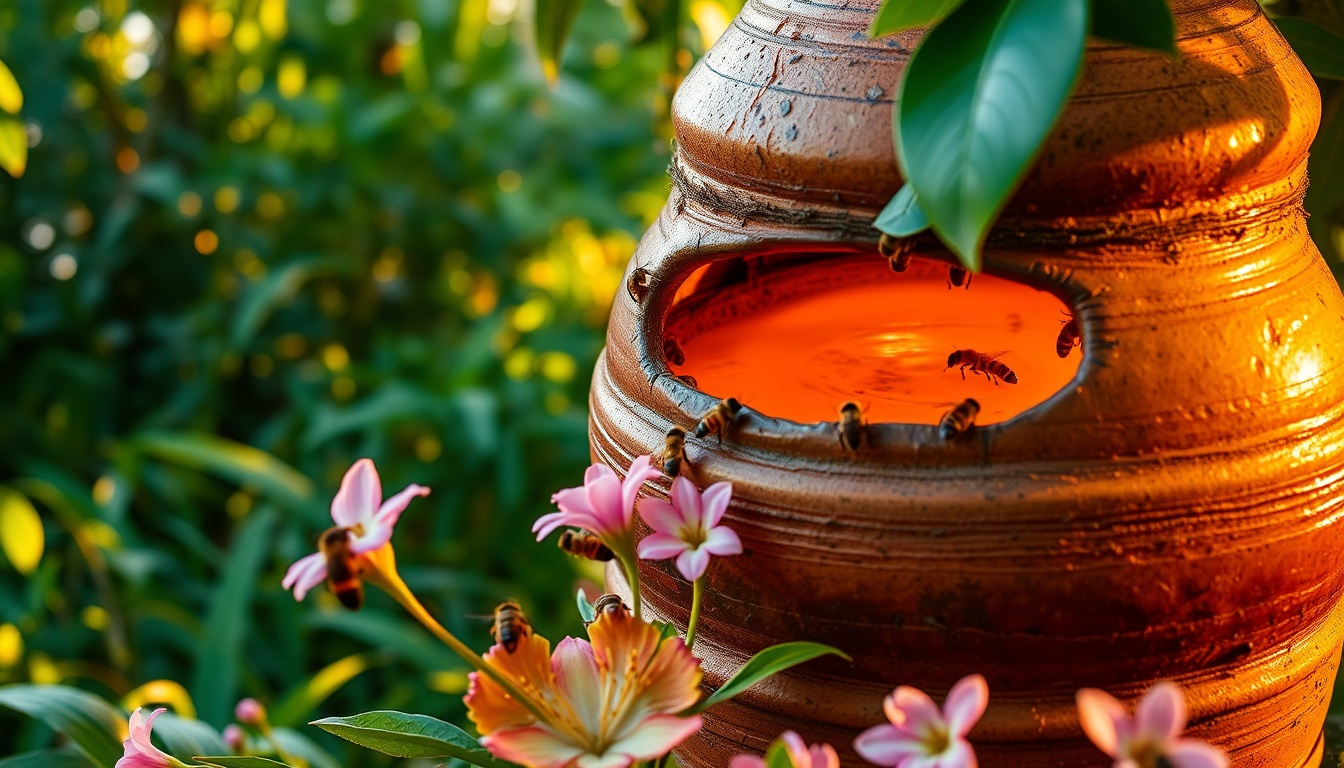
Uruçu (Melipona scutellaris) is the dominant commercial Meliponini species of Bahia and Sergipe in Brazil's northeast, and the bee around which the most developed meliponiculture tradition in the country has formed. Melipona scutellaris is larger than Jataí — workers approximately 12–13 mm — and builds pots of honey and pollen in a clustered arrangement inside hollow log and clay-pot hives (similar in principle to the Maya jobón, independently developed across tropical America). Colonies of 400–1,500 workers produce 2–4 kg of honey per year under good management, making Uruçu the most productive Meliponini species commercially viable in northeast Brazil. The honey is bright amber-gold, characteristically sweet-tart with a higher-than-Apis free acidity, and has a fragrant floral complexity shaped by the diverse Caatinga and Atlantic Forest flora of Bahia. The Northeast meliponiculture cooperative movement — supported by SEBRAE, EMBRAPA, and university extension programs — has made Bahia Uruçu honey the best-documented and most-traceable Brazilian stingless bee honey available to specialty importers. Additional key species include: Mandaçaia (Melipona quadrifasciata, São Paulo and Minas Gerais — amber, aromatic, 1–3 kg/year); Tiúba (Melipona compressipes, Maranhão and Piauí — adapted to semi-arid northeast, foundational to local Sertão honey culture); Guaraipo (Melipona bicolor, Atlantic Forest — larger colony, critically endangered); and Manduri (Melipona interrupta, Amazon basin).
Regional Monoflorals: Cashew, Copaíba, Cipó-uva and the Caatinga
Beyond the southern Apis monoflorals and the stingless bee honeys of the northeast, Brazil produces a range of genuinely distinctive regional monoflorals shaped by the extraordinary botanical specificity of its biomes. Cashew blossom honey (from Anacardium occidentale) is economically significant in Brazil's northeast — specifically Ceará, Piauí, Rio Grande do Norte, and Maranhão, where Brazil produces approximately 75–80% of the world's commercial cashew crop. Cashew trees bloom prolifically from August through November in the northeast, providing a dense, accessible nectar flow for both Africanized Apis mellifera and native Meliponini. The resulting honey is amber to orange-amber, with a mild, faintly fruity-sweet character that faintly echoes the cashew apple's own aroma. This tropical crop blossom honey shares the delicate fruity undertones with coffee blossom honey but develops distinctively different terroir characteristics: cashew's semi-arid Caatinga ecosystem creates more concentrated, amber color versus coffee's highland volcanic soils producing water-white clarity, while both maintain the mild sweetness that makes tropical agricultural honeys prized for their subtle complexity. Cashew blossom honey is widely produced and consumed in the Brazilian northeast but rarely exported under its own name — most reaches export markets blended into general "northeast floral" or "Caatinga" categories. Producers working with certified cooperatives in Ceará — some of them certified organic by IBD (Instituto Biodinâmico) — have begun marketing it as a distinct regional product, with growing international interest.
Copaíba honey deserves recognition as one of Brazil's most unusual monofloral varieties. Copaifera langsdorffii (copaíba balsam, known for its resinous medicinal oil) is a large leguminous tree distributed across the Cerrado and Amazon transition zones of Mato Grosso, Goiás, and Pará. When copaíba trees enter bloom — typically September to November — they produce prolific nectar flows that Apis mellifera colonies in range exploit intensively. The resulting honey is dark amber to reddish-brown, with a distinctive slightly resinous, balsamic note from copaíba volatiles that carry through the nectar pathway. Copaíba honey is intensely aromatic and full-bodied — not medicinal in a harsh sense, but complex in a way that places it in the category of chestnut or New York buckwheat honey in terms of flavor intensity and distinctiveness, though copaíba's resinous-balsamic character from tropical legume volatiles creates entirely different complexity than buckwheat's molasses-like intensity from glacial till soil minerals and temperate grain flower chemistry. It is extremely rare in export markets; domestic consumption in the central-western states is low because copaíba honey is unfamiliar to urban Brazilian consumers as well. Small-scale artisan producers in Mato Grosso have begun producing it as a premium forest honey, with some reaching specialty food stores in São Paulo and Rio de Janeiro.
The Caatinga biome — Brazil's unique semi-arid scrubland of the northeast interior — produces honey of a character shaped by extreme seasonal drought and intense floral density during the brief wet-season bloom. Cipó-uva honeys (from several Serjania species, a genus of woody vines in the Sapindaceae family abundant in the Caatinga) and angico honeys (from Anadenanthera colubrina and related legume species) are among the most distinctive Caatinga monofloral types, though small production volumes mean they rarely travel beyond local markets. Aroeira honey (from Myracrodruon urundeuva and related Anacardiaceae, sometimes called "Brazilian pepper tree") is produced in significant volumes across the Caatinga northeast and carries a distinctive peppery-spicy aromatic note from phenolic compounds in the pollen and nectar. The Caatinga honey landscape is one of the least studied and least internationally distributed of Brazil's honey territories — a genuine frontier for specialty importers willing to work with Caatinga cooperative structures.
MAPA IN 11/2020: The Americas' First Dedicated Meliponini Honey Standard
On April 14, 2020, Brazil's Ministério da Agricultura, Pecuária e Abastecimento (MAPA) published Instrução Normativa No. 11 — Brazil's dedicated regulatory standard for Meliponini (stingless bee) honey. This made Brazil the first country in the Western Hemisphere to codify stingless bee honey as a separate regulated product category with its own quality parameters, distinct from Apis mellifera honey. The significance of this regulatory moment is considerable: it formally recognises that Meliponini honey is not a deviant or inferior Apis honey but a biochemically distinct product category requiring different benchmarks, it provides a legal framework within which producers can certify and market their honey authentically, and it signals to the international specialty honey market that Brazilian stingless bee honey is subject to verified quality assurance — not merely artisan goodwill.
The key parameters of MAPA IN 11/2020 for Meliponini honey are calibrated to the actual biochemistry of stingless bee honey rather than to Apis honey standards retrofitted to a different biology. Moisture ≤35% (versus Apis mellifera's ≤20% in standard Codex and Brazilian Apis regulation) — this is perhaps the single most important acknowledgment in the standard, recognising that Meliponini colonies lack the large worker populations and high-ventilation nest airflow that drive rapid moisture reduction in Apis hives. A Meliponini honey at 28% moisture is not a defective high-moisture Apis honey; it is a correctly harvested Meliponini honey at a biologically appropriate water activity. Free acidity ≤85 meq/kg (versus 50 meq/kg for Apis honey) — reflecting the higher organic acid content of Meliponini honey, particularly lactic acid from the fermentative micro-environment of Meliponini nest pots. HMF ≤60 mg/kg (versus Codex ≤40 mg/kg for Apis) — somewhat more lenient, reflecting tropical storage conditions and the faster natural HMF accumulation in higher-moisture, more acidic matrices. Reducing sugars ≥50 g/100g (versus Apis ≥65 g/100g) — acknowledging Meliponini's different sugar profile with lower monosaccharide concentration. Diastase ≥3 Schade units (versus Apis ≥8 DN) — some Meliponini species produce honey with very low diastase activity by Apis standards; the lower threshold accommodates this without treating naturally low-diastase honey as heat-damaged.
In global regulatory context, MAPA IN 11/2020 places Brazil alongside Malaysia (MSM 2683:2017) as one of the world's only two countries with a dedicated codified Meliponini honey standard. The regulatory taxonomy for stingless bee honey now has five countries with documented positions: Malaysia and Brazil have codified separate standards (the "codify" posture); Thailand's ACFS has a Meliponini standard in draft (the "in-progress" posture); Indonesia's SNI 8664:2018 and Mexico's NOM-036-ZOO-1994 remain Apis-only with no federal Meliponini standard published or announced (the "defer" posture). The timing difference is notable: Malaysia's MSM 2683:2017 was triggered in part by the 2020 Fletcher et al. trehalulose discovery (retroactively justifying the standard's separate-category approach); Brazil's IN 11/2020 was driven by decades of meliponiculture advocacy and the growing commercial significance of northeast Brazil's Uruçu honey cooperatives. Both arrive at the same regulatory conclusion — stingless bee honey needs its own standard — through different evidentiary paths.
Quality Challenges: Adulteration, Moisture, and Traceability
The higher premium that authentic Meliponini honey commands over conventional Apis honey creates obvious incentives for adulteration. The most common forms of Brazilian stingless bee honey fraud are: dilution or substitution with conventional Apis mellifera honey (which is cheaper, more abundant, and visually similar at moderate dilutions); addition of invert sugar syrup or HFCS to extend volume; and origin misrepresentation, in which Apis honey is labeled as a Meliponini species. Before MAPA IN 11/2020 provided defined parameters, there was no legal reference for distinguishing adulterated from authentic product in Brazilian markets. The standard's moisture, acidity, and sugar-profile parameters now create a formal basis for testing, though enforcement capacity varies across Brazilian states and small-scale producers outside the cooperative structure often operate without systematic testing.
Moisture management is the most critical quality variable for Meliponini honey. Unlike Apis honey, which tolerates a wide range of extraction timings (provided comb is capped), Meliponini honey must be extracted at the correct colony maturation point — typically when the pot is sealed with a wax cap or propolis layer, indicating that the colony itself judges moisture concentration acceptable. Early extraction of unsealed Meliponini honey produces product at 40–45% moisture that will ferment within weeks at room temperature. Some producers use refractometers adapted for Meliponini honey (which require different calibration from Apis honey refractometers at the relevant moisture range) to test pots before extraction. EMBRAPA Amazônia Oriental and universities in Bahia and Piauí have developed best-practice guides for meliponiculture extraction that address moisture management systematically. Authenticated Brazilian Meliponini honey purchased through traceable cooperative channels — Instituto Peabiru in Pará, SEBRAE cooperative networks in Bahia, EMBRAPA-linked producers in Piauí — will include moisture testing and in many cases a full Certificate of Analysis.
Pollen analysis (melissopalynology) is available from Brazilian laboratories for Meliponini honey authentication to species level — Melipona scutellaris, Tetragonisca angustula, and Melipona quadrifasciata each show distinctive pollen profiles from their local foraging ranges that can be verified by a trained analyst. MAPA IN 11/2020 does not yet mandate pollen analysis as a certification requirement, but specialty importers sourcing Brazilian stingless bee honey for premium international markets increasingly request it as a standard due-diligence document. For buyers in the US and EU, the best proxy for authenticated Meliponini honey from Brazil is: named species (not just "stingless bee honey"), named producer or cooperative, state of production, moisture reading ≤35%, and preferably IBD or IMO organic certification (which adds traceability protocols). Price signal: authentic, well-documented Brazilian Uruçu or Jataí honey costs depending on species and channel; anything labeled "Brazilian stingless bee honey" at commodity Apis price is almost certainly not genuine.
Buying Brazilian Honey: What to Look For
For export-grade Apis mellifera honey from Brazil — the kind most likely available in US and EU specialty food stores — the best quality indicators are: clear country and state of origin (Rio Grande do Sul or Santa Catarina for southern honeys, Ceará or Bahia for northeast), declared floral source (bracatinga, eucalyptus, orange blossom, or cashew rather than generic "Brazilian honey"), harvest year, and a moisture reading at or below 18% (indicating good handling and minimal fermentation risk). Brazilian honey certified organic under IBD, Ecocert, or IMO certification is produced under a quality management system with traceability protocols — a meaningful differentiator when sourcing from a country whose export infrastructure varies widely in quality. SEBRAE-supported cooperatives in the northeast often have fair-trade certification alongside organic, which supports producer livelihoods in the economically disadvantaged Caatinga region.
For Meliponini honey, the purchase priority list is: (1) named species — Uruçu (Melipona scutellaris), Jataí (Tetragonisca angustula), Mandaçaia (Melipona quadrifasciata), Tiúba (Melipona compressipes) — not just "stingless bee honey"; (2) named producer or cooperative — Instituto Peabiru, Mel do Sertão, individual Bahia meliponiculture operations, SEBRAE-partnered northeast cooperatives; (3) state of production — Bahia for Uruçu, São Paulo/Minas Gerais for Mandaçaia, Piauí/Maranhão for Tiúba, Pará or Amazonas for Amazon species; (4) moisture test result ≤35%; (5) Certificate of Analysis showing acidity and sugar profile; (6) price above (authentic Meliponini honey cannot be produced cheaply — colony yields are too low). Beekeeping associations in Europe with strong Brazilian specialty honey contacts include Slow Food Presidia for Brazilian native bee honey (a Slow Food project that has supported Uruçu meliponiculture in Bahia and northeast states since the 2000s).
Brazilian Meliponini honey sits in the same tier as Yemeni Wadi Doan Sidr, Malaysian kelulut trehalulose honey, and Nepalese Pagal Mauri mad honey in the global specialty honey market: a product where the story, the biology, and the production constraints are as much a part of the value proposition as the flavor profile. The difference is that Brazil is producing this honey at scale through organised cooperative structures in a way that Yemen (war constraints) and Malaysia (still developing export channels for kelulut) are not. For a honey professional or enthusiast willing to research traceable sourcing, Brazil is the most accessible entry point to premium Meliponini honey outside of Southeast Asia — and in terms of species diversity, there is nowhere in the world more interesting.