About This Recipe
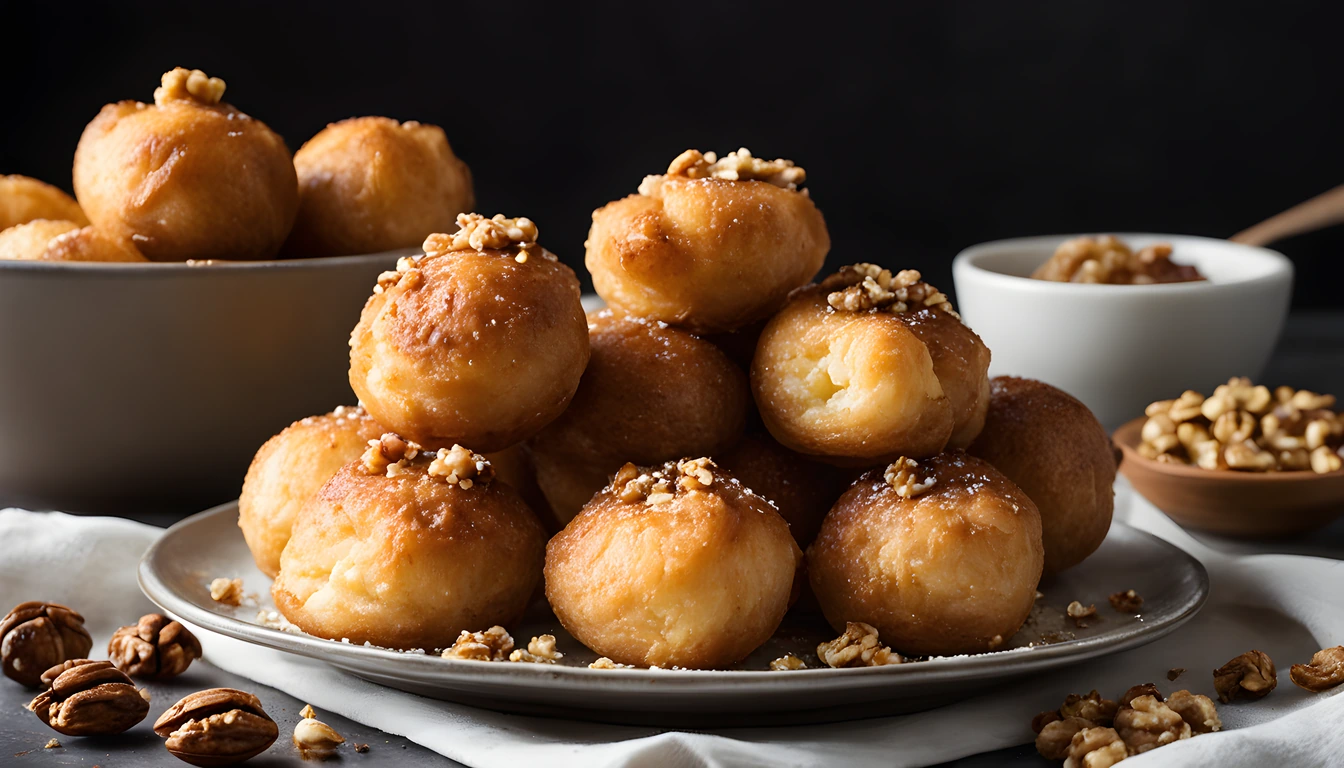
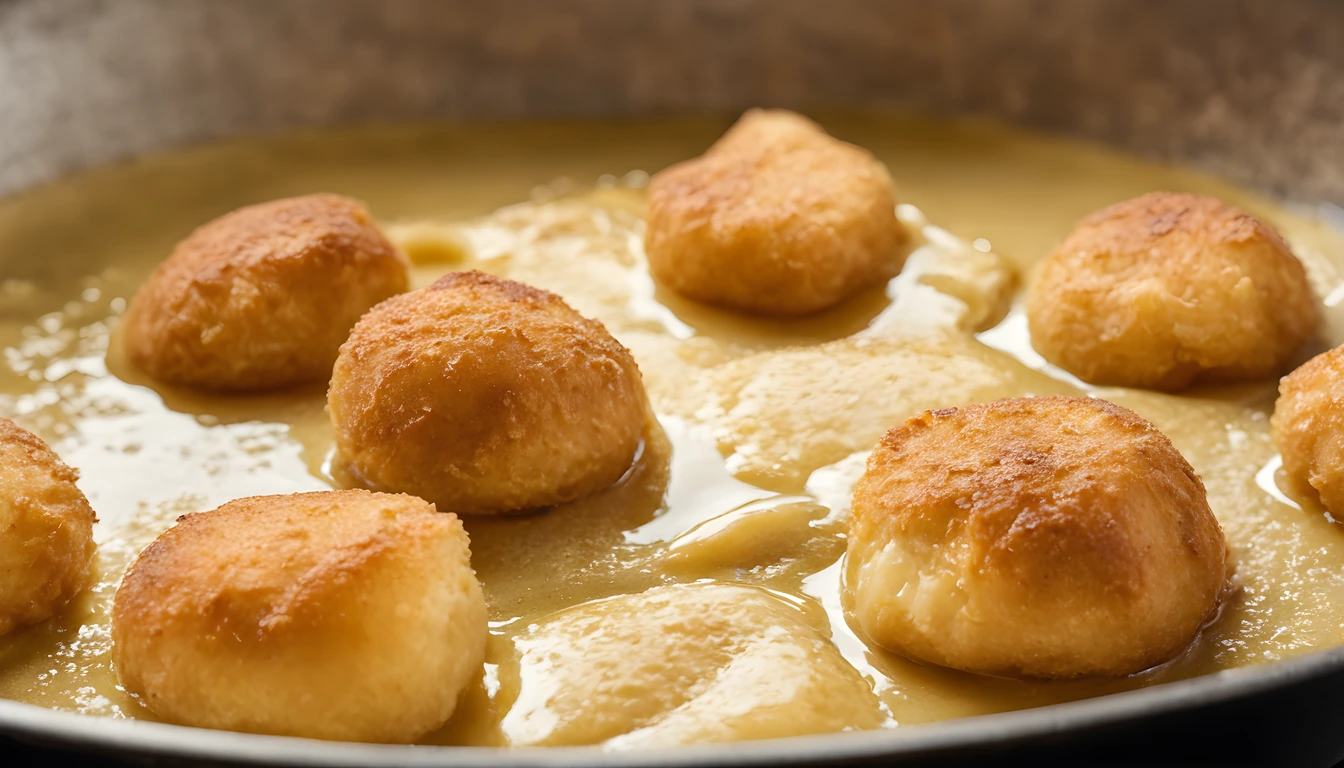
Loukoumades are Greek fried dough puffs: a loose yeast batter dropped by the spoonful into hot oil, where each piece swells into a hollow, deep-golden ball. While still hot they go into warm honey syrup for about 20 seconds, then come out glazed and soft under a scatter of walnuts and cinnamon.
The batter is deliberately wet, about 117 percent water to flour by weight. That slackness keeps the puffs airy rather than bready, and it is why the mixture is stirred rather than kneaded. Frying at 350°F sets the outside fast enough that the middle steams itself hollow.
Make the honey syrup before the batter finishes rising and keep it barely warm. Hot puffs take up warm syrup quickly; cooled puffs sit in it and turn heavy.
Recipe
Honey Loukoumades Recipe: Greek Fried Dough Puffs in Honey Syrup
Greek loukoumades made from a wet yeast batter dropped into hot oil, fried into hollow golden puffs, then dipped in warm honey syrup and finished with walnuts and cinnamon. Makes about 30 puffs, 6 servings.
11Ingredients
Yield: 6 servings
- 375 g all-purpose flour (about 3 cups)
- 440 g warm water (about 15 fl oz), for the dough
- 8 g active dry yeast (about 2 tsp)
- 4.2 g granulated sugar (1 tsp)
- 6 g table salt (1 tsp)
- 170 g honey (about 1/2 cup)
- 60 g water (about 2 fl oz), for the syrup
- 15 g fresh lemon juice (about 1/2 fl oz)
- 29 g walnuts, chopped (about 1/4 cup)
- 2.6 g ground cinnamon (1 tsp)
- 872 g canola oil for deep frying (about 4 cups)
Ingredient amounts scale; instructions show the original batch. Cooking times and pan sizes may need adjustment. Season to taste. Honey grams use US measures at 20°C and 17.5% moisture, a density estimate; weigh your honey for precision.
Instructions
- 1Proof the yeastWarm the 440 g water to about 105°F; it should feel comfortably warm on a finger, not hot. Stir in the 4.2 g sugar and the 8 g yeast and leave for 10 minutes. The surface should be covered with thick beige foam. If nothing foams, the yeast is dead and the batter will not rise.
- 2Mix a wet batterAdd the 375 g flour and the 6 g salt to the yeast water and stir with a wooden spoon for about 2 minutes, until no dry flour is left. The batter stays sticky and slides off the spoon in a slow ribbon; that is the texture you want, so resist adding more flour. Scrape down the bowl, cover it, and let it rise 75 minutes in a warm spot until doubled and bubbly.
- 3Warm the honey syrupPut the 170 g honey, 60 g water and 15 g lemon juice in a small saucepan over low heat. Stir for 3 to 4 minutes, just until the honey loosens and the liquid is even. Keep it over the lowest setting; it should never simmer, and it should be warm rather than hot when the puffs come out.
- 4Heat the frying oilPour the 872 g canola oil into a deep heavy pot, leaving at least 3 inches of headroom, and heat to 350°F (175°C). Clip a thermometer to the side of the pot and keep it there for the whole frying session.
- 5Fry in batchesWet two spoons. Scoop about 28 g of batter with one and push it off into the oil with the other; weighing the first scoop keeps the count close to 30 puffs. Fry 6 puffs at a time for 2 to 3 minutes, turning once after about 90 seconds, until deep golden and doubled in size. Let the oil climb back to 350°F between batches. Drain on a rack so steam can escape from underneath.
- 6Soak in honey and finishDrop each hot puff into the warm honey syrup for about 20 seconds, turn it to coat, then lift it out and set it on a serving plate. Scatter the 29 g chopped walnuts and the 2.6 g cinnamon over the top and serve while the puffs are still warm. The total time includes proofing, the rise, frying and dipping.
Estimated nutrition per serving
1638.65 calories · 149.21 g fat · 73.47 g carbohydrate · 7.82 g protein · 394.57 mg sodium
Serving: 5 loukoumades with honey syrup and walnuts (about 150 g), 1 of 6 servings
Calculated from ingredient weights and USDA FoodData Central: 168894, 173647, 175043, 169655, 173468, 169640, 167747, 170187, 171320, 172336. Estimates use ingredient input weights; actual portions, brands and cooking losses vary. Omitted nutrient values are unavailable, not zero.
How the batter should look at each stage
Before the flour goes in, the yeasted water should be foamy across its whole surface. After mixing, the batter is loose enough to slide off a spoon in a slow ribbon, with no dry flour at the bottom of the bowl.
After the rise it should be domed in the bowl, glossy, and spotted with bubbles, with a faint sour-milk smell. If it has not moved after 75 minutes, the room is too cool; move the bowl somewhere warmer and give it another 30 minutes.
Flavor intensity is computed from the listed flavor notes of 85 honeys in our catalog: 1 means most are described as mild or light, 5 means most are described as bold or dark. It is a tasting guide, not a laboratory measurement.
Sources: Honey (UC Agriculture and Natural Resources, Cottage Foods); USDA FoodData Central: Wheat flour, white, all-purpose, enriched, bleached; USDA FoodData Central: Beverages, water, tap, drinking; USDA FoodData Central: Leavening agents, yeast, baker's, active dry; USDA FoodData Central: Sugars, granulated; USDA FoodData Central: Salt, table; USDA FoodData Central: Honey; USDA FoodData Central: Lemon juice, raw; USDA FoodData Central: Nuts, walnuts, english; USDA FoodData Central: Spices, cinnamon, ground; USDA FoodData Central: Oil, canola.
- Foam on the yeast water within 10 minutes
- Batter drops from the spoon in a slow ribbon
- Doubled volume and visible bubbles after the rise
- Puffs turn deep gold in 2 to 3 minutes at 350°F
Pro Tip
If the batter stiffens while it stands, stir in warm water a tablespoon at a time until it drops from the spoon again.
1 = mild, 5 = bold. Editorial pairing guidance, not laboratory measurements; jars vary.
- Clover
- Plain syrup base; lets the lemon and cinnamon show
- Wildflower
- Fuller syrup with a floral finish on hot puffs
- Orange Blossom
- Citrus-leaning syrup that echoes the lemon juice
- Linden
- Herbal-floral syrup that sits well with the walnuts
- Buckwheat
- Dark, malty syrup; use half and expect a stronger taste
Matching a honey to another dish: the honey flavor map
Get the Honey Buyer's Cheat Sheet (free PDF)
16 varieties on one page — color, flavor, best use and what a fair price looks like — from the 304 honeys we track.
Frying: temperature and batch size
Six puffs at a time keeps the oil from falling below about 330°F, which is where the dough starts drinking fat instead of sealing. A thermometer is the only reliable check, but a cube of bread dropped in should brown in roughly 60 seconds at 350°F.
Use a deep pot with tall sides, and wet the spoons between scoops so the batter releases cleanly. Wet hands work just as well if you prefer to pinch off each piece.
- Oil at 350°F before every batch
- No more than 6 puffs at once
- Turn each puff once, after about 90 seconds
- Drain on a rack, not flat on paper
Pro Tip
Fry one test puff first. If it browns in under a minute the oil is too hot and the center will stay raw; if it takes more than three minutes the oil is too cool.
Syruping, serving and storage
Warm syrup soaks in faster than cold, and hot puffs take it up better than cooled ones, so keep the two moving together. Twenty seconds in the syrup gives a glazed shell with a soft middle; a full minute turns the puff heavy and prone to collapsing.
The batch is best within an hour of frying, before the syrup softens the crust too far. Leftovers keep a day in the refrigerator: reheat them uncovered at 350°F for about 5 minutes, then spoon over a little more warm syrup.
- Eat within an hour of frying
- Honey syrup keeps 2 weeks refrigerated in a sealed jar
- Leftover puffs: 1 day, reheated uncovered
- Un-syruped fried puffs freeze up to 1 month
Pro Tip
Strain any syrup left in the bowl back into the jar and use it on yogurt or pancakes the next morning.
Choosing the Honey
Use Clover Honey or Wildflower Honey or Orange Blossom Honey or Meligyris Greek Mountain Honey, Wild Thyme for the flavor described in this recipe. See our honey selection guide for other culinary choices.