Tepache Has No Starter — and That Is the Point
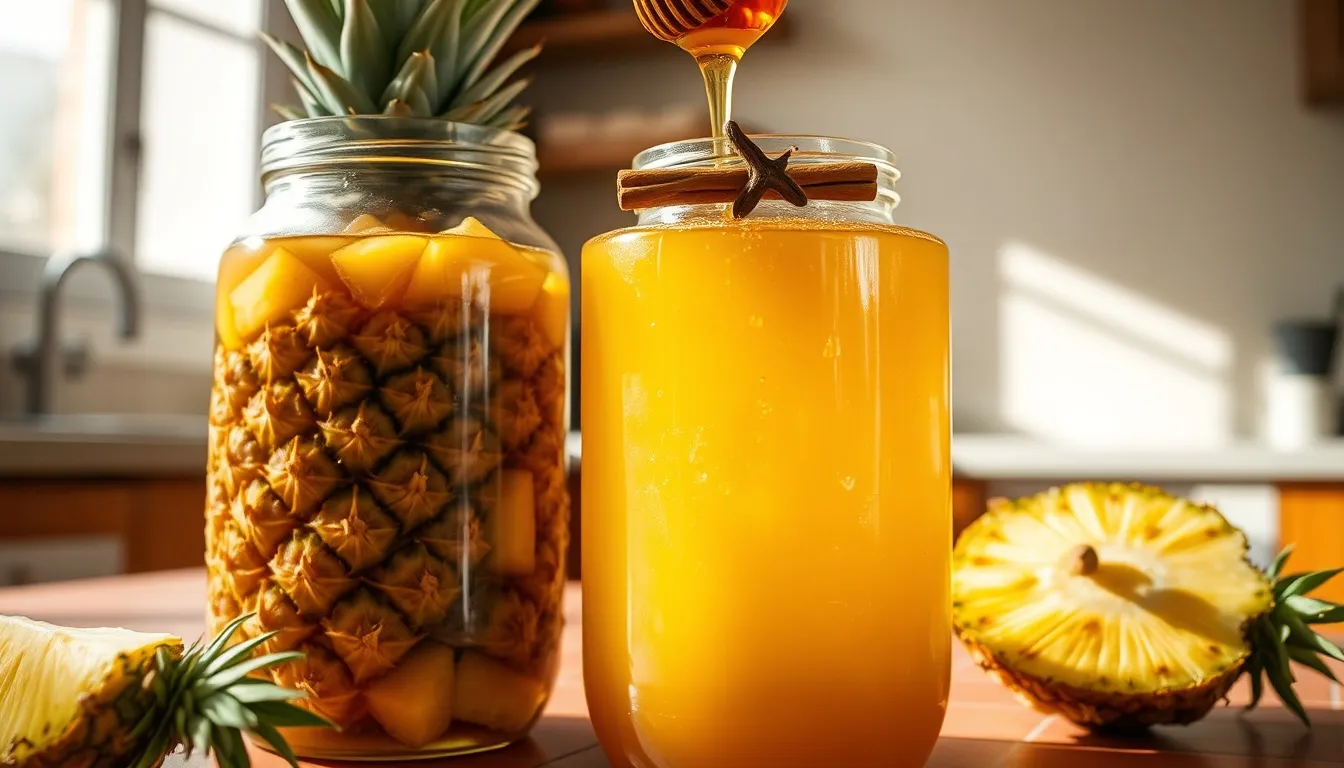
Tepache is a traditional Mexican wild-fermented pineapple soda. It has been brewed in Mexican home kitchens and at street stalls for at least a century, and the recipe is structurally distinct from every other live-fermented honey beverage in one specific way: it requires no pre-built starter culture. There is no SCOBY pellicle (the visible cellulose mat that lives at the top of a kombucha jar). There is no ginger bug — the Saccharomyces-and-LAB liquid starter that wild-soda builders feed for a week before brewing. There is no mead yeast pitch from a packet. The pineapple itself, specifically the surface microbiota living on the rind, carries the wild yeasts and lactic-acid bacteria that drive the fermentation.
Traditional Mexican fermented-beverage papers describe overlapping yeast and lactic-acid bacteria on fruit and agave substrates — Saccharomyces, Hanseniaspora, Lactobacillus, Leuconostoc, and Weissella among them. Escalante et al. (2008, International Journal of Food Microbiology 124:126–134) is a pulque community study, not a tepache recipe paper; do not treat its tables as a tepache formula. Romero-Luna and colleagues have surveyed several Mexican fermented drinks, including tepache, as a potential probiotic source. Those papers describe organisms that can live on pineapple surfaces. They do not prove a specific home jar will start, finish on a clock, or match a named strain list.
Pro Tip
If you came here looking to brew tepache and were worried about how to "find a starter" — there is nothing to find. Buy a ripe organic pineapple (the rind has to be unwashed and unsprayed, see below), and you have everything you need. The free Honey Tepache Calculator runs the recipe math for any batch size; this guide explains the ethnographic and microbiological reasons the recipe works.
The Traditional Recipe Anchor — Diana Kennedy and the 80 g/L Sweetener Floor
Diana Kennedy's 1986 reference work The Cuisines of Mexico documents the canonical home recipe: a fresh pineapple roughly chopped (rind included) in a clay olla, dissolved piloncillo (Mexican unrefined cane sugar), water to cover, and a couple of cinnamon sticks plus a small handful of whole cloves. Cover loosely with cheesecloth, leave on the counter 36 to 72 hours depending on the room temperature, strain, chill, and serve. The recipe is forgiving — there is no precise gravimetric ratio in the home tradition because every pineapple is a different size and every olla a different volume, and tepache is meant to taste roughly like the pineapple it came from.
The calculator's Classic preset uses 80 g honey per litre of honey-plus-water allowance and about 280 g pineapple rinds per litre. That is a cooking convention for this tool, not a number copied from Escalante 2008. Light (50 g/L) and Rich (100 g/L) are ingredient settings, not proven LAB-failure thresholds. Marsh et al. (2014) discuss osmotic stress in lactic-acid bacteria generally; they do not set a tepache-specific 120 g/L stall point. If a batch stays sweet or turns sharp, treat that as a kitchen outcome, not a cited microbiological law.
Modern home brewers often use whole chopped pineapple instead of just rinds. The ratio shifts — about 220 g/L of whole ripe pineapple instead of 280 g/L of rinds-and-core — because whole pineapple flesh contributes more juice (and therefore more starting fructose) than the rinds alone. The two builds taste subtly different: the rinds-only version is drier, more pineapple-cider, more recognizably traditional; the whole-fruit version is sweeter, juicier, and reads more like a pineapple-flavored soda. Both are legitimate.
Honey for Piloncillo at 1.0x — Why Tepache Math Differs From Shrub Math
In a honey shrub this site uses honey at 0.75x sugar by weight because the shrub treats honey as a foreground flavor. For tepache the calculator uses honey for piloncillo at 1.0x by weight. That is a cooking convention for this tool, not a sensory trial of tepache batches and not a number taken from Escalante 2008.
Ripe raw pineapple is a sugary fruit: USDA FoodData Central item 09266 lists about 13.1 g sugars per 100 g. That fruit composition does not by itself prove a 1.0x honey substitution, a Brix range for every pineapple, or a finished sweetness. Use the calculator presets to scale ingredients; taste the jar.
Tart fruit shrubs on this site still use the 0.75x honey-for-sugar cooking ratio because those recipes treat honey as the main sweetener. Do not treat either ratio as a fermentation law.
Pro Tip
The calculator uses three honey presets: Light at 50 g/L, Classic at 80 g/L, and Rich at 100 g/L. These are ingredient settings, not measurements of finished sweetness or alcohol. The recipe and fermentation time cannot establish the alcohol content of an individual batch.
The Spice Anchor — Cinnamon and Cloves per Diana Kennedy
The traditional spice profile is cinnamon and cloves. Diana Kennedy's The Cuisines of Mexico (1986) documents cinnamon and cloves in tepache de piña as flavoring, not as a laboratory LAB-selection protocol. Isolated eugenol and cinnamaldehyde can be antimicrobial in other assays; that does not prove a home tepache jar shifts toward Leuconostoc/Weissella or away from Lactobacillus plantarum. Use whole spices for flavor. Ground cloves over-extract and taste bitter; that is kitchen practice.
The spice load scales with the sweetness preset. A Light tepache at 50 g/L is best with no spice at all — a clean pineapple-honey expression where the spice would crowd the more delicate flavor. A Classic 80 g/L tepache takes the textbook one cinnamon stick plus four cloves per liter without any adjustment. A Rich 100 g/L tepache holds two cinnamon sticks and eight cloves per liter — the higher sweetness load needs the extra spice to keep the finished drink from reading as sticky-sweet.
- Use whole spices only — ground cloves over-extract within hours and produce a bitter, medicinal finish
- Crack each cinnamon stick in half before adding to expose more surface area
- Mexican (canela) or Ceylon cinnamon is preferred over cassia — softer, more complex aromatic
- Add spices at the start of F1 (with the pineapple, water, and honey) — they steep across the full 24–72 h primary
- Strain spices out at the same step as the pineapple solids before bottling for F2
Fermentation Timeline — F1 Primary and F2 Conditioning
The primary fermentation (F1) is a kitchen window of about 24 to 72 hours, faster in a warm room and slower in a cool one. Romero-Luna, Hernández-Sánchez and Dávila-Ortiz (2017, Annals of Microbiology 67:577–586) is a review of several Mexican fermented drinks as possible probiotic sources; it does not publish tepache temperature-coefficient constants or a 6-hour lag. Laboratory tepache runs in the literature often sample at 72 hours; that is one process, not a home clock. Taste for a sweet-tart balance; the clock is not a citation.
After F1, strain out the pineapple solids and the spices through fine-mesh sieve into bottles (swing-top or plastic soda bottles work; mason jars do not — they cannot vent and will pressurize). Leave 1.5 to 2 cm of headspace (Katz 2012 The Art of Fermentation, tepache chapter, is the canonical reference for the headspace guidance). The conditioning fermentation (F2) runs 12 to 24 hours at room temperature — the live yeast continue to ferment the residual sugars, building carbonation in the sealed bottle. Continued fermentation in a sealed bottle can increase both alcohol and pressure. Neither a short conditioning time nor a sweetness preset establishes a low alcohol content.
Burp the bottles once during F2 (about 8 hours in) by briefly cracking the cap to release excess pressure, then re-seal and refrigerate at hour 12 to 24 depending on how aggressive the carbonation is. Refrigeration slows fermentation; it does not establish or guarantee the alcohol content. There is no validated two-week shelf-life study for this recipe. Katz (2012) treats tepache as a live drink, not a shelf-stable syrup. Flavor usually dries and sours over days to a couple of weeks in the fridge; plan small batches and discard a bottle that smells like solvent or shows fuzzy mold.
The Honey Choice — Avoid Manuka, Stay Mild
Stay mild; skip high-MGO Manuka for the primary ferment. Mavric, Wittmann, Barth and Henle (2008, Molecular Nutrition & Food Research 52:483–489) identified methylglyoxal as the main non-peroxide antibacterial constituent of Manuka honey in agar assays against E. coli and S. aureus (MIC about 1.1 mM MGO). That paper does not test pineapple yeasts, lactic-acid bacteria, or a tepache jar. High-MGO Manuka may suppress microbes in a sweet must; no tepache trial shows that a Manuka batch fails to start. Use clover, wildflower, orange blossom, mesquite, or sage if you want a mild floral honey. Buckwheat or chestnut will dominate the pineapple flavor.
Pro Tip
For a first honey tepache, build at the Classic 80 g/L preset with mesquite or wildflower honey — both are mild enough not to compete with the pineapple, slightly more interesting than clover, and widely available in U.S. supermarkets and natural-food stores.
Recipe Math: A Worked 2-Quart Honey Tepache
For a nominal 2-US-quart batch (about 1.89 L), the calculator's Classic settings use 80 g/L honey and 280 g/L pineapple rinds and core. That gives about 151 g honey and 530 g pineapple rinds and core. These quantities scale the calculator presets; the finished strained yield has not been measured.
Honey: about 151 g, or approximately 107 mL, 3.6 US fluid ounces or 0.45 US cup — a little under 1/2 cup. These rounded estimates use the FAO Table 2.4 cooking estimate of 1.4204 g/mL at 20°C and assumed 17.5% moisture; actual honey varies. Subtract the estimated honey volume from the liquid allowance for about 1.79 L water. Spices round to 2 cinnamon sticks and 8 whole cloves. Fruit displacement, juice release, mixing and straining affect the actual fill and yield.
Combine pineapple, honey, spices, and water in a 1-US-gallon food-grade vessel, allowing room for roughly 1.89 L liquid, 530 g fruit and foam. Stir gently to dissolve the honey and use a clean breathable cover. Elapsed time, bubbling and taste do not measure alcohol content or establish batch safety.
After straining, measure the actual liquid yield before choosing bottles; do not assume two 1-quart bottles will be filled. Use bottles intended for carbonated drinks and follow their filling and pressure guidance. Refrigerate the finished drink. Alcohol content is unmeasured: it cannot be predicted from the 80 g/L preset, a short fermentation or carbonation. If you need an alcohol-free drink, this untested home ferment cannot provide that assurance.
For regulatory context, TTB guidance for kombucha explains that alcohol can increase after bottling and that classification depends on the product and process. This guidance does not establish the ABV or labeling status of a home tepache recipe.
- About 530 g pineapple rinds and core
- About 151 g honey (approximately 107 mL, 3.6 US fl oz or 0.45 US cup)
- 2 Mexican cinnamon sticks (cracked in half) + 8 whole cloves
- About 1.79 L water; the honey and water allowance excludes pineapple displacement
- A 1-US-gallon food-grade vessel allows room for liquid, fruit and foam
- Use bottles intended for carbonation and follow their filling and pressure guidance
- Finished yield and alcohol content: unmeasured; measure the strained liquid rather than assuming 2 US quarts
Why You Cannot Substitute Conventional Pineapple — The Microbiota Constraint
Home brewers often prefer unsprayed or lightly handled pineapple rinds because packing-line washes can reduce surface microbes. That is kitchen practice, not a proof that every conventional pineapple is sterile. USDA Organic rules (7 CFR 205.605) still allow chlorine materials in processing when residual chlorine stays within Safe Drinking Water Act limits, so an organic sticker does not mean "no chlorinated rinse" and does not guarantee a ferment.
Buy ripe pineapple with intact rind. Rinse dirt if you need to, but do not scrub the rind with bleach. A farmers-market unsprayed fruit is a reasonable starting point. Brand names are not a fermentation warranty.
Bubbles in the first day are a useful kitchen sign that something is active. No bubbles by 24 hours is a reason to wait longer or start over — not a diagnosis that the fruit was chlorinated.
Tepache vs Kombucha vs Ginger Bug vs Shrub — Where It Fits
Tepache occupies a specific niche in the live-fermented honey beverage lane. It is structurally distinct from kombucha and jun, which require a SCOBY pellicle that has to be acquired (from another brewer or grown over 7 to 14 days from a starter liquid) and which uses tea as the substrate. It is structurally distinct from a ginger-bug honey soda, which requires a 5-to-7-day liquid starter that has to be fed daily before it is brewing-ready. It is structurally distinct from shrubs (drinking-vinegar syrups), which involve no live ferment at all and use vinegar that was fermented elsewhere as the acid backbone.
What makes tepache unique among honey-fermented drinks is the substrate-borne starter mechanism. The microbiota live on the pineapple itself; the brewer's only job is to provide a hospitable environment (water, sweetener, time, room temperature) for those organisms to grow. This is the lowest-barrier entry point in the live-fermented honey beverage category — nothing has to be acquired, grown, fed, or pitched. If you can buy a ripe organic pineapple, you can brew tepache, and you can brew it tonight rather than waiting a week or two for a starter to finish maturing.
The trade-off is that the fermentation is wilder and less controllable than a SCOBY-driven kombucha or a yeast-pitched mead. Each pineapple brings its own microbiota composition, and the resulting tepache will taste subtly different batch to batch even with the same sweetener and spice load. That variability is part of the tradition — Mexican home tepache is meant to taste like the pineapple it came from, and consistency was never the point.
Take-Aways for First-Time Tepache Brewers
Start with a 2-quart batch at the Classic 80 g/L sweetness preset using rinds-only method, mesquite or wildflower honey, classic spice load (1 Mexican cinnamon stick plus 4 whole cloves per liter), at typical room temperature. The recipe will run 36 to 48 hours of F1 plus 12 to 24 hours of F2 — total brewing time about 2 to 3 days from cutting the pineapple to refrigerating the finished bottles. Use a USDA-organic pineapple; the surface microbiota constraint is the only fragile part of the whole process.
For batch math at any size — different pineapple build (rinds-only vs whole-fruit), different sweetness preset (Light 50 / Classic 80 / Rich 100 g/L), different spice load (Mild / Classic / Bold), different ferment temperature — the Honey Tepache Calculator runs the numbers live with the citations baked into the method-note copy. No account, no email, no tracking. The calculator is the working tool; this article is the why-it-works companion.
Tepache lives in the same broad category as kombucha, jun, ginger-bug honey soda, and mead, but the starter mechanism is genuinely different. If you have wanted to try wild fermentation but were intimidated by the SCOBY-acquisition or starter-feeding overhead, this is the lowest-barrier entry point in the category. The free Honey Kombucha Calculator, Honey Ginger-Bug Calculator, and Honey Mead Calculator cover the adjacent builds when you are ready for them.