The Varroa-Free Legacy: Iceland as an Accidental Bee Health Laboratory
For most of the 20th century and into the 21st, Iceland was one of the few inhabited territories on Earth where honeybees lived without Varroa destructor — the parasitic mite that has devastated managed bee populations worldwide since its accidental introduction from Asia in the 1960s and 1970s. This was not a deliberate conservation achievement: Iceland gained its Varroa-free status through geographic accident. The island sits in the North Atlantic 800 km from Scotland and 970 km from Norway, beyond any realistic range of natural bee migration. Honey importation was limited. Queen imports were subject to strict biosecurity screening. The result was decades of managed Apis mellifera colonies that did not require acaricide treatments, colonies that directed their biological resources toward honey production and brood rearing rather than fighting mite infestation.
International beekeeping researchers took notice. Iceland's isolated bee population became a reference case for studying what pathogen-free colonies look like — their wintering survival rates, their spring buildup trajectories, their colony weight gains under the extreme midnight-sun season. When scientists wanted to establish baseline data for Varroa-free honey production, Iceland was one of the few places they could do it at scale. The island's beekeepers, operating without the treatment schedules that define management in mainland Europe, developed practices calibrated to the island's own constraints: the short season, the cold, the geothermal terrain.
In the early-to-mid 2020s, first Varroa specimens were detected in Icelandic apiaries — a consequence of increased international trade, tourism-related contamination vectors, and the difficulty of maintaining perfect biosecurity in an era of global connectivity. Icelandic beekeeping authorities responded with monitoring programs and initial containment measures. The island's Varroa-free period, while extraordinary, has likely ended as a categorical status. What remains is a beekeeping tradition shaped by that legacy: generations of beekeepers who managed colonies without chronic mite pressure, whose practices and expectations were calibrated to extraordinarily healthy bee populations, and who now face the same challenge that confronted mainland European beekeepers decades earlier.
Pro Tip
Iceland's historical Varroa-free status made its bee population a scientific reference for healthy colony baselines. If you are interested in Varroa research or treatment-free beekeeping philosophy, Icelandic beekeeping literature from the late 20th and early 21st centuries provides genuinely unusual data: what managed honeybee colonies look like when Varroa is absent from the system entirely. The relevant contrast to look for is colony winter survival rates and spring buildup relative to Northern European mainland averages.
Arctic Terroir: What Blooms in Iceland When Bees Can Forage
Iceland's flora is constrained by geology, latitude, and climate in ways that produce a distinctive and limited palette for honey bees. The island sits between 63° and 66°N latitude — the Arctic Circle passes through its northernmost tip. The Gulf Stream moderates coastal temperatures considerably: Reykjavik averages approximately 11–12°C in July, warmer than many expect for its latitude. But the interior highlands are a different matter — cold, windswept, and botanically sparse. Commercial honey production is confined to the lowlands, primarily in south Iceland where the climate is most hospitable.
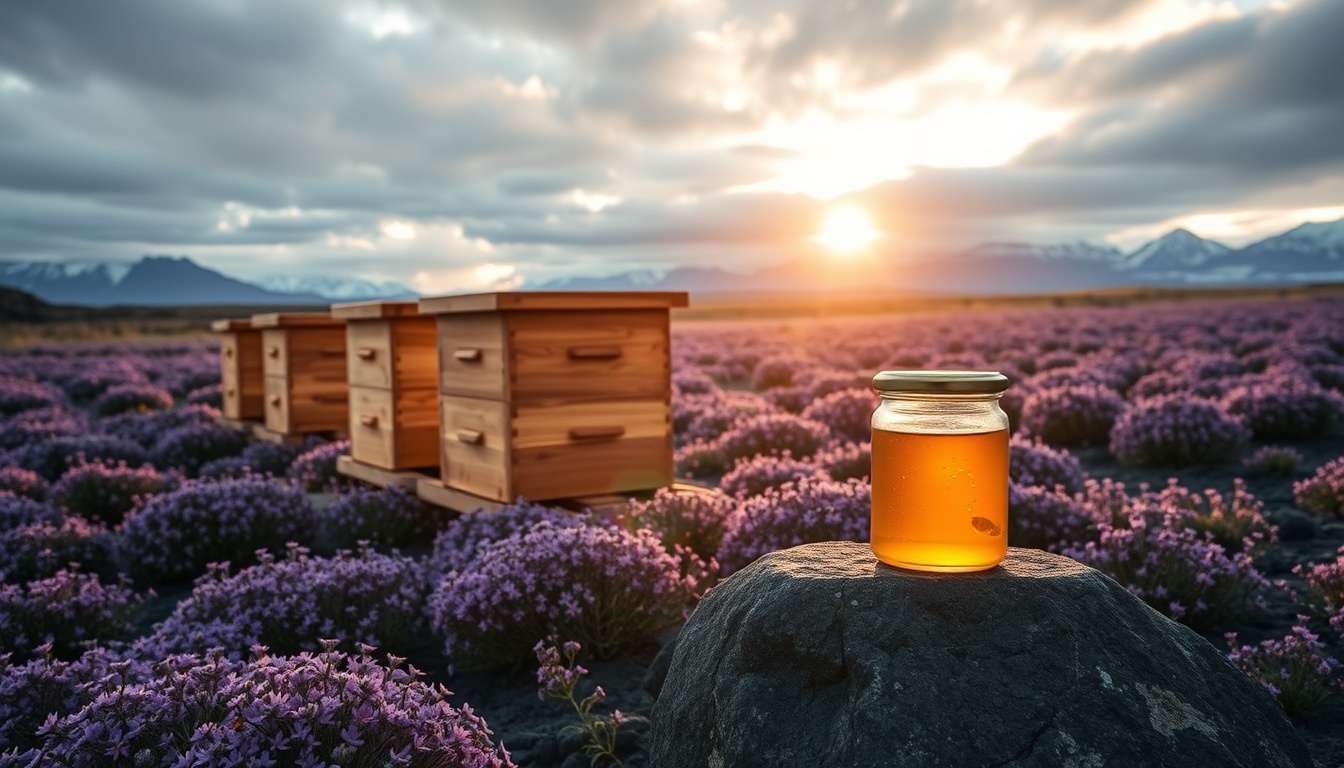
The defining nectar plant is blóðberg — Arctic thyme, Thymus praecox ssp. arcticus — which blankets Iceland's volcanic lava fields with a dense mat of tiny purple flowers in summer. Blóðberg is extraordinarily hardy; it colonizes the bare rock faces of recent lava flows that few other plants can penetrate. Its nectar is strongly aromatic with thymol and carvacrol compounds, creating similarities with Greek thyme honey in therapeutic compounds but with distinctly Arctic terroir character — the volcanic minerality and midnight sun concentration of aromatic oils impossible to replicate in Mediterranean climates giving Icelandic polyfloral honey a distinctive herbal-medicinal character that beekeepers and buyers recognize as characteristic of the island. Blóðberg is not a commercial monofloral in Iceland — the scale of production is too small — but it is the dominant flavour signature in Icelandic summer honey.
Angelica (hvannur, Angelica archangelica) is Iceland's most historically significant plant — it appears in the Landnámabók accounts of Norse settlement and has been cultivated and gathered as food and medicine since the 9th century. Angelica produces umbel flowers that attract pollinators in abundance and provides a rich nectar source in areas where it grows along riverbanks and coastal meadows. Fireweed or willowherb (mjallablaðka, Epilobium angustifolium) colonizes disturbed land and burned areas — it provides significant early summer nectar in the south and southwest. White clover (smári, Trifolium repens) grows in the warmer agricultural lowlands of the south and southwest, around Selfoss, Hveragerði, and the Rangárvellir plains, providing a cleaner, milder nectar component similar to pure clover honey USA but with distinctive volcanic soil minerality from Iceland's basaltic terroir creating more pronounced mineral complexity than temperate-zone American clover varieties to the polyfloral mix. Blueberry (aðalbláber, Vaccinium uliginosum) flowers briefly in early summer and contributes a subtle fruity note in highland edge areas.
Get the Honey Buyer's Cheat Sheet (free PDF)
16 varieties on one page — color, flavor, best use and what a fair price looks like — from the 304 honeys we track.
The Midnight Sun Season: 10 Weeks of Maximum Intensity
Iceland's honey season runs from roughly mid-June through late August — a window of approximately 10 to 12 weeks in the most favourable lowland areas. This is the shortest commercial honey season of any country in the Nordic cluster: Denmark manages 4–5 months, Norway's coastal zones 3–4 months, and even Arctic Finland's Lappi region extends 10–14 weeks with its midnight-sun advantage. What Iceland shares with northern Finland is the midnight sun itself: during peak summer, Reykjavik receives approximately 21–22 hours of daylight per day, with astronomical twilight never reaching true darkness. Colonies exploit this with foraging activity patterns that don't shut down at sunset.
The implication is density, not duration. Icelandic bees that forage on blóðberg patches during an 18-hour effective daily foraging window accumulate nectar rapidly when flowers are productive. Strong colonies in south Iceland can build substantial honey stores within a 6–8 week peak period. Beekeepers extract a single main crop, typically in August before the season closes, rather than managing multiple extraction rounds as warmer-climate European beekeepers do. The compressed season means production variability is high: a wet July that suppresses flower nectar production can halve the crop; a warm, dry summer with extended bloom can produce unexpectedly abundant honey.
The season's hard lower bound is the autumn transition. Iceland's weather turns sharply in September: Atlantic storms, wind chill, and the rapid reduction of daylight hours create conditions hostile to foraging. Colonies that have not built sufficient winter stores by late August face significant mortality risk. Icelandic beekeepers must time their extraction carefully — taking too much honey too early risks starving the colony; leaving too much reduces the commercial crop. This timing pressure is more acute in Iceland than in any other Nordic country, because the season end is faster and less negotiable.
Pro Tip
The compressed Icelandic season produces honey with a concentration of aromatic compounds unusual among Nordic varieties. Blóðberg (Arctic thyme) dominates the aromatic profile — the thymol and carvacrol compounds that give Icelandic honey its distinctive medicinal-herbal edge are more concentrated in short-season honey than in equivalents from longer-season mainland producers. When evaluating Icelandic honey, the aromatic intensity should stand out relative to Danish or Swedish polyfloral varieties.
Why Iceland Has No Commercial Honey Industry
Iceland's bee population is managed almost entirely by hobbyist and small-scale amateur beekeepers — people who maintain a handful of hives for personal production, gift-giving, and local sales rather than as a primary agricultural enterprise. Several structural factors make commercial-scale honey production unlikely under current conditions. First, the season is simply too short and too variable for a business model that requires predictable annual yields. A poor summer produces near-zero honey; a good summer produces modest amounts — the variability is incompatible with wholesale supply contracts or export logistics.
Second, Iceland's domestic market is tiny. With a population of approximately 380,000, even if every Icelander consumed Icelandic honey exclusively, total demand would be modest. The country imports the vast majority of the honey its residents consume, primarily from EU suppliers. Local production satisfies a niche premium market — restaurants in Reykjavik, farmers market visitors, tourists seeking a locally-sourced souvenir — but not mainstream retail. Third, the infrastructure for beekeeping at commercial scale does not exist: no large-scale extraction facilities, no packaging lines, no export-grade cold chain. Building that infrastructure for a product whose supply is seasonally variable and small in absolute volume would not be economically rational.
The contrast with Denmark illustrates the structural difference clearly. Denmark plants approximately 150,000–180,000 hectares of rapeseed annually, providing an enormous, reliable early-season nectar flow that underpins a commercial industry producing honey for export to Germany, the Netherlands, and beyond. Iceland has no equivalent structural crop — the largest nectar flows come from wild and semi-wild plants on volcanic terrain that cannot be cultivated at scale. The result is a relationship with honey that is artisanal by necessity: small batches, local character, personal sale.
Iceland's Bees: A Mixed Gene Pool Without a Conservation Program
Honeybees (Apis mellifera) are not native to Iceland. When Norse settlers arrived from Norway, Scotland, and Ireland beginning around 870 CE — a process documented in the Landnámabók (Book of Settlements) — they found no managed honeybees. The island's bee fauna consisted of bumblebees (Bombus spp.) and a small number of solitary bee species adapted to the Arctic flora. Commercial beekeeping in Iceland as we understand it today developed in the 20th century, with stocks introduced primarily from mainland Scandinavia and the British Isles.
The dominant genetic stock in Icelandic apiaries is Apis mellifera mellifera — the northern European dark bee — introduced from Norwegian, Danish, and Scottish sources over the past century. Unlike mainland Nordic countries, however, Iceland has not developed a formal subspecies conservation or selective breeding program. There are no designated Varroa-resistant breeding islands, no genetic evaluation programs comparable to Læsø's sortebiet program in Denmark or Osterøy's svartbiet program in Norway. The small size of the Icelandic bee population creates ongoing inbreeding pressure — with limited queens available and no structured mating control, the gene pool remains narrow.
The historical absence of Varroa meant this was not an urgent problem. Varroa resistance — hygienic behavior, VSH traits, recapping — matters less when the pathogen is absent. Now that Varroa has reached Iceland, the gene pool's resilience becomes a more pressing question. Whether Iceland develops a conservation and selection program modeled on its Nordic neighbors remains to be seen; the small beekeeper community and the hobbyist scale of operations make institutional program development more challenging than in countries with commercial-scale industries.
Geothermal Iceland: A Unique Wintering Advantage
Iceland sits on the Mid-Atlantic Ridge, one of the world's most geologically active zones. Geothermal energy is available across much of the country — hot springs, geothermal heating districts, and soil temperatures elevated by volcanic activity below. This creates a microclimate resource that Icelandic beekeepers in certain zones can exploit. In areas where geothermal soil temperatures warm the ground significantly — around Hveragerði (the 'hot spring town' southeast of Reykjavik), Reykjanes peninsula, or the Haukadalur valley — winter temperatures at ground level are milder than ambient air temperatures would suggest. Hives sited in geothermal zones may experience less extreme winter cold on their bases, potentially improving winter cluster survival.
Iceland's widespread geothermal district heating system — which provides space heating and hot water to roughly 90% of Icelandic homes — also means some beekeepers have access to controlled warm indoor wintering facilities. Bringing hives into geothermally-heated outbuildings during the coldest months (December–February) protects colonies from Iceland's most extreme weather events: the Atlantic low-pressure systems that bring sustained sub-zero wind chills capable of freezing exposed colonies rapidly. Indoor wintering is practiced across Scandinavia, but Iceland's free or very low-cost geothermal heat makes it practically accessible to small-scale keepers who would otherwise lack the energy budget for heated storage.
This geothermal advantage does not extend the effective honey season — bees still need flowering plants, and the flora follows the calendar regardless of ground temperature. But it may partially compensate for one of Iceland's key structural disadvantages: the relatively high colony winter mortality that would otherwise result from short foraging seasons leaving inadequate winter stores. Beekeepers near hot spring zones report that their colonies enter spring in better condition than might be expected from the ambient climate data alone.
Icelandic Honey Varieties: Arctic Thyme Polyflora and Rare Monoflorals
Iceland produces no classified monofloral honey in meaningful commercial quantities, and the concept of a certified monofloral designation — as applied to Spanish rosemary, Greek thyme, or Danish lynghonung — has no formal analog in Icelandic production. What Icelandic beekeepers produce is best described as sumarblóm polyflora (summer flower honey) — a seasonal mixed-source honey whose character varies significantly by hive location and annual conditions.
South Iceland polyflora, from the agricultural lowlands around Selfoss and the Þórsmörk nature reserve, is the lightest and mildest: white clover and fireweed contributions dilute the Arctic thyme aromatic signature, producing a pale amber honey with gentle herbal notes that contrast with continental varieties like Texas wildflower honey through Iceland's unique Arctic botanical assemblage and compressed 10-week midnight sun concentration versus extended four-season bloom windows across vast continental climate zones. North Reykjavik and Kjalarnes peninsula honey, from beehives in the warming zone of Hvalfjörður, tends toward darker amber and stronger aromatic character as blóðberg becomes more dominant in the floral mix relative to agricultural sources. Westfjords polyflora — from the remote, sparsely populated northwestern peninsula — is rarely available commercially but represents perhaps the purest expression of Icelandic wildflower honey: blóðberg, angelica, and coastal meadow species without any agricultural crop component.
Angelica honey — from Angelica archangelica specifically — is the rarest Icelandic variety. Individual beekeepers who site hives near large riverbank angelica populations sometimes describe a distinct component in their summer harvest: slightly sweeter than the thyme-dominant polyflora, with a complex herbal-citrus note. Separating angelica honey as a distinct variety requires deliberate hive placement and extraction timing that few Icelandic keepers pursue, but it represents a genuinely premium potential product that the commercial honey world has essentially never encountered as a named variety.
Pro Tip
When buying from Icelandic producers (typically at Reykjavik's Kolaportið weekend flea market, south Iceland farmhouse stalls, or via Icelandic food tourism channels), ask specifically about hive location and primary nectar source. 'Blóðbergshunangi' or 'þymianshunangi' refers to the Arctic thyme-dominant polyflora that defines Icelandic honey's character. Angelica honey, if you encounter it, is exceptionally rare and worth acquiring if provenance can be verified.
No Export, No Brand: Why the World Doesn't Know Icelandic Honey
Iceland produces no honey export worth documenting in international trade statistics. The total national production is consumed domestically, and not all of it reaches the formal retail market: much is consumed by the beekeepers themselves, gifted to neighbours and family, or sold in transactions that never enter any commercial record. This means Icelandic honey occupies an unusual position in the global honey landscape — genuinely distinctive in character, genuinely well-produced by a Varroa-managed (and for decades Varroa-absent) population, but essentially invisible to the international honey consumer.
No Icelandic honey brand has achieved the kind of international recognition that New Zealand's mānuka producers built through aggressive MGO certification and export marketing, or that Albanian beekeepers are beginning to build through wild-river provenance storytelling. This is not because Icelandic honey is inferior — it is because the production volume has never justified the investment in export logistics, cold chain management, packaging design, and the regulatory compliance requirements of the EU and US markets. The smallest countries with the most distinctive honeys often lack the institutional infrastructure to turn distinctiveness into international brand equity.
The irony is significant: Iceland's honey has genuine credentials that money cannot easily buy in most markets. The Varroa-free legacy — even if now compromised by new detections — represents decades of colony health that produced honey under conditions European and North American beekeepers can only approximate through intensive management. The Arctic thyme terroir is authentically unique and not replicable by southerly producers. The midnight-sun concentration of aromatic compounds is real and measurable. None of this has been marketed, because the volumes have never existed to make marketing worthwhile.
Iceland in the Nordic Honey Cluster: The Outlier Completes the Picture
The four Nordic countries that surround Iceland in the honey world — Sweden, Finland, Norway, and Denmark — all share certain characteristics: Apis mellifera mellifera genetics, Varroa management practices adapted to cold climates, thixotropic heather honey from Calluna vulgaris, and cloudberry or other sub-Arctic rarity varieties. This Nordic forest honey tradition contrasts significantly with Central European temperate varieties like German forest honey which feature different conifer chemistry and temperate forest botanical assemblages rather than Arctic-adapted flora. Iceland is connected to this cluster through its bee genetics and its climate, but differs in every economic and botanical dimension. Where Denmark has 150,000+ hectares of rapeseed providing volume, Iceland has no agricultural crops. Where Norway and Finland have formal dark bee conservation programs on protected islands, Iceland has no equivalent institutional structure. Where Sweden has achieved EU PGI protection for regional specialties, Iceland has no designation framework.
The Nordic comparison is also useful for understanding Iceland's Varroa challenge in context. Norway's svartbiet program on Osterøy island demonstrates what deliberate island-isolation breeding can achieve for Varroa-resistant stock development — a model that Iceland could theoretically adapt now that its open-population status has ended. Denmark's Læsø sortebiet program shows that criminal enforcement of queen import bans can maintain genetic purity even in a small island community. Iceland's bee population, now that Varroa has arrived, faces choices that its Nordic neighbors resolved a generation earlier.
Finland's lakkahunaja (cloudberry honey) and Iceland's potential angelica honey represent the same archetype in the Nordic cluster: a genuinely rare sub-Arctic variety produced in tiny quantities from a single source plant that grows only under specific conditions and cannot be commercially cultivated. Neither will appear on international retail shelves in meaningful quantities. Both represent the outer edge of what honey can be when terroir and climate conspire to produce something that cannot be replicated elsewhere.
Climate Change: Iceland's Beekeeping Future
Iceland is warming faster than the global average — a consequence of the Arctic amplification effect that accelerates temperature change at high latitudes relative to the tropics. Icelandic temperature records show a pronounced warming trend over the past three decades, with particular warming in spring and autumn. For beekeeping, the implications are structural: a season that currently runs from mid-June through late August might extend to early June through September — a difference of 3–4 weeks that could transform Iceland's honey production from a marginal hobby into a more viable small-scale industry.
Extended seasons would allow additional nectar flow time from late-blooming species. New flora is already moving northward: willowherb is extending its altitude range, and agricultural experimentation with heat-tolerant varieties is slowly changing what grows in south Iceland's lowlands. In a warmer Iceland, the honey botanical profile may shift toward more diverse sources beyond the current blóðberg-dominant character — potentially introducing varieties not yet associated with Icelandic production.
The risks are also real. Earlier springs create mismatch risks: colonies that break cluster in late March or April expecting forage can starve if the flora has not yet responded to the temperature signal. Increased rainfall associated with some climate change scenarios for Iceland could reduce summer foraging windows even as the calendar season extends. And Varroa management, having arrived during a period of climate transition, adds the complexity of a new pathogen precisely when beekeepers are navigating changing season dynamics. Iceland's beekeeping future will be determined by how effectively its small community of beekeepers adapts to both challenges simultaneously.
Icelandic Honey Standards and What Little Regulation Applies
Iceland is a member of the European Economic Area (EEA) but not the European Union. Its honey regulation follows the EEA Agreement provisions that incorporate EU Honey Directive 2001/110/EC — the same baseline standards that apply in Denmark, Sweden, Norway, and Finland. Moisture content ≤20%, HMF ≤40 mg/kg, diastase activity minimums, and country-of-origin labeling apply to commercial Icelandic honey. In practice, however, the hobbyist scale of Icelandic honey production means that most production falls below the thresholds for formal regulatory attention — producers selling directly at farmers markets or to personal contacts operate in a practical grey zone where the regulation's consumer-protection intent is served by the transparency of direct sale rather than by label compliance.
There is no equivalent of Denmark's DBF Danmarks Honning certification mark, no certification body that inspects Icelandic apiaries and verifies quality claims, and no national quality standard beyond the EEA baseline. This means that when an Icelandic honey is labeled 'blóðbergshunangi' (Arctic thyme honey), the labeling reflects the producer's honest representation rather than a verified pollen analysis. For consumers purchasing in Iceland, the appropriate verification is the same as at any artisanal-scale direct market: ask the beekeeper directly, establish the hive location, and trust that the small-scale sale context provides its own transparency.
For international buyers — in the rare cases where Icelandic honey reaches foreign markets through specialty import channels or luggage — there is no country-of-origin certification infrastructure to validate authenticity. The practical test is price (genuine Icelandic honey commands premium pricing reflecting its scarcity) and provenance documentation (a named beekeeper, a specific location). The absence of export documentation norms means that any 'Icelandic honey' appearing in international specialty retail deserves scrutiny — the volume of authentic export product does not support significant international retail presence.
Finding Icelandic Honey: Local Markets and Direct Producers
Icelandic honey is not exported in meaningful quantities and is not available in international specialty retailers. The realistic channels for accessing genuine Icelandic honey are limited to in-country purchase or direct-from-beekeeper contact. In Reykjavik, the Kolaportið flea market — held in a converted warehouse near the old harbour on weekends — occasionally includes food producers who sell local honey alongside other Icelandic artisanal food products. The Reykjavik Farmers Market and similar seasonal markets in the capital area feature honey producers when they have crop to sell, which varies annually based on season quality.
South Iceland is the most productive beekeeping region and the most likely place to encounter honey directly from producers. The agricultural communities around Selfoss, Hveragerði, and Flúðir in the Árnessýsla and Rangárvallasýsla districts host farm shops and direct-sale operations that occasionally list local honey. Agritourism operations in the Þórsmörk valley and the south Iceland highland areas sometimes include honey in their product offerings alongside lamb, dairy, and vegetable production. Tourist routes through the Golden Circle (Þingvellir, Geysir, Gullfoss) pass through honey-producing areas.
For visitors seriously interested in Icelandic honey, the most effective approach is to contact the Icelandic Beekeepers' Association in advance of a visit to identify producers currently selling. Icelandic local food networks are small, interconnected, and generally responsive — producers who are not actively selling may still facilitate introductions or visits. Expect to pay significantly more than mainland Nordic honey prices: the rarity premium and small-batch economics push Icelandic honey into a pricing tier consistent with artisanal specialty honeys globally. A 250 g jar of south Iceland summer honey at a Reykjavik market is a genuinely rare food product; the price reflects that.
Pro Tip
The single most reliable channel for Icelandic honey remains Reykjavik's Kolaportið flea market on weekends, particularly August through October when summer harvest honey reaches the market. If you are visiting Iceland specifically to find local honey, timing your visit to late August or early September maximises the chance that fresh-extracted summer honey is available directly from beekeepers who may be at the market or listed in local food directories.