The Crown Dependency Frame and the Order-in-Council Adoption Mechanism
Jersey (Bailiwick of Jersey, Bailliage de Jersey) is the largest of the Channel Islands at 118.2 km² and the most populous of the three British Crown Dependencies (BCDs) at approximately 103,267 residents (2021 census), the other two being the Bailiwick of Guernsey (62 km², ~63,000 residents — itself comprising Guernsey, Alderney, Sark, and Herm) and the Isle of Man (572 km², ~84,000 residents) in the Irish Sea. The constitutional position is unusual and load-bearing for any food-standards question: Jersey is a self-governing jurisdiction under the Crown that is neither part of the United Kingdom nor of the European Union, but whose foreign affairs and defence are exercised by the UK Government and whose primary legislation receives Royal Assent through the Privy Council via Orders in Council. The relationship traces to 1066 — when William the Conqueror crossed from the Duchy of Normandy to claim the English throne the Channel Islands remained Norman, and they remained loyal to the Crown when continental Normandy was lost to France in 1204 under King John, since when they have been governed as separate jurisdictions tied to the Crown rather than to the Kingdom of England (later the UK).
The practical consequence for honey-composition standards is that Jersey adopts UK food-composition law by Order in Council rather than by treaty or customs union. The relevant instrument is the UK Honey (England) Regulations 2015 (Statutory Instrument 2015/1348) — which transposed EU Council Directive 2001/110/EC (as amended by Directive 2014/63/EU) into UK domestic law and remain in force post-Brexit — extended to Jersey through a Jersey-specific implementation order under the States of Jersey's Food Safety (Jersey) Law 1966 and Food and Environment Protection (Jersey) Law 1998. The composition limits — moisture ≤20%, HMF ≤40 mg/kg, diastase activity (Schade) ≥8 units (or ≥3 for naturally low-diastase varieties), electrical conductivity ≤0.8 mS/cm for blossom honey and ≥0.8 mS/cm for honeydew, sugar profile per Annex II — apply de facto to Jersey-produced honey. Enforcement runs through the States of Jersey's Department of the Environment (Environmental Health & Trading Standards) at La Charrière, St Helier; analytical testing for any Jersey sample requiring official confirmation runs at UK reference laboratories — Fera Science Limited at Sand Hutton, York, or the Government Chemist function at LGC Group, Teddington — on a fee-for-service basis the same way English commercial-scale honey samples are routed.
This is the cluster's Crown-Dependency-by-Order-in-Council variant — structurally distinct from Andorra (Spain + France via 1278 Paréages and 1993 EU Cooperation Agreement), Liechtenstein (Switzerland via 1924 Customs Treaty and 1995 EEA membership), San Marino (Italy + EU via 1862 Treaty of Friendship and 1991 EEC Cooperation Agreement), Monaco (France via 1861 Treaty and 1963 Customs Convention), and Vatican City (Italy + EU via 1929 Lateran Treaty and 2009 Monetary Agreement). The five established European-microstate cases all adopt by treaty and customs/cooperation framework with continental neighbours; Jersey adopts by Crown-Dependency Order-in-Council with no customs union with the UK — the Common Travel Area covers people, not goods — which puts it in a structurally separate sub-cluster alongside Guernsey and the Isle of Man. The British Crown Dependencies sub-cluster is the natural parallel to the European-microstate cluster: same Adopted-by-Reference frame, different constitutional inheritance mechanism.
Post-Brexit Regulatory Transition: Protocol 3 to the UK-EU Trade and Cooperation Agreement
Pre-Brexit, Jersey's relationship with the European Communities (and later the EU) was governed by Protocol 3 of the United Kingdom's Treaty of Accession 1972, which placed the Crown Dependencies inside the EU customs territory and applied EU rules on free movement of industrial and agricultural goods, but excluded them from EU jurisdiction on most other matters (including services, capital, and social policy). Honey produced in Jersey could be sold into the EU single market without tariff or non-tariff barrier, and Jersey applied EU Council Directive 2001/110/EC compositional standards directly. Protocol 3 ceased to apply on 31 December 2020 at 23:00 GMT (the end of the post-referendum transition period), and from 1 January 2021 Jersey trades with the EU as a third country under the UK-EU Trade and Cooperation Agreement (TCA, formally the Trade and Cooperation Agreement between the European Union and the European Atomic Energy Community, of the one part, and the United Kingdom of Great Britain and Northern Ireland, of the other part).
The TCA preserves zero-tariff trade in qualifying goods (those meeting rules-of-origin requirements) but introduces customs declarations, sanitary and phytosanitary checks, and the practical reality that any Jersey-origin honey shipped to an EU member state requires the same export documentation as English- or Scottish-origin honey. Jersey-EU honey trade is in any case structurally minor: the island's total annual production is hobbyist-scale (estimates from the Jersey Beekeepers' Association place active hive counts at 200–500 colonies and total production at 5–15 tonnes per year, with some annual variation depending on weather and Varroa pressure) and the bulk of that stays on the island for direct-from-beekeeper sale at farmers' markets (St Aubin's Sunday market, the Royal Square farmers' market in St Helier) and at the Jersey Royal Society for the Prevention of Cruelty to Animals (Jersey SPCA) honey shop. There is no Jersey-origin commercial honey export brand at retail-grocery scale comparable to the way Manuka, Acacia, or Tupelo are positioned in international markets.
The honey question highlights a broader regulatory pattern across all three British Crown Dependencies: each maintains its own enabling primary legislation (Jersey's Food Safety Law 1966; Guernsey's Food Standards Ordinance 2008; the Isle of Man's Food Act 1996) but adopts UK food-composition Statutory Instruments by reference rather than re-drafting from first principles. The result is that a beekeeper on Jersey, on Guernsey, on the Isle of Man, or in any English county faces effectively the same Annex II compositional limits derived from EU Directive 2001/110/EC — adopted in the UK by S.I. 2015/1348, in the BCDs by Order-in-Council and reference. Non-trivially, this also means that any future divergence in UK honey law (e.g. a UK-specific HMF threshold loosening to align with US practice, or a UK-specific diastase methodology change) would propagate to all three BCDs unless the BCD legislatures explicitly opt out — which would be a constitutional possibility but has no precedent in food law.
Get the Honey Buyer's Cheat Sheet (free PDF)
16 varieties on one page — color, flavor, best use and what a fair price looks like — from the 304 honeys we track.
The Jersey Forage Calendar: Coastal Heath, Hedge Banks & the Jersey Royal Potato
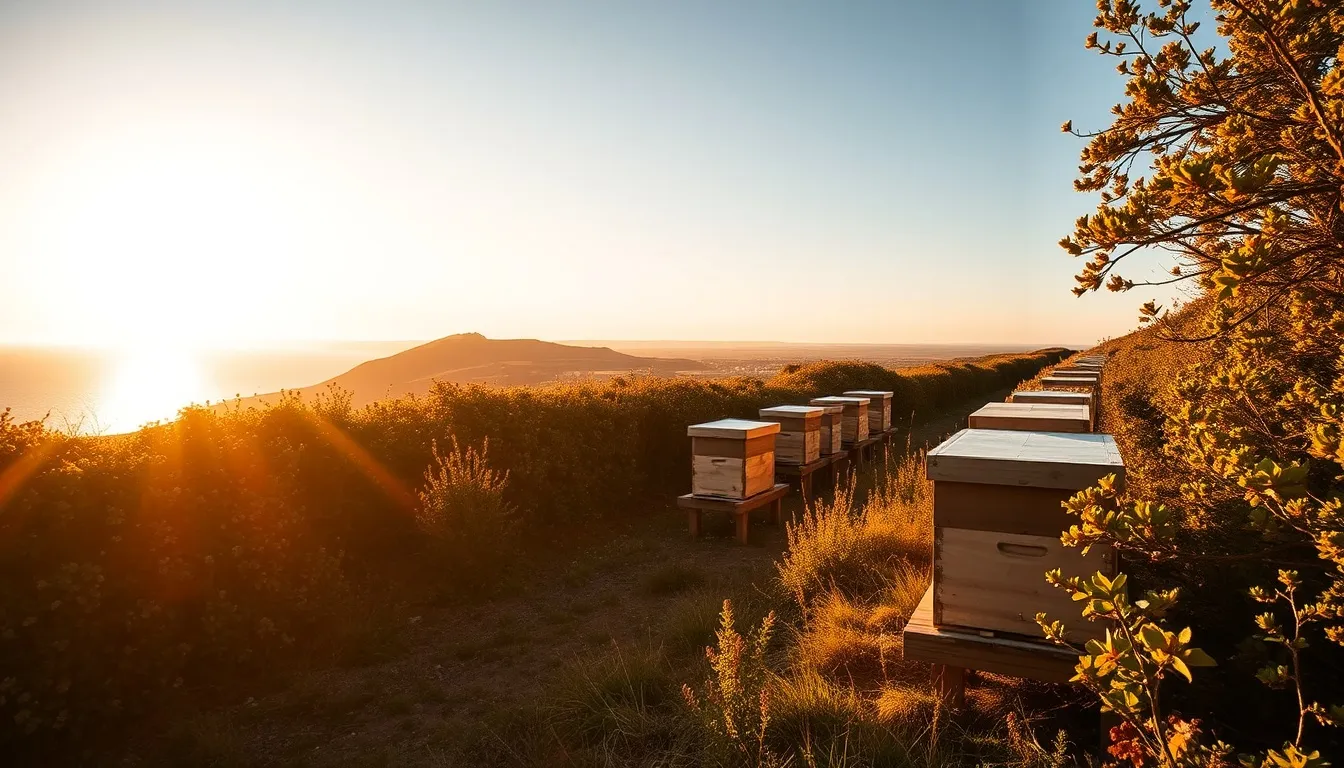
Jersey is a south-facing tilted plateau sloping from a high northern coast (Plémont, La Belle Hougue, Bouley Bay — cliffs to ~140 m) southward to the sandy bays of St Aubin's Bay, St Brelade's Bay, and St Clement's Bay. The island's geology is predominantly Late Proterozoic and Cambrian igneous and metamorphic — Jersey shale, the Jersey conglomerate, the south-eastern granites — overlain by a discontinuous wind-blown loess soil that supports the famous Jersey Royal early-season potato (a Solanum tuberosum cultivar grown almost exclusively on Jersey, protected as a UK Geographical Indication and farmed on the south-facing côtils, the steep coastal-slope fields). The forage profile reflects the geology and the agricultural-vs-coastal-heath partition: the island's interior is largely small-field arable and pasture with the dense, deep hedge banks (banques) characteristic of the Channel Islands and adjacent Brittany — these are 1.5–3 m earthen ridges topped with mixed-species hedgerow that function as wind shelter, livestock containment, and a year-round nectar reservoir of bramble (Rubus fruticosus aggregate), hawthorn (Crataegus monogyna), blackthorn (Prunus spinosa), gorse (Ulex europaeus), willow (Salix species), and ivy (Hedera helix).
The bloom calendar is long and benign — Jersey's maritime climate (USDA Zone 9b equivalent, mean annual temperature ~11.5 °C, sea-tempered winters, frost-free for most of the island below 50 m) supports an unusually extended foraging season: gorse and willow from late February; blackthorn and dandelion (Taraxacum agg.) in March; oilseed rape (Brassica napus, on the small commercial-arable acreage — minor) and hawthorn in April–May; bramble through May, June and July (the island's dominant nectar source by some margin); white clover (Trifolium repens) on grassland in June–July; lime / linden (Tilia × europaea) in urban-edge plantings in St Helier and Trinity in late June; and the late-season ivy flow from late September into November, which on Jersey routinely runs later and longer than equivalent English-mainland ivy because of the maritime mildness. The Jersey Beekeepers' Association's published forage notes describe the typical Jersey honey crop as a hedge-bank multifloral with a distinctive bramble-and-blackberry-flower note in the main June–July extraction window and a separate, paler ivy-dominated late-autumn crop that crystallises rapidly because of ivy's high glucose-to-fructose ratio.
There is no PDO, PGI, or domestic geographical-indication scheme for Jersey honey under the UK GI scheme that succeeded the EU PDO/PGI registry post-Brexit (the relevant register is now the UK Geographical Indications register administered by Defra), and no application has been filed for Jersey-origin honey. Jersey Royal potato, Jersey Cream, and Jersey Black Butter (a fruit conserve, not a dairy product) are protected; Jersey honey is not. The structural reason is the same as for most microstate-and-small-jurisdiction cases: total production volume is small enough that the cost-benefit of a GI registration would not justify the administrative load on the producer association, and the JBKA's strategic focus has historically been on Varroa management, queen rearing (the Jersey Beekeepers' Association queen-rearing project at Trinity is a notable internal initiative), and member education rather than on commercial-marketing infrastructure.
The Jersey Black Bee Loss: From Native Apis mellifera mellifera to Modern Hybrid Stock
The Jersey Black Bee — Apis mellifera mellifera, the European Dark Bee, the same subspecies native across Britain, Ireland, north-west France, and the Channel Islands before the late-19th-century introductions of imported Italian (A. m. ligustica) and Carniolan (A. m. carnica) stock — was historically present on Jersey and was for several decades treated as one of the few European populations that retained substantial mellifera genetic integrity into the late 20th century, alongside populations on the Isle of Man, in parts of County Galway, in pockets of north-west Scotland, and in Læsø in Denmark. The status changed during the late 1990s and the early 2000s when Varroa destructor — the parasitic mite that had spread westward from Asia from the 1970s onwards and reached the UK mainland in 1992 — was first detected on Jersey in 1998. The combination of mite pressure, the parallel arrival of viruses vectored by the mite (deformed wing virus, acute paralysis virus), and the loss of feral colonies meant that the JBKA-managed Jersey colonies and the small number of feral nests that had previously been regarded as A. m. mellifera populations declined sharply.
Replacement queens during the Varroa-recovery period were imported predominantly from UK Buckfast breeders (the synthetic Buckfast strain developed at Buckfast Abbey by Brother Adam from the 1920s), from Carniolan breeders in Slovenia and Austria, and from Italian (ligustica) breeders, on the practical reasoning that these imported lines were better-characterised for Varroa-tolerant queen-rearing and for honey productivity than the residual Jersey black-bee population. The result is that contemporary Jersey colonies are predominantly hybrid stock — Buckfast and Carniolan dominant with some ligustica and residual mellifera introgression — rather than the pre-1998 mellifera-dominant population. This is a meaningfully different conservation status from the Isle of Man, which retained a more substantial mellifera population through the Varroa transition and has a more active native-bee-conservation programme today; both jurisdictions are members of the Native Honey Bee Society of the British Isles (NIHBS / SICAMM) framework, but the Jersey position is closer to 'rebuild from imports' while the Isle of Man position is closer to 'preserve what remained'.
The honest conservation framing matters because the Jersey Black Bee is sometimes invoked in marketing copy and in popular gardening writing as if it were the dominant strain currently producing Jersey honey, and it is not. The JBKA does not currently publish a subspecies composition for the island's hives; the most defensible characterisation is that contemporary Jersey honey is produced predominantly by hybrid colonies with multiple subspecies in the genetic background, on a hedge-bank-and-bramble forage continuum that has been stable for several centuries. A future re-introduction or restoration project — modelled on the SICAMM or Læsø approaches — is a possibility but not a current programme. Visitors and consumers buying Jersey-origin honey at farmers' markets are buying hybrid-bee bramble-and-hedge-bank multifloral, not a heritage subspecies product.
Where Jersey Sits in the British Crown Dependencies Sub-Cluster
Jersey opens a new sub-cluster within the broader Adopted-by-Reference taxonomic frame: the British Crown Dependencies (BCDs) sub-cluster, comprising Jersey (118.2 km², ~103,000 residents, 200–500 colonies, 5–15 t/year), the Bailiwick of Guernsey (62 km² across four inhabited islands, ~63,000 residents), and the Isle of Man (572 km², ~84,000 residents). All three jurisdictions adopt UK food-composition law by Order in Council under their respective constitutional frameworks; all three lost their pre-Brexit EU customs-territory access at the end of 2020 and now trade with the EU under the UK-EU TCA; all three host long-established beekeeping associations (JBKA Jersey 1947; Guernsey Beekeepers' Association; Manx Beekeepers Association on the Isle of Man). The structural adoption mechanism — Crown-Dependency-by-Order-in-Council without customs union with the parent state — is shared across the three and is structurally distinct from the European-microstate cluster's treaty-and-customs-union mechanism.
The BCD sub-cluster is also distinct from the European microstates on subspecies-conservation grounds. The European-microstate cluster has no Apis mellifera subspecies-conservation through-line: Andorra and San Marino sit on continuous A. m. ligustica forage; Liechtenstein on A. m. carnica; Monaco on a fragmented mediterranean A. m. ligustica edge; Vatican / Castel Gandolfo on A. m. ligustica continuous with surrounding Lazio. The BCDs by contrast all sit historically on A. m. mellifera (the European Dark Bee) range, and the subspecies-conservation question is itself a structural variable across the three: the Isle of Man retained substantial mellifera through the Varroa transition; Jersey mostly did not; Guernsey's status is intermediate and less well-documented in the published literature. Any future BCD synthesis page would foreground this conservation-asymmetry alongside the shared Order-in-Council adoption frame.
The cluster-of-clusters now spans nine jurisdictions across two sub-clusters: five European microstates (Andorra, Liechtenstein, San Marino, Monaco, Vatican City) under the treaty-and-customs-union mechanism, plus three British Crown Dependencies (Jersey, Guernsey, Isle of Man) under the Order-in-Council mechanism — with the BCD sub-cluster's third member (Isle of Man) and second member (Guernsey) still to be shipped as standalone country guides. Together the eight-going-on-nine cases test the Adopted-by-Reference taxonomic frame across forage zones from high Pyrenean to Rätikon Alpine to sub-Apennine to Mediterranean Riviera garrigue to Mediterranean Sclerophyll on Castelli Romani volcanic soil to north-Atlantic-maritime hedge-bank-and-bramble. The framework is robust enough across geography, scale, and constitutional inheritance mechanism to count as a load-bearing cross-jurisdictional pattern in the corpus.