Myanmar's Honey Geography: Four Bee Species, Five Ecological Zones
Myanmar occupies a unique position in global apiculture: it is one of the few countries where four honeybee species coexist in active beekeeping and honey-collection traditions. Apis dorsata (the giant honeybee) builds exposed single-comb colonies on limestone cliff faces and tall trees across the country's interior. Apis florea (the dwarf honeybee) constructs tiny single-comb colonies in shrubs and tree forks from the Ayeyarwady delta to the Shan Plateau. Apis cerana (the eastern honeybee) fills hollow-log hives maintained by traditional beekeepers across every ethnic region. Apis mellifera (the western honeybee) occupies modern Langstroth apiaries introduced through FAO and UNDP programs from the 1990s onward. No other country in mainland Southeast Asia maintains all four species at this scale.
Myanmar's five ecological zones produce correspondingly distinct honey profiles. The Ayeyarwady delta and Irrawaddy lowlands (below 100 m) offer rice and sesame as primary nectar crops. The Bago Yoma and Rakhine Yoma hill ranges (200–1,000 m) provide teak forest wildflower. The Shan Plateau (900–1,500 m) supports polyfloral mountain honey from subtropical highland flora. The Karen, Kayah, and Kachin highlands (1,500–3,000 m) harbour wild Apis dorsata cliff colonies producing dark, mineral-rich rock honey. The Sagaing and Mandalay dry zone produces the world's most underrecognized sesame monofloral honey from the largest sesame cultivation concentration outside Sudan and Tanzania.
Wild Rock Honey: Apis dorsata and the Kayah Cliff-Harvest Tradition
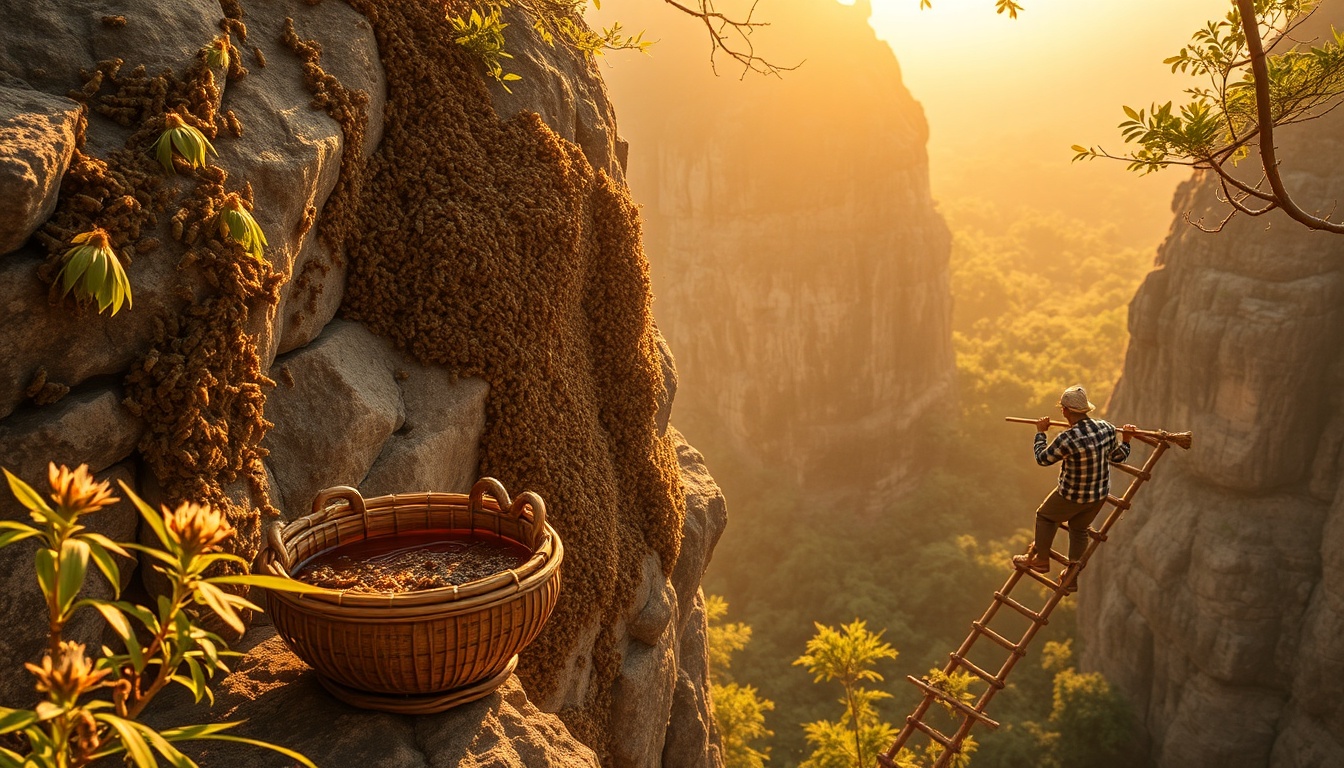
The giant honeybee (Apis dorsata) — wingspan up to 30 mm, the largest honeybee in the world — constructs exposed single-comb colonies on vertical cliff faces, limestone karst overhangs, and emergent trees across Myanmar's Karen, Kayah, and Kachin states. Individual colonies can contain 30,000–100,000 workers and produce 10–15 kg of honey in a large comb measuring up to one metre in diameter. In the Kayah State highlands, Loikaw district, and the Demoso valley, traditional Kayah (Karenni) honey hunters scale limestone outcrops using bamboo ladders lashed to cliff faces, wielding long bamboo poles with burning dried leaves to smoke the colony from below. The harvest is a collective community event — organised by the village headman, preceded by prayers to spirit guardians of the cliff, and governed by traditional protocols that determine harvest timing (typically November–March, post-monsoon when colonies are at peak population) and honey-sharing ratios among the hunting party.
Rock honey from Kayah State and the adjacent Karen (Kayin) highlands is dark amber to near-black, intensely flavoured, with a mineral complexity that reflects the limestone geology and the diverse highland flora — Imperata grassland, secondary forest scrub, and Pinus kesiya pine forest on upper slopes providing a distinctive mixed pollen profile. It is used medicinally by Kayah and Karen communities for wound dressing, respiratory treatment, and as a general strengthening tonic — particularly for children recovering from illness and for mothers postpartum. The taste is not comparable to any commercial variety: it is dense, slightly resinous, with a bitter-floral finish and a viscosity that indicates high pollen content. It is never filtered, rarely heated, and essentially never reaches markets outside the harvesting community.
Pro Tip
Wild Myanmar rock honey occasionally appears at the Mae Sot–Myawaddy border market in western Thailand, sold by Karen community traders. It is typically packaged in recycled glass jars or bamboo containers with no labelling. If purchasing, clarify whether it is from managed Apis cerana colonies or wild Apis dorsata harvest — the flavour profiles are dramatically different, with wild rock honey being substantially darker and more complex.
Get the Honey Buyer's Cheat Sheet (free PDF)
16 varieties on one page — color, flavor, best use and what a fair price looks like — from the 304 honeys we track.
Teak Forest Honey and Sesame Blossom: Myanmar's Distinctive Monoflorals
Myanmar contains the world's largest remaining natural teak forests — approximately 40% of the world's teak timber stock, concentrated in the Sagaing, Mandalay, and Bago administrative regions. Teak (Tectona grandis) blooms from June to August, producing small pale-yellow flowers in large terminal panicles that provide a significant nectar flow for apiaries placed in forest clearings and along logging roads. Teak honey is pale amber to water-white, mild and slightly woody-floral, with a faint resinous note that distinguishes it from generic lowland wildflower blends. It crystallises slowly due to its high fructose fraction. It has no international profile, no GI status, and no analytical chemistry published in accessible apiculture journals — yet it is a genuinely distinctive monofloral from one of the world's most iconic tree species, available in substantial volume in Sagaing and Mandalay regional markets.
Sesame honey from Myanmar's Magway dry zone is the more commercially significant underrecognised variety. Myanmar is consistently one of the world's top five sesame producers, and Magway Division — the 'sesame belt' — cultivates Sesamum indicum across several hundred thousand hectares. The sesame bloom in May–June produces a pale golden honey with a mild, nutty-floral aromatic character that is specific to Sesamum: analogous to the sesame honeys produced in the Nuba Mountains of Sudan and the semi-arid Tigray region of Ethiopia, but from a cultivation context that is purely agricultural rather than traditional. It crystallises at medium rate, is commercially harvested in significant volumes, and is sold domestically as a general-purpose honey rather than a premium monofloral. It is the variety most likely to reach Thai specialty importers and the only Myanmar honey with a realistic path to formal export markets in the short term.
Traditional Beekeeping Across Myanmar's Ethnic Communities
Myanmar's 135 officially recognised ethnic groups maintain distinct beekeeping traditions shaped by ecology, culture, and trade networks that predate colonial contact. Bamar (Burman) traditional medicine — thayo, drawing on Pali-language medical texts from the Bagan period — assigns specific therapeutic properties to different honeys by colour, viscosity, and floral source. Apis cerana honey from hollow log hives (ywet-ta in Burmese) is a standard household remedy for cough, wound care, and seasonal fever across lowland Buddhist communities. Honey is offered at pagoda festivals and serves as a standard gift item between families.
Shan communities on the plateau (900–1,500 m) practice both managed Apis cerana beekeeping and opportunistic Apis dorsata wild harvest from forest colonies. The Shan honey trade — moving product from mountain apiaries to Mandalay and Rangoon (Yangon) via traditional merchant networks — predates the British colonial period and is documented in Shan court records from the Kengtung kingdom. Kachin communities in northern Myanmar maintain Apis cerana beekeeping as part of a broader forest-product economy that includes rattan, bamboo, and wild mushroom collection; Kachin honey moves informally across the Chinese border to Yunnan Province via the Myitkyina–Bhamo–Ruili route, one of the oldest overland trade corridors in mainland Southeast Asia. Karen and Kayah communities combine managed Apis cerana with Apis dorsata cliff harvest, using honey both in traditional medicine and as a ceremonial item in animist and Christian (many Karen converted during the colonial period) ritual contexts.
Post-Coup Beekeeping: Honey Production Across Civil War Lines
Myanmar's February 2021 military coup and the subsequent civil war between the State Administration Council (SAC) and the People's Defence Force (PDF) and allied ethnic armed organisations have created a complex patchwork of territorial control affecting beekeeping infrastructure. SAC airstrikes and artillery attacks on Sagaing, Kayah, and Chin villages have destroyed beekeeping equipment, disrupted seasonal migration routes for managed apiaries, and killed beekeeping extension workers operating in contested zones. The FAO Myanmar programme — which had supported apiculture development for two decades — sharply reduced field operations after the coup, though it maintained some presence for humanitarian agricultural support.
The conflict has not stopped honey production. Ethnic-controlled territories — the Karen National Union (KNU) and its armed wing KNLA in the Karen/Kayin highlands, the Karenni National Progressive Party (KNPP) in Kayah State, the Kachin Independence Organisation (KIO) and its Kachin Independence Army (KIA) in Kachin State — maintain their own agricultural programs including beekeeping support. Honey produced in these territories moves along ethnic-controlled trade routes to Thailand (via Mae Sot/Myawaddy, Mae Hong Son, and Chiang Rai border crossings) and to China (via Kachin-China border at Mu Se/Ruili). Mae Sot's informal border market, long a hub for Karen community trade, regularly carries Myanmar honey including wild Apis dorsata rock honey from Kayah and managed Apis cerana honey from Shan and Karen community apiaries. The pattern mirrors Afghanistan and the Eritrean Tigrinya plateau: conflict disrupts formal infrastructure but cannot extinguish production in communities where honey is a cultural anchor and a reliable trade commodity.
Pro Tip
Mae Sot, on Thailand's border with Myanmar in Tak Province, hosts one of mainland Southeast Asia's largest informal border markets. Karen, Shan, and Kachin communities sell agricultural products including honey here. It is the most accessible point for purchasing authenticated Myanmar honey outside Myanmar itself.
Finding Myanmar Honey Outside Myanmar
Myanmar honey has essentially no presence in Western specialty retail. No GI applications have been filed for any Myanmar honey variety. No authentication infrastructure exists. No export promotion agency has targeted specialty honey markets in Europe or North America. The country's best honey — wild Apis dorsata rock honey from Kayah State, teak forest wildflower from Sagaing — remains in informal local and regional trade circuits.
The most accessible route for outsiders is the Thai border market system. Mae Sot (Tak Province, western Thailand) is the primary Karen community trade hub, accessible to travellers and specialty importers; honey from Karen and Kayah areas appears here regularly, typically in unlabelled glass jars or bamboo containers. Mae Hong Son and Chiang Rai border markets offer occasional Shan mountain honey from different ethnic production zones. Yangon specialty food shops — fewer and more precarious post-2021 — sometimes carry highland honey from domestic specialty producers. Myanmar diaspora communities in Bangkok, Chiang Mai, and Malaysia (where significant Myanmar migrant worker populations have formed) maintain some informal supply chains for specialty food items including honey.
For researchers and importers, FAO Myanmar and the Myanmar Beekeeping Association (pre-coup iteration) published production data and producer contacts that remain partially valid; the Mekong Institute in Khon Kaen, Thailand, has documented border trade flows including agricultural honey across the Thailand–Myanmar frontier. These sources provide the best entry points for establishing legitimate supply chains from a country whose food production is among the world's most under-documented.