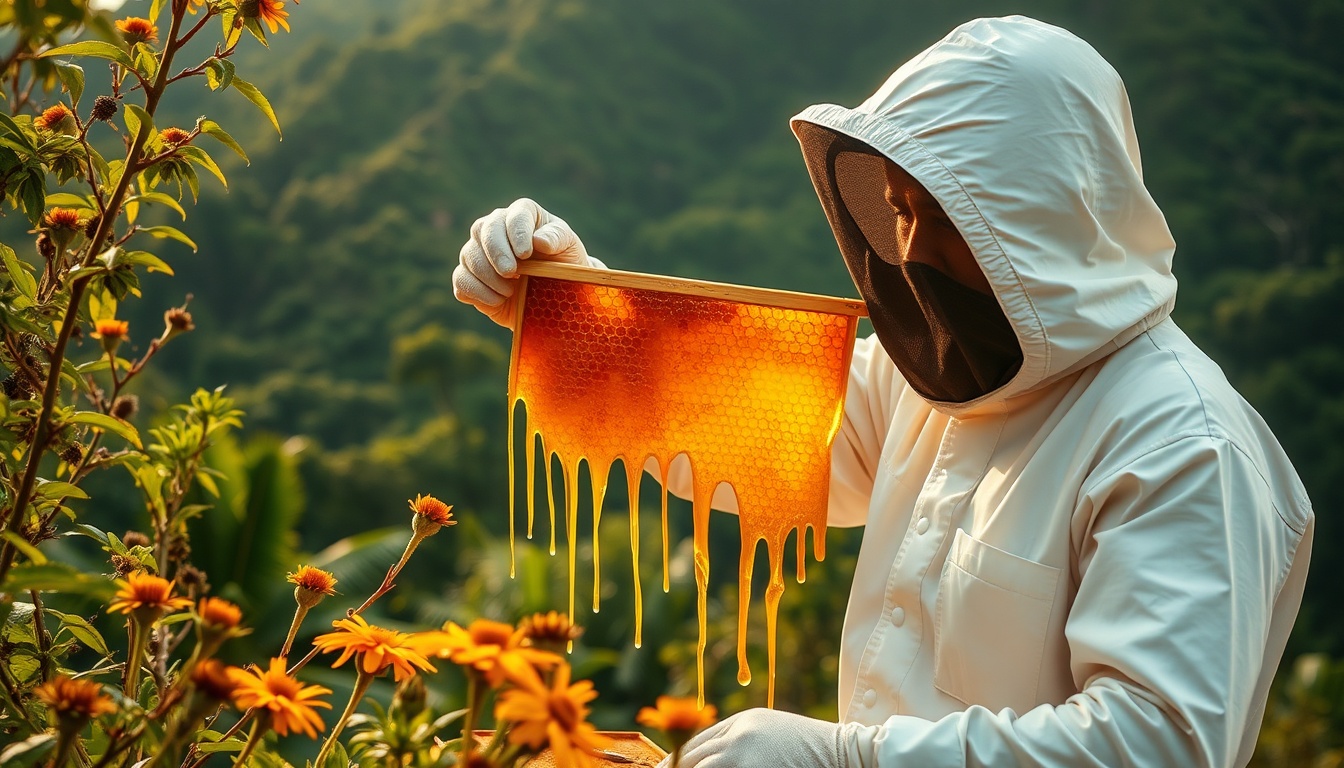
The United States' Tropical Honey Frontier
Puerto Rico occupies a singular position in the global honey map: it is a US territory, meaning its honey production falls under the jurisdiction of the United States Department of Agriculture and the Animal and Plant Health Inspection Service — the same federal oversight apparatus that governs honey from Florida or California. But Puerto Rico's climate, flora, and cultural inheritance are wholly Caribbean. The island sits at 18° North latitude, 60 to 100 kilometers east of Hispaniola, on the northeastern edge of the Caribbean archipelago. Its terrain ranges from coastal mangroves and dry limestone forests in the south to cloud-draped volcanic peaks in the northeast — El Yunque, the Luquillo Mountains, rising to 1,065 meters above the Atlantic coast.
This USDA-oversight paradox shapes the island's honey identity. On the mainland, the USDA grade-A standard is a marketing floor, not a quality ceiling — most commodity honey passes it comfortably. In the Caribbean context, where authenticity verification is a significant challenge for most island honey origins, the presence of federal inspection infrastructure makes Puerto Rican honey the most rigorously regulable tropical honey in the Americas. Yet virtually none of it crosses the water to mainland specialty food shelves. The island consumes nearly all its own production — a small but growing artisanal sector sells through local markets, agro-tourism farms, and directly from beekeepers — while the mainland's honey specialty stores are largely unaware that a domestic tropical origin exists.
The mainland invisibility is partly structural: Puerto Rico produces an estimated 10,000 to 15,000 kilograms of honey per year from approximately 3,000 to 5,000 registered colonies — minuscule by commodity standards, meaningful by artisanal ones. Pre-Hurricane Maria production was somewhat higher. The island's honey sector is organized through the Asociación de Apicultores de Puerto Rico (APIPR), which works with the Puerto Rico Department of Agriculture (PRDA) on production standards and beekeeper training. For the specialty food buyer, Puerto Rican honey represents a genuine first-mover opportunity: a domestic tropical origin with USDA oversight and no national brand.
El Yunque National Forest and the Luquillo Mountain Honey
El Yunque National Forest — 11,327 hectares (28,000 acres) in the Sierra de Luquillo in Puerto Rico's northeast — is the only tropical rainforest in the entire US National Forest system. It receives 3,500 to 5,000 millimeters of rainfall annually, making it one of the wettest points in the Caribbean, and supports four distinct forest types stacked by altitude: Tabonuco forest (below 600 m), Palo Colorado cloud forest (600–900 m), Dwarf forest (900–1,065 m), and Elfin woodland at the summit. The botanical diversity is exceptional: approximately 240 tree species, 150 fern species, and 50 orchid species, of which a substantial fraction are endemic to the Caribbean or to Puerto Rico specifically.
The dominant canopy tree of the Tabonuco zone — Dacryodes excelsa, called tabonuco by Puerto Rican beekeepers — produces a resinous aromatic honey during its spring flowering that has no widely recognized commercial name. Prestoea acuminata (Sierra palm) flowers year-round in disturbed edges. Cecropia schreberiana, the yagrumo tree — a fast-growing pioneer species with large lobed leaves — is a significant nectar source for Apis mellifera in the lower forest margins. Heliconia species (endemic to the El Yunque understory) attract pollinators at multiple levels. The ausubo tree (Manilkara bidentata), one of the island's hardest and most valued native timbers, flowers irregularly but abundantly when it does.
No commercially marketed 'El Yunque wildflower' or 'Tabonuco honey' variety exists with consistent production and distribution as of 2026. Several small apiaries in the Luquillo and Río Grande municipalities keep hives at the forest boundary — the buffer zone allows beekeeping at forest edges — and sell harvest locally. The honey produced from this flora is typically medium amber, mild to moderately floral, with a tropical aromatic profile distinct from any mainland US wildflower honey. The US Forest Service presence means that any future commercialization of El Yunque-adjacent honey would occur within a federally managed framework — a structural advantage over every other Caribbean forest honey origin.
Get the Honey Buyer's Cheat Sheet (free PDF)
16 varieties on one page — color, flavor, best use and what a fair price looks like — from the 304 honeys we track.
Yauco, Adjuntas, and the Coffee Highland Honey Gap
Puerto Rico's Cordillera Central — the limestone-and-volcanic-rock spine that runs east-west through the island's interior — reaches 1,338 meters at Cerro de Punta, the island's highest point. The highland municipalities of Yauco, Adjuntas, Lares, and Ponce's highland districts grow specialty Coffea arabica at 600 to 1,200 meters elevation, in the same altitude band that produces Jamaica Blue Mountain, Costa Rica Tarrazú, and Honduras Marcala coffees. Puerto Rican specialty coffee went largely dormant after Hurricane Hugo (1989) and the 1990s decline of cooperative infrastructure, but a pronounced revival has been underway since the mid-2010s: Café Yauco, Hacienda Lealtad in Lares, Café de Adjuntas (a cooperative), and several boutique producers have re-established Puerto Rican highland coffee as a premium product in domestic and export markets.
Coffea arabica blooms in Puerto Rico from February through April, with peak bloom in February and March depending on elevation and rainfall. The white flowers — fragrant, jasmine-adjacent, ephemeral — last three to five days each, creating a flush of nectar that Apis mellifera colonies exploit intensely during the bloom window. Honey harvested from coffee-blossom forage is typically pale straw to light amber, with a delicate floral quality — mild enough to be called 'light wildflower' but with a distinct aromatic note that experienced tasters associate with the bloom rather than with leaf or fruit chemistry. No 'Yauco coffee blossom honey' or 'Adjuntas coffee blossom honey' product is commercially marketed as of 2026. The highland honey from these municipalities is sold as generic island wildflower through local outlets if sold at all.
The structural argument for a Yauco or Cordillera Central coffee blossom honey is more tractable than in most other Caribbean origins because the specialty coffee revival has already rebuilt the farm-level infrastructure. Several of the Yauco and Lares producers keep small apiaries for pollination service — maintaining hives on coffee farms is standard practice in high-elevation Arabica production globally. The step from 'pollination apiaries on coffee farms' to 'marketed coffee blossom honey from the same farms' requires a honey harvester, a certifier willing to verify floral origin by pollen analysis, and a buyer willing to pay a premium for the designation. None of those elements are impossible; none of them are assembled yet. This is the same gap documented across the Caribbean cluster — Jamaica Blue Mountains, Dominican Republic Barahona, Haiti Kenscoff — but in Puerto Rico's case the USDA oversight infrastructure is in place to validate any future geographic or floral designation.
Taíno Heritage and Caribbean Stingless Bee Traditions
Puerto Rico was inhabited by Taíno people — an Arawakan-speaking culture whose island name, Borikén (or Boriquén), remains in use as a Puerto Rican cultural self-designation today. The Taíno maintained agricultural traditions across the Caribbean before Spanish colonization beginning in 1508. In Mesoamerica and adjacent areas, Melipona beecheii — the stingless bee called Xunan Kab in the Maya tradition — was kept by indigenous peoples in log hives for honey, wax, and ceremonial use. In the Greater Antilles, Caribbean-adapted populations of Meliponini are documented from pre-Columbian archaeological and ethnohistorical sources, though the specific species traditions in Puerto Rico are less well-documented than in Mexico or Guatemala.
Post-colonization, Taíno culture was severely disrupted; continuity of meliponicultura into the modern era in Puerto Rico is not well-attested in the literature in the way that Maya xunan kab traditions have persisted in Yucatán and Honduras. The honey plant called cobo in some Caribbean Arawakan dialects is referenced in colonial-era botanical accounts, but the connection to maintained meliponicultura practice is unclear. Small populations of native stingless bees (Trigona and Partamona species) are recorded in Puerto Rican entomological surveys — they are present as wild populations in forests and agricultural edges — but commercial meliponicultura does not exist in any documented form on the island as of 2026. This is a genuine gap: if native bee populations can be identified and brought into managed production, Puerto Rico could develop a stingless bee honey product with a Taíno cultural framing that no other US-territory origin can claim.
The ausubo honey tree and the jícaro tree (Crescentia cujete, gourd tree) — both embedded in Taíno material culture — flower in Puerto Rico and produce nectar accessible to both Apis mellifera and native stingless bees. The archaeological precedent for honey use in the Caribbean is present even if the unbroken practice is not. Several Puerto Rican cultural organizations have expressed interest in reviving meliponicultura as part of broader Taíno agricultural heritage programs, including work by the Proyecto Karaya collective in Ponce and agro-ecological farms in the central highlands.
Hurricane Maria, Colony Losses, and the Long Rebuild
Hurricane Maria made landfall on Puerto Rico on September 20, 2017, as a Category 4 storm with sustained winds of 250 km/h. The storm caused catastrophic and unprecedented agricultural damage across the island: the coffee sector lost an estimated 80% of production; the banana industry collapsed; livestock suffered severe losses; and the beekeeping sector, according to APIPR estimates and PRDA damage assessments, lost 70 to 80 percent of registered colonies. The mechanisms of colony loss were multiple: direct physical destruction of hives by wind and flooding; loss of nectar-producing vegetation when trees were stripped bare; contamination of foraging areas by debris and flooding; and displacement of beekeepers themselves, many of whom left the island in the months after the storm.
Recovery has been gradual and uneven. Queen bee production — Puerto Rico previously exported Africanized-hybrid queens to hobbyist beekeepers in mainland US states, a niche trade that valued the hybrid vigour and disease resistance of colonies derived from Caribbean-managed Africanized stock — was severely disrupted. APIPR worked with PRDA and USDA extension offices to coordinate nucleus colony distributions and training programs in the three years following the storm. By 2020 to 2022, colony counts were recovering, though they had not returned to pre-Maria levels. Several experienced beekeepers took the disruption as an opportunity to upgrade to modern Langstroth equipment from older hive designs, improving harvest consistency.
Hurricane Fiona (September 2022) delivered a secondary blow to the recovering sector — though less destructive than Maria, Fiona caused significant flooding and wind damage in the southern and western municipalities where several of the island's most established apiaries are concentrated. The accumulated disruption has reinforced a structural vulnerability: Puerto Rico's small-scale beekeeping sector, distributed across a densely populated island in the direct path of Atlantic hurricane tracks, faces climatic risk that no regulatory or market infrastructure can fully offset. The resilience argument — similar to what NGO-supported beekeeping programs document in Haiti — is that small-scale, diversified apiaries with locally adapted bees recover faster than large-scale monoculture operations. Puerto Rico's Africanized hybrid colonies, discussed below, have proved more resilient to environmental stress than pure European stocks.
USDA Oversight, APHIS, and the Africanized Bee Question
Africanized Apis mellifera — the hybrid resulting from Warwick Kerr's 1957 African queen introductions in Brazil and their subsequent spread through the Americas — reached Puerto Rico in the mid-1990s. The USDA Animal and Plant Health Inspection Service (APHIS) manages Africanized bee monitoring in the United States and its territories; Puerto Rico falls within the APHIS jurisdiction, meaning that Africanized bee presence is tracked and managed through the same regulatory framework that governs California and Texas. This is structurally different from every other Caribbean island: in Jamaica, Cuba, the Dominican Republic, or Haiti, Africanized bee arrival and management occur within national frameworks with varying enforcement capacity. In Puerto Rico, APHIS resources are federally funded.
After initial colonization in the mid-1990s, the Puerto Rican beekeeping community adapted to Africanized genetics rather than attempting eradication — the latter strategy has never been successful anywhere Africanized bees have established. APIPR established queen-rearing programs that selected for docile behavioral traits from the local hybrid population, producing what beekeepers informally call 'Puerto Rican bees' — Africanized in genetics, but behaviorally manageable under experienced handling. Several breeders developed queen lines with consistent hygienic behavior and defensive temperament within a manageable range. These queens were, pre-Maria, a small export item to hobbyist beekeepers in Florida and other southern states who valued the tropical-adapted genetic stock.
USDA grade standards apply to Puerto Rican honey: moisture content below 20% (the Beutler fermentation threshold), absence of prohibited additives, truthful labeling. The PRDA inspects processing facilities. For buyers seeking tropical honey with documented regulatory oversight — a meaningful distinction from honey imports relying on importer self-certification — Puerto Rican honey offers a domestic alternative. The island's honey is not certified organic at scale (organic certification requires USDA NOP compliance, which prohibits use of antibiotics including oxytetracycline, widely used in Caribbean beekeeping for American foulbrood management). Several small producers pursue NOP organic certification; it is achievable given the island's relatively contained geography and federal oversight infrastructure.
What to Buy and How to Find Puerto Rican Honey
Puerto Rican honey is sold primarily through local channels: farmers markets in San Juan (Santurce Mercado and Parque Sixto Escobar markets), Ponce (Plaza del Mercado), Mayagüez, and Yauco; agro-tourism farms in the Cordillera Central; and directly from beekeepers through social media and word of mouth. APIPR maintains a member directory that PRDA publishes and updates; this is the most reliable source for identifying active producers. Several organic and specialty food shops in San Juan carry local honey in small runs. The tourist-destination context means that some honey sold in gift shops or market stalls may be blended or of uncertain origin — buying directly from APIPR member producers provides the most reliable provenance.
What to look for: locally produced Puerto Rican honey will generally be labeled with the beekeeper's municipality (Yauco, Adjuntas, Lares, Luquillo, Río Grande, Jayuya) and sometimes the floral source if the beekeeper tracks it. Harvest date and moisture content are the quality markers most experienced buyers request. Puerto Rican wildflower honey is typically medium amber, mildly floral, with a warm tropical character. Coffee-adjacent highlands produce lighter honey during the February–April bloom; flamboyán-dominant lowland areas produce brighter, fruitier honey in spring. Year-round tropical foraging means fresh harvest is always available if you find an active producer — unlike temperate origins with a single annual harvest window.
For mainland buyers: no established Puerto Rican honey brand distributes nationally as of 2026. Puerto Rican specialty food events in major US mainland cities (New York, Orlando, Chicago) occasionally feature local producers, and Puerto Rican food markets in communities with large diaspora populations sometimes carry locally sourced honey. Online direct-from-farm sales from APIPR members who ship to the mainland exist but are small-scale. This is, structurally, the same situation as Hawaiian lehua honey before the mid-2000s specialty food market development — a domestic tropical origin with distinctive flora, awaiting the combination of producer investment and mainland buyer awareness that builds a category.
