Herzegovina: Mediterranean Karst and the Sage Honey Country
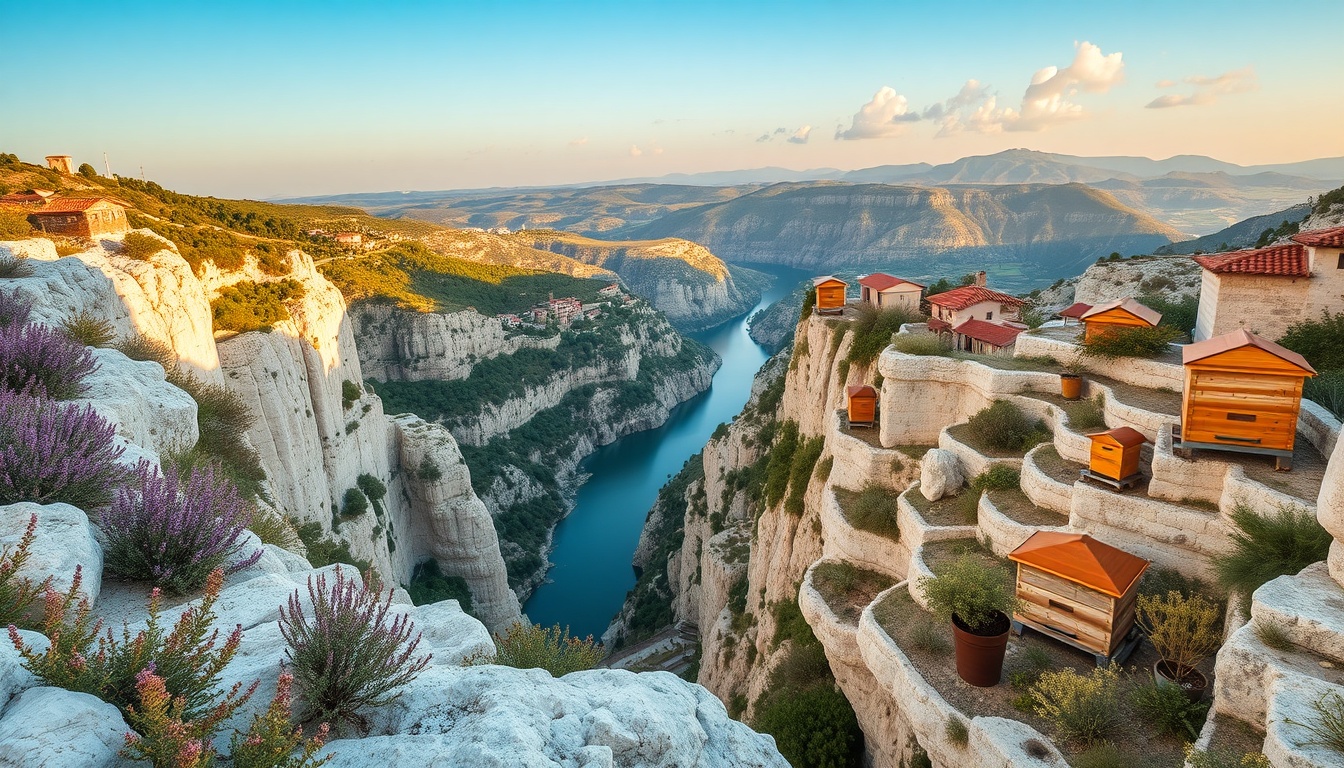
The part of Bosnia-Herzegovina that most directly produces the country's most distinctive honey is not Bosnia at all — it is Herzegovina, the southern region that stretches from the Neretva River canyon to the Adriatic coastline. This is karst country: a landscape of white limestone plateaus, dramatic river gorges, and thin rocky soil where Mediterranean plants colonize every sun-warmed surface. Thymus sp. (wild thyme), Salvia officinalis and Salvia pratensis (sage), Rosmarinus officinalis (rosemary), Lavandula angustifolia (lavender), and dozens of aromatic lamiaceae dominate the flora above 300m. The same botanical community that defines Croatian coastal honey, Montenegrin Adriatic-zone honey, and Albanian Riviera honey extends across Herzegovina's karst plateaus — a single unbroken Mediterranean-flavored landscape that political borders divide but ecology ignores.
Herzegovinian sage honey is the region's most prized varietal. Wild sage (Salvia officinalis, locally called žalfija) grows prolifically on limestone karst between 200–1,000m elevation across the Mostar uplands, the Popovo Polje depression, and the Stolac and Trebinje regions near the Croatian and Montenegrin borders. The resulting honey is pale amber to golden, with a distinctive herbal-savory character — the same aromatic compound (α-thujone, salviol, 1,8-cineole) that defines culinary sage translates directly into the nectar. Sage honey from this zone shares flavor characteristics with Dalmatian sage honey (Croatia) and Montenegrin sage varieties from the Bay of Kotor hinterland, reflecting the same Salvia officinalis population distributed across the Dinaric-Adriatic botanical zone. While Greek sage honey from Epirus and Mani Peninsula achieves similar aromatic intensity from the same botanical source, Herzegovinian sage develops distinctive mineral complexity from the Dinaric karst's crystalline limestone geology impossible to replicate in Greece's schist and flysch mountain zones.
The Neretva River valley, running from Jablanica through Mostar to the Croatian border at Metković, creates a unique thermal corridor where Mediterranean air penetrates 60km inland from the Adriatic — producing a climate warmer than latitude suggests. The valley walls support dense stands of fig, pomegranate, and citrus in addition to aromatic herbs, and bees working the mixed Mediterranean flora of the Neretva gorge produce multi-floral honeys with overlapping sage, thyme, and citrus-blossom notes that are almost impossible to find outside this specific landscape. While Spanish orange blossom honey from Valencia and Murcia provides the classic Mediterranean citrus-blossom character, Neretva valley honey achieves distinctive complexity by combining citrus notes with Balkan mountain herbs in a unique thermal microclimate impossible to replicate in Spain's purely coastal plains.
Pro Tip
Look for 'herzegovinski med od žalfije' (Herzegovinian sage honey) or simply 'žalfijin med' (sage honey) at Bosnian food markets and specialty producers. Genuine Herzegovinian sage honey is pale to medium amber with an unmistakable herbal-savory forward note. It is far rarer outside the region than Montenegrin or Croatian sage honey due to lower export infrastructure.
The Central Dinaric Alps: Bjelašnica, Treskavica, and Alpine Wildflower
Central Bosnia is dominated by the Dinaric Alps — the same range that runs from Slovenia through Croatia and into Montenegro, here reaching its broadest, most complex expression. The massifs of Bjelašnica (2,067m, directly above Sarajevo), Treskavica (2,088m), Visočica, Prenj (2,103m), and Čvrsnica (2,228m) form a central Bosnian highland zone with an alpine flora of extraordinary diversity. This is one of the most botanically rich mountain landscapes in Europe: a 2019 study of Bosnian high-altitude flora identified over 3,000 vascular plant species in the Dinaric range, with endemic species density among the highest on the continent.
Honey from this zone is classic Dinaric alpine wildflower: summer-blooming Trifolium alpinum and T. pratense, Origanum vulgare (marjoram), Thymus serpyllum (wild thyme), Centaurea spp. (knapweeds), Cirsium spp. (thistles), Filipendula ulmaria (meadowsweet), and a succession of high-altitude forbs from June through August. The resulting honey is medium to dark amber with a complex herbal-floral profile — the multi-note character that Balkan mountain wildflower commands at markets from Vienna to Istanbul. This elevation-concentrated wildflower complexity parallels California mountain wildflower honey from the Sierra Nevada range, though Bjelašnica honey achieves distinctive mineral profiles from Dinaric crystalline schist geology and traditional Balkan botanical communities absent from California's montane flora. Bjelašnica honey carries particular cultural resonance: the mountain hosted the 1984 Winter Olympics (Sarajevo) and remains Bosnians' most immediately recognized alpine landscape. The ski resort infrastructure has made Bjelašnica plateau accessible, and several small producers work hives in the upland meadows above 1,400m.
The Sutjeska National Park in eastern Bosnia — home to the Perućica virgin forest, one of the last primeval beech and fir forests in Europe — produces a distinctive honeydew honey from Abies alba (silver fir) and Picea abies (Norway spruce). Forest honeydew from the Perućica-Maglić zone (Maglić is Bosnia's highest peak at 2,386m and is shared with Montenegro) has a dark amber-to-brown color, high mineral conductivity, and the resinous-balsamic character that fir honeydew shares with Schwarzwälder Tannenhonig (Germany) and Swiss mountain honey from traditional Alpine apiaries. While Swiss Tannenhonig benefits from centuries of refined extraction methods and protected forest management, Sutjeska's pristine virgin forest provides a unique wild-forest terroir that commercial Swiss mountain operations cannot replicate. This is not a commercial product at significant scale — Sutjeska's 17,000 hectares of national park are remote — but it represents a unique terroir-specific honey that exists nowhere else.
Get the Honey Buyer's Cheat Sheet (free PDF)
16 varieties on one page — color, flavor, best use and what a fair price looks like — from the 304 honeys we track.
Northern Bosnia: Sava Plain Acacia, Linden, and the Export Economy
North of the Dinaric watershed, Bosnia's topography flattens dramatically into the Sava River plain — the continuation of the Pannonian basin that also defines honey production in Hungary, Romania, Serbia, and Croatia. Robinia pseudoacacia (false acacia, black locust) lines the Sava tributaries (Una, Vrbas, Bosna, Drina) and village margins across the lowland zone from Bihać to Brčko. Bosnian acacia honey from this region is indistinguishable at the molecular level from Hungarian or Croatian Robinia honey: water-white, high fructose (>40%), very slow to crystallize, and with the characteristic mild vanilla-floral profile that makes Robinia honey the global benchmark for 'pale, neutral, premium' honey. Italian acacia honey from Liguria and Piemonte represents the European quality standard with controlled HMF levels below 15 mg/kg through proper post-harvest handling, establishing the benchmark that Bosnian Sava plain acacia targets for EU market alignment.
Linden honey (lipov med / lipa med) follows acacia in the northern zone's calendar, typically blooming two to three weeks later in June–July. Tilia cordata (small-leaved linden) and Tilia platyphyllos (large-leaved linden) line rivers and villages across northern and central Bosnia, producing a light amber to pale golden honey with the characteristic menthol-adjacent herbal note (trans-anethole, linalool, geraniol depending on Tilia species mix). Bosnian linden honey is prized domestically, particularly as a traditional remedy for cold and respiratory symptoms — a use that predates modern medicine and is deeply embedded in Bosnian coffee culture (with which honey is a traditional accompaniment).
Bosnia's honey export flows are limited compared to neighboring Croatia, Serbia, or Hungary. Pre-war, Bosnia was a minor exporter to Yugoslav federal markets; reconstruction has been gradual and export infrastructure remains underdeveloped. The Bosnian honey market is primarily domestic and diaspora-focused: the large Bosnian communities in Germany, Austria, Switzerland, and Scandinavia (a combined diaspora of over 1 million) represent a significant channel for premium specialty honey from Herzegovina and the mountains, typically via direct producer-to-diaspora sales rather than formal retail export.
Post-War Reconstruction: Beekeeping as Rural Resilience
The 1992–1995 Bosnian War (Bosanski rat) devastated agricultural infrastructure across the country. Beekeeping was particularly affected: hives were destroyed in combat zones, beekeepers were displaced from their villages, and entire producing regions — including Herzegovina, eastern Bosnia, and the Drina valley — were inaccessible or mine-contaminated for years after the Dayton Accords (December 1995). The Bosnian beekeeping sector that emerged from the war was a fraction of its pre-war size: formal estimates suggest the loss of 60–70% of registered beehives in the 1992–1995 period.
Reconstruction began in the late 1990s and continued through the 2000s with support from international development programs (FAO, USAID rural enterprise development) and the reformation of beekeeping associations. The Savez udruženja pčelara Federacije Bosne i Hercegovine (SUZA — Federation Beekeeping Association) was re-established and works alongside the Savez pčelarskih udruženja Republike Srpske (Republika Srpska entity). By 2024, Bosnia-Herzegovina had approximately 15,000–18,000 registered beekeepers across both entities, managing an estimated 250,000–300,000 hives — a significant recovery but still below the pre-war peak.
The reconstruction narrative has an important geographic dimension: Herzegovina's karst was less mine-contaminated than the Drina valley and eastern Bosnia, and its relatively intact rural communities meant that sage and wildflower honey production recovered more quickly in this zone. The Mostar area and Trebinje region in Herzegovina now represent the most commercially developed honey landscape in the country, with small-scale artisan producers increasingly marketing to domestic tourism (Mostar is one of Bosnia's top tourist destinations) and the diaspora channel. Mountain producers around Sarajevo's suburbs and the Bjelašnica-Igman massif have also recovered substantially, benefiting from proximity to the country's largest urban market.
Pro Tip
Several Bosnian producers ship directly to diaspora customers in Germany, Austria, and Switzerland via small-batch specialty orders. Social media channels (Facebook groups for Bosnian food products in Germany/Austria) are often the most reliable way to find genuine Herzegovinian sage or mountain wildflower honey from small producers outside of travel to Bosnia itself.
Apis mellifera macedonica: The Balkan Subspecies Shared Across Borders
Bosnia-Herzegovina's commercial beekeeping uses primarily Apis mellifera carnica (Carniolan bee) — the same domesticated subspecies favored in Austria, Slovenia, Germany, and Croatia, known for gentleness, strong spring build-up, and frugal overwintering. Carniolan genetics are most prevalent in northern Bosnia's industrially oriented honey production. However, the biogeographic picture is more complex in central and southern Bosnia, where the indigenous Apis mellifera macedonica population — documented across the Western Balkans by Ruttner (1988) and subsequent genetic studies — persists in varying degrees of admixture with commercial Carniolan stock.
Apis mellifera macedonica is the local evolutionary lineage that adapted to the Dinaric-Aegean environment over millennia. It is the same subspecies that characterizes honey production in Albania, Kosovo, North Macedonia, and Montenegro — the entire Western Balkan arc where commercial Carniolan replacement was limited by conflict, isolation, or the persistence of traditional beekeeping practices. The Dinaric mountains from Sutjeska to Prokletije represent a continuous corridor where this native lineage has been maintained, particularly in areas where the war and its aftermath limited access to commercially bred queens. Bosnia's geographic position — between the Carniolan-dominated north and the macedonica-dominant south — means that its highland bee populations are often intermediate: morphologically between the two subspecies, behaviorally adapted to the specific local climate.
For honey quality and character, the macedonica lineage matters primarily through its foraging behavior: the subspecies shows documented preference for higher-altitude foraging ranges and stronger propensity for collecting from aromatic lamiaceae compared to commercial Carniolan lines. This behavioral trait, combined with the botanical richness of Bosnia's mountain zone, contributes to the distinctive character of genuine Bosnian highland wildflower honey — a complexity that commercial Carniolan production in the same landscape may not fully replicate.
EU Candidacy, Quality Standards, and Bosnia's Honey Regulatory Position
Bosnia-Herzegovina applied for EU candidate status in December 2022 and received candidate status from the European Council in December 2022, making it the newest EU candidate country in the Western Balkans alongside Moldova and Ukraine. As an EU candidate, Bosnia is undergoing alignment with EU acquis communautaire — including food safety, agricultural standards, and geographical indication frameworks. The honey sector is covered by Chapter 12 (Food Safety, Veterinary and Phytosanitary Policy) of the accession negotiations.
Current Bosnian honey standards are governed by the Pravilnik o medu (Ordinance on Honey), which closely follows the EU Honey Directive 2001/110/EC: moisture ≤20% (≤23% for heather honey), HMF ≤40 mg/kg (≤80 mg/kg for declared tropical-origin honey), free acidity ≤50 mEq/kg, diastase number ≥8 (≥3 for acacia and similar naturally-low-enzyme varieties). The BiH Institute for Standardization has published BAS (Bosnian-Herzegovinian Standard) norms aligned with EU requirements. Residue monitoring is conducted by the Agency for Food Safety of Bosnia and Herzegovina (BHAS), including veterinary drug residues and environmental contaminants.
Bosnia currently has no EU PDO (Protected Designation of Origin) or PGI (Protected Geographical Indication) honey designations — a direct consequence of non-EU membership and a GI registration backlog that is common across the Western Balkans (Kosovo, North Macedonia, Montenegro are in the same position). Herzegovinian sage honey (herzegovinski žalfijin med) and mountain wildflower honey from Bjelašnica or Sutjeska could plausibly qualify for PGI registration based on their terroir-specific characteristics and documented geographic scope — and EU accession progress would accelerate this process significantly. For comparative context, see our guides to Montenegrin honey and Albanian honey, which face the same GI landscape.